

Your hourly rate is actually the single biggest ceiling on your professional freedom, and honestly, if you're still selling blocks of time like a junior associate after two decades in the C-suite, then you're basically just building a high-priced cage for yourself. Look, I get it, because when you first start wondering how to price consulting services, the default move is to look at your old salary, do some back-of-the-napkin math, and hope that $300 an hour doesn't make you look like a total amateur to a prospective client. It's terrifying to put a single number on 20 years of hard-won wisdom, so you end up tracking every minute in a spreadsheet like some kind of human stopwatch, and that's just plain soul-crushing.
But it doesn't have to be that way, so today we're going to dismantle that "time-for-money" trap and show you how to architect a premium practice that hits a predictable $30,000 every single month. We're going to dive into the Fractional 1of1 Formula™ and the specific logic you need to package your expertise into a productized offer that high-level clients actually crave, so you can stop "selling" and start leading. We'll walk through the transition from being a "hired hand" to a strategic partner, giving you the blueprint to ditch the stopwatch and finally start charging for the massive, transformational value you bring to the table.
Key Takeaways
- You've gotta move past the salary-based math that's been capping your income for years and start looking at the absolute massive impact you have on a business so you can finally charge what you're worth.
- Look, we're going to dive deep into exactly how to price consulting services using outcome-based packages, and this is the secret to hitting that $30,000 monthly benchmark without having to track every single minute or work yourself into the ground.
- You'll learn the ins and outs of the Fractional 1of1 Formula™ which is the single most effective way to turn your decades of wisdom into a high-leverage offer that high-level clients are actually excited to pay for... and it's way easier than you think.
- So here's my advice on using the "Cost of Inaction" framework to justify your premium rates, so you can build the rock-solid confidence you need to pitch high-ticket deals to any CEO without feeling like a total fraud.
- You're going to see why having an automated lead-gen infrastructure is the only way to maintain your pricing power over the long haul, so you can build a practice that actually gives you the freedom you've been looking for.
Why Your Corporate Salary Mindset is the Single Biggest Barrier to High-Value Pricing
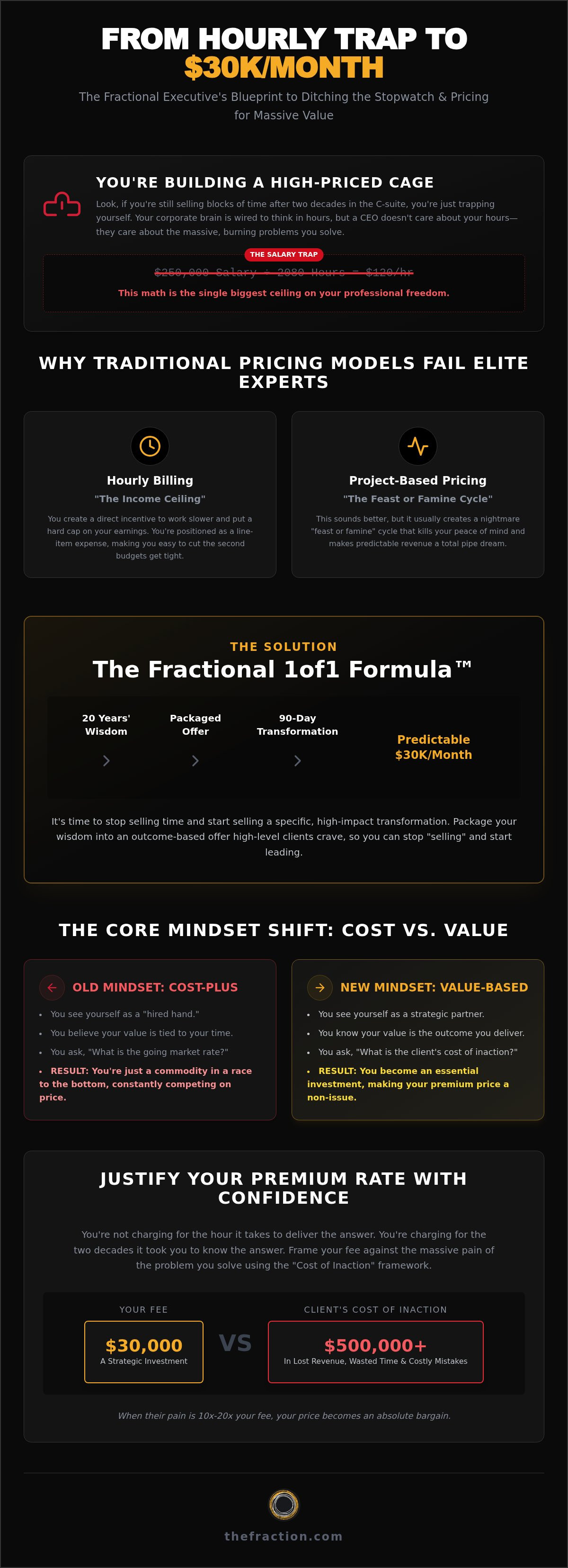
Look, if you're sitting there trying to divide your old VP or Director salary of maybe 200, 250, or even 300 grand by 2,000 working hours... well, you've already lost the game before it even started, because that's just the absolute quickest way to cap your income and stay stuck in the "Salary Trap." The thing is, your corporate brain is wired to think in terms of time spent at a desk, but a CEO doesn't care about your "hours," they care about the absolute massive, burning problems you can solve for them in the Management consulting industry. When you show up with an hourly rate, you're basically asking to be treated like a line-item expense that can be trimmed the second the budget gets tight, so you want to price like a strategic partner based on the results you deliver and become an essential investment that they can't afford to lose. Transitioning into fractional work in 2026 requires a total, radical rewrite of how you view your own market value, so you can stop thinking like an employee and start acting like a business owner.
The Difference Between "Cost-Plus" and "Value-Based" Thinking
Calculating your "overhead" and adding a little margin on top is honestly just a recipe for becoming a low-paid freelancer who's always stressed about the next gig, and it's the single biggest mistake I see high-level experts make. You've gotta make the psychological shift where you realize you're selling a specific, high-impact 90-day transformation that's going to change their business forever, and that's exactly how to price consulting services for maximum leverage. Think of your 20 years of wisdom like a massive, high-yield asset that clients are paying to access, so you're charging for the two decades it took you to know the answer, rather than the simple hour it takes to deliver it.
Why "Market Rates" are a Race to the Bottom
If you're spending your time looking at what "other consultants" in your niche are charging, all you're doing is averaging yourself into total obscurity and competing for scraps, which is just a very stressful way to live. The reality is that being "competitively priced" is usually just a slow race to the bottom, but when you use a high-end service offer structure, you can basically ignore the market averages entirely because you're no longer a commodity. Alls I'm saying is that you want to be singularly positioned as the only person who can solve their specific problem, so the whole question of pricing becomes soooo much less about what the guy next door is doing and more about the absolute massive value of the outcome you're guaranteeing for the client.
Comparing the 3 Traditional Pricing Models (And Why They Usually Fail Elite Experts)
So here's the thing... most people will tell you to just pick a model and start pitching, but they never tell you about the absolute massive hidden costs that'll eat your soul. Look, I've seen so many brilliant executives leave the corporate world only to get stuck in the same old traps because they're following the standard five key pricing strategies that everyone else uses. Hourly billing is basically a ceiling on your income and a direct incentive for you to work slower, which is just crazy for someone who's spent 20 years learning how to be efficient. Project-based pricing might sound better on paper, but it usually creates this nightmare "feast or famine" cycle that kills your peace of mind and keeps you on a constant revenue rollercoaster. And retainers? They sound great until you realize you’ve just bought yourself a boss without the health insurance or the 401k, and that's not why you started this journey. If you're trying to figure out how to price consulting services in a way that actually scales to $30,000 months, you have to see these models for the traps they really are.
The Hourly Billing Trap: Why It’s the Absolute Worst for Fractional Work
Look, the single biggest paradox in this industry is that the more efficient you get, the less money you actually make. If you can solve a million-dollar problem in ten minutes because you're a genius, an hourly model literally punishes you for being good, and that's just the absolute worst way to run a professional practice. Plus, hourly rates invite clients to "nickel and dime" your calendar and your sanity, and you'll find yourself defending why a certain strategy session took ninety minutes instead of sixty. Alls I'm saying is that you'll never hit those 250 or 300 grand years by selling hours, because there's a hard "Consultant’s Ceiling" on how much time you actually have to sell before you hit total burnout.
The "Flat Fee" Flaw: When Fixed Pricing Goes Wrong
Fixed pricing feels safer, but scope creep is the silent killer that'll turn a profitable deal into a volunteer project before you can even blink. As a senior leader, you probably underestimate the "political" time required to get things done in a high-level engagement, so you end up in dozens of extra meetings and stakeholder alignments that weren't in the original plan. To make this work, you have to productize professional services so you're selling a defined, repeatable system rather than an open-ended promise. It's about setting hard boundaries that protect your time while still delivering that massive, transformational result for the client. If you're ready to stop guessing and start building a real infrastructure, you might want to explore a more structured transition framework that actually supports your value.
The "Fractional 1of1 Formula™": Moving from Hourly Billing to Outcome-Based Packages
Look, the only way you're ever going to consistently hit those $30,000 months is if you stop selling "consulting" as some vague, open-ended service and start selling a very specific system that delivers a guaranteed result. When you're trying to figure out how to price consulting services, you've gotta realize that the Fractional 1of1 Formula™ is designed to completely replace that awkward "What's your rate?" conversation with a much more powerful question: "What is this specific outcome worth to your business?" Alls I'm saying is that you need to package your 20 years of wisdom into five repeatable components that don't rely on your physical presence 24/7, so you can scale without burning out. This is why high value offer development is the single biggest needle-mover for your practice, because it allows you to stop being a "hired hand" and start being the architect of a solution that wins clients fast.
Outcome-Based Pricing: The Gold Standard for 2026
You've gotta identify the true "Economic Impact" of your work, because if you're coming in to fix a broken sales process or a supply chain mess that's going to save a company $2 million, then a $50,000 fee isn't just reasonable... it's an absolute bargain. While there are 4 ways to price your services, the only one that really matters for elite experts is tying your fee to the single biggest problem the CEO is losing sleep over. It's what I call the "ROI Reframe," where you're selling the bridge that gets them across the canyon rather than trying to bill them for every individual wood plank and nail you use to build it, and that's how you command premium rates without the pushback.
The $10K-$15K Upfront + $5K-$7.5K Monthly Retainer Model
So here's my advice... charging a significant "Implementation Fee" of maybe 10, 12, or 15 grand right at the start is the absolute best way to ensure your client is fully committed to the 90-day transformation you're leading. Then, you layer on a monthly retainer in the range of $5,000 to $7,500, which feels like a total steal to a CEO compared to the 300 or 400 grand they'd have to pay for a full-time C-suite salary plus benefits. This creates what I call the "Z-pattern" of pricing, where you deliver massive initial value to get the momentum going and then transition into sustainable, recurring support that keeps the revenue flowing predictably every single month. It's the absolute best way to build a practice that doesn't feel like a job, because you're creating a predictable ecosystem where the client gets the stability they need and you get the high-ticket revenue you deserve.
How to Calculate Your Premium Price Point Without Feeling Like a Fraud
So here's my advice for when that "imposter syndrome" starts kicking in and you're tempted to lower your price just to get a "yes"... don't do it, because you're not just selling a few hours of work, you're selling the 20 years of mistakes you've already made and learned from. Look, when you're figuring out how to price consulting services at a premium level, the first thing you have to calculate is the "Cost of Inaction," which is basically asking the client what happens to their bottom line if they don't fix this problem in the next 90 days. Then you need to set your "Floor," which is the absolute minimum you need to make the engagement worth your elite time, and after that, you add a "Premium Multiplier" based on your specific, niche expertise that nobody else in the market has. Alls I'm saying is that if you aren't feeling slightly uncomfortable when you say your price, then you're almost certainly undercharging for the massive value you bring, so you've gotta push through that initial anxiety to reach those $30,000 months.
Using Market Research to Validate Your $30K Goal
Using a Custom Proof of Concept (PoC) call is the absolute best way to "price test" your offer before you ever officially pitch it to a prospect, because it lets you see their reaction in real-time. Speaking of... don't just guess what they'll pay, but instead, go out and interview 10 industry leaders to ask them exactly what the problem is costing their organization in lost revenue or wasted resources. This is the single biggest confidence booster you can find, because once you hear a CEO say they're losing 150, 200, or 250 grand a month, asking for a 15 grand implementation fee feels like you're doing them a huge favor. It turns the whole conversation from a stressful negotiation into a simple, logical business decision where the ROI is totally obvious to everyone involved.
Positioning as the "Only" Rather Than the "Best"
Look, trying to be "The Best" in your field is just an invitation for a pricing comparison, but when you position yourself as "The Only," you're creating a pricing monopoly where you set the terms. You've gotta use your unique corporate history and those specific scars you've earned to justify a fee that no generalist consultant could ever match, and that's how you bridge the "Authority Gap." This is why high-level clients are sooo much more willing to pay more for a specialized expert who has seen their exact problem ten times before than they are for a generalist who has to learn on the job. When you're the only one who can solve a specific, high-stakes problem, the price becomes a secondary concern to the absolute massive relief of finally having a solution that works.
Building the Infrastructure to Support Your $30K Monthly Pricing Strategy
Look, you can have the most sophisticated, beautiful pricing model in the entire world, but if your calendar is completely empty, then you're inevitably going to cave on your rates the very first time a prospect pushes back on you. The reality is that high-value pricing requires high-level leverage, and that's why you need an ai driven lead generation strategy that's working for you while you sleep, so you never feel that desperation to close a bad deal. When you have 15, 20, or even 25 strategy calls booked every single month, saying "no" to a low-ball offer becomes the single easiest thing in the world to do. Alls I'm saying is that figuring out how to price consulting services is only the first step, because you also need a sales process for consultants that makes those high-ticket fees feel like a natural, logical investment rather than a stressful pitch.
Automated Lead Gen: The Engine Behind Your Fees
So here's the thing... manual networking is a total "Pricing Killer" because it keeps you in a state where you're always just one "no" away from a financial crisis, and that's no way to run an elite practice. You've gotta move toward an AI-driven outreach system that creates the absolute biggest "Abundance Mindset" you've ever had, which is exactly what you need to hold your price floor when things get tough. This 90-day transition is about moving from being a corporate employee who's dependent on a single paycheck to becoming a systemized, high-ticket fractional business owner who controls their own destiny. It's about building an architecture that supports your value day in and day out, so you can focus on delivering that massive transformation instead of worrying about where your next client is coming from.
The 10X ROI Guarantee: Standing Behind Your Price
If you're going to charge premium rates, you've gotta be willing to stand behind them with a bold guarantee that removes the risk for the client and makes your fee look like an absolute bargain. The Fraction uses a co-building model that is the absolute best way to ensure you actually deliver the transformational value you're charging for, and we even offer a 10X ROI guarantee to prove we're just as invested in the outcome as the client is. It's all about creating a partnership where the client feels safe making a big investment because they can see the clear, systemized path to success that you've laid out for them. So, if you're ready to see if your 20 years of expertise can truly support a predictable $30,000 monthly practice, then you should Book your Proof of Concept call today.
Architecting Your $30K Monthly Reality
Look, we've covered the absolute biggest shifts you need to make to hit those 30, 40, or 50 grand months, but alls I'm saying is that it really comes down to ditching that employee brain and finally understanding how to price consulting services based on the transformational outcomes you deliver to a CEO. You've gotta stop selling your time like a commodity and start selling a systemized solution that's backed by a rock-solid infrastructure, because once you have the lead-gen engine running and the right offer in place, the confidence to charge what you're actually worth just flows soooo much more naturally.
We're talking about a 90-day journey toward professional autonomy that's built on a foundation of certainty, including a 30-Day System Build Guarantee and a Personalized Market Research PoC to validate your market value. Plus, we stand behind the architecture we build together with an industry-leading 10X ROI Guarantee, so you know you're making the absolute best investment in your future.
You've spent two decades building someone else's dream, so it's finally time to build a practice that honors your wisdom and gives you the freedom you've earned.
Frequently Asked Questions
How do I determine my first fractional consulting fee if I have no past clients?
Look, you've gotta realize that your "past clients" are actually the multi-billion dollar companies you've been leading for decades, so don't feel like you're starting from zero. So here's my advice: calculate the absolute biggest financial leak you can plug for a company and price your first engagement at about 10 or 15 percent of that total value. It's the single best way to build immediate momentum while ensuring you aren't leaving massive amounts of money on the table right out of the gate.
Is value-based pricing actually possible for operational or finance roles?
Value-based pricing is absolutely the gold standard for finance and ops because you're literally the architect of the company's bottom line. If you're figuring out how to price consulting services in these roles, think about the 200 or 300 grand you'll save them in operational waste or the massive tax liabilities you'll help them avoid. CEOs don't care about your spreadsheets; they care about the stability and the "peace of mind" profit you're building into their infrastructure.
Should I list my prices on my website or keep them hidden until the call?
You should definitely keep your specific numbers off your public site because a high-ticket fee requires a high-trust conversation to justify the investment. Look, if a prospect sees a 10 or 15 grand price tag without understanding the massive 10X ROI you're guaranteeing, they'll just treat you like a line-item expense. Speaking of... your website should sell the transformation and the system, but the actual math happens on the Proof of Concept call where you can tailor the value.
What happens if a potential client says my consulting fees are too high?
When a client pushes back on price, it's usually because they don't yet see the absolute massive cost of staying exactly where they are. So here's my advice: stop defending your fee and start asking them what it'll cost the business to have this same problem six months from now. If the "Cost of Inaction" is a 500 grand loss, then your 20 grand fee isn't "high" anymore; it's the single most logical investment they could make.
How much should I increase my rates once I have my first three clients?
Once you've got those first three wins under your belt, you've gotta realize that your "social proof" has just skyrocketed, so you should be looking to bump your rates by at least 25 or 50 percent for the next round. Alls I'm saying is that as your calendar starts to fill up, your scarcity becomes your greatest pricing lever. It's about building a practice where your fees reflect the actual market demand for your specific expertise.
Can I really charge $10,000 upfront for a consulting engagement?
You can absolutely charge 10, 12, or even 15 grand upfront as an "Implementation Fee," and honestly, it's the absolute best way to make sure the client is actually committed to the work. Think of it like a "buy-in" for the 90-day transformation you're leading. It covers the heavy lifting of the initial system build and ensures that you aren't just another advisor whose reports sit on a shelf gathering dust while the company stays stuck.
What is the difference between a retainer and a productized service fee?
A traditional retainer is basically just buying a block of your "access," which can quickly turn into you being a high-priced employee, but a productized service fee is about selling a specific, repeatable system with a defined outcome. Look, the Fractional 1of1 Formula™ is the absolute best way to understand how to price consulting services because you're selling the engine rather than just the mechanic's time. This shift is what allows you to scale predictably.
Do I need a complex contract to support high-value outcome-based pricing?
You don't need a massive, 50-page legal document, but you do need an airtight Statement of Work that clearly defines the "Economic Impact" and the specific 90-day transformation you're delivering. Alls I'm saying is that the best contracts focus on the "what" and the "why" rather than just the "how many hours." It's about setting clear boundaries so that both you and the CEO are perfectly aligned on the absolute massive value being created.


