

Your expertise is your most valuable asset, yet your manual approach to business development is likely your greatest liability. For many high-level professionals, the traditional sales process for consultants feels like a repetitive performance that drains time away from high-stakes delivery. You likely recognize the exhaustion of the "feast or famine" revenue cycle, where the discomfort of hard selling leads to inconsistent lead quality and a calendar dominated by manual outreach rather than strategic leadership.
It's a common frustration to believe that scaling your revenue requires sacrificing your professional autonomy to become a full-time salesperson. In reality, the path to growth doesn't require more effort, but better architecture. This article provides the blueprint to replace high-pressure tactics with an automated, AI-driven infrastructure that wins high-value clients effortlessly. We will examine how to transform your sales process into a natural extension of your authority, allowing you to secure a predictable flow of leads and scale your impact without increasing your manual hours.
Key Takeaways
- Reframe business development as a strategic infrastructure rather than a series of high-pressure pitches.
- Understand why a modern sales process for consultants prioritizes precise lead qualification over the exhausting volume of manual outreach.
- Leverage AI to map decision-maker ecosystems and initiate automated outreach that speaks with the authority of a peer executive.
- Architect a high-value offer that addresses specific, expensive problems to eliminate the need for traditional hard selling.
- Build a predictable, systemized practice that replaces the manual grind with a scalable, automated sales infrastructure.
Myth-Busting the Sales Process for Consultants: Why You Aren’t a Salesperson
The word "sales" often carries a stigma that suggests manipulation or aggressive persuasion. For a subject matter expert, this association is a significant psychological hurdle. You've spent decades building your expertise; the last thing you want is to appear like a telemarketer. However, a successful sales process for consultants isn't a performance. It's a strategic professional infrastructure designed to connect your solutions with the leaders who need them most. It is not about convincing people to buy things they don't need, but rather about creating the framework where value is recognized and exchanged.
Landing high-ticket consulting contracts doesn't require a "sales personality." In fact, the extroverted, high-energy pitch often does more harm than good in a corporate boardroom. Premium clients don't buy from the loudest person in the room; they buy from the person who most accurately diagnoses their pain. Your role is not to persuade, but to identify and evaluate. When you shift your focus from "closing a deal" to "diagnosing a business problem," the friction of the transaction disappears. You cease being a vendor and become a strategic partner.
The Credibility Gap: Why Hard Selling Repels Premium Clients
Traditional outreach often signals desperation rather than authority. When you chase leads using high-pressure tactics, you immediately lower your perceived value. High-value corporate partners aren't looking for vendors who need their business; they're looking for advisors who can solve complex, expensive problems. Chasing leads creates a power imbalance that is difficult to correct during the engagement. In contrast, attracting clients through a systemized approach maintains your standing as a peer executive. The moment you stop trying to sell and start providing expert advisory, your credibility increases. Authority is never granted to those who beg for attention.
Reframing Sales as Strategic Architecture
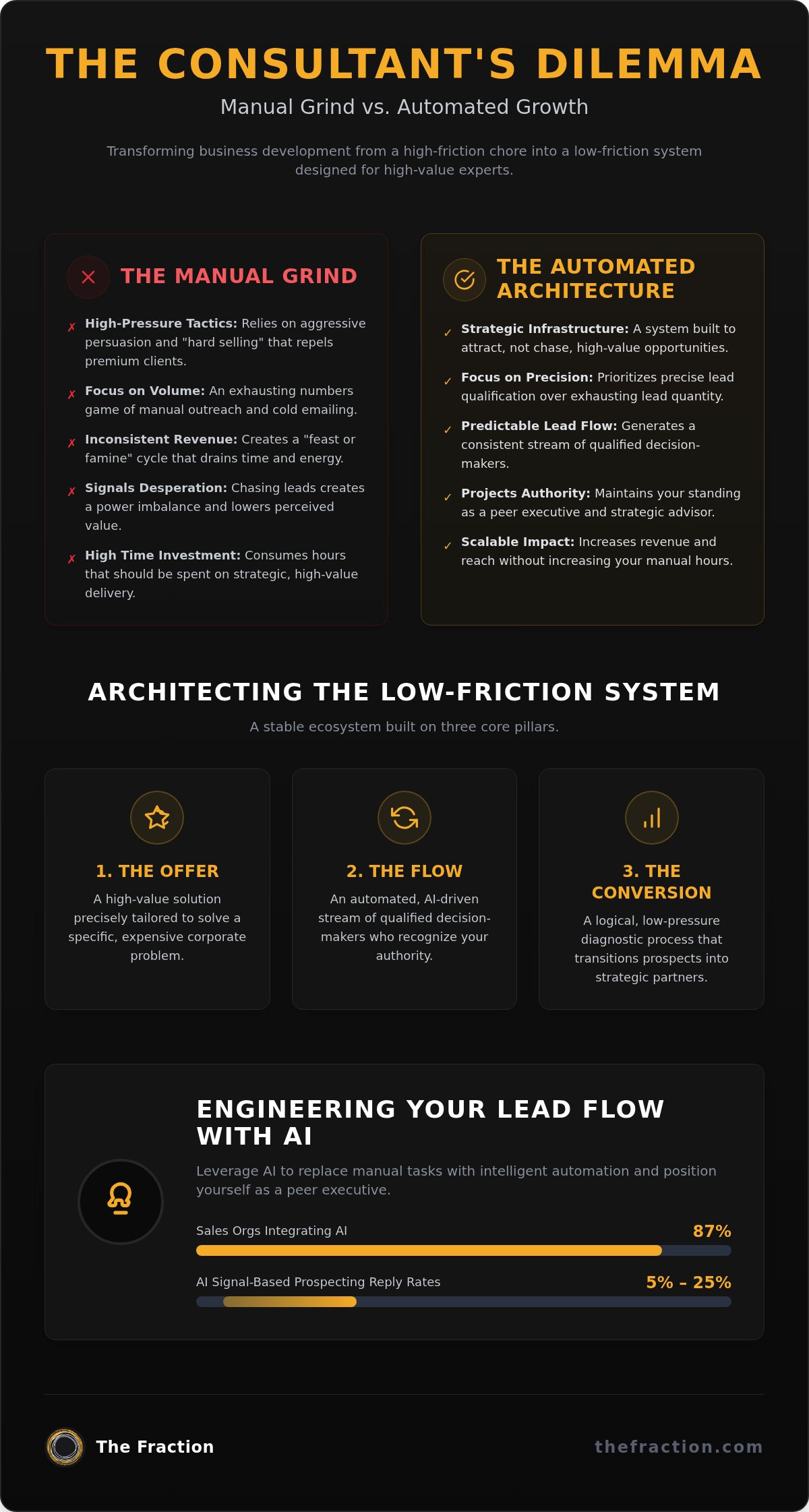
True growth requires moving away from manual effort and toward a "Low-Friction Sales System." At The Fraction, we view this as a balanced ecosystem rather than a linear funnel. This architecture relies on a tripartite structure that ensures stability and prestige:
- The Offer: A high-value solution tailored to an expensive corporate problem.
- The Flow: An automated stream of qualified decision-makers who recognize your authority.
- The Conversion: A logical, low-pressure transition from prospect to partner.
This approach treats business development as a form of sales process engineering where every component is measured and optimized for efficiency. It removes the emotional weight of selling by turning it into a predictable business function. The modern consulting sales process is a system that automates trust-building while preserving your professional integrity.
The Anatomy of a Low-Friction Sales System vs. Traditional Methods
Traditional business development is often reduced to a numbers game. It relies on the exhausting premise that more activity inevitably leads to more revenue. For the independent expert, this model is fundamentally flawed. A high-level sales process for consultants must prioritize lead qualification over lead quantity. Success is not found in the volume of your pipeline, but in the precision of your targeting and the strength of your positioning. The most effective sales interactions are those where the outcome is largely determined before the first meeting even begins.
Manual Grind vs. Automated Elegance
The hidden costs of manual LinkedIn outreach and cold emailing are staggering. These tasks consume the hours you should be spending on high-value delivery or strategic thinking. AI-driven tools now allow you to identify high-intent prospects without constant human intervention. In 2026, 87% of sales organizations have integrated AI into their workflows, and signal-based prospecting now achieves reply rates between 5% and 25%. By aligning sales and marketing functions into a single automated ecosystem, you eliminate the friction of chasing cold leads. This shift toward an AI-driven lead generation strategy ensures your outreach mirrors the voice of a peer executive rather than a desperate vendor.
The Discovery Call: From Pitch to Diagnosis
In a low-friction system, the discovery call is a diagnostic session rather than a persuasive pitch. You aren't there to convince; you're there to evaluate the fit. When your infrastructure is built correctly, you enter the conversation as an authority. Use high-leverage questions to establish this standing immediately:
- What is the measurable cost of inaction regarding this specific challenge?
- Which previous attempts to solve this problem have failed, and why?
- How does resolving this issue align with your broader organizational objectives for the next quarter?
When you approach the call as an architect diagnosing a structural flaw, the proposal becomes a mere formality. It shouldn't be a negotiation. It's simply a documented roadmap of the solution you've already agreed upon. If you find yourself haggling over terms, your sales process for consultants has failed to establish the necessary authority. Implementing a systemized expert approach ensures that every interaction reinforces your premium positioning and protects your time. This transition allows you to move from a manual grind to a state of automated elegance, where your growth is no longer tethered to your personal outreach hours.
Engineering Your Lead Flow: Integrating AI into the Consulting Sales Process
Manual prospecting is the primary bottleneck for high-value experts. When you spend your mornings scouring LinkedIn or drafting cold emails, you're trading your highest-value hours for low-leverage administrative tasks. Scaling a modern sales process for consultants requires a shift from manual labor to strategic engineering. By integrating autonomous AI agents into your business development ecosystem, you can maintain a consistent pipeline without sacrificing your focus on client delivery. This approach transforms lead generation from a daily chore into a predictable business function.
This engineering follows a logical, four-step progression designed to maximize impact while minimizing manual effort:
- Step 1: Ecosystem Mapping. Use AI to identify your ideal corporate decision-makers based on real-time "trigger events," such as recent funding rounds or leadership changes.
- Step 2: Peer-Level Outreach. Implement automated sequences that utilize large language models to mirror the tone and sophistication of a peer executive, ensuring your message resonates in the boardroom.
- Step 3: Autonomous Nurturing. Deploy AI-driven follow-ups that stay top-of-mind by providing relevant insights, removing the need for manual "checking in."
- Step 4: Algorithmic Refinement. Use data-driven feedback loops to analyze which messages generate the highest engagement, allowing the system to refine its targeting over time.
The Shift to AI-Powered Prospecting
The goal of automation is not to increase volume, but to enhance precision. While traditional methods often result in generic spam, AI tools allow for hyper-personalization at scale. By analyzing a prospect's recent public statements or organizational shifts, these systems can craft outreach that feels deeply researched and relevant. This is a critical distinction; in 2026, signal-based AI prospecting achieves reply rates of 5% to 25%, significantly outperforming the 3% average of traditional outbound methods. This level of efficiency allows you to focus entirely on high-stakes advisory work while the infrastructure handles the initial engagement.
Building the Technical Infrastructure of Growth
A scalable practice is built on a robust technical stack. This ecosystem typically includes a centralized CRM, an AI-powered prospecting engine, and an automated scheduling interface. While many consultants seek general coaching, the real barrier to entry is often the technical implementation. The Fraction serves as a strategic architect in this regard, focusing on the actual deployment of these systems rather than abstract theory. Tools collect data, but platforms execute strategy. By delegating the mechanical aspects of the sales process for consultants to a systemized infrastructure, you reclaim the professional autonomy necessary to lead your industry.
The Compelling Offer: The Engine That Drives Your Sales Process
A weak offer is the primary reason most consultants find themselves trapped in a cycle of endless persuasion. It's the silent killer of growth. If your service is perceived as vague or undifferentiated, your sales process for consultants will always feel like an uphill battle. You'll find yourself defending your rates and explaining your value repeatedly. In contrast, a high-value offer is designed to solve a specific, expensive problem. It shifts the conversation from the cost of your time to the value of the outcome. When the solution is clearly architected, the offer does 80% of the heavy lifting before you even reach a proposal.
Consultants often make the mistake of selling their time rather than their results. This approach caps your earning potential and commoditizes your expertise. Transitioning to premium pricing requires a fundamental shift in how you package your knowledge. Despite the clear benefits of this model, research indicates that only 39% of consultants have implemented value-based pricing. By focusing on ROI rather than billable hours, you justify a premium investment and align your incentives with your client's success. A well-structured offer doesn't just win clients; it wins the right clients.
Productizing Your Expertise for Scalability
Productization is the process of turning abstract consulting into a tangible, repeatable service model. It simplifies the sales conversation by providing a clear roadmap of what the client will receive. This structure reduces buyer anxiety because they aren't purchasing a "black box" of hours; they're buying a defined transformation. A winning offer relies on a tripartite foundation of clarity, scarcity, and results. You must define exactly what you do, why your capacity is limited, and what measurable impact the client should expect. This clarity transforms your expertise into a scalable asset that exists independently of your personal manual labor.
Premium Positioning Strategy
Your positioning dictates the caliber of leads you attract. This creates what we call the "Authority Loop," where high-value offers naturally attract high-value corporate partners. When you solve expensive problems, you aren't competing on price; you're competing on the certainty of the result. This premium positioning reinforces your status as a peer executive and allows you to maintain high standards for the clients you choose to accept. Your sales infrastructure should be a reflection of this authority. We specialize in helping professionals develop compelling offers that win clients quickly, ensuring your business development ecosystem is built on a foundation of strategic value rather than desperate outreach.
Implementing Your Automated Sales Ecosystem with The Fraction
Transitioning from a manual sales grind to a systemized professional practice is the definitive step toward long-term stability. A well-engineered sales process for consultants eliminates the volatility of the "feast or famine" cycle by treating business development as a predictable infrastructure. This evolution allows you to maintain the prestige of a high-level executive while enjoying the professional autonomy of a fractional leader. You're no longer a salesperson; you're a strategic architect of your own growth. The goal is to reach a state where your expertise is the primary driver of demand, supported by a system that requires minimal manual intervention.
The Fraction Advantage: Systems Over Recruitment
Many professionals look to recruitment agencies or general executive coaching to solve their lead generation challenges. These traditional routes often fail because they address symptoms rather than the underlying structural deficit. The Fraction takes a different approach by focusing on technical implementation over abstract advice. We build the actual infrastructure that allows you to win business without traditional sales pressure. Our 90-day transition framework provides a structured roadmap for landing fractional clients by deploying the AI-driven systems discussed throughout this article. This framework ensures that your transition is methodical, thorough, and deliberate. It is an invitation to view your career as a scalable business asset rather than a sequence of employment contracts.
Next Steps: From Corporate Executive to Strategic Architect
Your first priority is to audit your current business development efforts. Document every hour spent on manual outreach, research, and follow-up. Contrast this with the time spent on high-value strategic delivery. If your revenue is tethered to your personal manual labor, you possess a bottleneck rather than a scalable business. Success in the fractional market requires a shift in identity. You must move from being a resource that is "hired" to a partner that is "engaged." This distinction is reinforced by the systems you use to manage your pipeline.
Automation isn't merely a convenience; it's the primary engine of professional freedom. It enables you to scale your impact while preserving your time for high-stakes advisory work. When your lead flow is automated, you enter negotiations with the confidence of someone who has a predictable supply of opportunities. This leverage allows you to command premium rates and choose engagements that align with your long-term goals. The transition from a corporate role to autonomous leadership is entirely manageable with the right strategic framework. Ready to automate your lead flow? Learn more about The Fraction.
Architecting Your Professional Autonomy
Establishing a sophisticated sales process for consultants is the final step in securing your professional autonomy. You've seen how shifting from a manual "numbers game" to a systemized infrastructure allows you to maintain executive prestige while scaling your revenue. By prioritizing strategic high-value offer development and integrating AI-driven lead generation systems, you ensure that your business development functions as a natural extension of your expertise rather than a desperate performance.
The transition from a corporate executive to a strategic architect of your own practice requires a proven sales process for fractional leaders. This ecosystem replaces the exhaustion of traditional selling with a predictable, automated flow of high-intent clients. It's time to stop trading your delivery hours for outreach hours and start building a business that operates with the same precision as your advisory work. Your expertise deserves a platform that matches its caliber.
Automate your sales process and scale your impact with The Fraction.
The path to professional freedom is challenging, but with the right strategic framework, it's entirely manageable. Your future as an autonomous leader starts with the systems you build today.
Frequently Asked Questions
What is the ideal sales process for a solo consultant?
The ideal sales process for a solo consultant is a low-friction infrastructure that prioritizes high-level qualification over lead volume. It consists of an automated lead flow, a diagnostic discovery framework, and a productized high-value offer. This system ensures you enter every conversation as a peer executive rather than a vendor. By removing the manual grind of chasing prospects, you protect your time for high-stakes delivery and strategic leadership.
How do I generate leads without cold calling or traditional networking?
You can generate leads by implementing an automated, signal-based prospecting system. This approach uses AI agents to monitor specific trigger events, such as organizational shifts or funding announcements, to identify high-intent prospects. This replaces the unpredictable nature of traditional networking with a data-driven ecosystem. It allows you to initiate authoritative conversations with corporate decision-makers without the discomfort of cold calling or the time drain of manual outreach.
Can AI really handle outreach for high-level fractional roles?
Yes, AI can handle outreach effectively when it is engineered to mirror the sophisticated voice of a peer executive. Modern systems utilize large language models to analyze public data and craft hyper-personalized messages that resonate in the boardroom. This ensures your outreach maintains a high level of prestige and authority. When implemented correctly, these automated systems achieve significantly higher reply rates than traditional, manual outbound methods used by most consultants.
How long does it take to see results from an automated sales system?
Most high-level professionals observe a measurable shift in lead quality and pipeline volume within a 90-day period. This timeframe allows for the initial technical implementation, system calibration, and the natural duration of a high-ticket sales cycle. It is a methodical transition that prioritizes long-term stability and predictable revenue. This ramp-up period ensures that the automated infrastructure is fully aligned with your specific expertise and premium positioning.
What is the difference between consultative selling and a sales process?
Consultative selling is a communication technique used during a meeting, whereas the sales process for consultants is the overarching strategic infrastructure. The process encompasses everything from initial lead generation to the final partnership agreement. While consultative selling focuses on the diagnostic interaction, the sales process ensures you are only speaking with pre-vetted, high-value prospects. A robust process automates the trust-building stages that occur before the first discovery call begins.
Why do most consultants fail to scale their sales efforts?
Most consultants fail to scale because their business development is tethered to their personal manual labor. When you rely on manual LinkedIn outreach or networking, your growth is capped by the number of hours in your day. Scaling requires decoupling your revenue from your manual effort. By implementing an automated sales process for consultants, you can maintain a consistent pipeline while focusing on delivery, effectively removing yourself as the primary bottleneck.
Is it possible to land fractional clients while still in a full-time job?
It is entirely manageable to secure fractional clients during a corporate transition by utilizing an automated sales ecosystem. AI-driven systems can handle the heavy lifting of research and initial outreach in the background while you fulfill your current obligations. This allows you to build a pipeline of high-value opportunities before you officially launch your practice. It provides a secure bridge to professional autonomy by ensuring your first partners are secured before you leave your role.
What tools are essential for a modern consulting sales stack?
A modern sales stack requires a tripartite foundation consisting of a centralized CRM, an AI-powered prospecting engine, and an automated scheduling interface. These tools must be integrated into a cohesive ecosystem that collects data and executes a pre-defined strategy. This technical infrastructure allows a solo professional to operate with the efficiency of a much larger firm. It ensures that every lead is tracked and nurtured without the need for repetitive, manual administrative tasks.


