

Treating business development like an ad-hoc manual sprint is the fastest way to trap an elite practice in revenue whiplash, so building automated b2b prospecting systems has quickly become the single biggest dividing line between feast-or-famine cycles and true operational autonomy. Look… you already know the sinking feeling of pouring every ounce of energy into client delivery only to look up and find next month's calendar bone dry, and sending copy-paste LinkedIn messages feels like torching twenty years of executive credibility just to drum up a casual conversation.
So in this guide, you'll discover how to engineer a battle-tested acquisition engine that books qualified discovery calls multiple weeks in advance, running quietly in the background while you focus on delivery. We'll walk through the exact architecture for turning senior decision-makers into high-value strategic relationships, showing you how to replace manual sales pressure with an automated pipeline asset you own outright.
Key Takeaways
- How modern automated b2b prospecting systems combine verified targeting and conversational logic to book calendars weeks ahead without tripping platform limits.
- Why rented SDR agencies and spray-and-pray outbound erode your executive credibility while burning capital on unqualified conversations.
- The essential technical pillars required to capture high-value enterprise attention while your outreach runs quietly during off-hours.
- A practical five-step roadmap to productize your expertise so your business development centers on strategic outcomes rather than hard sales pressure.
- The blueprint for transforming client acquisition into an owned institutional asset that permanently breaks the feast-or-famine delivery cycle.
What Modern Automated B2B Prospecting Systems Actually Look Like in 2026
Most folks in the market still confuse pipeline machinery with buying a scraped contact sheet, but genuine automated b2b prospecting systems are fundamentally about building a living, self-correcting business asset. Look… downloading five thousand stale email addresses from an online database and blasting them with an aggressive generic pitch is the fastest way to torch your professional reputation, and frankly, that old approach is running blind. Modern architecture treats outbound acquisition like a precision instrument, combining verified targeting layers, synchronized multi-channel sequencing, and dynamic conversational logic that operates entirely in the background.
Rather than hammering cold lists with raw sales pressure, an institutional-grade engine listens for behavioral signals, adjusts the messaging in real time, and turns outbound into low-friction business discussions. This evolution ties straight into sales process engineering, treating pipeline development as a repeatable, mathematically predictable asset instead of a chaotic monthly scramble.
The Anatomy of an Autonomous Pipeline Engine
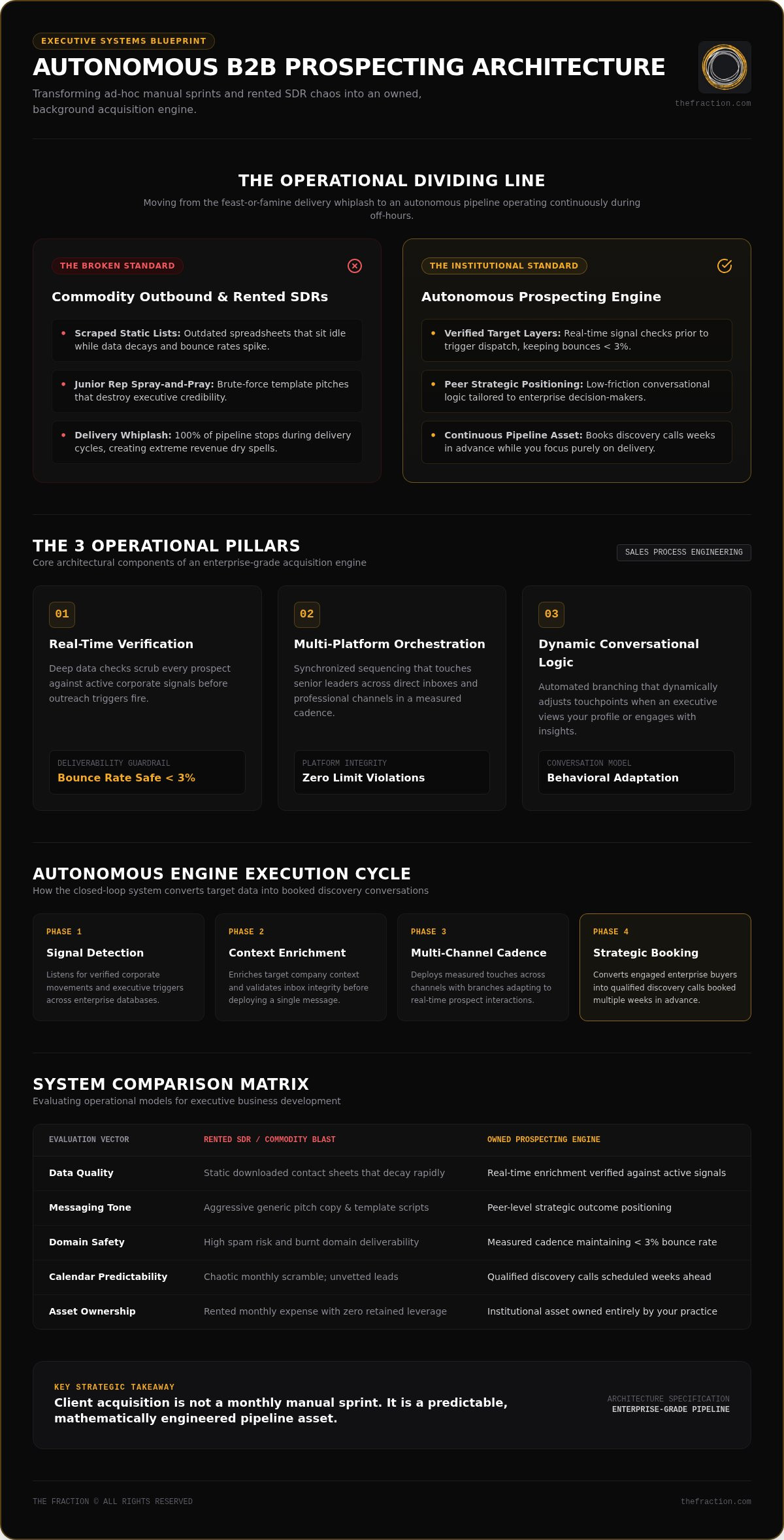
A high-functioning acquisition stack works like a private executive terminal, running quietly during off-hours while you manage client delivery, and it rests on three distinct operational layers:
- Real-time verification: Deep data checks that scrub every prospect against active corporate signals before an outreach trigger fires, keeping bounce rates safely below 3%.
- Multi-platform orchestration: Seamless sequencing that touches decision-makers across professional channels and direct inboxes in a natural, measured cadence.
- Dynamic conversational logic: Logic branches that adapt subsequent touchpoints based on whether an executive viewed your profile, engaged with an insight, or opened a conversation.
Static Lead Lists vs. Dynamic Acquisition Ecosystems
Renting a static database is like paying for a phone directory from three years ago, whereas an owned acquisition ecosystem functions like a dedicated command center. Static spreadsheets sit idle while the verified data goes stale, leaving you to push brute-force outreach that screams generic automation. Dynamic systems enrich the target's corporate context before a single message deploys, tracking relationship touchpoints across the entire pipeline. That closed-loop visibility gives you absolute certainty over pipeline velocity, systematically turning verified decision-makers into booked discovery conversations weeks in advance.
The Hidden Breakdown of Commodity Outreach and Rented SDR Agencies
Hiring an external lead generation outfit or blasting thousands of template emails feels like delegating a problem, but it usually ends up burning your cash and torching your market reputation. Look… when you hire a third-party shop to handle outreach, they treat pipeline like a sheer numbers game, spraying hundreds of contacts with templated scripts that scream junior rep, and the moment a senior buyer smells outsourced pitch copy, the door slams shut. Harvard Business Review highlighted decades ago how quickly online leads go cold, so relying on disconnected vendors who take days to route an inquiry ruins your pipeline velocity before a conversation even begins.
Enterprise decision-makers respond exclusively to peers who understand strategic outcomes, so when an outsourced agency uses aggressive sales pressure to book unqualified bodies onto your calendar just to hit quota, they end up destroying your executive credibility. That's precisely why modern operators implement owned automated b2b prospecting systems that keep positioning razor-sharp and protect professional standing.
Why High-Value Enterprise Buyers Reject Template Spam
A vice president or C-suite executive can sniff out an agency template from a mile away, and frankly, mass blasts destroy domain deliverability while sending your emails straight into spam folders. High-value clients buy enterprise clarity, not junior sales scripts. If you want to see how elite advisors structure conversations without using pushy tactics, study the blueprint for professional service sales automation to discover how strategic positioning systematically replaces brute-force outbound.
The Vulnerability of Delegating Business Development to Third Parties
Renting your pipeline from an outside firm means you are building your entire practice on rented land, and the second you cut the agency contract, your inbound meeting flow dries up overnight. These outfits rarely grasp the nuances of high-tier advisory work, so they flood your inbox with tire-kickers who lack the budget or authority to sign. Building an internal, automated acquisition engine gives you an owned corporate asset that operates during off-hours, keeps your calendar filled weeks ahead, and compounds enterprise value year after year.
Core Components of an Enterprise-Grade Prospecting Architecture
Building an enterprise pipeline requires treating your tech stack like an integrated power grid rather than a random patchwork of software subscriptions, so genuine automated b2b prospecting systems rely on four distinct operational pillars working in tandem. When these mechanics lock together, your pipeline turns into a self-sustaining asset that predictably produces qualified conversations.
| Acquisition Model | Pipeline Control | Asset Ownership | Lead Quality |
|---|---|---|---|
| Static List Portals | Manual, reactive searching | Rented access to stale rows | Low conversion, high bounce |
| Rented SDR Agencies | Delegated to external reps | Zero equity, disappears on exit | Scripted, junior volume |
| Owned Automation Engine | Programmatic, dynamic triggers | 100% owned permanent asset | Peer-to-peer, verified buyers |
Precision Targeting and Dynamic ICP Segmentation
Dialing in your ideal client profile goes far beyond broad industry tags… it means zeroing in on decision-makers wrestling with specific, high-stakes operational friction right now. By pairing deep LinkedIn Sales Navigator parameters with live firmographic triggers, you isolate executives actively searching for senior leadership, so your outreach arrives as a timely strategic intervention rather than cold noise.
Multi-Channel Synchronization and Deliverability Safeguards
Protecting your corporate domain requires serious technical hygiene, so setting up secondary tracking domains with proper SPF, DKIM, and DMARC protocols is fundamental to staying out of spam filters. By running automated warm-up sequences and coordinating subtle social profile touches right before an inbox message deploys, your outreach mirrors natural executive activity and keeps inbox placement exceptionally high.
Frictionless Calendar Conversion and Inbound Routing
The entire goal of these automated b2b prospecting systems is converting casual engagement into confirmed boardroom discovery calls without the messy back-and-forth friction of email tag. Automated pre-qualification filters instantly screen for decision authority before a prospect picks a slot on your calendar, ensuring you protect delivery time while keeping your pipeline full. To see how modern machine intelligence unifies this entire workflow, review our complete breakdown of an ai driven lead generation strategy.
How to Implement an Automated Prospecting Engine Step by Step
Engineering your own acquisition asset takes a deliberate build sequence rather than haphazardly clicking buttons in a sales tool, so deploying modern automated b2b prospecting systems comes down to a structured five-step rollout. When you follow a proven buildout framework, you go from relying on unpredictable referrals to running a fully owned operational engine in about thirty days flat.
Step 1 & 2: Crafting the Core Offer and Engineering the Data Stack
Everything starts with dialing in a crystal-clear, outcome-driven proposition that solves a burning enterprise headache, because even the absolute best software stack falls completely flat if you are pitching general advisory hours. Once your positioning speaks to specific corporate bottlenecks, you layer on verified targeting parameters using LinkedIn Sales Navigator, isolating the exact economic buyers who hold both the checkbook and the authority to greenlight your solutions.
Step 3 & 4: Technical Configuration and Automated Narrative Deployment
Next comes the technical wiring… standing up dedicated secondary domains, implementing DNS authentication, and running gradual warmup routines so your mailbox reputation stays pristine. From there, you craft conversational touchpoint sequences that deliver genuine strategic perspective, scheduling outreach during early morning or evening off-hours so you show up in executive inboxes at the ideal reading window without pulling you away from client delivery.
Step 5: Frictionless Conversion and Continuous Pipeline Optimization
Closing the loop means connecting prospect interest straight to an automated calendar router, letting qualified decision-makers book discovery sessions directly without tedious back-and-forth messaging. Weekly review cycles allow you to audit conversion checkpoints, refine conversational angles, and ensure the entire mechanism operates like an institutional engine. To see how experienced operators assemble this complete client acquisition engine, study the architecture behind automated business development systems.
Transforming Business Development into an Owned Institutional Asset
Operating without a dedicated acquisition engine leaves you handcuffed to corporate paychecks or erratic consulting gigs, so transforming pipeline creation into permanent company equity is how senior executives achieve genuine commercial freedom. When you treat client generation like internal intellectual property rather than an unpredictable chore, you strip away the income caps that typically tether solo practices. Modern automated b2b prospecting systems act like private client acquisition powerhouses, letting you build deep institutional leverage while sidestepping perpetual agency retainers.
Having your calendar consistently booked two to three weeks out fundamentally shifts how you negotiate advisory engagements. You walk into discovery calls holding immense strategic composure, knowing full well that you are speaking from a position of absolute abundance rather than financial panic. You can hold firm on premium pricing structures because your client pipeline continuously reloads itself in the background.
Escaping the Feast-or-Famine Delivery Cycle
Most solo practitioners run directly into the delivery trap… you land two great enterprise accounts, submerge yourself entirely in client deliverables for ninety days, and emerge only to realize your forward pipeline has completely vanished. Automated acquisition completely decouples fulfillment from outreach, running measured sequences during quiet hours while you solve client problems. Anonymous corporate leaders routinely shift out of this manic cycle by securing high-value recurring contracts, gaining the breathing room to double their engagement rates without working eighty-hour weeks.
The Power of Co-Building Your Acquisition Machine
Sitting through passive online courses provides conceptual theories but leaves you wrestling with messy API integrations and technical dead-ends, while renting an SDR agency traps you in permanent retainer dependency. Co-building an engine bridges the divide entirely, handing you fully operational infrastructure deployed in a thirty-day window where you retain permanent ownership of all custom targeting logic, messaging narratives, and automation software without ongoing licensing fees. When you are ready to install this operational predictability into your own practice, explore The Fraction Executive Model to permanently own your growth machinery.
Taking Full Command of Your Executive Acquisition Infrastructure
Look… breaking free from the feast-or-famine treadmill comes down to installing an engineered asset that runs quietly around the clock, so putting true automated b2b prospecting systems in place is how you protect your hard-earned reputation while scaling real enterprise impact. When you step off the hamster wheel of renting third-party agency lists and instead co-build an acquisition engine you control permanently, you take complete command of your pipeline velocity, systematically booking senior decision-makers onto your calendar weeks ahead without sacrificing delivery hours.
Deploying this proven architecture within a comprehensive 30-day build timeframe ensures you retain permanent ownership of all custom targeting workflows, automated sequencing, and sales assets without ongoing licensing lock-in, so you can step into every discovery conversation with absolute strategic authority and build the independent practice you deserve.
Frequently Asked Questions
How does an automated B2B prospecting system differ from sending bulk cold emails?
Bulk cold email blasts generic scripts to unverified spreadsheets, whereas genuine automated b2b prospecting systems operate like an intelligent radar grid. Instead of hoping for random inbox hits, these engines verify prospect signals in real time, trigger contextual touches across both social channels and direct email, and branch messaging based on live prospect engagement. The entire workflow creates low-friction peer conversations centered on strategic value rather than noisy sales pitches.
Can I run an automated prospecting engine while still employed in a corporate role?
You can absolutely run this infrastructure while holding down your day job, because the acquisition engine runs quietly during evening windows and off-peak hours. Outreach triggers execute automatically in the background, so your primary focus remains locked on corporate duties during normal business hours. You only step in when verified decision-makers book strategic discovery calls onto your calendar, letting you build predictable consulting revenue before ever tendering a resignation.
Will automating outreach put my personal LinkedIn account or domain at risk?
Risk only surfaces when operators push reckless volume using crude scraper tools, but enterprise architecture keeps accounts entirely safe through disciplined pacing. Modern setups maintain safe limits around twenty connection requests daily, clear pending invites systematically, and mirror authentic human engagement. For email channels, routing outreach through secondary domains configured with custom SPF, DKIM, and DMARC protocols safeguards your primary corporate reputation and keeps deliverability high.
What kind of response and conversion rates should executive services expect from automation?
Executive advisory outreach focuses on relationship caliber rather than vanity volume, so a healthy campaign typically generates reply rates between 3% and 5%, with elite personalized messaging reaching higher. Because senior decision-makers buy clear strategic outcomes, a modest volume of carefully targeted touches routinely converts into two or three qualified discovery calls every week, keeping executive calendars reliably booked weeks in advance without needing massive contact volumes.
How much time does it take to maintain an automated prospecting system once built?
Once the initial buildout and technical warm-up phases wrap up, ongoing operational management takes roughly three to four hours each week. Your daily routine simply involves reviewing warm prospect replies, confirming pre-qualified discovery meetings, and running a quick weekly check on deliverability metrics. Because targeting, sequencing, and routing operate autonomously, you spend your working time delivering client value rather than hunting down conversations.
Why do outsourced SDR agencies consistently fail to land premium consulting clients?
Outsourced SDR agencies rely on entry-level callers who lack the industry gravitas required to engage seasoned C-suite leaders, so their scripted outreach feels completely transactional. Senior enterprise buyers easily detect junior sales pressure, which instantly erodes your credibility. Rented agencies also focus purely on booking raw volume to hit monthly retainer metrics, leaving you with unqualified meetings while keeping ownership of the sales machinery for themselves.
What specific software tools are required to assemble an automated acquisition stack?
A robust stack brings together LinkedIn Sales Navigator for precision targeting, specialized enrichment engines to verify corporate data, and dedicated inbox infrastructure with proper domain authentication. Layering in proprietary automated b2b prospecting systems unifies these disparate components into one synchronized pipeline asset. That integration ensures social touches, mailbox warming, and automated calendar routing communicate seamlessly without requiring you to manually babysit multiple disconnected software dashboards.


