

Aggressive outreach can bring more inquiries, but a boutique law firm’s lead system needs clear guardrails. In the United States, ABA Model Rule 7.3 is relevant to lawyer solicitation, so automated lead generation for boutique law firms should be built around useful inbound capture, efficient intake, and carefully governed outreach. The aim is a steady path from first inquiry to the right next step, without treating every contact like a prospect to pursue.
It makes sense to want growth and control: more qualified conversations, less administrative work, and a process that reflects your practice’s judgment and standards. The tools matter, but how they work together matters more. This guide compares practical options for lead capture, qualification, CRM workflows, and follow-up, then shows how to choose a setup that fits your goals, budget, and team capacity. It also explains how to consider solicitation rules as you automate, so your system supports thoughtful client development rather than volume for its own sake.
Key Takeaways
- Connect website forms, intake questions, and scheduling so new inquiries move smoothly into the firm’s workflow.
- Assess lead quality by fit with your practice, then track whether inquiries progress to consultations and retained matters.
- Choose tools around your firm’s goals, team capacity, and follow-up process, with analytics that show what’s working.
- Build advertising-rule awareness into outreach workflows, especially when automating direct communications with prospective clients.
- Compare software by its lead tracking, follow-up, and integration capabilities, and use available trial periods to assess the workflow.
1. Intake scripts, questionnaires, and calendar integration
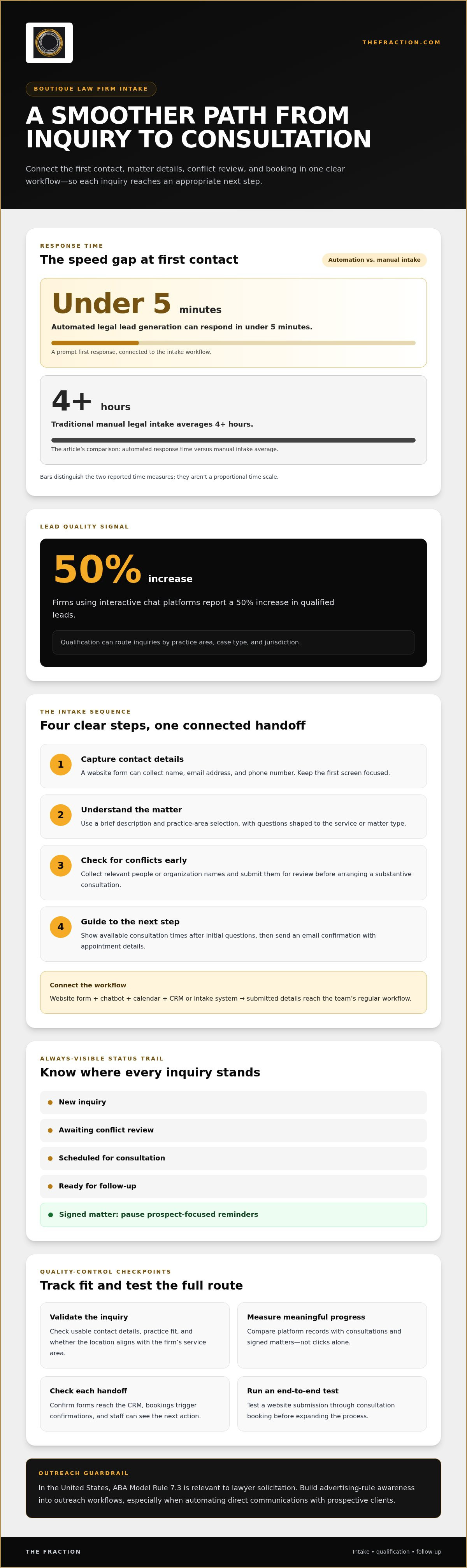
A useful intake workflow follows a clear sequence: capture contact details, understand the matter, and guide the person to an appropriate next step. A website form can collect a prospective client’s name, email address, and phone number. A brief description field and practice-area selection help staff direct the inquiry. Keep the first screen focused, so the form feels like an open door rather than a stack of paperwork.
Ask for the details your firm needs to understand the request, and save a full case history for a later conversation. For example, a family law form might ask which service the person is seeking and how they prefer to be contacted. A business law form could ask what kind of matter they’re dealing with. A phone script can follow the same structure, gathering consistent information without sounding like a checklist.
Include conflict checks early in the intake flow, before staff invest substantial time discussing a matter. Collect the names of relevant people or organizations, then submit those details for review before arranging a substantive consultation. This helps the firm identify matters that may warrant further consideration. Keep the script neutral and focused on gathering information, so prospective clients understand that this is an initial step.
Calendar integration makes an agreed next step easy to book. After the initial questions, show available consultation times and let the prospective client choose one. The calendar can send a confirmation email with appointment details, while a chatbot can gather basic information and guide visitors to a relevant form or booking option. Aim for one smooth handoff, not several disconnected doors.
Connect the form, chatbot, calendar, and CRM or intake system, so submitted details reach the team’s regular workflow. Automated legal lead generation can respond in under 5 minutes, while traditional manual legal intake averages 4+ hours. A confirmation message can acknowledge receipt, explain what happens next, and offer a simple way to update contact details. Follow-up messages can remind someone about a scheduled consultation or invite them to complete remaining intake fields.
Make every handoff visible, so staff can see whether an inquiry is new, awaiting conflict review, scheduled for consultation, or ready for follow-up. When a matter becomes signed, update its status and pause prospect-focused reminders. This status trail distinguishes an open inquiry from a client relationship and prevents duplicate outreach from cluttering the process.
Review the workflow at practical checkpoints: forms reach the CRM, calendar bookings trigger confirmations, and staff can see the next action. Test one example, from website submission through consultation booking, before expanding the process. An end-to-end test reveals where handoffs need attention and helps keep the prospective client’s intake experience coherent.
2. What are the best lead generation automation tools for small to mid-sized law firms?
A strong setup works like a relay, with each tool passing useful information toward a consultation. A small law firm might connect a website form, an interactive chat platform, a CRM, and a consultation calendar, then use campaign reporting to assess performance. Start with the matters your firm wants to attract and the staff available to handle inquiries. That way, technology supports a real acquisition strategy instead of adding another dashboard to manage.
How do automated lead generation strategies differ by practice area and location? A firm focused on local clients can shape campaigns around its service area, while a firm serving clients across jurisdictions can use location as a key qualification detail. Practice area also shapes the questions: an estate-planning inquiry needs a different route from a personal-injury matter.
Qualification turns incoming interest into a useful next step. Set criteria for practice area, case type, and jurisdiction, then direct each inquiry to an appropriate team or consultation option. The 2025 Legal Trends Report identifies automated consultation bookings as one of the most widely used time-saving automations at growing firms. Interactive chat platforms can add another layer, and firms using them report a 50% increase in qualified leads.
For calls, an answering workflow can gather contact details and the caller’s matter category, then route the inquiry to staff or a booking option. A 24/7 call-answering setup can create a consistent first point of contact outside office hours, while a human review step keeps unclear or sensitive requests in experienced hands. Think of automation as the switchboard, directing each conversation toward the right person for follow-up.
Lead validation gives the system a quality-control checkpoint. Review whether contact details are usable, the matter fits your firm’s practice, and the location aligns with its service area. Then compare platform records with consultations and signed matters. If a campaign produces many inquiries but few relevant appointments, revisit its targeting, qualification questions, and routing before expanding its reach.
What are the risks of buying leads or using third-party legal lead services? Inquiries may be shared with others, poorly matched to your firm, or missing useful context. That can weaken conversion and consume follow-up time. Record how each lead arrives, what information it includes, and whether the resulting conversation fits your practice.
Measure the path from inquiry to consultation and signed engagement, rather than clicks alone. A mature law firm digital marketing strategy can aim for a 3x to 5x return on ad spend, while tracking lead fit alongside revenue. For firms aligning their offer with the systems that bring in prospective clients, an automated lead-generation strategy can help connect those moving parts.
3. Choosing methods based on budget, goals, bandwidth, and tracking
Start with your practice goal, then use it to guide your choice of channels, tools, and reporting. A firm seeking more consultations needs a different acquisition path from one focused on a particular matter type. Write down the intended result, who will handle incoming prospects, and what counts as progress. This brief is the map before the drive, keeping campaigns and software pointed toward the same destination.
One playbook recommends allocating roughly 60% of a law firm’s marketing budget to long-term organic authority and roughly 40% to high-intent paid capture. Treat that split as a planning lens, then adjust the mix to your priorities and staff capacity. Organic campaigns can build visibility over time, while paid campaigns can reach people actively seeking a relevant service. Keep the channels distinct in your reporting, so you can see which part of the acquisition engine is pulling its weight.
First-party data gives your firm a direct record of people engaging through its own channels, including website forms, consultation requests, and referral forms. Store each interaction in a CRM with its source, practice area, stage, and next action, then use that record to guide relevant follow-up. CRM users report improved access to customer data at a rate of 74%. A well-kept CRM becomes the firm’s working ledger, making warm prospects easier to identify and organize into an email nurture campaign.
Build analytics around a clear path: campaign source, inquiry, qualified prospect, consultation, and signed matter. Then review where momentum slows, because each pause suggests a different adjustment. Many inquiries but few consultations may indicate a mismatch in messaging, qualification, or scheduling. Consultations without signed matters call for a closer look at the service offer and whether it addresses what prospects came to solve.
Call tracking can add another layer to the picture. Assign a trackable source to each campaign, then record the call outcome in the CRM, such as “consultation requested” or “outside practice area.” Compare those outcomes with website inquiries in the same report. This gives the team a clearer view of which campaigns generate relevant conversations and where staff time goes.
Before expanding a campaign, make sure its source is recorded, someone owns the next action, and its outcome flows into reporting. If staff capacity is tight, a smaller set of fully measured channels can work like a well-tuned instrument, giving your firm clearer signals than a crowded mix with scattered data. A compelling offer gives prospects a meaningful next step, while campaign tracking shows whether it attracts the right conversations.
4. How do you automate lead generation without violating attorney advertising rules?
Small law firms can combine local SEO, paid search, referral forms, and carefully managed follow-up. SEO builds organic visibility, while pay-per-click advertising charges when someone clicks an ad. Local Service Ads should target only areas your firm genuinely serves.
Automate around clear information and deliberate review, rather than letting a platform send every prospect the same message. AI can help sort inquiries by practice area, case type, and jurisdiction, then route them for staff review. The system organizes and directs information, while lawyers retain control over what the firm communicates.
U.S. bar rules governing advertising and solicitation depend on the applicable jurisdiction. ABA Model Rule 7.3 is relevant to lawyer solicitation, California Rules 7.1 through 7.5 govern attorney communications, and the Supreme Court of Texas identifies Texas Rules 7.01 through 7.06 as rules governing attorney communications.
For an AI-powered campaign, define its audience based on your firm’s actual practice and service area, then review the ad, landing page, and automated messages together. For example, a local firm can limit geographic targeting to its genuine service radius and route inquiries outside its practice area for appropriate handling. Measure relevant consultations, not just clicks or form submissions.
Keep a human review point before personalized outreach or a matter-specific response goes out. A staff member can inspect the inquiry, confirm that the routing makes sense, and decide whether follow-up is appropriate. This creates a practical boundary between automated organization and direct communication, particularly when a campaign reaches prospective clients who haven’t contacted the firm first.
Balance paid advertising with SEO according to urgency and team bandwidth. Paid search can reach people actively looking for a service, while SEO supports long-term visibility through useful practice-area pages and clear website content. SEO can take 3-9 months to ramp, depending on competition, so track it separately from paid campaigns. Review the source, inquiry quality, consultation bookings, and signed matters for each channel.
Before publishing, examine every automated touchpoint as one connected sequence: ad, landing page, form, confirmation, and follow-up. Check that each describes the firm’s services accurately and identifies the next action clearly. For a Texas campaign, compare those communications with Texas Rules 7.01 through 7.06; for a campaign reaching another state, account for that jurisdiction’s applicable rules. This gives lawyers a repeatable review process as targeting and content change.
5. Lead generation software options for small law firms
For a small firm, useful software usually connects several functions. A website form captures inquiries, a CRM organizes records, and scheduling software handles consultation requests. Email automation can support follow-up, while analytics helps identify the original source. Map intake from first contact to next action, then select tools that address the gaps. This keeps software selection tied to a real workflow instead of a long feature list.
Compare platforms across four capabilities: lead tracking, automated follow-ups, analytics, and integrations. A CRM, for example, should preserve an inquiry’s source when staff update its status. A booking tool should pass appointment details into the firm’s workflow. A chatbot should collect useful information without creating a separate record that staff must re-enter manually. Each connection should reduce a handoff or clarify who owns the next step.
The right fit depends on your practice, staff capacity, and growth plans. A solo attorney may prioritize simple routing and consultation scheduling, while a firm with several practice areas may need distinct intake paths. List who will review new inquiries, what information they need, and what follow-up they can manage. Then assess whether each platform supports that process. Automation is useful only when the team can act on the information it provides.
Use reporting to understand what drives conversion. Track inquiry source, practice area, consultation status, and signed matters consistently. If referrals generate relevant consultations while another source brings mismatched inquiries, that comparison can guide future investment. Review conversion alongside lead quality and staff workload. A high inquiry count alone doesn’t show whether software supports sustainable growth.
Before adopting a platform, test the complete path with a sample inquiry. Submit a form, confirm its CRM record, trigger a follow-up, and book a consultation. Check that staff can see the source and next action without switching between disconnected records. A free trial period, when available, can help your firm evaluate the actual workflow before deciding.
Keep the first implementation focused: choose one intake path, connect its essential tools, and review a report after using the workflow. Add features when a clear need emerges, such as routing inquiries across practice areas or measuring campaign sources. This staged approach gives your firm a practical basis for evaluating software and keeps intake manageable as the practice grows.
The Fraction: Automated & AI lead generation systems
The Fraction helps professional firms build automated, AI-driven lead generation systems around a clear offer and practical follow-up process. For a boutique law firm, that can mean connecting how prospects discover the firm with a compelling service, a well-defined next step, and a sales process that doesn’t feel like selling. The goal is a coherent path from first interest to a meaningful conversation, not disconnected tools that may not work together.
Turn to this support when your firm has identified its audience and service but wants a more coherent system for attracting and converting prospective clients. Your lawyers remain responsible for reviewing advertising and outreach against applicable professional rules, while the acquisition process is shaped around the firm’s goals. Contact The Fraction to discuss whether this approach fits your firm.
Build a system your firm can learn from
A durable approach to automated lead generation for boutique law firms starts with deliberate decisions and improves as your firm learns which conversations are the right fit. Choose a clear next step: define what a qualified inquiry means for your practice, assign someone to review results, and use the findings to refine the process. This gives your growth strategy a compass, so new tools and campaigns support your direction instead of adding complexity for its own sake.
The Fraction can help build that foundation with automated, AI-driven lead generation systems, a sales process that doesn’t feel like selling, and a compelling offer and service. The next step is a thoughtful conversation about your goals and the client relationships you want to build.
Your firm can build a more considered path to growth, one clear decision at a time.
Frequently Asked Questions
How do I balance aggressive lead generation with ABA Model Rule 7.3 regarding solicitation?
Build growth around useful inbound information and review outbound outreach before it goes live. ABA Model Rule 7.3 is relevant to lawyer solicitation, so classify each campaign by who initiates contact and what the message says. For example, have a lawyer review an automated message aimed at a specific person before launch, and give staff a clear process for pausing or correcting messages when a recipient responds.
Can you use AI to generate leads?
Yes, AI can support lead generation by helping qualify inquiries against your firm’s criteria, such as practice area, case type, and jurisdiction. It can also organize information for intake and follow-up. For example, a firm might use AI to sort an inquiry into the right matter category, then have staff review it before deciding how to respond. Connect the system to your firm’s intake workflow.
How can AI improve client intake conversion at law firms?
AI can clarify the first steps by directing people to relevant information and the appropriate intake path. For example, a visitor seeking help with a business contract could be guided to a focused form instead of a general contact page. Measure whether the person completes the next step, such as submitting the form or requesting a consultation. Review incomplete forms to identify confusing questions.
How can law firms diagnose where their client acquisition is failing?
Compare each stage, from first inquiry through consultation and signed engagement, and look for where progress slows. If website visitors rarely submit forms, inspect the page’s message and form usability. If inquiries arrive but consultations remain scarce, review follow-up and scheduling. If consultations don’t lead to engagements, examine whether the service offer matches clients’ needs. Track each stage consistently before changing campaign tactics.
How do you automate lead generation without violating attorney advertising rules?
Use a jurisdiction-aware review process for ads, landing pages, and automated communications before publishing or changing a campaign. ABA Model Rule 7.3 addresses lawyer solicitation, while the Supreme Court of Texas identifies Texas Rules 7.01 through 7.06 as rules governing attorney communications. Keep a record of approved content and assign responsibility for reviewing updates, especially when AI changes message wording or audience selection.
What are the best lead generation automation tools for small to mid-sized law firms?
The best fit is a connected set of tools your firm can operate: a website form, CRM, consultation calendar, and follow-up automation. Choose based on your team’s workflow. A small practice, for instance, may need clear source tracking and simple booking, while a firm with multiple practice areas may need separate routing. Test how information moves from submission to staff review before adding features.
What are the three stages where AI improves law firm client acquisition?
AI can support three stages: attracting relevant interest, organizing and qualifying inquiries, and managing follow-up. For example, a firm can publish practice-area information, sort incoming requests by matter type, and use its CRM to identify people who need a next step. These stages work best as one connected path, with staff overseeing decisions about communications and potential representation.
What is automated lead generation for boutique law firms?
Automated lead generation for boutique law firms uses connected digital processes to attract inquiries, organize prospective-client information, and support timely follow-up. For example, a practice-area page can lead to an intake form, which sends a record to a CRM and prompts staff to review the inquiry. Automation coordinates the handoffs; the firm’s team decides whether the matter fits and what response is appropriate.


