

A lead system earns its place when useful conversations keep moving while your team is deep in client work. Automated lead generation for creative agencies connects the steps that attract prospects, capture their details, assess fit, and follow up with relevant information, giving each opportunity a clear path toward a real conversation.
If referrals, occasional outreach, or a quiet contact form have been carrying the load, you’ve seen how promising leads can drift away while everyone focuses on delivery. A strong setup works like a well-run studio: each part has a clear role, the process stays personal, and the right tools support the way your agency wins work.
This guide explains what automation means, how to qualify prospects, shape follow-up, capture interest on your website, and test the system as you learn. Think of it as a studio workflow that gets sharper with every project: each step has a purpose, and the whole process keeps improving.
Key Takeaways
- Connect lead capture, CRM records, and follow-up so prospects move through a clear, consistent process.
- Qualify leads using fit and intent, then tailor the next step to where each prospect is in their decision.
- Build follow-up sequences that feel relevant and personal, with messages shaped around a prospect’s interests.
- Make website forms easy to complete and collect the information your agency needs to start a useful conversation.
- Test one part of the system at a time, measure how prospects respond, and use what you learn to refine the process.
1. What is automated lead generation?
Automated lead generation links the steps that attract prospects, capture their details, and guide follow-up. For a creative agency, the journey might begin when someone downloads a project guide from a landing page. A form records their service interest and source, then passes those details into a customer relationship management system, or CRM. From there, a workflow can send a useful email and create a follow-up task, keeping every handoff clear while the team focuses on client work.
Lead nurturing automation helps an agency keep the conversation relevant as a prospect considers its services. Someone exploring branding might receive a related case study, then an invitation to discuss a project after another meaningful interaction. The CRM holds the contact record and engagement history, giving future messages useful context. The Content Marketing Institute reports that 73% of marketers use email as a top content distribution channel. It also reports that 71% measure content effectiveness in generating sales through email engagement, giving agencies a way to assess how nurture content supports conversations.
Integration connects the process, so start by mapping the path from traffic source to landing page, CRM record, email platform, and sales task. Choose tools that share the fields your team relies on, such as contact details, project type, and campaign source. If platforms lack a direct connection, use an integration service. Test the workflow with a sample record: submit the form, confirm the CRM entry, and check whether the right campaign starts. This walkthrough can reveal duplicate records, missing fields, or a message triggered by the wrong action.
For U.S. privacy and email marketing, design campaigns around applicable rules. Build permission records, accurate sender details, unsubscribe handling, and limited data access into the workflow. Before launch, review how those requirements apply to each campaign’s audience, data, and channels.
Lead generation platform costs vary with the tools, user access, contact volume, integrations, and implementation work involved. Pricing depends on the project and is provided after a quote request, so compare the full technology stack rather than focusing on a single feature.
Keep the architecture lean by connecting tools to defined steps and assigning an owner to each workflow. For example, preserve a prospect’s original source in the CRM even after they book a call, so your team can compare campaigns and improve the path from first visit to qualified conversation. Automation organizes handoffs, while human judgment shapes the offer and relationship. That balance lets the system grow with the agency instead of becoming a maze of disconnected tools.
2. Lead scoring and qualification
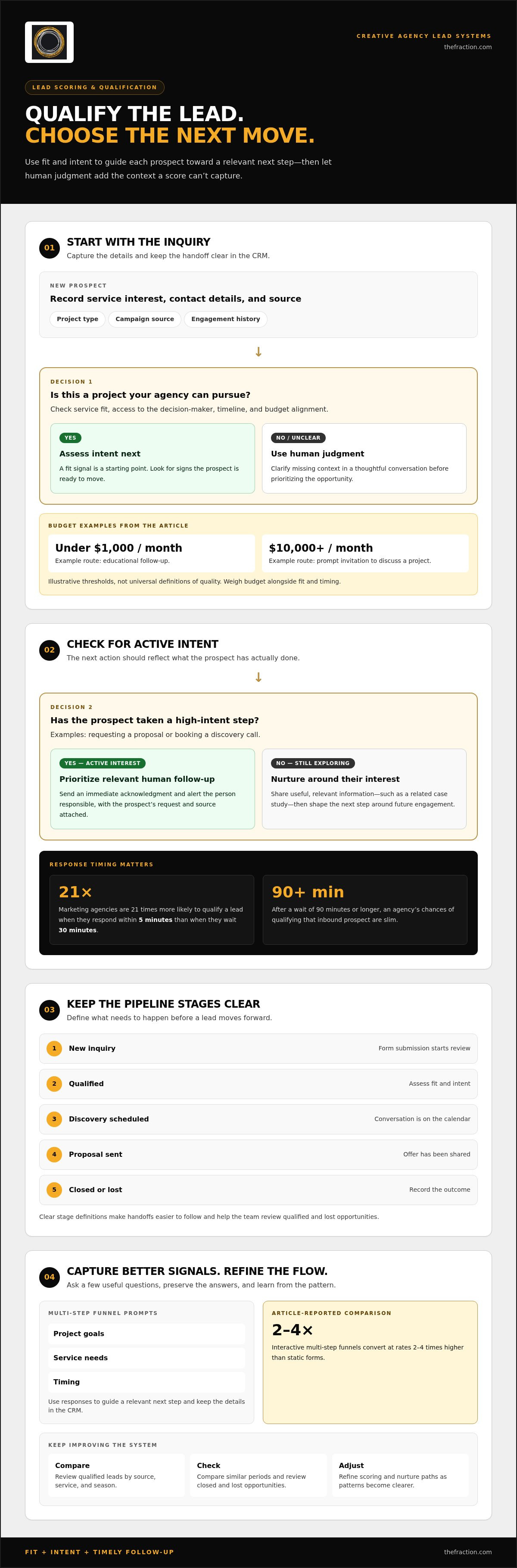
Lead scoring helps an agency decide which prospect deserves attention first, using signals tied to fit and intent. Start with the conditions that make a project worth pursuing: a need your team can solve, access to the decision-maker, a workable timeline, and a budget aligned with the service. Give more weight to signs of active interest, such as requesting a proposal or booking a discovery call. Treat the score as a guide to the next action, with a thoughtful conversation adding the human judgment numbers can’t capture.
For example, an agency might route a prospect with a monthly marketing budget under $1,000 into educational follow-up, while a prospect with $10,000 or more receives a prompt invitation to discuss a project. These are illustrative thresholds, not universal definitions of quality. Weigh budget alongside service fit and timing, because a larger budget alone offers only one piece of the picture. Review scoring rules against closed and lost opportunities, then adjust them as the pattern of qualified leads becomes clearer.
Give the CRM clear sales stages, such as new inquiry, qualified, discovery scheduled, proposal sent, and closed or lost. Define what moves a lead between each stage, so a form submission begins the review process and qualification follows after fit and intent are assessed. An interactive, multi-step funnel can ask about project goals, service needs, and timing in sequence; interactive multi-step funnels convert at rates 2-4 times higher than static forms. Use the answers to guide prospects toward a relevant next step and preserve their responses in the CRM.
Response time shapes whether an agency can qualify an inbound lead while interest is active. Marketing agencies are 21 times more likely to qualify a lead when they respond within 5 minutes than when they wait 30 minutes. Build an immediate acknowledgment into the workflow, then alert the person responsible for relevant human follow-up. After a wait of 90 minutes or longer, an agency’s chances of qualifying that inbound prospect are slim. Include the prospect’s request and source in the alert, so the response starts with context.
Seasonal consistency depends on comparing like with like. Track qualified leads by source, service, and season, then compare similar periods to understand changes in demand. A campaign attracting early-stage research in a slower season may need a different nurture path from one bringing active project requests. This distinction helps teams improve the funnel while keeping qualification standards aligned with the agency’s goals.
When scores and stages leave the sales process feeling improvised, a sales process that feels natural can help align qualification with the way your agency builds client relationships.
3. Automated outreach and follow-up sequences
A follow-up sequence gives each prospect a relevant next step after an inquiry, download, or conversation. For example, a branding prospect might receive a case study, followed by an invitation to discuss their project. Use CRM lead scoring to tailor messages: an active inquiry can prompt personal contact, while early research can receive useful educational content. Each message should reflect the prospect’s interest instead of repeating the same pitch to everyone.
The strongest channels depend on where your target audience already engages and how they prefer to hear from an agency. LinkedIn, email, Google search, and landing pages can work together, with each channel serving a distinct role. HubSpot reports that 89% of B2B marketers use LinkedIn for lead generation, making it a practical channel to test for agency prospects.
Share a clear point of view, a project insight, or a practical lesson, then connect relevant posts to focused landing pages. A visitor interested in brand strategy should land on a page about that service, not a generic agency homepage. Use LinkedIn engagement and form submissions to understand which topics attract qualified interest.
Personalization makes automation feel more like a considered introduction than a message fired from a template. Use details the prospect has shared, such as their requested service or stated business challenge, and make the next step specific. Salesforce reports automated emails can increase click-through rates by up to 199%. Aaron Ross gained 16 new customers by personalizing his automated email template. Those examples support testing relevance, while your own campaign results should guide the wording.
Buying leads can create a mismatch between the agency’s offer and a prospect’s actual needs. Automated cold outreach can also feel irrelevant when the message lacks context. Poorly targeted volume may harm sender or platform reputation, so keep outreach focused, accurate, and easy to stop.
Build a sequence around clear triggers: a prospect requests a guide, attends an event, or replies to a message. Send the next communication that fits the action, then pause automation when someone responds or books a conversation. Assign an owner to replies, because automation can organize follow-up while a person handles nuance, questions, and project fit.
Review each campaign by channel, audience, and meaningful action, such as replies or booked conversations. If LinkedIn posts bring visits but few inquiries, compare the post’s promise with the landing page and its call to action. Change one element at a time, then keep the messaging that produces relevant conversations. This turns outreach into a learning system instead of a fixed sequence running without attention.
4. Website forms, pop-ups, and lead capture
A landing page should make the next step obvious: request a project conversation, download a guide, or view a relevant case study. Static contact forms convert at an average rate of 1-3%, so form design deserves attention alongside the page’s message. Keep the request aligned with the offer. A page about brand identity, for example, should invite visitors to discuss a branding project rather than ask them to describe every possible need.
Ask only for information that helps your team respond usefully. A creative agency might request a name, work email, service interest, and short project description, then gather more context during a conversation. Each extra field demands more effort, so remove questions that don’t shape the next step. Label fields clearly, explain what happens after submission, and make the form easy to complete on mobile.
Pop-ups can engage visitors when their timing and message fit the page. Someone reading a design services page could see an invitation to view a related project example, while a visitor returning to a project inquiry page might see a direct contact option. Keep the offer relevant and the close control visible. A pop-up that interrupts reading without adding value can distract from the page and weaken the path into your pipeline.
Visitor identification begins with information a person chooses to provide, such as a form submission or consultation request. Connect that action to its source, the page visited, and the selected service, then pass those details into the CRM. Analytics can show which channels bring visitors and which pages lead to inquiries. The record should describe the interaction, not make assumptions about an unknown visitor.
Audit the full capture workflow by testing it as a prospect. Open a landing page, submit a test inquiry, and check that the CRM receives every field. Confirm that the right team member gets an alert, the acknowledgment reflects the request, and the source stays attached to the record. Review the experience on mobile and desktop, too. This process can reveal broken forms, confusing messages, or a handoff that leaves an inquiry waiting.
Use conversion data to identify where a page can improve. An agency landing page converting at 4% instead of 3% would produce 33% more leads from the same traffic. Compare pages with similar goals, then test one change, such as a clearer headline or a shorter form. Track submissions and qualified conversations together, because more form fills alone don’t show whether the page attracts suitable prospects.
Map each form to its next action: a guide request can trigger relevant content, while a project inquiry can create a prompt sales task. Review workflows across channels so the visitor’s original intent stays visible. This connection turns isolated forms into a coherent growth system, with the page, analytics, CRM, and human follow-up working together.
5. Ongoing testing of lead generation systems
Testing turns a lead system into a learning loop: each change should answer a specific question. Start with one stage, such as a landing page, email template, or qualification prompt. Record the current result, the change you’ll make, and the outcome that matters. For example, test whether a service-specific headline attracts more project inquiries than a general agency message. Keep other elements steady so the result is clear.
Measure the pipeline beyond traffic and form submissions. Track how visitors become inquiries, how many inquiries qualify, which leads reach a sales conversation, and which become clients. Add the channel and campaign source to each CRM record, so you can compare Google traffic with LinkedIn referrals or email responses. More clicks matter less if qualified conversations remain unchanged, so connect each metric to the next stage.
To measure performance and ROI, compare revenue attributed to won work with the costs of the tools and campaigns that generated it. Review conversion rates at each funnel stage alongside client fit, so a high volume of inquiries doesn’t hide weak lead quality. Use consistent attribution rules in the CRM, and assess performance across the path from first interaction to closed work.
Run a focused experiment by changing one element at a time. For a form, compare a shorter version with the current one; for an email, test a personalized opening against a general template. Keep the audience, targeting, and offer consistent during the test. If several elements change together, you can’t tell which influenced behavior, leaving little guidance for the next decision.
Set a clear start and review point for each test, based on the available traffic and response volume. Compare like with like: assess a landing page for branding inquiries against similar branding traffic, not a broad portfolio page. Record changes in a simple experiment log, including the page, audience, message, CRM outcome, and decision to keep, revise, or stop the change.
Look for patterns before rewriting the whole system. If prospects open a campaign but rarely reply, examine the message and its next step. If a personalized email earns replies but few suitable projects, revisit targeting and qualification. If traffic reaches a page but leaves without engaging, check whether the page promise matches the visitor’s intent. Each signal points to a different part of the process.
Testing works best as a routine shared by the people managing campaigns and handling sales conversations. Bring CRM outcomes into the review, note what prospects asked, and choose the next experiment based on those observations. This grounds optimization in real behavior rather than assumptions, helping your agency build a more dependable path from attention to client work.
The Fraction: Automated & AI lead generation systems
The Fraction helps agencies turn lead generation into a connected business system, combining automated and AI lead generation systems with a sales process that doesn’t feel like selling. When follow-up, qualification, and testing need a clearer structure, this is a natural next step: align the system with your offer, audience, and approach to building client relationships.
A strong system also depends on what you’re selling. The Fraction helps shape a compelling offer and service, giving prospects a clear reason to start a conversation and helping your agency communicate its value with confidence.
Ready to strengthen your lead generation process? Contact The Fraction to discuss your next step.
Make your next improvement deliberate
Make your lead generation system part of how your agency makes decisions, not just a set of campaigns running in the background. A thoughtful approach to automated lead generation for creative agencies creates room to learn from conversations, refine your offer, and choose the next improvement with intention. The goal is a process your team can understand, manage, and adapt as the agency’s priorities evolve.
Choose one practical next step: review where prospects lose momentum, clarify the decision you want your system to support, or identify where the process needs a stronger foundation. Small, considered changes can give your team direction and make future improvements easier to evaluate. You have the pieces; now shape them into a system that reflects the agency you’re building.
Keep moving with purpose, and let each improvement clarify the next.
Frequently Asked Questions
What is automated lead generation?
Automated lead generation uses software workflows to identify and manage potential customers through a business’s acquisition process. For example, a visitor who requests a project guide could receive it automatically, while the agency records the request for follow-up. Automation handles repeatable actions; people still decide which prospects fit, how to respond to complex needs, and whether an engagement makes sense.
What is automated lead generation for creative agencies?
Automated lead generation for creative agencies connects audience-building with the agency’s services and client conversations. A design studio, for example, could create a campaign around packaging work, then direct interested prospects to a relevant project inquiry. The system maintains continuity between the agency’s expertise, the prospect’s interest, and the next interaction, while the team brings creative judgment to the relationship.
Which lead generation tools work best for creative agencies?
The most useful tools depend on the process the agency needs to support. A practical setup may include a CRM for contact and opportunity records, an email platform for follow-up, website forms for inquiries, and analytics for channel performance. Choose tools that share information your team uses, such as service interest and inquiry source. A simple, connected setup is easier to manage than separate platforms with overlapping jobs.
How can creative agencies automate lead capture and qualification?
Connect each inquiry form to CRM fields that capture the essentials for an initial review. For example, a web design agency could ask about the type of site, the prospect’s main objective, and the desired project stage. Use the answers to route inquiries for review, while keeping a person involved in judging fit. Test the full path with a sample submission before sending live prospects through it.
How can agencies personalize automated outreach without sounding generic?
Make each message respond to a genuine signal, such as a service page viewed, an event attended, or a question submitted. A prospect who requested rebrand information could receive a relevant project example and a short note about the challenge it addressed. Use templates for a dependable structure, then tailor the opening and suggested next step. Keep the message focused on the prospect’s stated interest.
What CRM and marketing automation integrations do agencies need?
Start with connections that preserve the prospect’s journey: website forms to CRM, CRM to email campaigns, and campaign or website analytics to reporting. For instance, a consultation request should create a contact record with its original source and selected service. Map fields before connecting platforms, then test a submission and an update. This helps the team see consistent prospect information across marketing and sales activity.
What privacy and email marketing rules apply to automated lead generation in the United States?
Build permission records, accurate sender details, unsubscribe handling, and limited data access into campaigns. Before launch, review how applicable requirements apply to each campaign’s audience, data, and channels.


