

Lead generation helps an accounting firm attract potential clients, earn their interest, and give them a clear next step. Automated lead generation for accounting firms connects those activities into a consistent path from first contact to conversation. Each interaction should help a prospect understand what to do next.
Referrals can open valuable doors, and inbound campaigns can help people discover your expertise. Both work better when connected to relevant outreach and useful follow-up. Bring the channels together around the clients you want to serve and the conversations you want to create.
This article explains lead generation for accounting firms and how inbound campaigns, outbound outreach, content follow-up, and multiple channels can work as one system. You’ll see how the pieces fit together and how to choose a practical place to start.
Key Takeaways
- Use a useful resource or value-based offer to give prospective clients a clear reason to start a conversation.
- Build inbound campaigns that connect helpful content with a relevant next step, so interest has somewhere to go.
- Choose inbound, outbound, or a coordinated mix based on your audience, capacity, and the kind of client relationships you want to build.
- Follow up with content downloaders through relevant, well-timed messages that continue the conversation rather than simply repeat a sales pitch.
- Connect email, search, webinars, referrals, and targeted outreach into one system, then refine it based on how prospects respond.
1. What is Lead Generation?
Lead generation is the process of attracting a potential client and creating a path toward a business conversation. A prospect might find an article about tax planning, share contact details to receive a related resource, and then decide whether to discuss their needs. Each step helps the firm assess whether there’s a good fit.
A lead magnet offers a prospect something useful in exchange for contact information, usually a name and email address. An accounting firm might provide an eBook about preparing records for filing, a white paper on cash-flow planning, or a meeting with an expert. Focus the resource on a specific concern so prospects have a clear reason to engage.
The value matters more than the format. A guide for business owners preparing for filing can answer practical questions, while a resource for a company considering hiring can explain which financial information to organize. Choose the audience and problem first, then create a resource that helps them take a useful next step.
A focused offer can also invite prospects to discuss their situation directly. For example, a firm could offer a brief review of a prospective client’s last tax return. This gives the conversation a clear purpose and practical starting point, helping the prospect understand why sharing contact details may be worthwhile.
Website forms and popups can present these offers as visitors explore accounting services. An eBook popup, for example, can invite a visitor to enter an email address to receive a downloadable guide. Test the offer and placement, then track engagement. A clear benefit and relevant timing make the form more useful.
Make the exchange straightforward: explain what the visitor will receive, what information the form requests, and how the resource will be delivered. Someone looking for a small-business filing checklist should see that specific promise, not a broad invitation to “learn more.” Clear expectations show the value before a prospect shares details.
Lead magnets can also show an accounting firm which topics attract interest. If a tax-planning guide draws responses, follow up with related information. If a cash-flow resource gets attention, continue with that subject. The download signals interest in a topic, while the prospect’s later actions help shape the conversation.
Referrals and professional networks can provide introductions, while a lead magnet gives prospects a consistent way to learn about the firm. A referral partner might share a relevant guide with a business owner, who can review it and decide whether to start a conversation. The personal introduction adds context to the resource.
Treat each offer as a doorway with a clear sign: a defined audience, a useful resource, and one next step. That gives automated lead generation for accounting firms a practical foundation, connecting each contact to a real need and relevant follow-up.
2. Automated inbound lead generation campaigns
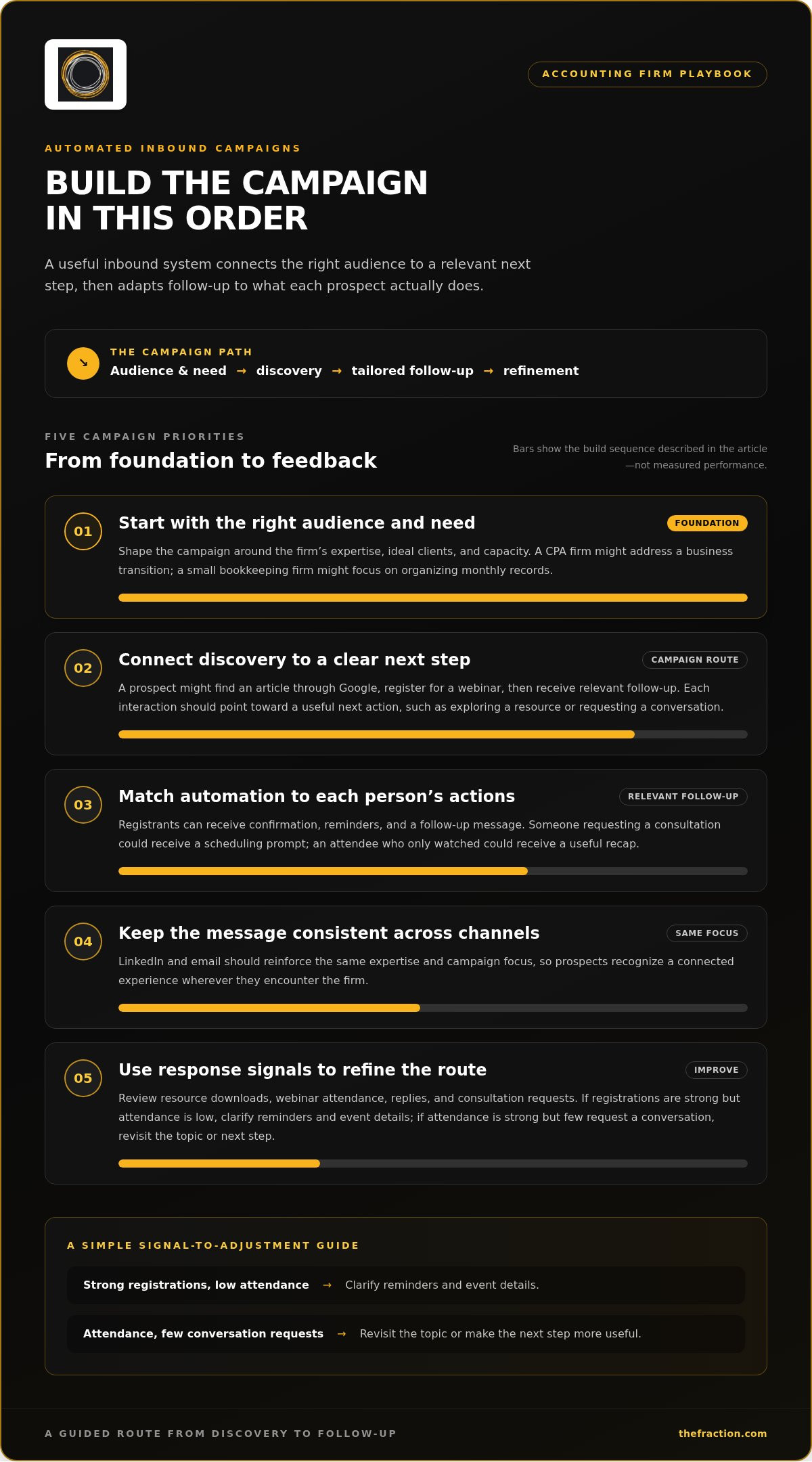
For CPA firms, inbound campaigns can address complex advisory needs, such as planning for a business transition. Small bookkeeping firms can highlight recurring support, such as organizing monthly records. The right campaign reflects the firm’s expertise, ideal clients, and capacity.
An inbound campaign connects a discovery point with a relevant next step. A business owner might find an article through Google, register for an accounting webinar, and receive follow-up emails. Each interaction should make the next action clear, whether that’s exploring a resource or requesting a conversation.
Webinars let prospects learn before speaking with a firm. A session about preparing for a business transition, for example, can invite attendees to discuss their circumstances afterward. Treat registration, attendance, questions, and consultation requests as distinct signals, then tailor outreach to each person’s actions.
Automation coordinates these interactions. A registration form can trigger a confirmation, a reminder, and a follow-up message with related information. Someone who requests a consultation could receive a scheduling prompt, while an attendee who only watched could receive a useful recap. Match each message to the prospect’s actions instead of repeating the same pitch.
LinkedIn posts can help an inbound campaign reach a professional audience. A CPA firm might share business-planning insights, while a bookkeeping practice could explain how organized records support routine reporting. Keep messaging consistent across LinkedIn and email so prospects recognize the same focus across channels.
Track actions that show meaningful interest, such as resource downloads, webinar attendance, replies, and consultation requests. If registrations are strong but attendance is low, clarify reminders and event details. If people attend but few request a conversation, revisit the topic or make the next step more useful.
Start with a campaign that fits the firm’s capacity, then refine it before adding audiences or channels. A small bookkeeping firm could feature a resource about organizing monthly records, while a CPA firm could host a discussion about a specific planning challenge. Tailor follow-up to the needs behind each offer.
Think of a campaign as a guided route, with every message pointing to a relevant next step. Review responses, adjust the content, and keep the experience consistent from discovery through follow-up. This makes inbound activity a process the firm can manage and improve.
3. Comparing inbound and outbound strategies
Inbound and outbound create opportunities from different starting points. With inbound, a business owner finds an accounting firm through search, social media, or a professional referral, then chooses to engage. With outbound, the firm identifies a suitable prospect and initiates contact. One responds to existing interest; the other creates an opening.
Inbound prospects may move through the sales process faster because they’ve reviewed the firm’s website and expressed interest. Someone requesting information about business accounting, for example, already has a reason to consider support. A useful first conversation can focus on their needs, timing, and fit.
Outbound requires more qualification. A prospect receiving a cold call may have no immediate accounting need, so the firm must establish relevance before discussing services. A targeted email can identify a business trigger, explain one specific problem the firm solves, and ask a simple question. That gives the recipient a clear reason to respond.
Each strategy also requires a different operating commitment. Inbound campaigns can be outsourced, while outbound typically needs a full-time in-house employee or an equivalent outsourced commitment. The work includes defining the audience, preparing messages, maintaining outreach, and managing replies. Partners should weigh that ongoing effort against the firm’s capacity.
A practical strategy can begin with inbound foundations, then add focused outbound when the firm has room for additional work. For example, an accounting firm serving a defined industry could create relevant website content, then contact businesses that match its audience. Test an initial list of 150 to 300 contacts, review responses, and refine the message before expanding.
Before outreach begins, the firm’s partners should approve the audience, messages, and sending rules. In the United States, commercial email must comply with the CAN-SPAM Act, including accurate sender identity, clear opt-out instructions, and a real physical address. The AICPA Code of Professional Conduct also prohibits false, misleading, or deceptive advertising and solicitation.
Measurement should reflect each channel’s job. For inbound, track which sources lead to qualified inquiries and consultations. For outbound, track positive replies and consultations per 1,000 emails sent. Those measures help partners see whether a campaign is attracting the right conversations, rather than simply producing a higher volume of names.
Social media can support either approach, depending on how the firm uses it. A practical LinkedIn post can help prospects discover the firm’s expertise, while direct outreach can introduce that expertise to a selected business. Keep the message consistent across the post, website, and follow-up so each interaction feels connected.
Choose inbound when prospects are already seeking the service and the firm can create useful discovery paths. Choose outbound when a defined audience needs a direct introduction and the firm can sustain the effort. A coordinated approach works when partners can manage both without weakening follow-up or service capacity.
4. Following up with content downloaders
A download reveals which topic caught a prospect’s attention, so use that signal to shape the next message. Someone requesting a real estate bookkeeping guide may value examples about tracking property income and expenses. Someone downloading a filing checklist may need a different path, with practical reminders tied to that resource.
Record the resource, source, and date in your contact system. A Google search, Facebook post, and referral can create different expectations, even when prospects download the same guide. Keeping that context helps each email connect to the action that began the conversation.
Build a sequence around a useful progression, rather than sending the same pitch repeatedly. A default outbound sequence can include 6 to 9 touches over 14 to 21 days. Warm inbound leads typically need 5–12 email touchpoints before converting to a consultation. These are planning benchmarks, so the messages should still respond to each prospect’s actions.
For example, send the requested guide first, then share a related tip, answer a common question, and invite the reader to discuss their situation. If a real estate owner downloads a bookkeeping resource, follow up with an explanation of how organized records support clearer reporting. Each email should add relevant context.
Email automation can support one-to-one conversations with prospects and clients. Use the downloader’s name and resource topic, then adjust the sequence when someone replies, books a consultation, or downloads another item. Reply directly to a person with a question; a quiet reader may benefit from another helpful example.
Keep the language specific and the next step easy to understand. Instead of asking, “Are you ready to work with us?”, ask whether the reader wants to discuss the bookkeeping challenge covered in the guide. This keeps the exchange focused on their situation and gives the firm a clearer signal of interest.
Review the sequence after each campaign. Compare which messages receive replies, which links readers open, and which topics lead to consultations. If a filing guide gets downloads but little follow-up engagement, try a more useful next message, such as an explanation of what records to gather before filing.
Automation works best as a relay, with each message passing along a useful next step. Set clear pauses for replies and consultation requests, and remove those contacts from the general sequence when the conversation changes. A prospect who has booked shouldn’t keep receiving the same invitation.
Use the sequence to learn, too. If readers from Google respond to practical filing guidance while Facebook visitors engage with business-planning examples, tailor future content to those patterns. The goal is a relevant conversation, shaped by the downloader’s first signal and guided by what they do next.
5. Multi-channel lead generation for accounting firms
A multichannel system gives prospects several ways to discover and engage with an accounting firm. Search, referrals, webinars, email, and paid ads can serve different stages of the decision while working together. The aim is a clear path from first interaction to a relevant conversation.
U.S. accounting firms should follow the CAN-SPAM Act for commercial email, including accurate sender identity, clear opt-out instructions, and a real physical address. The AICPA Code of Professional Conduct prohibits false, misleading, or deceptive advertising and solicitation. Keep messages accurate, and have partners approve audiences and outreach rules.
Give each channel a specific role. Search can help a business owner find information while researching an accounting issue; a webinar can explain a focused topic; and email can continue the conversation after registration. Pay-per-click advertising charges a fee each time someone clicks an ad, so track whether those visits produce suitable inquiries.
Referrals can extend a firm’s network through bankers, lawyers, insurance agents, real estate agents, and fellow accountants. Give each partner a concise description of the clients and needs the firm serves. Add outbound email to a defined niche only when the firm can handle the resulting work.
How much do accounting firm lead generation platforms cost? Prices vary by platform and scope. Relevant factors include the channels, automation scope, and integration requirements. Compare the expected workflow and capabilities alongside the price, rather than treating platform cost as the entire campaign investment.
What CRM integrations do accounting lead generation tools support? Support varies by tool, but integrations generally move lead details and activity into a customer relationship management system through a connector, an application interface, or a data import. Confirm that the firm’s chosen system can record the source, consent status, and follow-up activity.
What are the risks of buying leads for an accounting firm? Purchased contacts may have a poor service fit, outdated details, or limited interest, consuming staff time and weakening conversion. Review how contacts were collected and whether the audience matches the firm’s services before adding them to an outreach campaign.
How can accounting firms measure lead generation ROI and conversion rates? Track each channel from inquiry through consultation and new-client decisions, then compare the resulting business with campaign and staff costs. Measure positive replies and consultations per 1,000 emails sent, and review which sources produce qualified conversations.
Build a simple channel view that records the source, audience, next step, and outcome for every inquiry. If search brings research-oriented prospects while referrals bring ready introductions, tailor follow-up to each group. The firm can then expand the channels that fit its capacity and client goals.
The Fraction: Automated & AI lead generation systems
The Fraction helps professionals build a connected path from attracting prospects to starting sales conversations. For an accounting firm, its automated and AI lead generation systems can coordinate inbound campaigns, outbound outreach, and follow-up. A compelling offer gives potential clients a clear reason to engage.
Turn to The Fraction when your firm has identified its audience and services but needs a stronger system for consistently creating relevant conversations. The Fraction can also help shape a sales process that feels natural, with an offer and service designed to win clients quickly, without pressure-heavy pitches.
For an accounting firm, this means aligning the message, offer, and follow-up with the clients you’re equipped to serve. Contact The Fraction to discuss your lead generation goals.
Build a growth system your firm can sustain
First, define what a well-qualified opportunity looks like for your firm, then shape each campaign around that standard. A deliberate approach to automated lead generation for accounting firms helps connect the audience, offer, and follow-up, while leaving room to adjust as you learn which conversations are a fit.
The Fraction brings together automated and AI lead generation systems, a compelling offer and service designed to win clients quickly, and a sales process that doesn’t feel like selling. Together, these can create a clearer route from first interest to a meaningful business conversation.
Choose an approach your team can execute consistently, and make each interaction a relevant next step. A stronger growth system starts with a considered first move.
Your expertise deserves a clear path to the clients who value it. Keep building that path with intention.
Frequently Asked Questions
What is Lead Generation?
Lead generation is the process of finding potential clients and creating a path for them to consider a firm’s services. For an accounting practice, this can mean identifying a suitable business audience, attracting inquiries, and recording each prospect’s needs and next step. That helps the firm distinguish general interest from an opportunity that fits its expertise, available capacity, and preferred client relationships.
Which lead generation tools work best for accounting firms?
A study of professional services firms found search engine optimization to be the most effective online lead-generation tool. Accounting firms can combine SEO with useful website resources, webinars, email follow-up, referrals, LinkedIn, and targeted outreach, then refine the mix based on prospect responses.


