

A boutique agency needs a steady path from a clear offer to real client conversations, and that path works like a well-built bridge: each piece gets the right buyer closer to a project. A client acquisition system for boutique agencies connects the service, the audience, and the follow-up, so growth has a structure behind it instead of depending on a lucky month.
If referrals have carried the business so far, or leads arrive in bursts and then go quiet, the tension is familiar: you want room to grow, but delivery still needs your attention. The goal is an approach that fits the agency you’ve built and the work you want to keep doing.
This guide looks at how productized agencies can define acquisition, compare channels, make referrals more intentional, and build a system they can keep running. You’ll learn how to choose a useful channel mix, connect each part, and make business development feel like part of the work rather than a scramble around it.
Key Takeaways
- Define acquisition around a clear offer, the right-fit buyer, and the pipeline activity that shows whether your approach is working.
- Choose a focused mix of channels, then build trust through useful insights and thoughtful follow-up.
- Compare inbound and outbound by how each helps you reach, engage, and move prospective clients toward a conversation.
- Make referrals more intentional by understanding why past clients chose you and creating natural moments to ask for introductions.
- Build a repeatable process before adding more tactics, then use automation to support the parts that are already working.
1. What is client acquisition for productized agencies?
Client acquisition is the repeatable path from attracting a suitable buyer to starting a paid project. For a productized agency, it connects a defined service with an audience and the conversations that move prospects toward a decision. Think of the pipeline as a map: each stage shows where a potential client is and what could help them take the next step.
Set a revenue goal and connect it to pipeline activity. A target alone offers little direction; linking it to specific actions helps the team see the work behind the outcome instead of hoping revenue simply appears.
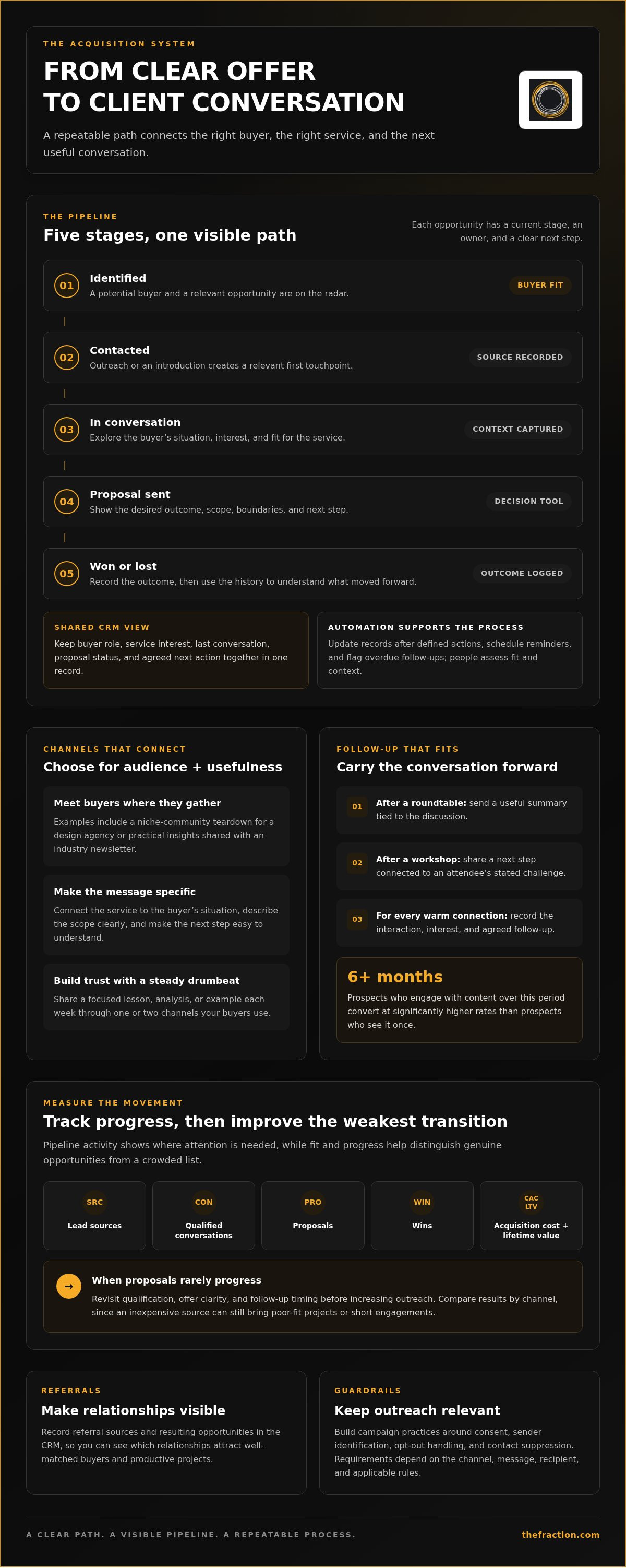
For a clear pipeline view, name stages that reflect how your agency sells, such as identified, contacted, in conversation, proposal sent, and won or lost. Assign every active opportunity an owner and next step, so stalled projects stay visible. Automation can update records after defined actions, schedule reminders, and flag overdue follow-ups, while people assess fit and context.
Centralize records in a customer relationship management system, or CRM, rather than splitting details across inboxes, spreadsheets, and private notes. One CRM record, for example, can bring together a buyer’s role, service interest, last conversation, proposal status, and agreed next action. This shared view makes it easier to see whether opportunities are progressing or merely accumulating, and to compare pipeline activity over time.
Measure how prospects move through the process, not just final revenue, to identify where attention is needed. Track lead sources, qualified conversations, proposals, and where decisions pause. Then examine the weakest transition and adjust one part of the process. If proposals rarely progress, revisit qualification, offer clarity, and follow-up timing before increasing outreach.
Referral-dependent pipelines need the same visibility as inbound or outbound activity, because a relationship can be a valuable source of opportunity. Industry benchmark data shows that partner referrals account for a substantial share of closed revenue relative to raw pipeline volume, so record referral sources and resulting opportunities in your CRM. That history can show which relationships attract well-matched buyers and lead to productive projects.
In the United States, email and telemarketing outreach can involve different federal and state rules, depending on the channel, message, and recipient. Build campaign practices around consent, sender identification, opt-out handling, and contact suppression. The relevant obligations depend on those details.
Common acquisition risks include counting unqualified leads as pipeline, relying on one referral source, and automating follow-ups without checking relevance. Track fit and progress alongside volume, so your dashboard reflects genuine buying opportunities rather than a crowded list.
2. What unconventional customer acquisition channels should I consider?
Look beyond familiar social posts and cold emails. Your buyers may gather in places that feel more like conversations than sales channels. A productized design agency could host a short teardown for a niche business community, while an analytics firm might share practical insights with an industry newsletter. The channel works when it connects a specific audience with a useful reason to talk.
Shape the message around the buyer’s situation, since one broad pitch can blur the value for different prospects. A healthcare organization may care about clearer patient communication, while a software company may focus on launching products faster. Describe the value in each group’s language, and make the service scope and next step easy to understand.
Trust builds through useful contributions over time, more like a steady drumbeat than a one-time announcement. Share a focused lesson, analysis, or example each week through one or two channels your buyers use, and follow up with context tied to what someone engaged with. Prospects who engage with content over 6+ months convert at significantly higher rates than prospects who see it once, so consistency gives familiarity room to grow.
Follow-up feels natural when it adds something relevant to the conversation. After a roundtable, send a useful summary; after a workshop, share a next step connected to an attendee’s stated challenge. Record the interaction, the buyer’s interest, and the agreed follow-up, so a warm connection doesn’t disappear into an inbox.
For acquisition KPIs, track qualified conversations, proposals, wins, customer acquisition cost (CAC), and lifetime value (LTV). Together, these show both the effort involved and the quality of incoming work. Compare results by channel, since an inexpensive source can still bring poor-fit projects or short engagements.
Treat a proposal as a decision tool, not a service catalog. Start with the buyer’s desired outcome, clarify the work and boundaries, then explain how progress will be reviewed and what happens next. Consider contract value alongside the effort needed to deliver and retain the account. To assess campaign ROI, compare attributable revenue with campaign spend, then consider whether the resulting work fits your delivery capacity.
When interest comes in but prospects struggle to see why your service fits, sharpen the offer before adding more tactics. A clearer value proposition gives introductions, events, and follow-ups one coherent story; if that’s the sticking point, explore how to sharpen your offer and service.
3. Inbound marketing versus outbound prospecting
Inbound and outbound create different routes to the same buying conversation. Inbound earns attention through useful content, search visibility, events, or partnerships; outbound starts conversations with prospects who fit a defined profile. A boutique agency can combine them, giving each channel a distinct role and a way to deliver value.
Inbound works like a well-placed signpost: a founder shares expertise, and buyers with a relevant problem find it. A focused article, practical guide, or case study can describe the challenge and explain the agency’s approach. This route builds trust before a sales conversation, though its pace depends on whether the audience finds and engages with the material.
Outbound gives the agency more control over whom it approaches. First, define a narrow buyer profile by industry, business situation, and service need. Research relevant prospects, identify a specific challenge, and write a message that connects it to a useful next conversation. A generic pitch describes the agency; a personalized message explains why this prospect might care.
LinkedIn can support personalized outbound when the agency warms up its presence, engages with relevant posts, and sends context-specific messages. A Salesbread survey also reported positive reply rates above 48% for some documented campaigns combining profile warm-ups, engagement, and personalized messaging. Those figures describe reported campaign results, not a target every agency should assume.
Multichannel outbound can combine LinkedIn with email, thoughtful event follow-up, or a partner introduction. The aim is a coherent message, not repeated copies of the same pitch. Focus on accounts where your service fits, and coordinate each contact around one relevant business issue.
Use your CRM to record each prospect’s source, message, response, and next step. Compare qualified conversations and progressing opportunities across inbound, outbound, and partnerships. Adjust the channel mix based on fit and movement, not surface-level activity alone. If outbound brings replies but few serious discussions, refine targeting or the reason for reaching out before increasing volume.
A founder-led agency may start with inbound expertise and add selective outbound to reach specific accounts. Keep the offer consistent across both routes while adapting the entry point: content teaches, outreach invites dialogue, and partnerships transfer trust. This lets the channels reinforce one another instead of competing for attention.
4. Referral systems and opportunity creation
Referrals become more predictable when an agency gives relationship-building a clear structure. Treat past clients, complementary firms, and professional communities as distinct sources, since each group understands your work from a different angle. A referral system helps create opportunities consistently rather than waiting for introductions to arrive by chance.
Nielsen found that 84% of people trust word-of-mouth recommendations more than forms of advertising. Referred customers also have 16% higher lifetime value than customers acquired through other channels. Those findings make referrals worth managing as a meaningful business channel, while the quality of each introduction still depends on fit, timing, and the service being recommended.
Start by interviewing 3-5 of your best past clients. Ask what prompted them to hire your agency, which outcome mattered most, and how they would describe the service to a peer. Their language can reveal a sharper value proposition and the situations where your work is easiest to recommend. Record those patterns, then use them to guide conversations with potential partners.
Make referral requests specific and easy to act on. Instead of asking a satisfied client to “send anyone,” describe the business problem you solve and the organizations that benefit. For example, a productized brand agency might ask for introductions to growing firms preparing a new offer. A precise request gives the referrer a useful prompt.
Schedule requests around business reviews or project wrap-ups, when clients can reflect on progress and the working relationship. Briefly summarize the outcomes, then ask whether a peer faces a similar challenge. Follow up with thanks and a clear next step, so the introduction feels valued rather than transactional.
Partnerships and outbound outreach can widen your referral network. Identify complementary professionals who reach the same buyers, then suggest a useful exchange, such as a joint discussion or relevant introduction. Boutique agencies can generate leads through referrals, partnerships, and outbound outreach by making focused requests, nurturing relationships, and contacting well-matched prospects with a clear reason to connect.
Use a shared CRM or another central platform to record the referral source, introduction date, fit, and follow-up. Review the activity regularly: which relationships create qualified conversations, which introductions progress, and where visibility fades. These records protect warm opportunities from slipping through the cracks and show where personal follow-up could move a conversation forward.
Keep the process human. When a client introduces you to a colleague, respond promptly, mention the shared context, and ask about the colleague’s priorities before describing your service. A thoughtful first exchange builds trust with both people and gives the referral a stronger chance of becoming a genuine opportunity.
5. Building a repeatable agency acquisition system
A repeatable system turns business development from a last-minute scramble into a weekly operating rhythm. Start by choosing one ideal client profile, one clear offer, and a small set of acquisition channels. Then assign each activity an owner and place it on the calendar. A boutique agency can reserve 5-8 hours weekly for business development, protecting that time even when delivery work gets busy.
Give the week a practical shape. Set aside 2-3 hours for strategic conversations and 2-3 hours for creating or sharing useful content. Publish at least one valuable post or article weekly on a chosen channel, and keep a focused list of 10-20 ideal-fit companies. That combination gives outreach a clear audience while useful content supports trust between conversations.
Build one workflow from first contact through proposal and follow-up. For each prospect, record the source, fit, last interaction, next action, and decision stage in your CRM. Define what qualifies a conversation, such as a relevant business need, an involved decision-maker, and a service that matches your delivery capability. A consistent definition helps the team compare opportunities instead of counting every reply as progress.
Track movement through the workflow. Review qualified conversations, proposals sent, decisions reached, and the stage where opportunities slow down. If outreach brings replies but few qualified discussions, refine the target profile or opening message. If conversations progress but proposals stall, revisit how the proposal describes outcomes, scope, and pricing. Reassess pricing annually to keep the offer aligned with delivery effort and client value.
Add automation only after the workflow works manually. Use it to organize prospect records, prompt follow-ups, and support consistent outreach, while relying on personal judgment for qualification and proposal discussions. Fix the weakest transition first instead of adding another channel to an already crowded process.
Consistency creates the learning loop. Review activity weekly, identify which source produces qualified conversations, and update the next week’s actions accordingly. A predictable acquisition system usually develops through 90-120 days of sustained effort; consistent implementation can increase prospect conversations within 4-6 weeks. Treat those periods as process guidance, then use your own CRM activity to see what is working for your agency.
A client acquisition system for boutique agencies grows stronger when you document what works, repeat the right actions, and improve one bottleneck at a time. This discipline builds expertise over time, rather than trying to perfect every channel at once.
The Fraction: Automated & AI lead generation systems
The Fraction helps agencies strengthen the path from a compelling offer to qualified client conversations. Its automated, AI-driven lead generation systems support consistent outreach, while a sales process that doesn’t feel like selling gives prospects a more natural way to explore fit. The focus is the system behind acquisition: connect a clear service with the right audience, then create a practical route to a conversation.
This can be a useful next step when your offer is defined but lead generation feels inconsistent or outreach takes too much manual effort. If prospects also struggle to see why your service matters, refining the offer and acquisition process together can make your next move clearer.
Contact The Fraction to discuss your agency’s acquisition goals.
Make your next acquisition move deliberate
Growth comes from treating acquisition as part of how your agency operates, not as a task squeezed between client projects. A client acquisition system for boutique agencies should fit your capacity, reflect the work you want to deliver, and help you learn from each conversation. That’s how you build momentum without making business development feel like a second full-time job.
Choose your next improvement by identifying where prospects lose clarity or stop moving forward. Your offer may need sharper positioning, or your outreach may need a more natural path into conversation. Start there, then give the change consistent attention so you can learn from the results. Small, deliberate adjustments build a stronger foundation for the decisions that follow.
If you’re ready to shape that foundation around your agency, The Fraction can help you determine the next step.
Your agency has valuable work to bring to the right clients. Build the system that helps them find it.
Frequently Asked Questions
What is client acquisition for productized agencies?
For a productized agency, client acquisition is the process of turning a defined service into a steady flow of suitable projects. Imagine a content agency offering a fixed-scope launch package: acquisition covers how a prospect discovers the package, understands its value, and decides whether it fits. The system also helps the agency learn which buyers benefit most, improving its positioning and sales conversations over time.
What unconventional customer acquisition channels should I consider?
Consider channels that put your expertise in front of a concentrated audience, such as guest workshops for professional communities, partner-led webinars, niche podcasts, or useful contributions to industry newsletters. A cybersecurity agency, for example, could teach a short session for a software founders’ group. Choose a channel where you can offer practical value, then follow up with attendees who show a relevant need instead of collecting contacts without a clear next step.
Which client acquisition channels work best for boutique agencies?
The best channels reach your ideal buyers and create qualified conversations without disrupting delivery. A specialist agency might rely on referrals for warm introductions, publish expertise to build visibility, and use targeted outreach to approach selected accounts. Compare channels by fit, sales progress, and the work required to maintain them. A smaller, well-managed mix is often easier to improve than a scattered presence across every platform.
How should boutique agencies define their ideal client profile and niche?
Define your ideal client profile by describing organizations with a costly problem your agency can solve and the conditions that support successful delivery. Include industry, company situation, buyer role, urgency, and access to decision-makers. Then look for patterns in past projects: which clients valued the work, made decisions clearly, and achieved the intended outcome? Use those patterns to shape a niche and test whether your offer resonates with real prospects.
What are the steps to build a repeatable agency sales pipeline?
Build the pipeline by choosing a target buyer, defining a relevant offer, selecting a manageable acquisition channel, and recording each opportunity’s stage and next action. Set a clear qualification rule before outreach, so the team can distinguish genuine opportunities from casual interest. After every sales conversation, document the buyer’s need, decision process, and follow-up date. Review stalled opportunities regularly and improve the specific handoff or message causing friction.
What CRM and sales automation tools suit small boutique agencies, and what do they cost?
A small agency usually needs a CRM that centralizes contacts, deal stages, reminders, and basic reporting, with automation for repeatable administrative tasks. Start with the simplest setup that supports your current sales process, then add integrations when they address a real workflow problem. Software costs vary with factors such as user seats, contact limits, automation features, and integrations. Compare the full plan and setup needs before choosing.
How much should a boutique agency budget for client acquisition?
Set a budget by identifying the people, tools, content, events, and outreach activities needed to reach qualified buyers, then compare that investment with client lifetime value. Use the relationship as a planning reference, not a fixed rule: delivery margin, retention, sales cycle, and the quality of acquired projects all affect what your agency can sustain.
Which client acquisition metrics should agencies track, and what are typical benchmarks?
Track qualified conversations, proposal progression, new-client wins, acquisition cost, and lifetime value, then compare results by channel. The 2024 Ebsta and Pavilion report found partner referrals account for 10% of pipeline and 31% of revenue, offering a reference point for referral contribution. Treat benchmarks as context rather than a universal target, because niche, offer, deal size, and buying process shape what healthy performance looks like for each agency.


