

A steady pipeline starts with making your firm’s value visible and giving the right prospects a clear reason to talk. Client acquisition for architecture firms works best as a connected system: compelling project showcases, relevant outreach, strategic partnerships, clear positioning, and client stories that reinforce one another.
Referrals matter, but become more dependable when your broader presence helps prospective clients understand what you do, whom you serve, and what distinguishes your approach. Treat each project story as a doorway into your work, helping potential clients picture the design, collaboration, and outcome before they reach out.
Learn how to make your portfolio more persuasive, tailor outreach to the people and projects you want to attract, build useful partnerships, sharpen your positioning, and turn client experiences into stories that build trust. Together, these steps create a clearer path from discovery to consideration, and from an initial conversation to a well-matched project.
Key Takeaways
- Shape your portfolio around the projects and expertise you want to be hired for, so prospective clients can quickly see the fit.
- Turn networking into meaningful follow-up by tailoring outreach to each contact’s interests and conversation.
- Build partnerships with complementary professionals by clarifying how collaboration can create value for shared clients.
- Make your firm’s point of difference specific and easy to understand, so clients can compare your expertise beyond price alone.
- Use client stories to show how your process addressed a real project challenge and what the collaboration delivered.
1. Digital presence and project showcases
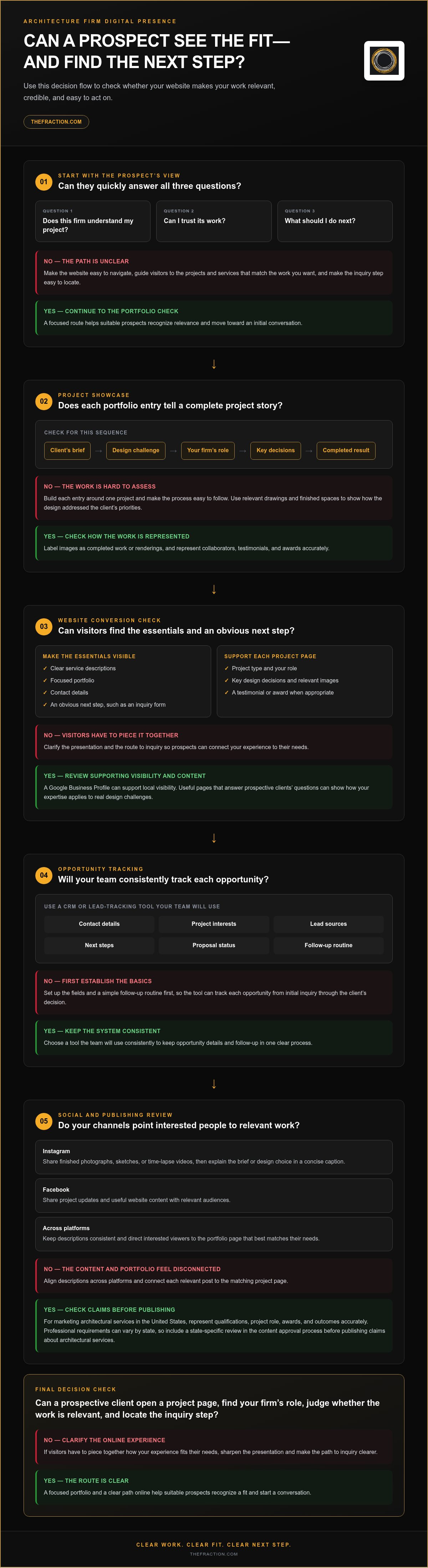
Your digital presence should quickly answer three questions for prospective clients: Does this firm understand my project? Can I trust its work? What should I do next? Make the website easy to navigate, guiding visitors to the projects and services that match the work you want, rather than leaving them to browse an unstructured gallery.
Build each portfolio entry around one project and a simple sequence: the client’s brief, the design challenge, your firm’s role, key decisions, and the completed result. A residential renovation, for example, could show how the design addressed the owners’ priorities, using drawings and finished spaces to make the process easy to follow. Label images as completed work or renderings, and represent collaborators, testimonials, and awards accurately.
Choose a CRM or lead-tracking tool your team will use consistently. Record contact details, project interests, lead sources, next steps, and proposal status. Set up these fields and a simple follow-up routine first, so the tool tracks each opportunity from initial inquiry through the client’s decision.
Help your website convert prospects with clear service descriptions, a focused portfolio, contact details, and an obvious next step, such as an inquiry form. On each project page, explain the project type, your role, and key design decisions, supported by relevant images. Add a testimonial or award when appropriate. A Google Business Profile can support local visibility, while useful pages that answer prospective clients’ questions demonstrate how your expertise applies to real design challenges.
Social media gives each project another way to introduce your work. On Instagram, share finished photographs, sketches, or time-lapse videos, then explain the brief or design choice in a concise caption. Use Facebook to share project updates and useful website content with relevant audiences. Keep descriptions consistent across platforms, and direct interested viewers to the portfolio page that best matches their needs.
When marketing architecture services in the United States, represent your qualifications, project role, awards, and outcomes accurately. Professional requirements can vary by state, so include a state-specific review in your content approval process before publishing claims about architectural services.
Set your marketing and business-development budget according to your growth priorities, available capacity, and the channels your team can manage consistently. The right investment depends on the activities you pursue and the time and resources needed to follow up on the inquiries they generate.
Review the digital experience as a prospective client would: open a project page, find your firm’s role, assess whether the work is relevant, and locate the inquiry step. If visitors have to piece together how your experience fits their needs, clarify the presentation. A focused portfolio and a clear path online help suitable prospects recognize a fit and start a conversation.
2. Industry networking and personalized outreach
A professional network can open doors, but relying on familiar contacts alone can narrow the opportunities ahead. Think of networking as cultivating a garden: the strongest relationships grow through useful conversations and consistent care, not a single introduction. Start by defining the clients, project types, and locations your firm wants to serve, then look for where those people exchange ideas, such as industry events, architectural associations, or local community projects. That focus turns a busy calendar into a deliberate business-development practice.
Before an event, set a useful goal, such as meeting developers working on adaptive reuse or learning about upcoming community projects. Prepare a concise introduction that explains your firm’s work and the problems it solves. Ask contacts about their priorities, and listen for details that can shape a thoughtful follow-up. If someone describes a difficult renovation, for example, you can later share a relevant project example.
After the event, send a personal email that picks up the conversation. Mention what you discussed, connect it to a useful insight, and suggest an easy next step, such as continuing the discussion on a call. A note like, “Your comments about coordinating renovation phases stayed with me,” feels more genuine than a generic message about keeping in touch. If you promised a drawing, article, or project example, include it. Keeping your word offers a small, tangible glimpse of how your firm works.
Group contacts by project interest so you can share examples that fit their priorities. A developer exploring mixed-use work may value a different example from a homeowner planning an addition. Keep a simple record of each person’s role, interests, last conversation, and agreed follow-up. Use those details to choose one relevant resource before sending a message. This keeps outreach personal and helps you spot relationships that could lead to project opportunities.
Networking also grows through contribution. Join an architectural association, take part in a design discussion, or support a community project where your expertise can help solve a real problem. Regular participation lets potential collaborators see your judgment and working style. Build connections with complementary professionals, including contractors, engineers, interior designers, and property professionals, while keeping client needs at the center. Referrals are more useful when people understand which projects suit your firm and why.
Review your outreach regularly: note which events led to meaningful conversations, which messages received replies, and which relationships call for a thoughtful next step. If networking creates conversations but your firm struggles to explain its value, refine the offer those conversations lead toward. A clearer compelling service offer can make it easier for prospective clients to understand what working with your firm could involve.
3. Partnerships with designers and real estate agents
A strong partnership gives clients a connected path from property decisions to design decisions. Interior designers, real estate agents, contractors, and architects often meet clients at different stages, so clarify how your expertise complements theirs. For example, an agent may spot renovation potential during a property search, while an architect can help assess how the client’s goals could shape the project. Partnerships work best when each professional understands the other’s role and makes introductions that serve the client.
Choose partners whose clients and project needs align with your practice. A firm focused on custom homes might connect with agents representing buyers interested in older properties. A workplace design practice could build relationships with commercial brokers and interior designers. Write down your ideal project profile, then identify professionals who encounter those needs regularly. This keeps outreach focused and helps both sides explain which opportunities make sense.
Make the first conversation collaborative, not transactional. Ask a designer which project challenges tend to arise before their work begins, then explain where architectural input could help. Ask a real estate agent what questions buyers raise about renovations, additions, or site possibilities. These discussions reveal where your knowledge is useful and give you a grounded way to describe a potential referral relationship without promising outcomes neither professional controls.
Agree on a simple handoff process before introducing clients. Decide what information the client has approved for sharing, who will make the introduction, and how the professionals will follow up. For example, an agent can introduce a buyer to an architect after the buyer expresses interest in evaluating a property’s design potential. The architect can then discuss the project directly with the client, while keeping the agent informed only with the client’s permission.
Make collaboration visible through practical, shared activities. Host a discussion about planning a renovation, contribute design insight to a property event, or create a short guide with a designer on coordinating early project decisions. Each activity should answer a real client question. A useful session might explain when an owner should involve an architect in a property discussion, and how design goals, budget priorities, and practical constraints shape the next steps.
Partnerships need ongoing care, much like a coordinated project team. After an introduction, thank the referring professional, share an appropriate update with the client’s consent, and follow through on agreed actions. Check in periodically with a useful example or question instead of repeatedly asking for referrals. Track which relationships lead to relevant conversations and where handoffs cause confusion, then improve the process together.
Effective partnerships depend on clear expectations, reliable communication, and complementary expertise. Respect designers and real estate agents as professionals with their own client responsibilities, and keep the shared goal in view: helping people make informed property or project decisions. When everyone understands the right moment to involve one another, collaboration feels seamless to clients and creates better-qualified opportunities for your firm.
4. Brand differentiation and unique selling propositions
Clear positioning helps prospective clients see why your architecture firm fits their project. Without it, your practice can blend into a crowded field of polished portfolios and similar service descriptions. Identify the clients and projects that best match your expertise. For example, a practice might focus on adaptive reuse for community organizations or custom homes on challenging sites. A specific focus gives people a stronger reason to remember you.
Build your unique selling proposition around three points: whom you serve, what challenge you address, and how your approach helps. A residential firm could say, “We guide owners of older homes through thoughtful, phased renovations.” This identifies an audience, a project challenge, and a service approach. Use plain language that a prospective client can repeat after one conversation. Strong positioning explains what you do and why clients should consider your firm.
Back up each claim with evidence from your work. If you emphasize renovation expertise, show a project where existing conditions shaped the design decisions. Explain the challenge, your role, and the choices that made the work possible. If collaboration defines your approach, describe how your team coordinated with a contractor or interior designer. Specific proof gives your message substance and helps prospects connect your expertise to real projects.
Test your message with people who understand your target market. Ask a past client, referral partner, or colleague to read your homepage and describe the projects they think you handle. If their answers vary widely, refine the wording and examples. A marketing audit can review your positioning across your website, proposals, and social media. Compare each platform with the same central promise, then close any gaps.
Use social media to reinforce what makes your firm different, rather than posting attractive images without context. If your firm specializes in compact urban homes, pair a project image with a short explanation of how daylight, storage, or circulation shaped the design. On Instagram, connect a visual detail to the client’s original challenge. On LinkedIn, reflect on a project for developers or professional collaborators. Each post should make your expertise easier to recognize.
Keep your positioning relevant to the clients you want, and review it as your project mix changes. If your firm wants more institutional work, feature the relevant expertise and explain how your process responds to stakeholder needs. If you seek residential additions, prioritize examples showing how your team handled existing buildings and household priorities. Consistency across proposals and conversations helps prospects understand your value before comparing firms on price alone.
Start your review with one question: What should the right client remember after encountering your firm? Write a concise answer, then check your project descriptions, service pages, and proposals against it. Remove broad claims any practice could make and replace them with concrete examples from your work. A distinctive position acts like a compass, guiding your communications toward clients and opportunities your firm is equipped to serve.
5. Case studies and client success stories
Common acquisition mistakes include relying only on referrals, sending generic proposals, and showing attractive images without explaining the work behind them. These habits make it harder for prospects to assess fit, compare your expertise, and understand the project’s value.
A strong case study is like a guided site visit: it shows the client’s starting point, the design decisions, and the finished outcome. Build each story around one project and a central challenge, such as adapting an older building for a new use or improving daylight in a compact home. This gives readers a clear narrative instead of a gallery without context.
Use a consistent sequence: describe the client’s goals, explain the constraints, outline your role, show key decisions, and present the completed work. For a renovation, explain how the existing structure shaped the design response. For a community project, show how stakeholder needs informed the planning. Protect the client’s identity unless they have approved attribution, and get permission before sharing project photographs or quotations.
Include evidence that helps prospective clients understand the project. A testimonial can describe the collaboration, while project details demonstrate your expertise. Explain what changed and why, using specifics such as the design approach, materials, or project phases. Avoid suggesting every project will have the same result. The goal is to make your process visible and your positioning credible.
Business-development examples also show why process deserves attention. HDG Architecture reduced administrative time by 25% after implementing firm-wide business-development tracking. Workshop/APD achieved 50% profit growth after establishing systematic business-development processes throughout its team. These examples concern business development, so use them as context for documenting how work is pursued, rather than as promises about architectural project outcomes.
Adapt each case study for different audiences. A short project summary can support a proposal, while a more detailed version can help a prospective client understand your approach. A social post might focus on one design decision; a meeting presentation can tell the full project story. Keep the facts consistent across formats, and choose examples that match the projects your firm wants to attract.
Track whether case studies help prospects take the next step. Note which examples prompt relevant questions, come up in client conversations, or support a proposal discussion. If prospects repeatedly ask about the same challenge, develop a case study that addresses it directly. Over time, these stories document your firm’s judgment, collaboration, and design approach, helping potential clients connect your experience to their own ambitions.
The Fraction: Automated & AI lead generation systems
The Fraction helps architecture firms build a more consistent path from prospective interest to client conversations with automated and AI-powered lead generation systems. If your team has strong work to showcase but needs a clearer way to attract and follow up with potential clients, these systems can support a more organized acquisition process.
The Fraction also helps develop compelling offers and a sales process that doesn’t feel like selling. That way, conversations can focus on the project’s needs, your expertise, and whether there’s a good fit. This is a practical next step when your firm is ready to turn its positioning and outreach into a repeatable business-development approach.
To discuss strengthening your client acquisition approach, contact The Fraction.
Build a pipeline your firm can sustain
Choose one improvement your team can put into practice now, then make it part of how the firm works. For example, review recent inquiries and identify where promising prospects stopped moving forward. That point may reveal a gap in follow-up, your offer, or the way your firm explains its value.
Treat client acquisition for architecture firms as an ongoing business discipline, not a burst of activity between projects. Assign clear ownership for each next step, track what prospective clients respond to, and refine your approach as you learn. A steady system gives your expertise more chances to reach the right people while keeping your team focused on delivering excellent work.
If you’re ready to make that system more deliberate, The Fraction can help you develop a compelling offer and a sales process that feels natural to your firm.
Your firm has valuable expertise to bring to the right projects. Give that expertise a clear path to the clients who need it.
Frequently Asked Questions
What are the most effective client acquisition strategies for architecture firms?
The most effective approach combines clear positioning with a reliable way to qualify and follow up with prospective clients. For client acquisition for architecture firms, define which project types fit your expertise, then create a simple intake process that asks about scope, decision-makers, timing, and goals. Reviewing these details helps your team prioritize promising inquiries and shape an initial conversation around the prospect’s needs.
How do architecture firms generate leads through referrals, networking, and partnerships?
Make referrals easier by giving former clients and professional contacts a clear picture of the projects your firm wants. After a successful project closeout, ask for feedback and whether they would feel comfortable introducing you to someone with a similar need. For a referral from a contractor or designer, agree on an introduction the client approves and follow through promptly, so each partner knows what happened after the handoff.
How can architecture firms use SEO, content marketing, and social media to attract clients?
Connect each channel to a specific prospect question. Create a website article explaining a project decision, optimize its title and headings around the service and client need, then share a concise takeaway on social media. For example, a post about planning an addition can direct readers to a fuller explanation of the design process. Track which pages lead to relevant inquiries, then create more content around those topics.
What professional rules and advertising regulations apply to marketing architecture services in the United States?
Represent your qualifications, project role, awards, and outcomes accurately. Professional requirements can vary by state, so include a state-specific review in your content approval process before publishing claims about architectural services.
How do client acquisition strategies differ for residential, commercial, and public-sector architecture projects?
Tailor outreach and project examples to the client’s needs: homeowners planning an addition may value residential renovation examples, while commercial clients may be interested in workplace or mixed-use projects. The material does not provide a specific strategy for public-sector projects.


