

More automated leads only help when the right prospects rise to the top…so, how do you improve lead quality from automation? It comes down to connecting three parts of the system, like gears that need to turn together: scoring that reflects buyer fit and intent, nurturing that responds to where a prospect is in the decision process, and content that answers the questions buyers actually have.
It makes sense to start with lead scoring, because a clear threshold gives marketing and sales a shared way to decide which leads need a conversation and which need more time… but a score’s only one part of the system. If nurturing and content keep sending the same message to every prospect, automation can still overlook the people most likely to become clients.
So this guide explains how to build lead scoring around fit, engagement, recency, and negative signals, then line up nurture paths and content with buyer needs. You’ll also learn how to refine lead-generation tactics based on the quality of the leads they produce, so the whole process can support a stronger, more dependable pipeline.
Key Takeaways
- Coordinate lead scores with nurture paths, so prospects get the right next step as their readiness changes.
- Align sales and marketing on shared qualification rules and clear handoff points, so everyone's following the same map.
- Use account fit and prospect behavior together to see which leads show promise beyond activity alone.
- Match content to buyer needs and funnel stage, giving prospects useful answers as they weigh their options.
- Review lead quality across sources, then refine campaigns, forms, and routing based on how leads move through the pipeline.
1. Should you score and nurture leads together?
Yes…scoring and nurturing work best as two connected parts of one process, like a signal and the response it sets in motion: a score helps you decide what happens next, while a nurture sequence keeps the conversation relevant until a prospect’s ready to discuss a purchase. A high-intent action can prompt a timely sales handoff, while early research can point them toward useful information instead.
Build the sequence around the buyer’s journey, then decide what moves a lead from one path to another. Someone exploring a problem may need an educational guide; a prospect comparing approaches may need a clear explanation of your process; and someone evaluating a specific offer may need evidence that speaks to their concerns. Map those stages to the actions prospects take, like viewing a service page or requesting details, so each action works like a signpost for what comes next.
Segmentation makes each message feel more relevant. Group leads by meaningful differences, such as role, business need, source, or expressed intent, then connect each group with content that answers its questions. For example, a decision-maker looking for a better client-acquisition process could receive guidance on qualification and follow-up, while someone still defining the problem gets content that helps them see the possible approaches more clearly.
Give every nurture message a clear purpose, so a case example, process explanation, or response to a common objection can help a prospect assess fit without turning every email into a sales pitch. Match the evidence to the segment: a buyer concerned about implementation needs a different explanation from one comparing service outcomes, and that way the sequence stays focused on the buying decision.
Personalization means more than adding a first name…use a prospect’s relevant actions and stated needs to shape the next message, and stop sending content that no longer fits their stage. For instance, after a prospect requests information about an offer, address that request rather than sending them back to broad introductory material. Each touchpoint should feel like the next step in one conversation, not a fresh conversation starting from scratch.
Set clear rules for moving leads between nurture and sales. A relevant purchase signal can raise a lead’s priority and prompt a handoff; someone engaging with educational content can keep receiving guidance suited to their stage. Marketing and sales should agree on these transitions, including what information goes with a handoff and when a lead returns to nurture, so shared rules prevent conflicting messages and make follow-up more useful.
To improve lead quality from automation, look at the fit and progress of the leads a sequence produces, rather than just message activity. Compare outcomes across sources and segments, then refine content, timing, or handoff rules where prospects stall. Scoring spots the signal; nurturing gives it a relevant next step in the buying process.
2. How does a professional set up lead scoring in a marketing automation platform?
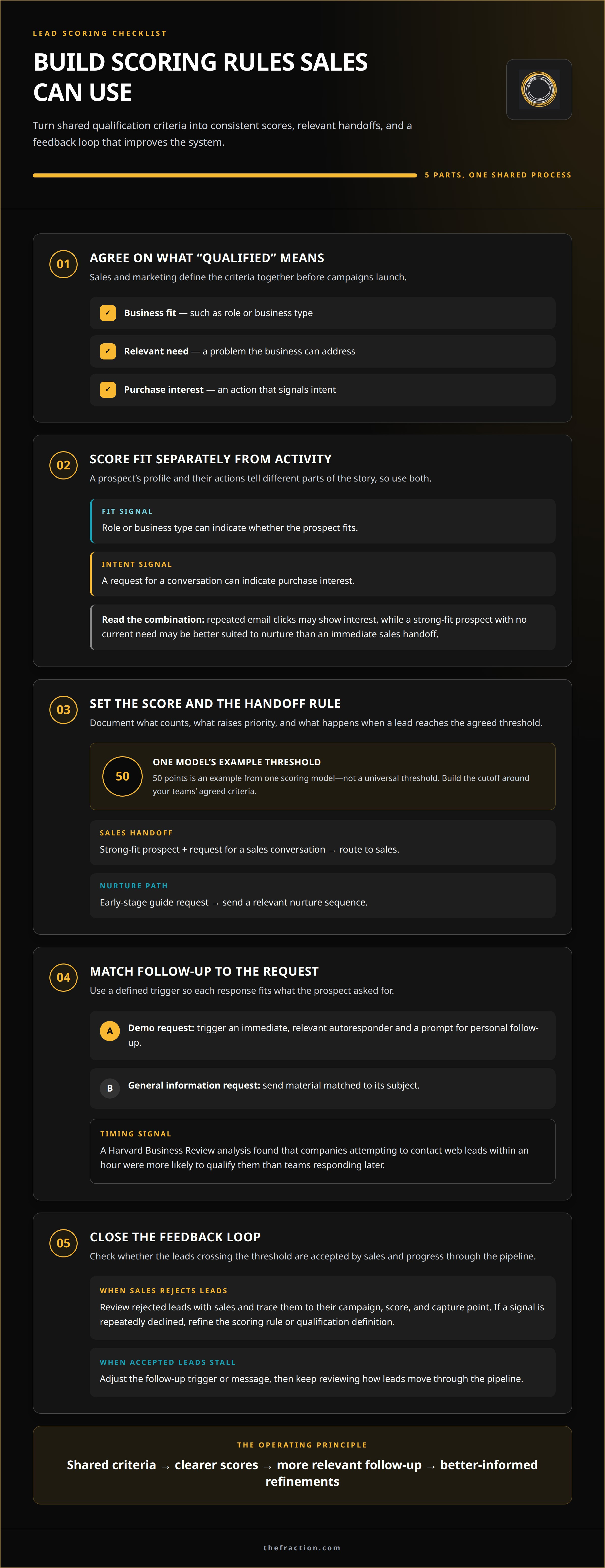
Start by agreeing with sales on what a qualified prospect looks like, then translate that definition into fields and scoring rules. For example, the teams might define a sales-qualified lead through a combination of business fit, a relevant need, and an action that shows purchase interest. Marketing automation can capture those signals consistently instead of treating every form submission as equally ready.
Next, separate qualification from activity. A prospect’s role or business type can indicate fit, while a request for a conversation can indicate intent. Either signal on its own can mislead: repeated email clicks may show interest, but a strong-fit prospect with no current need may be better suited to nurture than an immediate sales handoff.
Sales and marketing should document their criteria together before campaigns launch. Agree on which details count toward qualification, which actions raise priority, and what happens when a lead meets the threshold. For example, route a strong-fit prospect who requests a sales conversation directly to sales, while sending an early-stage guide request into a relevant nurture sequence.
Thresholds turn those shared criteria into a practical handoff rule. One example scoring model sets 50 points as its sales-qualified-lead threshold, but that figure belongs to the model, not every business. A professional builds the threshold around the agreed criteria, then checks whether the leads crossing it receive acceptance from sales and progress through the pipeline.
Timely follow-up also needs a defined trigger. A Harvard Business Review analysis found that companies attempting to contact web leads within an hour were more likely to qualify them than teams responding later. In the platform, a demo request could trigger an immediate, relevant autoresponder and a prompt for personal follow-up, while a general information request receives material matched to its subject.
Common lead automation mistakes include scoring every click equally, using thresholds sales hasn’t agreed to, and sending the same autoresponder after every form submission. These choices can misread intent, create poor handoffs, and leave prospects with content that ignores their request.
Finally, review rejected leads with sales and trace them back to their campaign, score, and capture point. If sales repeatedly declines leads with a particular signal, refine the scoring rule or qualification definition. If accepted leads stall after handoff, adjust the follow-up trigger or message. This feedback loop makes the platform’s rules more useful over time by connecting marketing activity to sales outcomes.
For a lead-generation system built around clearer qualification and follow-up, explore this automated lead-generation approach.
3. Lead and account scoring using fit and behavior
Reliable scoring combines who a prospect is with what they do. Firmographic fit can include industry, company size, location, and job title, while engagement reflects actions such as viewing service pages or returning to a pricing page. A single click is a weak signal; repeated, recent activity from a decision-maker at a target account carries more context.
Which lead qualification criteria best predict conversion? The strongest criteria combine clear fit with relevant intent and timing. For example, a decision-maker from a target industry who requests a consultation shows a stronger buying signal than an unrelated visitor who downloads a general guide.
Distinguish explicit data from implicit data. Explicit information comes directly from a prospect, such as their role, company, or stated need. Implicit information comes from observed behavior, such as repeat visits or campaign engagement. Combining both helps prevent a polished form submission from outweighing evidence of actual interest and gives teams a fuller view of each segment.
Account scoring adds another layer. Several people from one organization may engage separately, so assess the account’s combined fit and activity alongside each lead’s individual signals. For instance, several relevant stakeholders viewing product information may indicate broader buying interest, even if no single contact has reached the handoff threshold.
Which lead scoring models are best, rule-based or predictive? Rule-based scoring is easier to explain because teams can see how each criterion affects the score. Predictive scoring can help identify patterns across larger sets of records, but its usefulness depends on having suitable data and clear outcome definitions.
How can marketing automation improve lead scoring accuracy? It can standardize incoming fields, combine explicit details with behavioral signals, and apply the same scoring rules across sources. Automated evaluation can also flag data issues that suggest a prospect needs further qualification before sales takes action.
Validation keeps scoring connected to actual results. A professional can start with one model, track and adjust it for 30-60 days, then review it quarterly at minimum. If high-scoring leads repeatedly fail to progress, the team can inspect the signals, source, or account criteria behind those scores and revise the model.
Which metrics measure automated lead quality and sales impact? Track invalid and duplicate rates, sales acceptance, follow-up speed, lead-to-opportunity conversion, and funnel progression by source. Together, these measures show whether scoring identifies quality leads and supports pipeline progression, rather than simply rewarding activity or growing a contact list.
4. Content tailored to buyer personas and funnel stages
Content earns attention when it answers a specific buyer’s question at the right stage. An early-stage prospect needs help naming a problem; someone comparing solutions needs clear distinctions; a buyer assessing an offer needs evidence about the process and expected value. Map each asset to one audience need and one next action.
Start by defining the audience through shared buying characteristics, rather than a broad job title alone. An example ideal customer profile might include companies with 10-100 employees and annual revenue of $2M-$10M. Then identify the decision-maker’s role, business challenge, and reason to act, so each persona reflects a real buying context.
Company size and industry can shape both the problem and the most useful answer. A smaller firm may need guidance on creating a consistent client pipeline with limited internal capacity. A larger organization may need advice on coordinating stakeholders and qualification practices. An industry-specific example makes the same core idea concrete for each segment.
Build a simple content map across the buying journey. At the awareness stage, publish an explainer that helps prospects recognize the cost of inconsistent lead quality. During consideration, offer a process comparison or detailed FAQ. At the decision stage, explain what implementation involves and how the proposed service addresses the buyer’s priorities.
Personalization should change the substance, not just the greeting. For one industry, an email might address a sector-specific objection; for another, it could focus on lead routing or follow-up. Use information the prospect provided and relevant actions they took, then connect each message to a useful landing page.
Coordinate outreach across channels so the buyer hears one coherent story. If a prospect downloads a guide, a follow-up email can answer its central question and point to a related FAQ. A later sales conversation can build on that topic instead of restarting with a generic introduction. Each action should continue the same thread.
Match the content format to the question and next step. A concise checklist can help a prospect assess a process, while a detailed service page can explain an offer’s approach. If someone repeatedly explores implementation details, provide a direct explanation and a suitable way to discuss their needs.
Finally, review engagement and sales feedback by persona, industry, and funnel stage. If one audience downloads introductory material but rarely progresses, the content may attract curiosity without answering a buying question. Refine the message, asset, or next action for that segment, then assess whether the resulting conversations show stronger fit and clearer intent.
5. Adjusting lead-generation tactics
Let lead quality and pipeline progression guide campaign decisions, with lead volume as a supporting signal. Each source opens a different path into the funnel, so review which prospects advance. Paid search may attract buyers with an immediate need, while a broad social campaign may reach early-stage researchers. Comparing these patterns helps tailor each campaign’s audience and next action.
Start the review with campaign-level records and sales feedback. Check which sources produce relevant inquiries, which records support follow-up, and where prospects lose momentum. For example, if a campaign attracts businesses outside the intended market, refine its targeting criteria. If sales conversations reveal an unclear need, make the campaign message more precise about what prospects can expect.
Form questions can also improve the quality of incoming leads. A company name and role can clarify who is making the inquiry, while a question about the prospect’s current challenge can inform routing. Tie each field to a specific decision, then examine whether the answers help sales prioritize conversations and understand the prospect’s situation.
Next, compare campaign behavior with the intended outcome. If a campaign generates guide downloads but few requests for further discussion, its offer may suit early-stage interest better. A landing page focused on a clear business problem can attract more relevant prospects. Adjust targeting, messaging, or the next step to align the funnel with buyer intent.
Strategy shapes results as much as software. 58% of marketers polled said they struggled to succeed with automation tools because of ineffective strategy. A professional can map each campaign from first interaction through follow-up, then identify where the journey loses alignment. Strong initial engagement followed by limited sales progress, for example, may point to a mismatch between the campaign promise and the conversation that follows.
Make changes in a controlled sequence. Refine one campaign element, such as audience criteria, landing-page messaging, or the follow-up action, while tracking the same quality measures. Comparing results across sources and segments helps connect each change to lead progression. This deliberate approach gives every adjustment a clear purpose and informs the next decision.
Finally, use sales feedback to shape future lead-generation tactics. If one source regularly produces prospects outside your service fit, refine its audience criteria. If another brings suitable buyers who need more time, adjust the follow-up path to support their decision. Optimize each campaign for the prospects it can serve well, then refine the funnel around observed buyer behavior.
The Fraction: Automated & AI lead generation systems
The Fraction helps professionals connect lead-generation activity with a clearer path from first interest to client conversation. Its automated and AI-powered lead generation systems support a process built around qualification, relevant follow-up, and the buyers you want to reach, so each activity has a clear place in the journey.
Turn to The Fraction when leads are arriving but scoring, messaging, or handoffs need more deliberate structure. The work can also include shaping a compelling offer and service that wins clients quickly, alongside a sales process that feels like a useful conversation, with each step making it easier for prospects to see the value. Together, these elements give prospects a clearer reason to engage and a more natural next step.
If you’re ready to discuss a lead-generation system for your business, contact The Fraction.
Build a lead system that keeps learning
To improve lead quality from automation, treat the system like a working framework that can evolve as your offer, audience, and sales conversations show you what buyers respond to…because every qualified conversation gives you a sharper view of prospects’ questions, the signals that point to genuine readiness, and the places where the journey could use more clarity.
That keeps automation tied to the real business, so it grows with you instead of turning into a separate machine measured only by activity. As your understanding deepens, use those insights to refine the experience from first contact through the decision to engage, making the process clear and relevant to the people you want to serve.
So here's the move…pick the next decision that would make the path feel more coherent, then build from there with clear intent and a practical definition of quality for your business, like adding the next piece to a map as you learn where buyers actually want to go.
A more deliberate system can give you a stronger foundation for the growth you’re working toward, one thoughtful step at a time.
Frequently Asked Questions
How does a professional set up lead scoring in a marketing automation platform?
Start by mapping your lead fields to the platform’s scoring and routing capabilities, then treat the data like ingredients you’re getting ready for a recipe. A job-title field, for example, may contain several variations for the same role, so tidy those entries up before applying rules. Test a sample of existing records from different sources, checking that scores and routing work as intended when fields are blank, inconsistent, or duplicated.
What is lead quality?
Lead quality describes how well a prospect record helps a business decide what to do next, a bit like having the right map before you set off. A useful record gives the team enough context to understand who the prospect is, what they may need, and how to handle the inquiry. For example, an inquiry with clear business context can help the team prepare a relevant conversation, while a record with little context may need a little more digging first.
How can a lead-generation professional validate your data earlier?
Validate information as soon as a form submission or imported record enters the system, so errors don’t travel downstream like a small leak turning into a bigger mess. Review recurring errors by source, too, then adjust the capture process where those errors begin. For example, if event uploads regularly use inconsistent company names, standardize those values in the import workflow before records reach campaign lists or sales queues.
How does a lead-generation professional decide how many fields your form should have?
Weigh the value of each answer against the effort required from the prospect, like deciding how much luggage you really need for the trip. Most web forms keep things fairly lean, and a focused form might ask for contact details plus one question that changes follow-up. A longer form can suit a detailed inquiry, while an early-stage download may call for fewer questions. Choose a design based on the form’s purpose and the decisions its answers support.
How often should a professional review your lead scoring rules?
Revisit the rules when the business changes its target audience, offer, sales process, or lead sources, because scoring rules are a bit like a map and the route can change. For example, adding a new service may change which company roles indicate a strong fit, while a new campaign could introduce unfamiliar engagement patterns. Review whether existing rules still reflect current sales decisions, and document adjustments so the team understands what changed and why.
Should you score and nurture leads together?
Yes, coordinating nurture and sales communication keeps automated messages aligned with a prospect’s current status, like keeping everyone on the same page of the playbook. Define when nurture messages pause, such as after a prospect books a sales conversation or changes their communication preferences. That way, an automated campaign won’t carry on as if nothing happened, and the team can restart or redirect communication when the prospect’s situation changes.
What should a professional enrich in your lead data, and what should they leave alone?
Add information when it supports a specific decision, such as assigning account ownership or preparing a relevant conversation. For example, a verified company domain may help associate several contacts with the same organization. Data with no clear use in routing, qualification, or follow-up is extra baggage for the team to maintain, so keep records focused and useful.
How does a lead-generation professional define and measure lead quality?
Define lead quality together with the people who handle inquiries, using shared descriptions of fit and readiness that the team can apply consistently, like agreeing on the rules before the game starts. To assess the definition, compare leads from different campaigns and trace what happened after they entered the sales process. Reviewing accepted and declined leads together can expose unclear criteria and sharpen the team’s understanding of a genuinely useful inquiry.


