

As a fractional executive…or a professional thinking about making the jump…AI-generated leads can look like a faster road to your next client, but a fuller pipeline only helps when the right people arrive and understand why they should talk with you. So troubleshooting low-quality leads means tracing the whole route, from who you’re trying to reach to what happens after they respond.
Look, it’s easy to blame the AI first, but lead generation works like a relay…your audience, message, measurement, and follow-up each pass the baton, and one shaky handoff can make the whole effort feel like a dead end.
So here’s what we’ll unpack: signs your audience fit is off, your message is missing the mark, your attribution has gaps, or you and a potential client have different ideas about what makes a lead qualified. We’ll look at the clues that separate a targeting issue from a handoff problem, so you can put your attention where it’ll make the biggest difference instead of rebuilding the whole system.
Key Takeaways
- Read lead quality through the whole funnel: rising lead volume alongside falling sales acceptance can point to a deeper performance gap.
- Assess whether your targeting reaches the roles and accounts that can genuinely benefit, rather than simply expanding the audience.
- Use AI to scale relevant messaging while keeping human judgment in the strategy and personalization that make outreach feel specific.
- Connect attribution and sales feedback so teams can see which sources and handoffs contribute to meaningful pipeline progress.
- Align marketing and sales around a shared definition of a qualified lead, then build follow-up around buyer readiness and intent.
Metrics for diagnosing poor lead-generation performance
Review lead volume, record quality, buyer intent, and sales outcomes together. A high number in one metric can distract from the signal that matters. When troubleshooting low quality AI-generated leads, compare what enters the system with what reaches a relevant sales conversation.
Lead Data Quality and Completeness
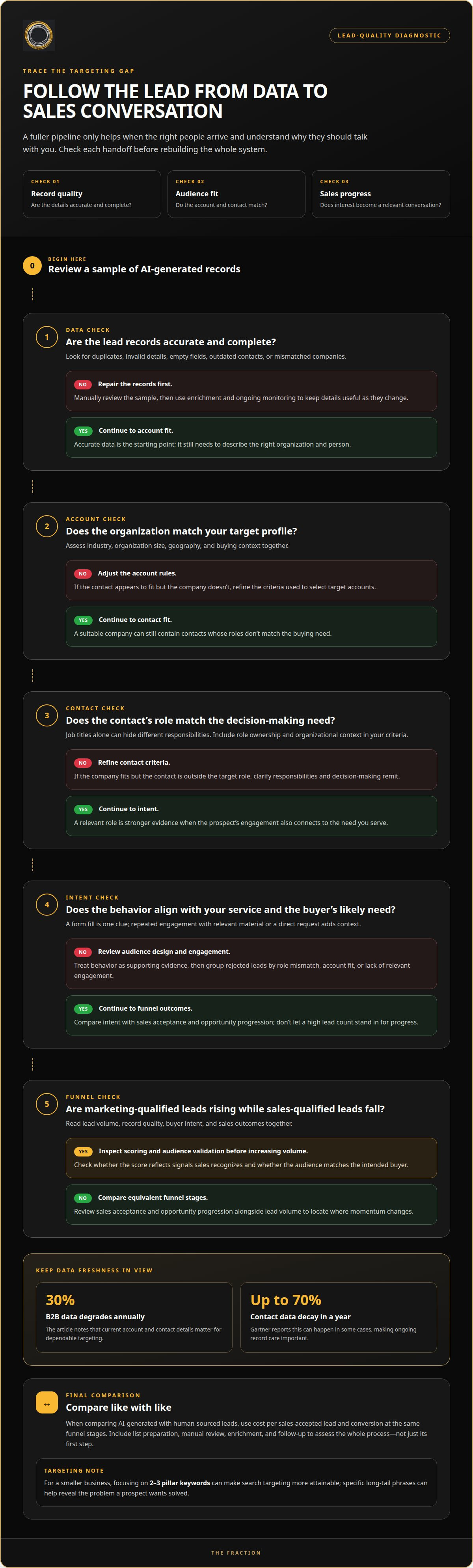
Lead data quality and completeness show whether records contain accurate details for targeting and follow-up. Missing roles, outdated contact information, or mismatched companies can send promising prospects down the wrong path. A manual review of sample records is a useful first check.
Pull a sample of AI-generated records and look for duplicates, invalid details, and empty fields, then compare those problems with sales acceptance. Gartner reports that B2B contact data decay can reach 70% in a year in some cases, so records need ongoing care. Think of data like fresh ingredients: enrichment and monitoring keep it useful as details change. A practical roadmap moves from record accuracy to audience fit, routing, and sales outcomes, which helps you pinpoint the technical snag or process gap. That’s the work of troubleshooting low quality AI-generated leads, following evidence from one stage to another instead of guessing.
Buyer Intent and Lead Quality Signals
Buyer intent signals are behaviors or details suggesting that a prospect has a relevant need and may be considering a decision. A form fill is one clue; repeated engagement with a relevant page or a direct request for information adds context.
Compare those signals with role, account fit, reason for engagement, sales acceptance, and opportunity progression. If marketing-qualified leads rise while sales-qualified leads fall, inspect scoring and audience validation before increasing volume. The score should reflect signals sales recognizes. Follow-up timing can also reveal whether interest received prompt attention.
Cost and Conversion Comparisons
Compare AI-generated and human-sourced leads by calculating cost per sales-accepted lead and conversion at the same funnel stages. Include list preparation, manual review, enrichment, and follow-up to assess the whole process, not just its first step.
A 2024 Adobe survey found that 39% of surveyed business leaders said AI-generated leads converted at a higher rate than leads from traditional methods. Use that finding as context, then compare equivalent audiences, time periods, qualification rules, and conversion definitions in your own reporting. In the United States, privacy and consent requirements depend on data collection, outreach channel, and use. Keep collection notices, consent records, and opt-out handling in view, with qualified legal counsel assessing applicable state and channel-specific obligations.
Misaligned roles and irrelevant targeting
AI lead generation can attract the wrong prospects when its inputs describe broad roles, outdated accounts, or an unclear audience. Automation acts like a spotlight: if the targeting profile points to the wrong people, it magnifies the mismatch.
Clear B2B Targeting Strategy
A B2B targeting strategy spells out which organizations and decision-makers are most likely to need your offer. That clarity gives AI tools a sharper profile to work from, and it helps the system prioritize relevance over raw lead volume. For example, a service for finance leaders needs criteria that separate finance decision-makers from general employees at the same company.
Build that strategy around business need, role, company characteristics, and buying context, then use the same criteria across campaigns and lead scoring. For a smaller business, focusing on 2-3 pillar keywords can make search targeting more attainable, while specific long-tail phrases help reveal the problem a prospect wants solved.
Broad prompts, vague audience definitions, and automation that groups unlike job titles together can misdirect targeting. A director at one company may own purchasing, while a director elsewhere has a different remit. Add responsibilities and organizational context to your criteria, then use sales feedback to identify recurring mismatches.
Target Account Fit and Data Accuracy
Target account fit measures how closely an organization and its contacts match your intended customer profile. Accurate data matters because an outdated role can send a good message to a contact who’s moved on. B2B data degrades by 30% annually, so current account and contact details are essential to dependable targeting.
Assess industry, organization size, geography, and decision-making role together to understand account fit. If the company fits but the contact is outside the target role, refine contact criteria. If the contact fits but the company does not, adjust account rules. This distinction helps pinpoint the targeting gap.
Behavior-based targeting adds actions to profile information. A prospect who repeatedly engages with material about a specific business challenge may be more relevant than someone who matches a job title alone. Treat behavior as supporting evidence and check whether it aligns with your service and the buyer’s likely need.
For a practical review, group rejected leads by reason, such as role mismatch, account fit, or lack of relevant engagement. Those patterns can show whether audience design or data quality needs attention. If your targeting needs a wider strategic reset, explore a more deliberate executive growth strategy.
AI qualification uses data, behavior patterns, and predictive analytics to score leads by interest and intent. Start with AI marketing data hygiene: flawed inputs can produce increasingly inaccurate outputs. Clear data ownership and governance establish accountability for collecting, maintaining, and correcting records.
Teams can measure AI agent accuracy by comparing responses with benchmark queries and tracking errors caused by conflicting data sources. B2B teams can diagnose weak lead quality by checking low-quality placements, weak audience validation, missing enrichment, lack of intent data, and no sales feedback loop.
AI-generated messaging and authentic personalization
AI can draft messages quickly, but relevance comes from the details behind each one…because when you’re building relationships and opening client conversations as a Fractional executive, a note about a buyer’s reporting delays gives you a much stronger starting point than a broad pitch about “business growth.” Match their situation, language, and priorities, and make sure the message reflects what your offer can deliver.
Personalized B2B messaging starts with a clear reason to reach out, so use a relevant role, business challenge, or expressed interest to shape the opening…that’s the difference between a message with a real thread to follow and a company name dropped into a standard template. A prospect engaging with material about hiring bottlenecks might welcome a message about that challenge, while a contact exploring expansion gets a different angle.
AI tools can vary language and adapt messages for audience segments, helping you build tailored outreach at scale, and they can suggest themes from patterns in past interactions. But the output follows the inputs…so an outdated profile or vague prompt can produce confident copy that misses the buyer’s context, like a map pointing toward yesterday’s destination.
Build personalization from evidence you can see. A prospect’s role can suggest likely responsibilities, while a resource request or conversation topic gives you a concrete signal about what’s on their mind. When context is still taking shape, frame it as a question and invite the prospect to fill in the picture.
Before sending messages, review a sample for factual accuracy, tone, and fit with the offer. Check that each opening detail belongs to the recipient, the problem matches your service, and the next step feels appropriate…someone who downloaded an introductory guide may welcome a useful follow-up before a meeting request.
Use replies, positive responses, objections, and unsubscribes as feedback. If a specific operational example leads to useful conversations, keep it; if a personalization detail repeatedly prompts corrections, remove it from the prompt or source data. Track these signals alongside qualified conversations, so open rates sit in the passenger seat instead of steering the whole client-development effort.
Human oversight keeps the strategy grounded while AI supports drafting and variation. You can set the audience, offer, and communication goal, then ask AI for alternatives to review…a small test across buyer segments can show which language earns engagement, and sales feedback can reveal whether those replies lead to relevant discussions.
Authentic personalization feels like a conversation built around a real signal, with a clear thread from the buyer’s needs to your experience and next step. When a message reflects a relevant need and an accurate detail, AI can help amplify your judgment and make it easier to start the right client conversation.
Client-growth signals and decisions
Attribution connects the places a potential client first encounters your work with the conversations and outcomes that follow, so you can see which parts of your client-growth effort are moving people forward. When that connection gets fuzzy, a channel can look weak while activity that rarely leads to a good-fit conversation gets all the credit.
For a fractional executive, useful measurement brings together signs of momentum and business impact. Track attention, engagement, conversations, opportunities, and revenue by source, then look at the whole path like a trail of breadcrumbs. A post with plenty of clicks and few relevant conversations may point to a mismatch in audience, message, or follow-up, so compare the same stages across channels and periods using consistent definitions; that way, your dashboard helps reveal where the real constraint sits.
Attribution rules shape how much credit each touchpoint gets for an opportunity. First-touch reporting highlights discovery, while last-touch reporting emphasizes the moment someone takes action, but buyers often find their way to you through several steps. Someone might read a LinkedIn post, attend a webinar, and then book a meeting, so review the sequence to see where interest grows into an opportunity or loses momentum, with each channel playing its part in the journey.
Your CRM can connect relationship-building and marketing activity with client conversations and outcomes. Map source, campaign, qualification status, owner, and opportunity outcome to shared fields, then test that updates move correctly between your marketing tools and CRM. When a lead has an owner but its source is missing, the thread between engagement and revenue gets harder to follow. Duplicate records or inconsistent naming can split one buyer journey across reports, so these small technical snags can cloud the choices you make about where to spend your time.
Set a shared, revenue-based definition of a qualified lead and record acceptance decisions in the CRM. Capture rejection reasons, such as the wrong role, poor timing, or no relevant need, and use those signals to refine your targeting or nurture prospects with a better fit. A regular pipeline review connects those adjustments to open opportunities and closed outcomes, so you can keep shaping the client-growth approach around what you learn.
Momentum can slip at handoffs: campaign-to-CRM sync, marketing-to-sales transfer, or SDR-to-account-executive ownership. For a stalled lead, compare timestamps, field changes, and assignment history, like retracing a route to find the turn where the journey changed. If source data arrived while ownership stayed blank, routing likely needs attention. If ownership and follow-up are recorded but no opportunity emerges, review qualification and message fit. That distinction points you toward a process, data, or audience adjustment, and tracing the records before changing campaign spend gives you a clearer view of the cause.
Use one report to follow each lead from source to outcome, with stage definitions visible to everyone involved. Review source, engagement, acceptance, speed to lead, opportunity creation, and revenue together, then compare conversion by source and rejection reason to prioritize the most frequent or consequential break. When attribution is incomplete, keep unknown sources in their own category and let the evidence build over time. This gives you a clearer view of which client-growth activities are creating sales-ready demand.
Marketing and sales qualification alignment
AI lead scores help only when marketing and sales agree on what they mean. Shared qualification criteria make automation a useful handoff instead of another source of disagreement.
Lead Scoring Accuracy
Lead scoring accuracy measures how well a score predicts whether a prospect fits the business and merits sales attention. Compare scores with outcomes, then adjust signals that repeatedly misclassify prospects. For instance, if webinar attendance earns a high score but rarely leads to a relevant conversation, lower its weight and examine stronger indicators.
Tie scoring logic to context, including role, expressed need, and meaningful engagement. An AI tool can rank records consistently, but its predictions reflect the criteria and examples it receives. Review accepted and rejected leads together, recording why sales acted or passed. That feedback gives the model a clearer basis for prioritization.
Lead Qualification Alignment
Lead qualification alignment means marketing and sales share a definition of a sales-ready prospect. A common standard helps both teams distinguish early interest from genuine fit. Agree on role, need, timing, and next step, and make those criteria visible in lead records.
Inbound leads can require nurturing before a sales conversation. Studies cited in the research indicate that 50-75% of inbound leads are not ready to buy immediately, while 39% of sales teams believe the leads they receive aren’t ready. Those figures point to a practical distinction: interest can justify relevant follow-up without triggering an immediate sales handoff.
Build a shared process around three decisions: what qualifies, who follows up, and what happens when a prospect needs more time. Set response and follow-up expectations, then use shared dashboards to track acceptance and progression. Joint pipeline reviews keep discussions grounded in actual records rather than abstract debates about lead quality.
Trust also shapes whether AI-supported qualification gets used. Research cited in the brief indicates that 51% of companies struggle to get sales teams to trust AI-qualified leads. Make scores explainable: show the relevant fit and engagement signals behind each recommendation, and preserve a clear route for sales feedback. When sales can see why a lead ranked highly, the score becomes a starting point for judgment.
Review rejected leads by reason, separating scoring errors from genuine timing or fit issues. If several prospects lack decision-making authority, revise role criteria. If they have a relevant need but require more time, create a nurture path. This distinction helps marketing respond effectively and sales focus its attention.
Isolating scoring errors from genuine timing concerns helps resolve underlying friction. A shared, revenue-backed definition of a qualified lead can reduce handoff problems by giving both teams the same standard for deciding when a lead is ready.
B2B lead-generation teams should create SLAs for response time, qualification, and follow-up, use shared dashboards, and hold joint pipeline reviews to align sales and marketing. Keeping these expectations connected gives both teams a consistent basis for reviewing the handoff and its progress.
The Fraction: Automated & AI lead generation systems
The Fraction builds automated and AI lead-generation systems alongside a sales process that doesn’t feel like selling. When targeting, follow-up, and qualification are disconnected, reviewing the path from first contact to a relevant sales conversation can reveal where to focus.
A compelling offer gives outreach a clearer foundation: prospects need to understand what you solve and why it matters to them. The Fraction helps develop offers and services designed to win clients, connecting lead generation and sales as parts of one system rather than separate efforts producing disconnected results.
If you’re ready to discuss a more aligned approach, contact The Fraction.
Turn lead-quality signals into your next decision
Turn your findings into a focused improvement instead of changing targeting, messaging, and qualification all at once. Choose the gap most clearly affecting sales conversations, assign ownership, and agree on how to assess the change. This creates a practical feedback loop: each result informs the next decision, while AI supports a process shaped by actual buyer responses.
With a disciplined approach to troubleshooting low quality AI-generated leads, weak performance becomes useful information about your system. Refine the parts that shape fit and follow-through, so lead generation supports relevant conversations and deliberate decisions as the market responds.
Keep learning from the signals and refining the system, so each improvement creates a stronger foundation for growth.
Frequently Asked Questions
Why aren't my marketing efforts generating clients?
Look, if your marketing's bringing attention but few real client conversations, it's a bit like casting a wide net with the wrong bait…you may be reaching people who don't see a clear reason to hire you, or the right people may not yet understand the problem you solve. Start with your offer, audience, and actual conversations, then judge support by whether it helps you improve those pieces.


