

A steadier consulting income starts with a pipeline you can read, more like a dashboard than a crystal ball. It shows how prospects move toward paid work. Predictable Revenue is a sales methodology built around keeping leads moving through each pipeline stage; predictable revenue for solo consultants takes shape when you track that movement. Start with four monthly measures: new leads, new opportunities, lead-to-opportunity conversion rate, and opportunity-to-customer conversion rate.
Income can still swing from one month to the next, so planning may feel like crossing shifting ground even when your expertise and client work are strong. This article walks through pipeline metrics, a 60-90-day revenue forecast, targeted prospects, and lead qualification, then connects those pieces to the income volatility of self-employment. Together, they give your business development a more deliberate rhythm, so you can spend less time scrambling when the pipeline thins and more time shaping what comes next.
Key Takeaways
- Track how prospects move from first contact to opportunity and client so you can see where your pipeline is gaining or losing momentum.
- Refresh a 60-90-day view of confirmed and probable work each month, then identify the new business you need to close in the next 30 to 60 days.
- Build a focused prospect list around the clients your expertise can serve well, and use clear qualification criteria to prioritize the strongest opportunities.
- Review income patterns over a rolling 12-month period to understand how project cycles and business-development habits shape monthly fluctuations.
- Use timely, relevant follow-up to nurture promising leads, while keeping your sales process manageable alongside client delivery.
1. Sales pipeline and lead-generation metrics
For predictable revenue for solo consultants, a pipeline works like a dashboard, showing where prospects are and what could move each one forward. Predictable Revenue, the sales methodology developed by Aaron Ross, centers on moving leads through defined stages. You can adapt that idea to a one-person business with a simple tracker for prospects, next steps, and outcomes.
Review four monthly measures: new leads, new opportunities, lead-to-opportunity conversion rate, and opportunity-to-customer conversion rate. The first pair tracks activity and qualified conversations; the conversion rates show how interest advances toward paid work. Compare results month by month, and note which service or prospect source generated each opportunity.
Keep active and nurture prospects in separate pipeline lanes. An active prospect has a relevant need, a real conversation, and a next step, such as reviewing a proposal. A nurture prospect may be a strong fit, but the timing is still developing, so set a useful follow-up. This helps you prioritize current opportunities while keeping future relationships on the radar.
After a meeting, capture the prospect’s problem, decision process, timing, and agreed action. A conversation belongs in the pipeline when it points to a plausible project and a concrete next move, such as scoping the work. If the meeting ends at an early stage, record the lead and choose a relevant follow-up. Every meeting should leave a breadcrumb.
How do retainers compare with project-based and hourly consulting fees? A retainer covers ongoing, agreed work and brings recurring revenue. A project fee covers a defined deliverable, while an hourly fee charges for time worked. Retainers can make income easier to anticipate; projects and hourly engagements can fluctuate with scope and demand.
How should solo consultants price retainers and recurring services? Define scope, service cadence, access, and expected workload, then set a fee that reflects reserved capacity and delivered value. Review the arrangement when the client’s needs or workload change, so both sides have a clear picture of the commitment.
What revenue models create predictable income for solo consultants? A blend of retainers and project work can combine recurring commitments with defined engagements. Hourly work can suit assignments whose scope evolves. Choose a model that fits the work, then track how each engagement type contributes to your pipeline.
What contract terms help protect recurring consulting revenue? Set out the scope, payment schedule, service period, renewal or termination process, and how changed requests will be handled. Clear terms give each retainer a sturdy frame and make planning around agreed commitments more grounded.
Use the pipeline as a working map: review stalled opportunities, refresh next steps, and compare monthly conversions. This rhythm can show whether your business development needs more lead generation, sharper qualification, or a clearer path from conversation to decision.
2. 90-Day revenue forecasting
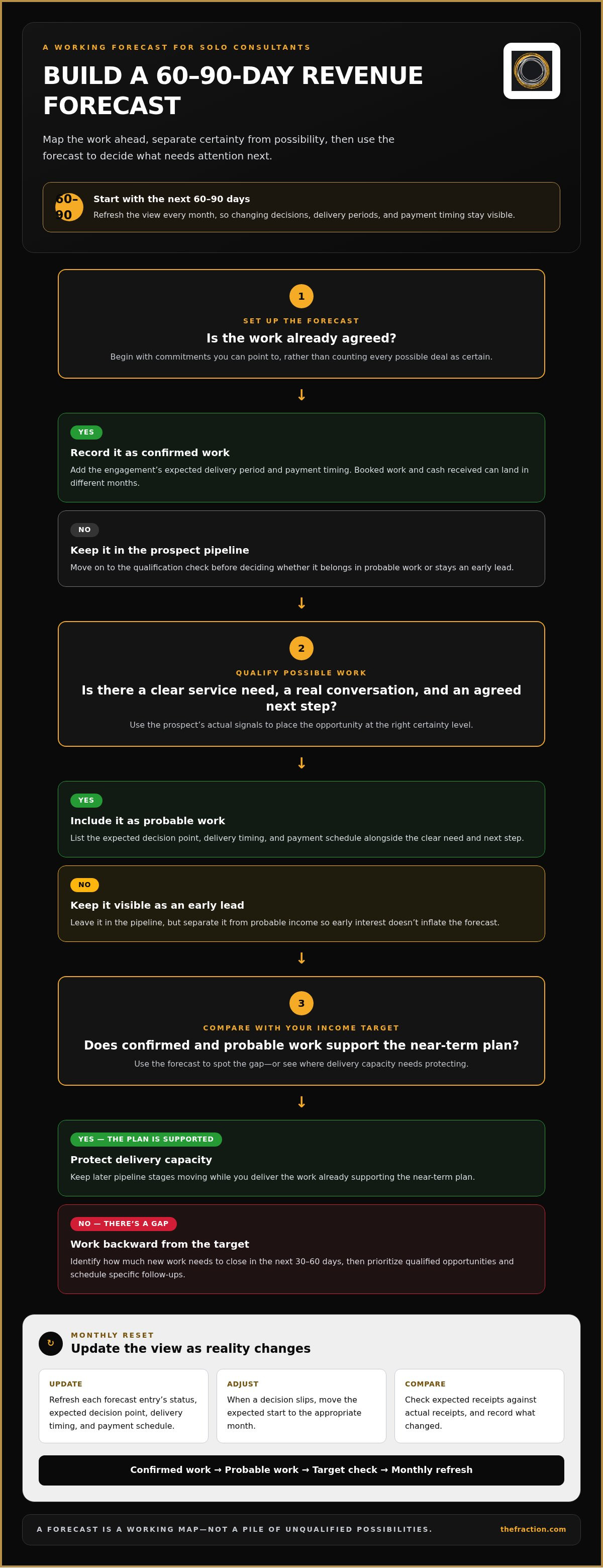
A rolling forecast gives your business development a forward view, like a dashboard that brings upcoming work into focus. Map the next 60-90 days, then refresh the view every month with confirmed and probable work. Separate signed engagements, active opportunities, and early conversations, since each carries a different level of certainty. That distinction makes the forecast useful for decisions, rather than a simple total of every possible deal.
Start with the work already agreed. Add each engagement’s expected delivery period and payment timing, since booked work and cash received can fall in different months. Then list probable work based on real prospect conversations, agreed next steps, and a clear service need. Keep early leads visible in your pipeline, but separate them from probable income so interest alone doesn’t inflate the forecast.
Next, compare the forecast with your income target. Identify how much new work needs to close in the next 30 to 60 days to meet that target, then work backward to the prospects and decisions that could produce it. If a gap appears, prioritize qualified opportunities and schedule specific follow-ups. If confirmed work already supports the near-term plan, protect delivery capacity while keeping later pipeline stages moving.
Give each forecast entry a status, expected decision point, delivery timing, and payment schedule. For example, list a signed project as confirmed work, while a proposal under review stays probable when the need and next step are clear. When a decision slips, move the expected start to the appropriate month. This small adjustment keeps the forecast aligned with changing timelines and helps you spot shifts early.
What tools can solo consultants use to forecast cash flow and manage recurring billing? A spreadsheet can track expected income, due dates, expenses, and forecast status; a calendar can flag decision points and payment dates. Invoicing or accounting software can organize recurring invoices, while a monthly review keeps those records aligned with actual receipts.
Make the review repeatable: update the forecast, compare expected receipts with actual receipts, and record what changed. Separate a delayed client decision from a reduced project scope, because each calls for a different business-development response. Over time, this process shows which assumptions hold and which need adjustment, making the forecast easier to scale as your consulting work grows.
If your forecast reveals a gap between your expertise and the opportunities reaching you, refining the offer can strengthen the path from interest to committed work. Explore how to build a compelling consulting offer as one practical part of that transition.
3. Ideal customer profiles and targeted prospect lists
An ideal customer profile gives your prospecting a compass, directing business-development effort toward buyers with a real reason to engage. Start with clients whose problems match your expertise, whose decisions you can influence, and whose work you can deliver well. For example, a cybersecurity consultant might focus on growing firms preparing for a system review, rather than contacting every company with a website.
Build the profile from evidence in completed projects and serious conversations. Record the client’s business challenge, what triggered the search for help, who shaped the decision, and which outcome mattered. Then compare patterns across past work. If clients repeatedly needed clearer reporting before expansion, that shared need can guide your profile and sharpen your offer.
Translate the profile into selection criteria you can apply consistently. Specify the type of organization, the problem you solve, the likely decision-maker, and the conditions that make your work useful. Add disqualifying signals, such as a prospect seeking implementation beyond your scope. Clear criteria help you prioritize strong-fit prospects and avoid spending effort on contacts whose needs point elsewhere.
Turn those criteria into a targeted prospect list, not a broad directory. For each organization, note the relevant trigger, likely contact, and reason your expertise could matter. A strategy consultant might track firms entering a new market and identify leaders responsible for that transition. This context makes outreach specific, while a generic message to every executive gives the relationship little room to begin.
Keep the list practical enough to use between client commitments. Add a source, next action, and follow-up date for each prospect, then update the record after every interaction. A response about a current priority may move a contact toward an active conversation; a polite response without immediate need may call for a thoughtful future touch. This simple rhythm makes prospecting repeatable without treating every name alike.
Review the list against actual conversations and outcomes. If several qualified prospects understand the problem but hesitate over the proposed result, revisit how the service is framed. If meetings consistently reveal a different buyer or trigger, refine the profile instead of adding more names. These adjustments connect market feedback to your positioning, so the prospect list evolves with evidence rather than habit.
Use automation to organize research and follow-up while keeping judgment in the relationship. A system can surface a prospect’s role, capture conversation notes, or remind you about an agreed next step; you decide whether the context merits a personal message. This reduces administrative effort and preserves the human value of outreach, giving a solo consultant a more repeatable way to generate relevant conversations.
Predictable Revenue recommends avoiding prospecting emails on Fridays and Mondays, a consideration when choosing a follow-up time. A reviewer said the outbound prospecting approach is difficult for a one-person business because one person has to handle many duties. Focusing outreach on the strongest-fit contacts can make the process more manageable alongside other responsibilities.
4. Income volatility among self-employed workers
Self-employment makes income timing a moving target, because projects and business development rarely progress evenly. The typical self-employed worker experiences approximately 30% monthly income variation. The highest-earning month tends to be about 30% higher than the lowest month in the same year. The JPMorgan Chase Institute found that income fluctuations follow patterns tied to project cycles and business-development behavior. Both delivery schedules and time spent finding work shape those patterns.
Track monthly receipts across a rolling 12-month period, separating invoices issued from payments received. Mark each month’s project completions, new engagements, and collection delays beside the income total. This organization helps reveal whether a lower month followed a delivery gap, a slow sales period, or late payment. It also shows whether strong months depend on a single large project or repeatable client work.
What monthly revenue can solo consultants realistically expect by niche and experience? There’s no single figure that fits every consultant, because niche demand, experience, service scope, available capacity, and client mix all shape revenue. Compare your own rolling 12-month pattern with your target, then identify which work and business-development practices move income toward it.
How many clients should a solo consultant have to stabilize revenue? The right number depends on each engagement’s value, duration, workload, and share of total income. Consider how a client departure would affect cash flow and delivery capacity, then build a client mix that fits your available time and reduces dependence on any single account.
Reduce concentration risk by developing relationships with several suitable clients and keeping prospecting active during delivery periods. If one client accounts for most expected income, prioritize qualified opportunities elsewhere before that engagement ends. Late payments call for a separate operating practice: issue invoices promptly, state payment dates clearly, track receivables, and follow up consistently. Forecast receipts using expected payment timing, rather than treating every issued invoice as cash already available.
MBO Partners’ research identifies income unpredictability as independent workers’ primary driver of financial stress, ahead of isolation, healthcare costs, and client difficulty. That finding makes cash-flow practices part of running the business, not an afterthought. Specialize in work you can deliver consistently while preserving room for a balanced client mix. A consultant relying on one long project, for example, can use quieter delivery periods to develop other client relationships. These habits help move income planning toward a steadier operating rhythm, even as project cycles shift.
Build a sustainable framework that aligns with a defined service scope and repeatable delivery process. Salaried employees experience approximately 14% monthly income variation. This comparison underscores why self-employed workers benefit from planning around their own income patterns rather than assuming each month will resemble the last. Use the rolling record to distinguish temporary timing gaps from a recurring mismatch between workload, pricing, and cash needs. Keep business development moving while serving clients, and make room for work that supports a balanced client mix. Revisit the forecast when project timing or payment expectations change, so spending decisions reflect likely receipts instead of an unusually strong month.
5. Lead nurturing and qualification
A prospect who’s interested today may need a different conversation before becoming a client, so treat nurturing like tending a garden: offer relevant value, then give the relationship room to develop. After each exchange, record the prospect’s stated problem, desired outcome, decision process, and next step. Those details help distinguish active buying signals from polite interest and make follow-up more personal.
Qualification starts with fit, not pressure. Check whether the prospect has a problem your expertise addresses, a reason to address it, and a workable path to a decision. Then assess whether the expected scope fits your delivery capacity. For example, a consultant specializing in operating models can explore the organization’s current challenge before proposing work, rather than pitching a solution before understanding the need.
Use a simple decision record for every meaningful conversation: the prospect’s need, fit with your service, readiness, decision-makers, and agreed action. A clear need and scheduled discussion can warrant active follow-up; a strong fit without immediate timing belongs in nurture. If the request falls outside your expertise, close the loop respectfully and preserve time for better-aligned opportunities.
For outbound outreach, connect the first message to a specific business trigger or challenge. A consultant might refer to a company’s planned expansion and ask how its operating process will support the change. If the prospect responds, ask focused questions before presenting an offer. This sequence creates a useful exchange, improves efficiency, and helps both sides decide whether a deeper conversation makes sense.
Keep nurture messages useful and tied to what the prospect has shared. Send a relevant insight, an answer to an earlier concern, or a practical observation about their stated goal. Then invite a clear next step when the timing fits. A message that simply asks whether they’re ready can feel like a sales chase; a thoughtful follow-up gives the prospect a reason to continue the conversation.
Review nurtured leads during each pipeline update, checking for changed priorities, new information, and unanswered questions. Move a prospect forward when their need, fit, and next action become clearer; keep the relationship warm when timing remains uncertain. If qualified conversations repeatedly stall after the offer is introduced, revisit how the service communicates its value and the result it supports. That adjustment can make future discussions more direct and useful.
The Fraction: Automated & AI lead generation systems
The Fraction helps solo consultants build a more structured path from prospecting to client conversations through automated and AI-powered lead generation systems. When lead generation competes with delivery work, these systems can help create a repeatable process for finding and engaging relevant prospects.
Consistent opportunities also depend on what happens after a prospect responds. The Fraction develops a sales process that doesn’t feel like selling, alongside compelling offers and services designed to win clients quickly. Together, these elements connect targeted outreach with clear value and a practical next step for the buyer.
If you’re ready to strengthen your lead-generation approach and make your offer easier to act on, contact The Fraction to discuss your business.
Make your next revenue decision with confidence
Predictable revenue for solo consultants comes from decisions you can repeat: which opportunities deserve attention, what work fits your capacity, and when to adjust your business-development effort. Choose one improvement to put into practice, then observe how it affects your pipeline and planning. You might clarify the value of your offer, create a consistent follow-up routine, or make prospecting easier to sustain alongside client delivery.
Think of the process as a professional operating system that gets stronger with use. Keep the parts that help you make clear decisions, refine the parts that create friction, and let real conversations guide what changes next. You’re building greater command over how work enters the business, and each deliberate adjustment can make the path forward easier to see.
Your expertise deserves a business foundation that supports it. Keep building, one thoughtful decision at a time.
Frequently Asked Questions
Can I scale my consulting business without hiring a large team?
Yes, you can scale a consulting business by systematizing repeatable work and automating suitable business-development tasks. Start by documenting how you deliver a common client outcome, then identify administrative steps that follow the same pattern each time. Keep your judgment focused on diagnosis, recommendations, and client decisions, where your expertise matters most. Add people only when demand and clearly defined processes justify the extra operating capacity.
How can consultants build a reliable sales pipeline and forecast revenue?
Build reliability by connecting prospecting activity to clear forecast assumptions, then testing those assumptions against actual results. Group expected work into conservative, expected, and upside scenarios, using confirmed commitments as the firmest foundation and genuine buying signals for possible additions. After each review, identify which assumptions changed and why. For example, a delayed decision shifts expected cash timing, while a smaller agreed scope changes the opportunity’s value.


