

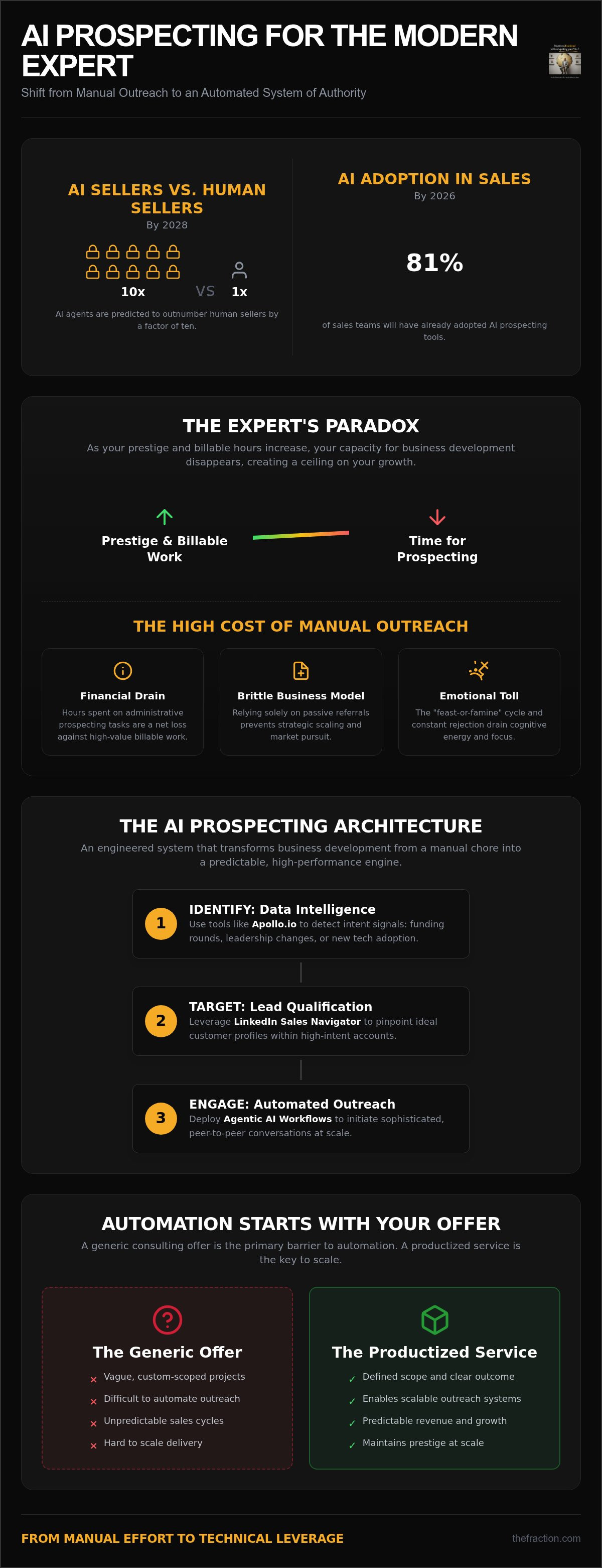
By 2028, AI agents are predicted to outnumber human sellers by a factor of ten, and with 81% of sales teams already adopting these tools in 2026, the window for manual outreach is closing. For the seasoned professional, the obstacle to growth is rarely the quality of work, but the manual labor required to find it. You didn't escape the corporate grind to spend your afternoons on cold outreach, yet the "feast or famine" cycle often makes business development feel like an exhausting second job. Transitioning to ai prospecting for professional services allows you to reclaim your time while maintaining the stability, prestige, and autonomy of your practice.
You likely understand that traditional, high-pressure sales tactics are fundamentally incompatible with high-level consulting. You need a lead generation system that functions as a strategic architect, identifying opportunities before your competitors even see them. This article demonstrates how to leverage agentic AI, signal-based selling, and automated workflows to build a predictable flow of premium clients. We'll explore the technical infrastructure needed to automate your outreach, ensuring your sales process feels like a sophisticated peer-to-peer consultation rather than a desperate pursuit of volume.
Key Takeaways
- Escape the "Expert’s Paradox" by replacing manual, time-intensive outreach with a system of automated authority that generates leads while you deliver results.
- Learn how to deploy ai prospecting for professional services by leveraging intent signals and natural language processing to initiate sophisticated, peer-to-peer conversations.
- Understand why a generic consulting offer is the primary barrier to automation and how to productize your expertise into a high-ticket service that scales.
- Identify the specific technical stack, including LinkedIn Sales Navigator and Apollo, required to build a predictable and manageable lead generation engine.
- Master a low-friction sales process that prioritizes technical leverage over high-pressure tactics, allowing you to maintain prestige while scaling your impact.
The Professional Services Prospecting Trap: Why Manual Outreach Fails in 2026
The manual approach to business development is a relic of a slower, less competitive era. For the elite consultant, the "hustle" is not a badge of honor; it's a systemic failure that limits your potential. We define ai prospecting for professional services as a technical architecture for automated authority. This system builds a digital infrastructure that identifies, qualifies, and initiates contact with high-value targets without requiring your constant presence. It ensures that your expertise is visible to the right people at the right time, effectively decoupling your income from the hours spent on manual outreach.
Many professionals fall victim to the "Expert’s Paradox." As your prestige grows and your billable hours increase, your capacity to perform lead generation effectively disappears. This creates a dangerous ceiling on your growth. Relying solely on referrals creates a brittle business model that is subject to the whims of your network. Referrals are passive; they don't allow for strategic scaling or the intentional pursuit of specific, high-value market segments. To achieve true professional autonomy, you must shift from manual effort to technical leverage.
The High Cost of Manual Lead Generation
Every hour you spend searching LinkedIn or drafting cold emails is an hour stolen from high-level strategic work. If your billable rate is significant, performing administrative tasks is a net loss for your firm. Beyond the financial drain, manual prospecting carries a heavy emotional toll. The constant "rejection cycle" and "feast-or-famine" revenue swings prevent you from making long-term investments in your practice. You cannot build a sustainable legacy on a foundation of inconsistent, manual outreach that drains your cognitive energy and professional focus.
The AI Advantage: Beyond Simple Automation
True AI prospecting goes far beyond simple "if-this-then-that" sequences used in early-generation bots. It utilizes sophisticated intent detection to identify when a prospect is actually ready to engage based on real-world business signals. By analyzing these triggers, AI allows you to maintain executive-level personalization at a scale that is physically impossible for a human to replicate. AI prospecting is the alignment of data intelligence with professional outreach. It transforms your sales process from a pushy pursuit into a peer-to-peer consultation, ensuring you remain a strategic partner rather than a desperate vendor. This transition is not just about efficiency; it's about maintaining your professional standing while your systems do the heavy lifting.
Engineering the AI Prospecting Ecosystem: The Technical Architecture
Building a scalable practice requires more than a refined skill set; it demands a robust technical foundation that operates independently of your billable hours. A sophisticated ai prospecting for professional services ecosystem functions as a digital architect, constructing a bridge between your expertise and the specific market segments that need it most. This architecture doesn't just automate tasks; it engineers a system of technical leverage that preserves your professional standing while maximizing your market reach. By integrating high-fidelity data with intelligent outreach, you transform business development from a manual chore into a predictable, high-performance engine.
Data Intelligence and Lead Identification
The first pillar of this ecosystem is the identification of high-value prospects through intent signals. Rather than casting a wide net, elite professionals use tools like Apollo.io to detect specific trigger events, such as recent funding rounds, leadership transitions, or shifts in company strategy. These signals indicate a likely need for external expertise, allowing you to focus your energy on the "ready-to-buy" 3% of your market. AI filters the immense noise found in standard B2B databases, ensuring that every contact in your pipeline aligns perfectly with your Ideal Customer Profile (ICP). When you implement these AI-driven lead generation systems, you move from chasing leads to managing a refined, contextually relevant pipeline that respects both your time and the prospect's needs.
Automated Engagement Strategies
Once high-intent prospects are identified, the system transitions to automated engagement. This involves a multi-channel synchronization strategy that links LinkedIn activity, email sequences, and social signals into a unified narrative. Natural Language Processing (NLP) plays a critical role here, crafting peer-to-peer messaging that reflects your unique professional voice. By utilizing AI to reference specific company news or industry trends, you achieve a level of personalization at scale that was previously impossible. To maintain the highest standards of prestige, successful systems incorporate a "Human-in-the-Loop" protocol. This ensures that while the heavy lifting is handled by the machine, every high-value interaction receives a final layer of human scrutiny to prevent errors and maintain executive-level nuance.
The final stage of the technical architecture is predictive lead scoring and CRM integration. By feeding engagement data back into your central system, AI can prioritize leads based on their likelihood to convert. This creates a seamless transition from automated outreach to a low-friction sales process. Your CRM becomes more than a static database; it evolves into a dynamic map of your market's needs. This unified professional image ensures that when a prospect finally speaks with you, they've already been nurtured through a series of intelligent, high-value touchpoints that establish your authority before the first meeting even begins.
Offer-First Automation: Why Your Service Structure Dictates Prospecting Success
Efficiency is a multiplier, not a cure. If you attempt to scale a generic consulting offer using automated systems, you'll simply accelerate your rate of rejection. Successful ai prospecting for professional services requires a shift from broad expertise to a productized architecture. You cannot expect an algorithm to find your ideal client if you haven't defined the specific, high-stakes problem you solve. When your service is structured as a repeatable outcome rather than an open-ended engagement, your technical systems can target intent signals with surgical precision.
Traditional consulting often relies on the expert-for-hire model, which is notoriously difficult to automate. This model requires extensive discovery calls and custom proposals for every lead. By contrast, a productized offer creates a low-friction entry point. It allows you to approach prospects not as a vendor seeking work, but as a strategic architect offering a specific solution. This clarity enables your AI tools to identify trigger events that suggest a prospect is currently experiencing the exact pain point your offer addresses.
Defining Your High-Value Offer
Transitioning from selling hours to selling outcomes is the foundational step in building a scalable sales engine. A winning professional service offer typically follows a tripartite structure: a defined entry point, a proprietary methodology, and a measurable result. This level of specificity allows your AI stack to go beyond basic demographic filters. Instead of searching for generic job titles, your system can identify prospects who are mentioning specific challenges in public forums or company reports. When your offer is narrow, your targeting becomes exponentially more effective.
Aligning Messaging with Market Needs
AI tools now allow you to analyze market sentiment at a scale that was previously impossible. By monitoring industry trends and competitor weaknesses, you can adjust your offer positioning in real time to meet evolving needs. A productized service simplifies the sales funnel by transforming a complex consulting engagement into a clear, repeatable outcome that prospects can easily visualize and approve. This clarity is essential for peer-to-peer messaging. For example, a fractional CFO offer that promises to optimize capital efficiency for Series B startups will consistently outperform a generic accounting service. The former addresses a specific strategic milestone, making it a high-ticket investment rather than a commoditized expense.
Implementing Your Automated Lead Flow: A Strategic Roadmap
Building a system of ai prospecting for professional services is a methodical exercise in technical architecture. It requires a transition from the chaotic "hustle" of manual outreach to a structured environment of technical leverage. This roadmap isn't merely a list of tools; it's a blueprint for professional autonomy. By following a disciplined implementation strategy, you ensure that your business development engine operates with the same precision as your client delivery. The goal is to create a digital infrastructure that identifies, nurtures, and qualifies leads before you ever step into a meeting.
The first step involves a rigorous audit of your existing network and a clinical definition of your Ideal Customer Profile (ICP). Most professionals fail here by being too broad. You must identify the specific trigger events that signal a high-value opportunity. Once your target is defined, you can begin the technical assembly. This involves integrating LinkedIn Sales Navigator for social signals, Apollo for deep data enrichment, and Lemlist for sophisticated delivery. If you're ready to move beyond manual searching, you can implement an automated lead generation system that handles the heavy lifting for you.
Selecting the Right Sales Automation Stack
The technology market in 2026 offers a variety of specialized tools that outperform generic "all-in-one" CRM platforms. While all-in-one systems promise simplicity, they often lack the granular control required for elite professional services. A best-in-class stack typically utilizes a tripartite structure: a data source for lead identification, a social layer for signal monitoring, and a delivery layer for outreach. Budgeting for this ecosystem should be viewed as a strategic investment in scalability. High-performing teams often see a significant return on investment as these tools effectively replace the need for a full-time business development representative.
The Nurture Sequence: Building Trust on Autopilot
An effective nurture sequence establishes your authority through a series of high-value touchpoints. We recommend a 5-touchpoint sequence that provides strategic insights before making any direct "ask." This approach positions you as a peer and a strategic architect rather than a vendor. Modern AI tools can now "read" prospect replies and categorize them by sentiment, allowing you to prioritize warm leads that show genuine interest. This sentiment analysis ensures that you only spend your time on conversations with a high probability of conversion. When the AI detects a positive signal or a specific technical question, the system triggers a notification for a personalized human follow-up. This "Human-in-the-Loop" model ensures that your outreach remains sophisticated and contextually relevant while operating at a scale that manual efforts can't match.
Refinement is the final, ongoing step in the roadmap. You must constantly monitor your conversion data and feedback loops to optimize your messaging. By analyzing which intent signals lead to the highest-value contracts, you can iterate on your ICP and outreach strategy. This creates a self-improving system that grows more efficient over time, providing the stability and prestige required for long-term professional success.
Beyond the Toolset: Building a Sales System That Scales Your Impact
Technical tools are only as effective as the strategic framework they support. While the software handles the labor of identification and outreach, mastering ai prospecting for professional services is ultimately about your sales architecture and professional positioning. A systemized lead flow does more than fill a calendar; it transforms your market standing from a seeker of work into a sought-after authority. By decoupling your business development from your manual effort, you create a permanent asset that scales your expertise without compromising your premium brand.
The transition from a corporate employee to a systemized consultant requires a fundamental shift in how you view the sales process. You aren't "selling" in the traditional, high-pressure sense. Instead, you're deploying a "Fractional" sales process that prioritizes peer-to-peer consultation and strategic alignment. This approach ensures that every interaction reinforces your authority and sets the stage for a high-value partnership. When your systems handle the initial friction, you're free to focus on the high-level work that truly moves the needle for your clients.
The Low-Friction Sales Conversation
A sophisticated sales system changes the nature of the first meeting. Rather than a pitch, the discovery call becomes a strategic diagnostic session. Because your automated lead scoring has already filtered for high-intent, qualified prospects, you can enter every conversation with the confidence of a seasoned executive. You're no longer justifying your fee; you're determining if the prospect is a fit for your proprietary methodology. By positioning the client’s desired outcome as the hero of the story, your service becomes the logical bridge to their success. This low-friction environment preserves your prestige and ensures that your sales process feels like a natural extension of your professional expertise.
Scaling Your Professional Autonomy
The long-term value of an automated system lies in the gift of time. By implementing these strategies, many professionals reclaim 20 or more hours per week that were previously lost to manual prospecting and administrative "grind." This reclaimed time is the foundation of true professional autonomy, allowing you to invest in deep work, service innovation, or personal freedom. You're not just buying a tool; you're building a business development asset that you own and control. If you're ready to redefine your professional impact and move away from the "feast or famine" cycle, it's time to build your automated lead generation ecosystem with The Fraction. This is the final step in moving from a corporate role to becoming a systemized, high-impact expert who controls their own growth and market destiny.
Architecting Your Professional Market Authority
Transitioning from a manual, time-intensive business model to a systemized practice is not merely an operational upgrade; it's a fundamental professional evolution. By implementing ai prospecting for professional services, you secure the technical leverage necessary to maintain prestige while scaling your impact. We've established that a productized service offer serves as the essential foundation for automation. This strategic clarity allows your technical stack to identify high-intent signals and nurture relationships on your behalf, effectively ending the feast or famine cycle.
True autonomy is achieved when you own the infrastructure of your growth. You no longer need to choose between delivering high-caliber work and finding your next elite client. Instead, you can rely on a strategic framework that operates with the calculated confidence of a seasoned executive. If you're ready to leave the corporate grind behind and build a practice that reflects your true value, it's time to take the next step. You can automate your lead flow and scale your professional impact with The Fraction. We specialize in the strategic development of compelling service offers and the implementation of a sales process that doesn't feel like selling. The path to a predictable, high-value practice is now entirely manageable with the right blueprint.
Frequently Asked Questions
Is AI prospecting ethical for high-level professional services?
AI prospecting for professional services is entirely ethical when built on a foundation of relevance and strategic alignment. The goal is not to deceive prospects with synthetic personas, but to ensure your expertise reaches the specific leaders who require it. Ethical systems prioritize high-fidelity data and peer-to-peer messaging, moving away from mass spamming toward intentional, value-based outreach that respects the prospect's time and professional standing.
How do I ensure my automated outreach doesn’t sound like a bot?
You avoid sounding like a bot by centering your outreach on specific business triggers rather than generic templates. Modern tools can reference recent funding rounds, leadership changes, or industry shifts to provide immediate context for your message. When your outreach addresses a real-world problem with the nuance of a seasoned executive, the prospect perceives a strategic partner rather than an automated script.
What is the best AI tool for finding fractional executive leads?
Tools like Apollo.io and LinkedIn Sales Navigator remain the gold standard for identifying fractional executive opportunities. These platforms allow you to filter by specific intent signals and job title changes that suggest a company is moving toward an external leadership model. By integrating these data sources with a refined outreach layer, you create a technical architecture that uncovers opportunities before they reach public job boards.
Can I use AI prospecting for LinkedIn without getting banned?
You can safely use LinkedIn for automated outreach by strictly adhering to the platform's volume limits and engagement guidelines. The risk of a ban is highest when using low-quality, high-volume bots that ignore human behavior patterns. Sophisticated systems use a "Human-in-the-Loop" protocol to ensure every interaction remains within safe parameters while maintaining the prestige of your professional brand.
How much does it cost to set up an automated sales funnel for a consultant?
The investment required for an automated sales funnel typically includes software subscriptions for data enrichment, outreach delivery, and CRM management. While costs vary based on the complexity of your technical stack, the real metric is the return on your time. For a consultant, replacing twenty hours of manual labor per week with a systemized lead flow is a strategic investment in long-term professional autonomy.
Do I need a large marketing budget to start AI prospecting?
A large marketing budget is not a prerequisite for successful ai prospecting for professional services. Unlike traditional advertising that requires significant spend to "buy" attention, AI-driven systems focus on technical leverage and data precision. You can start with a lean stack of specialized tools and scale your investment as the system begins to generate a predictable flow of high-ticket consulting opportunities.
What is the difference between automated lead gen and a traditional sales coach?
A traditional sales coach provides the knowledge of how to sell, whereas an automated lead generation system provides the actual infrastructure to execute. While a coach might refine your verbal pitch, a systemized architecture handles the labor of identification, qualification, and initial engagement. One teaches you the "hustle," while the other provides the technical leverage to grow without it.
How long does it take to see results from an AI-driven sales system?
Most professionals see initial engagement and warm conversations within the first thirty days of system implementation. However, a fully optimized sales engine typically requires a ninety-day cycle to refine the Ideal Customer Profile and nurture sequences based on conversion data. This steady, methodical approach ensures that your pipeline remains consistent rather than falling into the "feast or famine" cycles of manual outreach.


