

In 2026, the most successful professionals have stopped chasing leads and started architecting ecosystems. The era of manual, high-friction outreach has been replaced by a strategic reliance on technical infrastructure that identifies and engages ideal clients before you even open your laptop. You likely recognize that the traditional, pushy sales model is a relic of the past, yet the pressure of inconsistent revenue cycles makes the transition to a modern sales stack feel like a technical hurdle you aren't ready to clear.
This guide provides the blueprint you need to master b2b lead generation automation tools and build a predictable, scalable system that mirrors your professional standing. We'll show you how to move from the exhaustion of "feast or famine" to the stability of a high-value sales engine that operates with quiet, executive precision. We'll examine the specific tools and workflows that allow you to integrate AI-driven identification, hyper-personalized outreach, and compliant data practices into a single, cohesive framework that protects your time and reinforces your authority.
Key Takeaways
- Transition from the manual "Expert's Dilemma" to a scalable business architecture that removes the physical ceiling on your professional growth.
- Identify the core ecosystem of b2b lead generation automation tools required in 2026 to maintain high-deliverability and precision targeting at scale.
- Master the shift from broad prospecting to intent-based acquisition, focusing your resources on high-value clients who are already signaling a need for your specific expertise.
- Design a "non-sales" sales system that utilizes automated, value-first touchpoints to transform cold prospects into strategic partners with minimal friction.
- Recognize that technical infrastructure is only as effective as the strategy behind it, requiring a compelling offer to serve as the foundation of your growth.
The Strategic Shift: Why Manual Prospecting Fails the Modern Expert
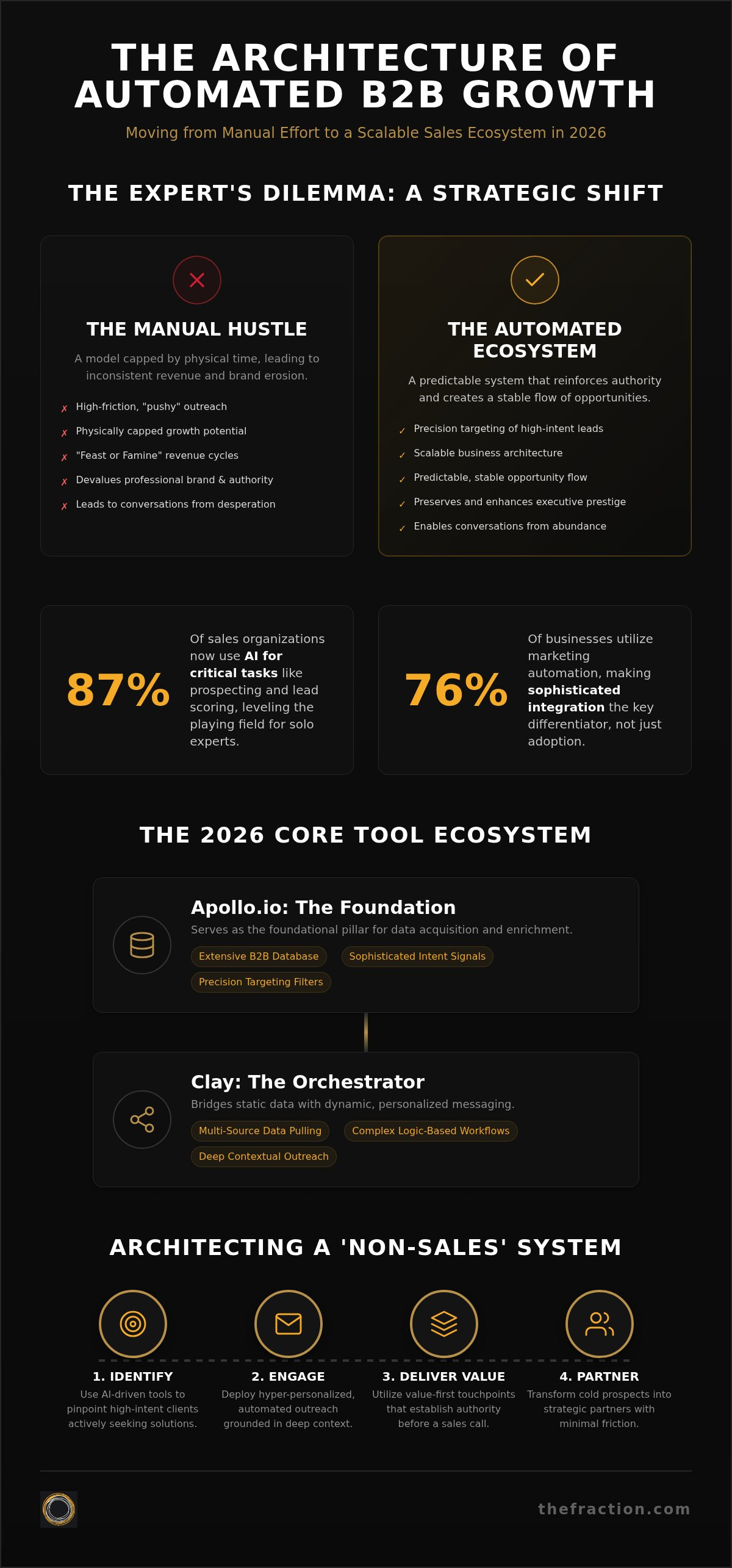
Manual prospecting is a relic of a linear economy. For the elite professional, every hour spent on manual outreach is an hour stolen from high-value delivery, strategic thinking, and personal autonomy. This creates the "Expert’s Dilemma," where your ability to generate new business is physically capped by the hours you can spend on cold outreach. To scale in 2026, you must stop viewing b2b lead generation automation tools as mere software and start treating them as strategic business architecture. This infrastructure allows you to transition from a service provider who "hustles" for leads to a system owner who manages a predictable flow of opportunities.
A sophisticated sales engine does more than just save time; it preserves your executive prestige. High-level consulting requires a position of authority, yet traditional "pushy" sales tactics quickly erode that standing. By implementing an automated framework, you replace the friction of chasing prospects with the precision of a system that identifies high-intent leads. This shift is rooted in the broader evolution of Marketing Automation, which has moved from generic email blasts to complex, AI-driven ecosystems that mirror the nuances of human expertise. In the 2026 economy, professional success is defined by how effectively you can monetize your experience without being tethered to the manual labor of lead acquisition.
The Hidden Cost of the 'Manual Hustle'
The opportunity cost of manual lead generation is staggering for those whose expertise commands a premium. When an executive spends three hours a day on data entry or manual LinkedIn messaging, they aren't just working; they're devaluing their professional brand. Repetitive, manual tactics often result in a "sales-y" perception that can damage your reputation among high-value peers. Conversely, a predictable, automated pipeline provides a psychological foundation of stability. It removes the anxiety of "feast or famine" cycles, allowing you to enter every sales conversation from a position of abundance rather than desperation.
AI as the Great Equalizer for Solopreneurs
Automation allows a single expert to operate with the output of a mid-sized agency. In 2026, 87% of sales organizations use AI for tasks like prospecting and lead scoring (Globe Market Research, June 2026). This technology enables you to maintain hyper-personalized, peer-to-peer connections at a scale that was previously impossible without a large support staff. AI Prospecting is the systematic identification of high-intent professional opportunities. By leveraging these systems, you ensure that your outreach is always relevant, timely, and aligned with the specific needs of your target market, effectively leveling the playing field against larger competitors.
The Core Ecosystem: Top B2B Lead Generation Automation Tools for 2026
Building a high-performance sales system requires more than just a list of subscriptions; it demands a curated ecosystem where each component serves a specific strategic purpose. In a landscape where 76% of businesses already utilize marketing automation (SeoProfy, July 2026), the differentiator for elite experts is no longer the presence of technology, but the sophistication of its integration. A well-architected stack functions as a digital nervous system, handling the heavy lifting of identification, enrichment, and engagement with executive precision. This allows you to focus your cognitive energy on high-level strategy while your b2b lead generation automation tools maintain a consistent pipeline of opportunities.
Data Acquisition and Enrichment Foundations
Apollo.io remains the foundational pillar of the modern sales stack. With its extensive database and sophisticated intent signals, it allows you to identify companies that are actively seeking solutions before they even reach out to a competitor. In 2026, the ability to filter by real-time growth indicators and technology stacks is essential for precision targeting. However, raw data is only the beginning. To transform these leads into meaningful connections, elite professionals use Clay as a sophisticated orchestrator. Clay bridges the gap between static contact information and personalized messaging by pulling data from dozens of sources to trigger complex, logic-based workflows. This ensures that every outreach attempt is grounded in deep context, making your expertise feel like a natural solution to their current challenges. If you are ready to deploy this level of technical infrastructure within your own business, the transition from manual work to system ownership becomes a manageable reality.
Engagement and Outreach Orchestration
Once your data is enriched, the focus shifts to engagement. Lemlist has established itself as the premier tool for high-deliverability outreach because it prioritizes the "human" element of communication. In an era where 95% of B2B marketers use AI at least weekly (Globe Market Research, June 2026), the ability to bypass spam filters and land in the primary inbox is the new currency of sales. Lemlist allows for the integration of personalized video and dynamic content at scale, building trust before the first discovery call is even scheduled.
LinkedIn Sales Navigator serves as the essential social layer for authority-based prospecting. It provides the real-time insights necessary to engage with prospects based on their recent activity and professional milestones. When automating these touchpoints, it's critical to maintain compliance with evolving regulations. As of August 2, 2026, the EU AI Act requires clear transparency for AI-driven interactions. By combining the social authority of LinkedIn with the deliverability of Lemlist, you create a multi-channel approach that respects platform boundaries while maximizing your professional reach.
Comparing Intent Data and AI Prospecting Platforms
The distinction between broad prospecting and intent-based acquisition is the difference between casting a wide net and spear-fishing with surgical precision. While broad prospecting focuses on volume, intent-based acquisition leverages behavioral signals to identify organizations that are actively seeking a solution. This transition is vital for the modern expert. By utilizing b2b lead generation automation tools that prioritize intent, you ensure your outreach is no longer a cold interruption but a timely intervention. This strategic approach transforms your sales system from a generic numbers game into a sophisticated mechanism for high-value client acquisition.
For professionals operating in global markets, data accuracy varies significantly by geography. While Apollo is a powerhouse for North American data, Cognism provides the localized accuracy and mobile-direct dials necessary for global professional services, particularly within the UK and European markets. Complementing this outbound precision is the identification of anonymous demand. Leadfeeder, now part of Dealfront, reveals the high-value organizations visiting your website, allowing you to deanonymize interest and trigger outreach to companies already engaging with your brand. These systems work in tandem to ensure no high-intent opportunity is overlooked.
Evaluating the role of AI SDRs requires a nuanced understanding of where automation ends and expertise begins. While these agents can manage initial inquiries and handle repetitive scheduling tasks, the transition to a "Strategic Partner" requires the human touch. The goal of your sales architecture isn't to replace the expert, but to ensure the expert only enters the conversation when the prospect is qualified and ready for a high-level dialogue. This balance maintains your professional prestige while maximizing your operational efficiency.
Evaluating Intent Signals: Who is Ready to Buy?
Apollo’s intent filters provide a robust starting point by tracking keyword research and technology installations, yet specialized platforms like 6sense offer deeper, account-based insights into the "dark funnel." For fractional leaders, "Job Change" alerts are often the most potent trigger. When a new executive enters a role, they're 40% more likely to bring in external expertise within their first 90 days. Leveraging intent data within your sales architecture reduces sales friction by 40% by ensuring your outreach aligns with a prospect's active search phase. This timing is the cornerstone of a non-sales sales system that feels like a natural extension of your expertise.
The Technical Stack Comparison Table
Selecting the right b2b lead generation automation tools depends on the complexity of your target market and the depth of personalization required. A Fractional CFO may prioritize financial intent signals, such as recent funding rounds or M&A activity, whereas a Fractional CHRO would focus on headcount growth or hiring freezes.
| Tool | Ease of Use | Sophistication | Primary Use Case |
|---|---|---|---|
| Apollo | High | High | Foundational database and general intent filtering. |
| Cognism | Medium | High | Localized data accuracy for EMEA and global markets. |
| Clay | Low | Extreme | Complex data orchestration and hyper-personalized outreach. |
Matching your tool selection to your specific professional role ensures that your technical infrastructure supports your unique value proposition. Whether you are a CMO looking for tech-stack shifts or a COO tracking operational inefficiencies, your sales stack should be a reflection of your strategic focus.
Architecting a 'Non-Sales' Sales System with Automation
True professional autonomy requires a sales architecture that operates without the friction of traditional solicitation. This is where the concept of a "non-sales" sales system becomes a functional reality. By leveraging b2b lead generation automation tools, you can design a journey that guides a prospect from being a complete stranger to a strategic partner through the consistent delivery of value. This isn't about trickery; it's about using systems to demonstrate expertise at scale. By the time you actually speak with a prospect, the "sale" has already been facilitated by the technical infrastructure you've built.
A sophisticated sales engine manages the heavy lifting of identification and initial engagement, allowing you to focus on high-level delivery. The transition from automated outreach to human conversation should feel like a natural progression of a professional relationship. When your system provides consistent, relevant insights, you're no longer seen as a vendor chasing a contract. Instead, you're perceived as a peer who's already contributing to their organizational success. This level of automated sales infrastructure ensures your first human interaction is informed, relevant, and highly authoritative.
The Anatomy of a High-Value Lead Magnet
In 2026, the traditional gated whitepaper is a relic. Modern prospects demand immediate utility and personalized insights. Interactive tools, such as AI-driven operational audits or personalized benchmarking calculators, have replaced static forms. These tools provide instant value while simultaneously gathering deep data points for your CRM. When integrated with your outreach stack, these magnets allow for a seamless experience. A prospect engages with a tool, receives a personalized report, and is then entered into a sequence that references their specific results, creating a feedback loop that reinforces your expertise.
Automated Nurture: Building Authority on Autopilot
Authority is built through consistency, not intensity. An automated nurture sequence should be designed as a "90-Day Authority Framework," staying top-of-mind through high-signal content rather than intrusive "just checking in" emails. This involves a strategic blend of case studies, industry insights, and LinkedIn social proof. Automation tools can now synchronize your email outreach with social interactions, ensuring that when you appear in a prospect's inbox, they've already seen your expertise validated on their social feed. This creates a multi-dimensional presence that reinforces your standing as a leader. To master this integration, you must understand The AI-Driven Lead Generation Strategy that underpins high-value consulting.
The ultimate goal of this architecture is the "Expert-to-Peer" hand-off. Automation handles the identification, the initial value delivery, and the long-term nurturing. However, the final stage of the journey-the strategic consultation-must remain human. The system's job is to deliver a prospect who is educated, qualified, and eager to discuss how your specific expertise applies to their challenges. This ensures your time is spent only on the highest-leverage activities, turning your sales process into a natural extension of your professional service.
Implementing Your Strategic Growth Infrastructure with The Fraction
Technology is a multiplier, not a foundation. While the b2b lead generation automation tools explored in this guide provide the necessary horsepower, they cannot compensate for a weak market position or a generic value proposition. At The Fraction, we recognize that the most sophisticated technical stack will fail if it isn't built upon a compelling, high-value offer. Our role is to act as your strategic architect, moving beyond high-level coaching to provide the actual technical and strategic deployment required for professional autonomy.
The transition from a corporate employee to an autonomous system owner requires a fundamental shift in how you view your time. In the corporate world, your value is often tied to your presence; in the world of fractional consulting, your value is tied to your systems. By deploying AI-powered lead generation systems, you stop being the engine of your business and start being the pilot. This infrastructure allows you to monetize your corporate experience with executive precision, ensuring that your expertise is delivered to the right market at the right time without your constant manual intervention.
The Fraction’s Implementation Framework
We facilitate this transition through a structured tripartite framework: Offer, Infrastructure, and Execution. We first refine your professional experience into a high-demand service that resonates with the 2026 market. Next, we deploy the specific technical infrastructure-integrating the databases, orchestrators, and outreach tools discussed earlier-to create a seamless acquisition engine. Finally, we oversee the execution phase until the system reaches a predictable rhythm. For example, we've helped experts transition from 40-hour manual outreach weeks to a model where their only "sales" task is attending three to five high-qualified discovery calls per week, all generated by their automated ecosystem.
Your Path to Professional Autonomy
2026 is the definitive year of the systematized expert. In an environment where 85% of B2B marketers struggle to connect marketing performance to business outcomes (G2, February 2026), owning your own lead generation ecosystem is the ultimate competitive advantage. It provides the stability of a corporate role with the prestige and leverage of an independent consultant. You're no longer dependent on a single employer; you're supported by a diverse pipeline of high-value opportunities that you own and control.
The first step toward this professional evolution is a rigorous audit of your current process. Identify the single most repetitive task in your current acquisition workflow-whether it's data gathering, lead scoring, or initial outreach-and recognize it as your first automation opportunity. By reclaiming just five hours a week through technical leverage, you create the cognitive space needed to scale your impact. If you're ready to move beyond manual prospecting and build a sales system that operates with executive precision, it's time to Explore our AI-Powered Lead Generation Systems.
Architecting Your Future: The Transition to System Ownership
The transition from corporate professional to autonomous expert is not merely a change in title; it's a fundamental restructuring of how you generate value. By moving away from manual prospecting and embracing a sophisticated ecosystem of b2b lead generation automation tools, you reclaim the cognitive bandwidth necessary for high-level delivery. Success in the 2026 economy requires a tripartite approach: a compelling service offer, a resilient technical infrastructure, and a specialized sales process that avoids traditional "hard selling" tactics.
You possess the industry expertise; now you require the implementation of an AI-powered lead generation and sales system to amplify it. Establishing a predictable, executive-grade pipeline is the final step in securing your professional autonomy and ensuring your expertise reaches the high-value clients who need it most. It's time to stop being the engine of your business and start being the architect of its growth. This shift ensures that your sales system operates with the same precision and authority that you bring to your consulting work.
Build your automated sales infrastructure with The Fraction and secure the professional future you've earned. Your expertise deserves a system that matches its caliber.
Frequently Asked Questions
What are the best B2B lead generation automation tools for solo consultants in 2026?
The most effective b2b lead generation automation tools for solo consultants in 2026 are those that prioritize precision over volume. A foundational stack typically includes Apollo.io for data, Lemlist for human-centric outreach, and LinkedIn Sales Navigator for social authority. These tools allow a single expert to maintain a sophisticated presence without the overhead of a large agency. By focusing on a "less is more" approach, you ensure every interaction remains high-caliber and aligned with your professional standing.
Is it safe to use LinkedIn automation for professional outreach?
LinkedIn automation is safe only when it mirrors natural human behavior and respects the platform's evolving limits. High-level consultants should avoid aggressive connection blasting and instead use automation to support authority-based prospecting. This involves automating the social layer, such as profile visits or post engagement, to build familiarity before sending a personalized message. Maintaining this balance protects your account and ensures your outreach is perceived as a peer-to-peer connection rather than spam.
How much does it cost to set up a professional lead generation automation stack?
A professional automation stack in 2026 typically requires a monthly investment ranging from $150 to $500 depending on your volume and depth of data enrichment. For example, Apollo.io plans range from $49 to $119 per user, while specialized AI agents like SyncGTM start at $99 per month. These costs represent the technical infrastructure necessary to replace manual labor with scalable systems. Investing in this architecture allows you to reclaim executive hours that are far more valuable than the subscription fees.
Do I need a CRM if I am using an all-in-one tool like Apollo.io?
While Apollo.io offers robust lead management features, a dedicated CRM remains essential for managing the long-term journey from stranger to strategic partner. Apollo excels at the top of the funnel for identification and initial outreach, but a CRM like HubSpot or Pipedrive provides the depth needed for complex, high-value consulting deals. Integrating these b2b lead generation automation tools ensures that your data flows seamlessly from cold prospect to a managed professional relationship without losing critical context.
Can AI really write personalized outreach emails that don't sound like bots?
AI can produce hyper-personalized outreach that resonates with executives if it is grounded in specific, first-party data. By using orchestrators like Clay to pull recent company news or financial reports, you can generate messages that feel deeply researched rather than generic. It's important to remember that as of August 2026, the EU AI Act requires transparency in AI interactions. Disclosing the use of AI in a professional, sophisticated manner can actually reinforce your brand as a forward-thinking, technically adept expert.
What is the difference between inbound and outbound lead generation automation?
Outbound automation focuses on actively identifying and reaching out to ideal clients, whereas inbound automation captures and nurtures interest from those already engaging with your brand. Tools like Apollo.io handle the "push" of outbound prospecting, while platforms like Dealfront manage the "pull" by identifying anonymous website visitors. A balanced ecosystem uses both to ensure you are simultaneously hunting for new opportunities and harvesting the interest generated by your authority-building content.
How do I integrate my existing corporate network into an automated system?
Your corporate network can be integrated into an automated system by using social signals as triggers for personalized outreach. Automation allows you to track job changes or company milestones within your existing network, providing a natural opening for a value-first conversation. This approach turns a static list of contacts into a dynamic source of opportunities. It bridges the gap between your past corporate experience and your current professional autonomy, ensuring your network remains a living asset.
What is 'intent data' and how does it help land fractional clients?
Intent data refers to behavioral signals that indicate a company is actively researching a solution or experiencing a transition. This includes keyword research, technology stack changes, or executive hires, which serve as primary triggers for fractional service offers. By focusing on these high-intent signals, you reduce sales friction and ensure your outreach reaches prospects during their active "buy mode." This precision is what allows a "non-sales" system to feel like a timely, professional intervention.


