

Choosing between an appointment-setting company, in-house SDRs, and a dedicated team really comes down to who should carry each part of the sales load, and where automation can take the repetitive work off your people’s hands. Think of automated B2B appointment-setting systems as the gears behind the calendar…they keep outreach and booking moving, so your sales team can focus on the conversations that call for its expertise.
If you’re weighing those options, you’ve already spotted the real decision: a booked meeting needs to fit your sales process and give the next conversation somewhere useful to go. Complex B2B sales are more like a relay than a single finish line, so the right model helps each prospect move forward with context, handoff by handoff.
So here’s what you’ll get: how appointment setting supports longer sales cycles, how team models compare, and where automation fits alongside human judgment. By the end, you’ll have a practical framework for choosing a setup that matches your sales process and gives qualified opportunities a clear next step.
Key Takeaways
- Choose appointment times and follow-up practices that make it easier for qualified prospects to show up and engage, so the conversation can get moving.
- When you're weighing an appointment-setting company against in-house SDRs, consider the level of control, expertise, and capacity your sales process needs.
- For high-value sales with longer cycles, connect each meeting to a thoughtful qualification and follow-up process, so prospects have a clear path forward.
- Treat prospecting, appointment setting, and closing as connected stages, so booked meetings can move into qualified opportunities.
- Use automation for repeatable lead-generation tasks, but shape your offer and sales process around the conversations your buyers need.
Why Are B2B Appointment Setting Services Important?
Appointment setting bridges the gap between prospect interest and a useful sales conversation. Automation can handle routine steps along the way, such as responding to replies, applying qualification rules, and offering meeting times. Keep a person involved whenever a response calls for judgment.
Meeting Booking and Attendance
Meeting booking takes an interested prospect through to a confirmed calendar slot, keeping a promising conversation moving. A platform can find available times, send an invitation, and issue a reminder, while your sales team decides who should receive each booking. For example, a request to discuss a product could prompt a calendar option and a clear meeting invitation.
Attendance is more likely when the invitation reaches the right person and makes the meeting’s purpose clear. Include the topic and attendee details, and provide an easy way to reschedule. Compare attendance with bookings: a full calendar can still conceal missed meetings or prospects who arrive without context. These patterns can reveal unclear invitations, poor timing, or weak qualification.
Qualified Meetings and Direct Appointments
Direct-meeting appointment setting takes a prospect from an initial response straight to a scheduled sales conversation. It works best when the prospect’s request and fit are clear. For example, someone asking about a specific business service could book time with the relevant salesperson, so they can move straight into the conversation.
Qualification criteria are the gate between a prospect’s response and a meeting with your sales team. Define signals such as a relevant role, a business need, and interest in discussing a solution, then capture those details before confirming the appointment. Someone who accepts an invitation may still sit outside your buying criteria, so meeting volume alone can obscure the difference between a genuine opportunity and a request for general information.
Automated Replies and Booking
Automated reply handling can answer common scheduling questions and offer available times, turning an incoming message into a next step. Someone who wants to talk later could receive a callback option, while a prospect ready to speak could see open calendar slots. Set clear limits and route unusual requests or unclear intent to a person.
Review replies and booking outcomes against the rules the system is designed to follow. The U.S. Government Publishing Office says algorithmic systems should include controls that let operators verify they work as intended. Check for misrouted replies, duplicate bookings, and appointments without qualification details. These checks help keep the system aligned with sales criteria and catch small errors before they carry forward.
Appointment setting company, in-house SDR or dedicated SDR team?
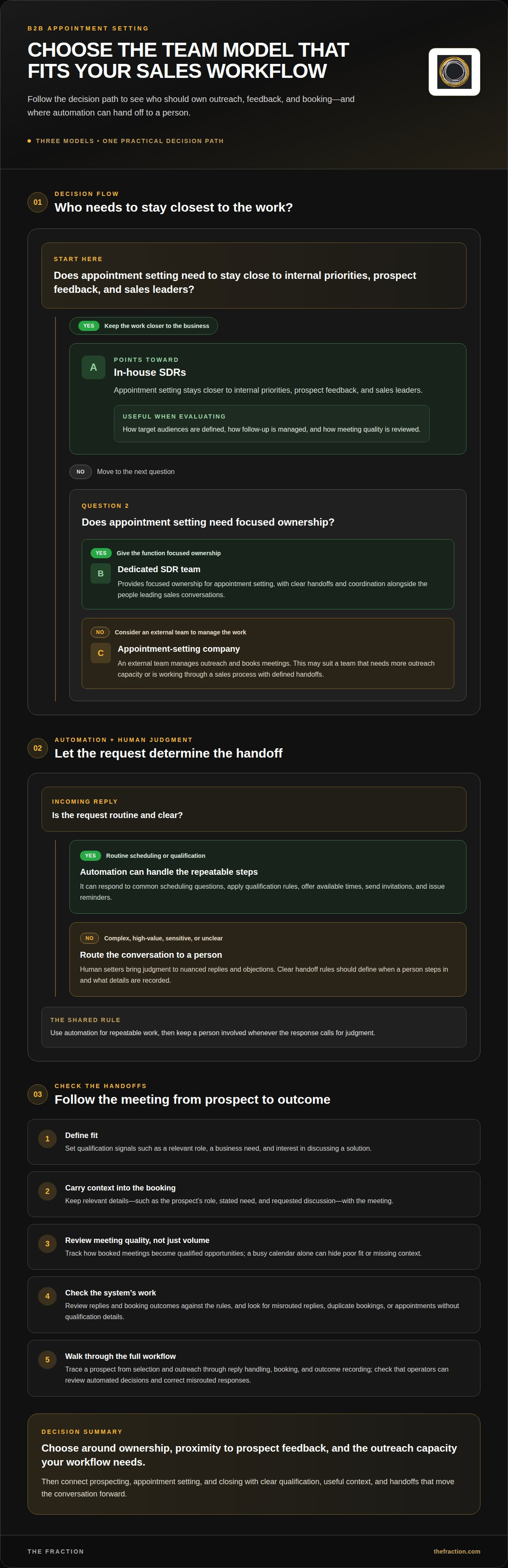
The right model depends on how closely appointment setting needs to sit alongside your sales team, offer, and conversation decisions…so think of it like choosing who’s in the passenger seat, who’s reading the map, and who’s got their hands on the wheel. Compare who owns the process, who brings specialist judgment, and how much execution capacity your sales workflow needs.
Provider Model Comparison
An appointment-setting company brings in an external team to manage outreach and book meetings, while in-house SDRs keep that work closer to internal priorities, prospect feedback, and sales leaders. A dedicated SDR team gives appointment setting focused ownership, but it still needs clear handoffs and coordination with the people leading sales conversations…like a relay team, everyone needs to know when the baton’s coming their way.
Compare models by tracing who defines the target audience, manages follow-up, and reviews meeting quality. A company entering a new market may value direct access to prospect feedback, while a team with an established sales process may need more outreach capacity. Track how booked meetings become qualified opportunities, so you’re measuring useful progress, not just a busy calendar.
AI and Human Setter Approaches
A basic chatbot follows predefined prompts, while conversational AI can handle a wider range of replies and guide prospects toward scheduling. AI setters can manage routine qualification and booking; human setters bring judgment to complex, high-value, or sensitive conversations. Together, they can work like a relay…automation handles the straightforward request, then passes a nuanced objection to a person.
Clear handoff rules are what make that relay run smoothly. Spell out which replies the system can manage, when a person should step in, and what details to record. Test a routine scheduling request and a prospect’s detailed question, then see whether each response moves the sales conversation forward with the right context in hand.
System Tools and Features
A practical platform should connect prospect records, outreach channels, reply handling, and calendar booking, while showing your sales team why each meeting was booked. For example, the prospect’s role, stated need, and requested discussion can travel with the calendar invitation…like luggage that actually makes it onto the same flight, instead of getting lost between tools.
Walk through a sample workflow, from selecting a qualified prospect to sending outreach, handling a reply, booking a time, and recording the outcome. Check whether operators can review automated decisions and correct a misrouted response. This hands-on comparison shows how the features support your sales process, so you can see how each one fits into the bigger picture.
Cost per Month or Meeting
Price depends on the case and is provided after a quote request. Factors include the provider model, outreach scope, channels, qualification complexity, and level of human involvement. Monthly and per-booked-meeting arrangements distribute effort differently, so compare what each includes and how it defines a qualified meeting.
To compare the value, connect the fee structure to the work behind each booking and your sales team’s ability to act on the resulting conversations. A calendar filled with low-fit meetings carries a different value from carefully qualified conversations…a little like a full shopping basket where half the items aren’t what you came for. A sales process built around clear offers can help bring the commercial foundation and prospect conversations into closer alignment.
Appointment setting for high-priced products and long sales cycles
High-priced B2B sales often involve several decision-makers, detailed evaluation, and multiple conversations. Appointment setting supports sales development by creating a steady pipeline of qualified prospects, while each meeting advances a specific decision. For example, an initial discussion can establish business needs, and a later meeting can bring in technical or financial stakeholders.
Map the process in your CRM from first outreach through closed opportunity. Give each stage a clear entry condition, such as matching the target market or agreeing to discuss a defined business need. Connect follow-up tasks to those stages so an SDR can see the next action and the account owner can review context before engaging.
Customize CRM fields around details that affect the sale: account type, prospect role, stated challenge, and next agreed step. A workflow can assign a qualified reply to the right salesperson, create a follow-up task after a discovery meeting, and preserve notes for the next conversation. This is more useful than automating every action, because each trigger should support a specific handoff.
Efficiency means reducing administrative work while keeping the conversation rich with context. If salespeople spend time arranging routine calls, automation can handle calendar coordination and reminders, leaving them more time for discovery and deal strategy. Outsourcing appointment setting can add execution capacity, while internal teams retain ownership of qualification rules and pipeline priorities.
Measure performance across the full sales path, focusing on qualified meetings alongside the broader picture. Track attendance, progression to opportunities, pipeline value, and closed revenue, then compare outcomes with system and staffing costs. Calculate ROI as (attributed revenue minus total costs) divided by total costs. For long sales cycles, assess groups of prospects by when they entered the pipeline.
If a campaign produces meetings but few opportunities, review targeting and qualification before increasing outreach. If qualified opportunities advance but remain open, examine follow-up timing, stakeholder coverage, and sales-stage movement. This separates appointment-setting performance from later sales execution and helps identify where the pipeline slows.
Review results together with sales development and account owners. A shared view of booked meetings, qualified opportunities, and CRM notes helps determine whether prospects fit the market and whether handoffs support progress. For a long-cycle offer, success means building a repeatable path from relevant outreach to an informed buying conversation, with calendars filled by the right conversations.
Prospecting, appointment setting, and closing
A B2B lead-generation program connects three activities: prospecting, establishing appointments, and closing deals. Automated outreach can move prospects through those stages when campaigns, prospect data, and sales follow-up work together.
Prospect Data and Automated Outreach
Start with a target list that reflects the accounts and roles your offer serves. Useful prospect records include a business name, contact role, relevant need, and outreach history, giving each message a clear reason to reach out. For example, software designed to support a sales team should target relevant business roles, so each message lands with the right person rather than getting lost in a catch-all contact list.
Coordinate email, LinkedIn, and calling, then record replies and outcomes in one system. This helps salespeople distinguish new prospects from people who have already replied or booked a conversation. Before launching a campaign, remove duplicate records and route responses that need personal judgment to a salesperson.
Business Prospecting Workflows
A prospecting workflow should move from account selection to relevant outreach, appointment setting, and sales follow-up. Start with a qualified target list, group prospects by business need, and write messages that address those needs. A company exploring a new software platform, for instance, may need a different opening conversation from an established buyer comparing vendors.
For cold email, warm new domains and accounts for at least 2 to 3 weeks before campaigns. Keep hard bounce rates at or below 1 to 2%. A sequence can use 3 to 4 steps, spaced 2 to 3 days apart on business days. Track replies, meetings, and opportunities by campaign, then refine the targeting or message when prospects disengage.
Email, Calling, and SMS Rules
For U.S. outreach, treat email, calling, and SMS as separate channels with channel-specific requirements. Build each workflow around the intended recipient, outreach method, applicable consent, sender identification, and opt-out handling. So here's the key: permission for one channel leaves the others to be handled on their own terms.
Before launch, review the campaign’s audience, message, and technology against applicable U.S. requirements, and preserve opt-out requests in the system. For example, suppressing a contact from a future SMS campaign should update the records used by every campaign on that channel. Make this review part of campaign setup, where it can guide the whole process from the start.
What happens after a meeting is booked matters to closing. Record the prospect’s stated need, agreed next step, and account owner, then use those details to guide follow-up. If a campaign generates replies but few opportunities, revisit the target list and message. If meetings progress, carry the prospect’s context into the sales conversation.
B2B appointment-setting services
A B2B appointment-setting service connects lead generation to sales conversations, with clear ownership at every handoff, so the right prospects can move toward a relevant next step instead of slipping through the cracks between teams. That can mean qualifying leads from marketing campaigns, arranging meetings, and staying on top of follow-up…think of it as building a bridge from the first hello to a useful sales conversation.
Start by getting clear on the target account and buyer role. For example, a firm selling financial software might focus on finance leaders at businesses facing a particular reporting challenge, so each outbound message has a real business reason to land in their inbox. A focused target list does that work, while qualification criteria help separate a genuine opportunity from a general inquiry.
Then map the workflow in clear stages, like passing a baton without dropping it. First, align the campaign’s audience and offer with the sales team’s qualification rules. Next, decide who owns replies, meeting preparation, and post-meeting follow-up. Then capture outcomes in the CRM, so the account owner can see whether the prospect needs a discovery conversation, a technical discussion, or a follow-up later on.
- Target: Spell out the accounts, roles, and business needs the campaign should reach.
- Connect: Match outbound messages to the offer and the prospect’s likely priorities.
- Implement: Decide who handles replies, books meetings, and owns follow-up.
- Review: Use meeting outcomes and sales feedback to tune the next campaign.
That feedback loop matters because a booked meeting only creates value when the sales team can act on it. If prospects show up but lack the relevant business need, adjust targeting or qualification before you expand the campaign. If conversations turn into qualified opportunities, keep the message and context that helped those prospects engage, so the next campaign has something solid to build on.
Keep the service tied to internal sales decisions, so the campaign and sales team are rowing in the same direction. The team should share current offer details, flag conversations that need specialist input, and pass meeting outcomes back to campaign managers. For instance, a prospect asking about implementation may need a different next conversation from someone who’s still defining the problem.
Measure progress from target account to qualified opportunity, rather than treating activity as the finish line. Review which campaigns reach the intended buyers, which meetings move into sales discussions, and where prospects pause, then use those signals to refine the message, improve handoffs, and build a more coherent pipeline.
The Fraction: Automated & AI lead generation systems
The Fraction helps professionals build a steadier path from lead generation to qualified sales conversations…with automated and AI-driven systems supporting outreach and follow-up, so the sales process feels more like a real conversation and gives prospects a natural way to engage.
Turn to this approach when your sales team needs a clearer connection between its target market, offer, and appointment-setting workflow…because a compelling offer and service give each conversation a stronger foundation and a clear reason to move forward. The goal is a thoughtful client-acquisition process, built around trust and useful conversations.
Contact The Fraction to talk through your sales process.
Build a Sales Engine That Can Evolve
Look, treat your appointment-setting process as part of your sales architecture, with room to shift as your market, offer, and buyer conversations change…because automated B2B appointment setting systems work best when the team keeps learning from real prospect responses and uses those signals to refine its approach. That way, the system becomes a practical bridge between market feedback and the next version of your sales process, helping each conversation point toward what comes next.
The Fraction can help you build that foundation with automated and AI-driven lead generation, a sales process that feels natural, and a compelling offer designed to win clients. So if you’re ready to explore how these pieces could fit your business, start a conversation.
A deliberate next step can turn scattered outreach into a coherent path forward, like laying track for the conversations your business is ready to have.
Frequently Asked Questions
What Services Do Appointment Setter Agencies Provide?
Appointment setter agencies typically take on parts of outbound prospecting and meeting coordination, so think of them as helping move a prospect from the first hello to a calendar invite. Depending on the arrangement, that can include preparing target lists, contacting prospects, handling initial replies, qualifying interest, booking meetings, and reporting outcomes. For example, an agency might pass along a prospect’s stated business challenge and requested discussion topic to a sales representative, so agree on the handoff details and give your internal team what it needs to pick up the conversation.
Can an AI appointment setter book directly into my calendar?
Yes, an AI appointment setter can book directly into a calendar when it can see available meeting times and the booking process is configured for that purpose. So, when a prospect expresses interest, the system can offer open slots and record the selected time, much like a digital assistant keeping the calendar moving. Decide which meeting types it can schedule, who receives them, and how it should handle requests outside those rules.
Does it work on phone calls?
Yes, AI appointment setters can support phone conversations by qualifying leads, arranging meetings, scheduling callbacks, transferring calls to people, and recording outcomes. For example, the system can route a straightforward scheduling request to an available time, then pass a complex question to a salesperson, like handing the right conversation to the right person. Define the handoff conditions and review recorded outcomes so you can see what the caller requested and what should happen next.
How Do You Maintain High-Quality Leads Even with a High Volume of Meetings?
Protect lead quality by defining qualification criteria before you turn up outreach, because volume without a clear filter can fill the calendar with meetings that go nowhere. A meeting might require the prospect to fit your target customer profile, have a relevant business need, and agree to discuss a potential solution. Review outcomes with sales representatives and look for patterns, such as mismatched roles or unclear needs, then use what you learn to refine audience selection and qualification decisions.
How do you keep show rates healthy?
Make the meeting easy to understand and attend, so the invitation acts like a clear map rather than another mystery on someone’s calendar. Name the discussion topic, identify attendees, and provide a clear way to reschedule. A confirmation message can ask the prospect to acknowledge the time, helping surface conflicts early, and if they request another slot, offer a suitable time and update the calendar promptly.
Is a platform like this challenging and time-consuming to set up?
Setup effort depends on how ready your prospect data, qualification rules, calendars, and sales workflow are, because those pieces are the tracks the system runs on. A team with consistent account records and an agreed meeting definition has fewer decisions to resolve than one still defining its target audience. Start by mapping one campaign from prospect selection through meeting handoff, then configure and test each step before expanding.
What is an automated B2B appointment setting system?
An automated B2B appointment-setting system uses software and defined workflows to support prospect outreach, reply handling, qualification, scheduling, and follow-up. It can connect campaign activity with calendar bookings and pass relevant prospect information to the sales team, like a relay that carries the conversation forward. For example, a system might record a prospect’s response, offer a meeting time, and attach the conversation context to the resulting appointment.
What are the best automated B2B appointment setting platforms?
The best platform is the one that fits your sales process and supports the complete appointment workflow, so compare how it handles outreach channels, prospect records, reply routing, calendar access, qualification fields, reporting, and human handoffs. A team that relies on phone conversations, for example, should assess call handling alongside scheduling, while a team with complex deals may prioritize review and escalation controls. It’s a bit like choosing the right tool for the job: the fit depends on how your team actually works.


