

Sales technology earns support when it solves a shared business problem, so it needs to feel less like one more tool on the shelf and more like a useful part of the way the business works. To understand how to get partner buy-in for sales technology, connect the proposed CRM or integration to priorities that matter to executives and partners…then show how it could improve their work, and bring in the people who’ll use it early, so the proposal reflects real sales needs as well as leadership goals.
Partners and executives need more than a feature list before they commit time, budget, and attention…they need to see how a change fits the way the business grows. So this guide shows how to build a clear case for adoption, explain efficiency gains in business terms, and build confidence with practical evidence. It covers stakeholder alignment, the benefits of CRM tools and integrations, data quality, and a focused rollout, so the technology can become part of the sales process and make the work flow more smoothly.
Key Takeaways
- Map each stakeholder’s priorities, influence, and concerns before you present a technology proposal, so your case lands on what each person values.
- Connect time saved and smoother workflows to practical business outcomes, showing how those operational gains can support revenue, capacity, or reliability.
- Frame integrations around the benefits they can bring customers and sales teams, then strengthen the proposal with input from the departments involved.
- Make CRM adoption easier by building data quality and everyday usability into the rollout from the start, like laying a solid foundation before adding the walls.
- Start with partner needs and real workflow challenges, then choose technology that addresses them and gives users a clear reason to engage.
2. Aligning partnership plans with executive priorities
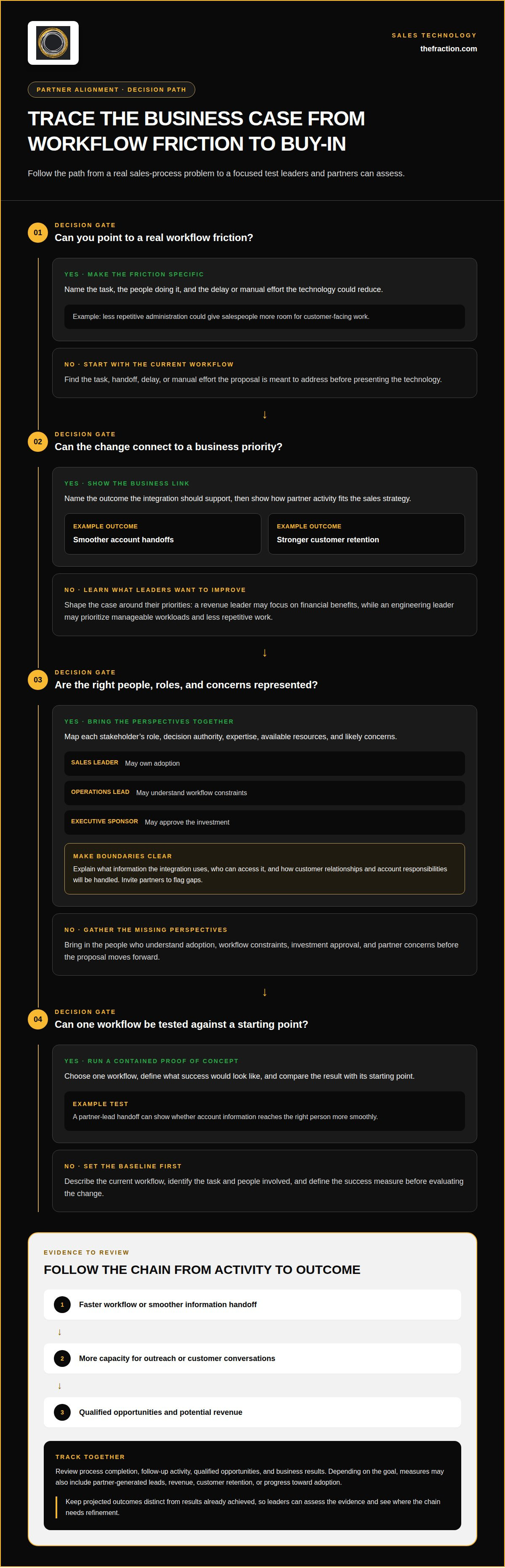
A proposal gets executive attention when it ties the technology to a business priority, so name the outcome the integration should support, like smoother account handoffs or stronger customer retention, and show how partner activity fits the sales strategy and where each team contributes. That gives leaders a clear business case to weigh, with the technology connected to the result they care about.
Before presenting the plan, find out what each executive wants to improve, because a chief revenue officer may focus on financial benefits while an engineering leader may prioritize manageable workloads. Shape the explanation around each person’s priorities…connect revenue leaders to commercial outcomes and show engineering leaders how the technology could reduce repetitive work.
Map stakeholders before seeking approval, so for each person, identify their role, decision authority, expertise, available resources, and likely concerns. A sales leader may own adoption, an operations lead may understand workflow constraints, and an executive sponsor may approve the investment…bring these perspectives together early, like pieces of a puzzle, so the plan reflects both the strategic goal and the practical work needed to achieve it.
Address partner concerns about data privacy, security, and customer ownership directly, explaining what information the integration uses, who can access it, and how customer relationships and account responsibilities will be handled. Document those boundaries in the partnership plan, then invite partners to flag gaps before the proposal moves forward.
Salespeople should help shape partnership plans, too, so ask a trusted account executive where partner introductions or shared account work could fit into the existing sales process. For example, a technology partner might introduce a customer, recommend an integration, or explain its value…specific actions help salespeople see how the relationship supports customer conversations and fits naturally into their workload.
Define a small set of outcomes for executives and partners to review together, with measures that might include partner-generated leads, revenue, customer retention, or progress toward adoption, depending on the goal. Set a baseline and regular review points to assess results and identify adjustments, so the review process keeps discussion grounded in evidence, surfaces concerns early, and gives stakeholders a practical reason to stay involved.
3. Connecting efficiency improvements to business outcomes
An efficiency claim gets persuasive when it links a technical change to work people value, because saved time is only the first step…a modest improvement in process speed, for example, needs context for a revenue leader: which activity moves faster, who gains capacity, and what important work that capacity could support? That’s how a technical detail becomes a business case people can picture.
Start with the current workflow as your baseline, then trace how the change could affect the business, like following a path from one task to the next. Identify the task, the people doing it, and the delay or manual effort the technology could reduce. If salespeople spend less time on repetitive administration, explain which customer-facing activities could get more attention, so executives can see how an operational improvement could support a commercial priority.
A chief revenue officer needs to understand the financial reasoning behind an investment, so connect the proposed tools to specific activities, such as lead routing or coordinated partner introductions. Then explain how those workflows could create more capacity for customer conversations, while keeping projected outcomes distinct from results already achieved.
Make the process change tangible…if automation reduces data entry, identify which entries and explain what salespeople could do with the time saved. If an integration improves information handoffs, describe how shared context could help an account executive prepare for a customer conversation. These concrete links give stakeholders more to evaluate than a feature list.
Trace the path from activity to outcome: a faster workflow could support more outreach, and those conversations may create qualified opportunities and potential revenue. Track process completion, follow-up activity, qualified opportunities, and business results together, so leaders can see where progress is occurring and where the chain needs refinement. That evidence keeps the proposal grounded as it develops.
A contained improvement can also serve as a proof of concept for a broader investment, so choose one workflow, define what success would look like, and compare the result with its starting point. A partner-lead handoff, for instance, can show whether account information reaches the right person more smoothly…the test gives leaders a small, practical signal to use when considering the next step.
How to get partner buy-in for sales technology comes down to making business value traceable from task to outcome. The conversation feels more grounded when the proposal shows what changes, who benefits, and what evidence will guide the decision. That’s the difference between asking people to trust a promise and giving them a clear way to assess the opportunity.
4. Making the case for technology integrations
A technology integration needs to solve a customer or sales problem people can actually see, so start with the friction in the current workflow and then show how connecting the systems could smooth it out. Think of a shared customer record as a common map…a partner and sales representative can use it to coordinate an account conversation instead of finding their way separately. Lead with that day-to-day benefit, so decision-makers can picture the value before you get into the features.
Partners are more likely to use sales technology when it helps them serve customers, support shared opportunities, or strengthen their position, so make those benefits concrete. Maybe it means warm introductions, clearer access to joint sales opportunities, or a better customer experience…show how each one connects to what partners actually do, rather than promising future growth in the abstract.
Shape the proposal around the person making the decision, because the same integration can look like a different tool depending on who’s holding it. A sales leader may care about smoother lead handoffs, while a product leader may focus on customer satisfaction and product differentiation. For example, explain how an integration could help a partner recommend a solution and give the sales team useful context for follow-up…same capability, different reasons to care, so make the case fit each role.
Build the argument around outcomes the integration could plausibly support, and connect each outcome to the work people do. Shared account information matters when it helps teams coordinate customer conversations; a connection between systems matters when it cuts duplicate work or makes it easier to act on a sales opportunity. Spell out the intended outcome, the workflow change, and who benefits, so organizations can see what the integration could realistically achieve.
Bring in evidence from the teams closest to the work, because they can usually point to where disconnected tools create friction. Ask sales, marketing, customer success, and product colleagues what’s getting in the way. Marketing might explain how integration supports follow-up after a joint webinar, while customer success may describe how partner context helps during a renewal…those examples show whether the need reaches across departments and make the proposal feel grounded in real work.
Build adoption into the case, because launch is more like opening day than the finish line. Explain how partners will learn the workflow, where they can find guidance, and how teams will share feedback. A pilot with a small group, for example, can show whether account details appear where users need them, so use what participants learn to refine the process before expanding it across the partnership.
Finally, tie the integration back to the partnership’s shared commercial story, so both sides can see why it matters. If a joint solution helps customers understand a product’s value, partners have a clearer reason to recommend it and sales teams have a stronger reason to engage. Explain how the integration supports that story, what each side contributes, and how teams will recognize progress…a clear mutual benefit gives people something solid to champion across the relationship.
5. CRM data quality and user adoption
A CRM earns trust when its records help partners take useful action. Sales representatives can use CRM software and sales apps to manage client relationships and monitor sales activity, but inaccurate account details, duplicate contacts, or outdated ownership fields can make that work harder. Before launch, define what information supports a real sales task, who maintains it, and how partners should use it, so each field has a clear purpose.
After launch, measure adoption through actual use and data quality. Track whether partners access the CRM, complete agreed workflows, and enter usable information. Check whether key records have current contact details, account ownership, and relevant next steps. These measures show how the system is being used, since regular logins can sit alongside incomplete records.
A CRM earns its place when partners can connect their daily sales tasks with the tool’s practical benefit. Show, for example, how updating an account record helps the next person prepare for a customer conversation, so using the system becomes part of the work rather than a separate chore.
Protect data quality by agreeing on a small set of shared practices. Define who owns each account field, what counts as a complete record, and how changes are recorded. If an account executive receives a partner introduction, the handoff could capture the customer’s needs, the relevant contact, and the agreed next action. Consistent examples make expectations easier to follow.
How should you measure and improve partner adoption after launch? In the early stages and as the rollout continues, review workflow use, record completeness, and partner feedback. If a measure reveals friction, identify where users stall, then adjust instructions, workflow steps, or field definitions.
Keep the review practical. A short conversation with partner users can reveal why a field is skipped or account ownership feels unclear. Compare that feedback with CRM records, then make one focused improvement at a time. If partners leave next steps blank, for instance, clarify what belongs there and show an example from a typical customer handoff.
For an enterprise sales team, the same process can guide a broader rollout. Start with the partner workflow, make data responsibilities visible, and give users a simple way to raise issues. Then assess whether the change improves customer information and supports the intended sales activity, so adoption becomes an operating practice rather than a launch announcement that quickly fades.
5. How do you identify partner needs and select sales technology they will use?
Start with the partner’s actual sales work, because that’s where the real needs show up…map how a lead moves from introduction to customer conversation, and look for the spots where handoffs start to drag. Technology sales reps work with customers to identify challenges and figure out which technology could help, so bring that same consultative approach to partners: ask about a specific task, where it gets sticky, and what a better process would make possible.
Talk with the people who’ll use the technology, not just the executive sponsor, because choosing a tool without their input is a bit like planning a route without asking who’s driving. A partner sales rep might need a faster way to share account context, while a partner manager might need visibility into joint opportunities. Ask each person to walk through a recent example, then capture the task, information needed, people involved, and current workaround…those details turn broad requests into requirements you can actually use.
Separate essential needs from preferences before comparing options, so the search doesn’t turn into a hunt for shiny features. For each requirement, describe the partner’s problem and the outcome the tool should support. If a team struggles to coordinate referrals, for example, a useful solution should make the handoff clear and actionable. If a partner wants customer updates, clarify which updates matter and who needs them, so selection stays grounded in how people work.
Look at how a proposed tool fits the partner’s existing sales process, because even the slickest tool can feel like another hurdle if it adds steps to the day. Consider whether it supports the agreed workflow, gives users access to needed information, and keeps the process moving. A CRM integration may look attractive in a demonstration, but the partner’s daily workflow is the real test…walk through a sample referral from first contact to follow-up before deciding.
Use partner input to rank the options, so the choice reflects what matters in the work itself. Ask users to weigh workflow fit, ease of use, customer value, and adoption effort. A simple comparison can bring the trade-offs into focus: one tool might provide stronger account context, while another makes referral handoffs smoother. Talk through the differences together, so the selection reflects shared priorities rather than one team’s favorite feature.
Before a wider rollout, test the preferred option against a real partner task, because a small trial can show where the wheels catch before everyone’s using it. Have a small group complete a sample handoff, then ask where instructions, information, or ownership felt unclear. Use their feedback to refine the workflow and training materials. That focused test lets partners shape the solution and helps establish whether it addresses the original need.
Choose technology partners can connect to a clear business purpose and a workable sales routine…a sales process partners can adopt
The Fraction: A sales process that doesn’t feel like selling
The Fraction helps professionals build a clearer path from what a customer needs to a sales conversation that feels confident and natural…because when your offer and service give people a clear reason to move forward, the conversation has something solid to lean on. And for teams looking to turn better technology adoption into stronger lead generation, The Fraction builds automated, AI-driven lead generation systems and sales processes.
So if your technology plan’s ready but your sales process still needs a sharper offer, clearer messaging, or a more reliable way to generate leads, this could be the next step…think of it like a connected engine, where technology keeps the process moving and the offer gives customers a reason to engage.
Contact The Fraction to talk through your sales process.
Turn partner alignment into a practical next move
How to get partner buy-in for sales technology is easier to answer when the next step is concrete. Choose one shared sales workflow and turn the proposal into a working agreement: who owns the decision, what partners will do, and how the team will learn from early use. That agreement bridges executive intent and the habits that make adoption real.
Keep the first move focused, so partners can see where their input matters and leaders understand what the decision enables. A thoughtful rollout grows from clear ownership and useful feedback, like a path that gets easier to follow with each step. You have a practical starting point; shape it around the people who will use it.
Build alignment one clear decision at a time, giving the partnership room to move forward with confidence.
Frequently Asked Questions
What is partner buy-in for sales technology, and why does it matter?
Partner buy-in means partners understand why a sales tool is in the mix and are willing to use it in the work you share, because the process runs on the people using it, including partner teams contributing leads, customer context, or follow-up. Think of a referral workflow like a relay…both organizations need to agree who passes the lead, who picks it up, and how the partner stays in the loop, or the handoff loses momentum.
How can you build a business case for sales technology adoption with channel partners?
Start with one shared sales objective, then connect the proposed tool to a specific partner activity, so the value feels like a bridge to work both sides already need to do. If channel partners need clearer referral visibility, for example, show how the workflow captures a handoff and prompts the right person to follow up. Spell out the effort each organization will put in, the intended customer benefit, and how both sides will review progress…shared ownership gives the proposal stronger footing.
What ROI metrics should you use to demonstrate sales technology value to partners?
Choose measures that fit the job the technology is meant to improve, so you’re looking at the right dashboard for the journey. For a referral workflow, track referrals received, qualified opportunities, completed follow-up, and associated revenue. For customer retention, look at renewal outcomes and partner involvement in the account. Compare results with a defined starting point, then read the measures together: activity shows whether people are using the process, while business outcomes show where it’s contributing value.
What training and onboarding help partners adopt new sales technology?
Build role-based onboarding around real tasks, like submitting a referral, updating an account, or reviewing a shared opportunity, so partners can see how the tool fits into their day. A short walkthrough shows the workflow, and a practice scenario gives users a chance to try each step before working with customers. Keep instructions concise, name a support contact, and collect questions after initial use…then use recurring issues to clarify the guidance or simplify the process, helping partners build confidence through practice.


