

What if prospecting that looks free is quietly taking your most valuable hours? Calculating the cost of manual prospecting means looking beyond subscriptions and contact data to the time you spend researching, writing outreach, and tracking who needs a follow-up. When those tasks compete with client delivery or higher-value business development, the real cost starts to come into focus.
Start with visible expenses, because software charges and data purchases are easy to find. But a useful estimate also includes your working time, the opportunities those hours could support, and the pipeline gaps that appear when outreach happens inconsistently. A low-cost contact list, for example, can still take substantial personal effort to turn into relevant conversations.
In this guide, you’ll build a practical model using your own hours, expenses, and conversion experience, rather than borrowed benchmarks. We’ll identify the direct and indirect inputs, then compare hands-on prospecting with a more repeatable system, so you can decide which work deserves your attention and which tasks could be systematized while you retain ownership of the infrastructure.
Key Takeaways
- Calculating the cost of manual prospecting starts with a clear definition of the work and a simple formula: direct expenses plus prospecting hours valued at your chosen hourly rate.
- Group costs into labor, data and software, messaging infrastructure, and administration to catch inputs that are easy to miss.
- Compare manual and system-supported prospecting using your own records for time, consistency, control, setup effort, and ownership.
- Use a repeatable audit and worksheet to track hours, expenses, qualified conversations, and the assumptions behind your totals.
- Assess whether prospecting has become recurring work that competes with valuable executive time, then identify where clearer targeting, offer positioning, and follow-up could make the process more consistent.
Calculating the Cost of Manual Prospecting Starts With Defining the Work
Before you price the process, draw its boundaries. Manual prospecting is the work you personally do to find and progress potential clients: researching accounts, identifying contacts, preparing messages, reaching out, following up, and recording activity. Think of it as the front end of your sales process, where the goal is to create relevant conversations and track the work that supports them.
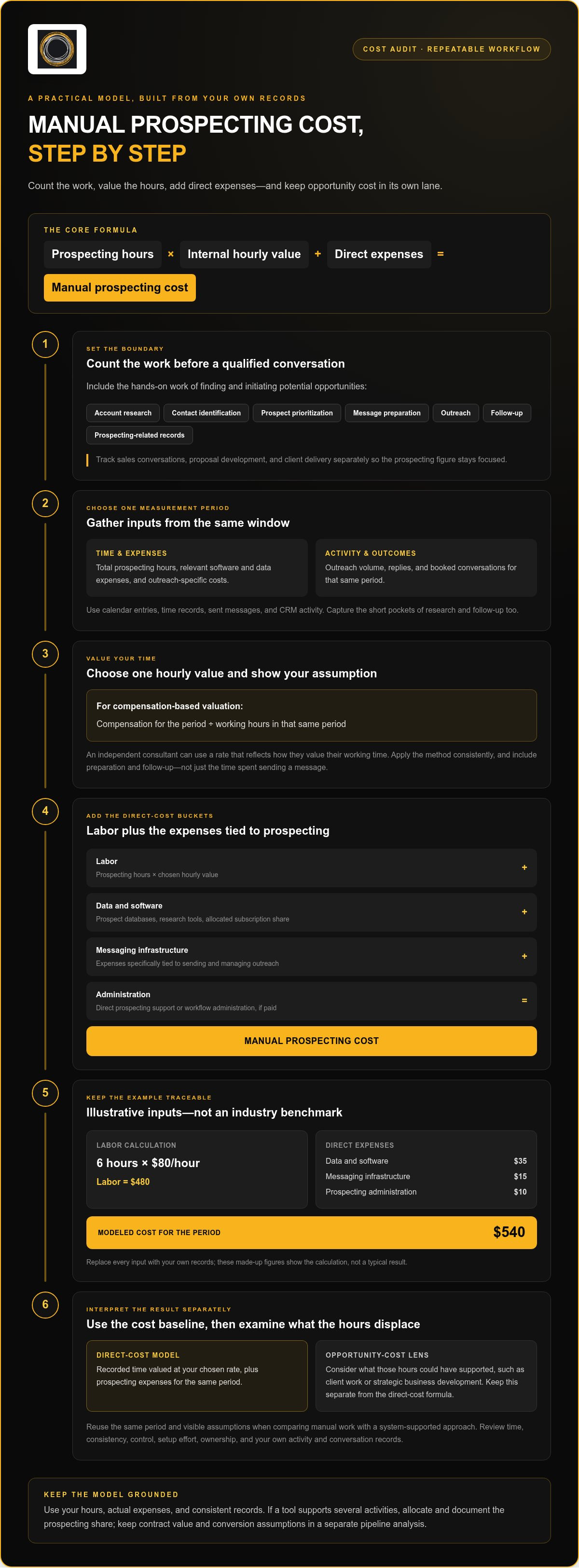
Manual prospecting cost is the direct expense of prospecting plus the value of the hours spent doing it, calculated using an appropriate internal hourly rate. In formula form: direct expenses + (prospecting hours × internal hourly rate). This gives you a grounded baseline for calculating the cost of manual prospecting, using your own workflow instead of a generic benchmark.
Which activities belong in a manual prospecting calculation?
Include account research, contact identification, prospect prioritization, message preparation, outreach, follow-up, and CRM updates. These are the moving parts before a qualified sales conversation takes place. Track sales conversations, proposal development, and client delivery separately, so your prospecting figure stays focused on finding and initiating potential opportunities.
Choose a defined period, such as a month, then trace the workflow using calendar entries, time records, sent messages, and CRM activity. If research and follow-up happen in short pockets between other responsibilities, capture those too, because scattered minutes can add up like loose change in a drawer.
Which inputs should you collect before calculating?
Gather total prospecting hours, relevant software and data expenses, outreach volume, replies, and booked conversations for the same period. If a tool supports several business activities, allocate the share that reasonably belongs to prospecting. Using one consistent period and clear records makes the result easier to compare later.
For your internal hourly rate, use your actual compensation and working-hour assumptions. For example, divide compensation for the period by the working hours in that same period, using a calculation that fits your role and compensation structure. If you’re an independent consultant, choose a rate that reflects how you value your working time, and keep that assumption visible.
Opportunity cost adds a separate lens: consider what else those hours could have supported, such as client work or strategic business development. Keep that comparison separate from the direct-cost formula, which already values the prospecting hours. Contract value and conversion assumptions also belong in a separate analysis; they help assess pipeline economics, while recorded time and direct expenses show what prospecting consumed.
Build a Full Cost Model for Manual Prospecting
Once you’ve defined the work, give every input its own place in the model. Think of it like assembling an operating picture: labor shows the effort, direct expenses show the cash outlay, and a separate opportunity-cost view shows what that effort may be displacing.
Manual prospecting cost = labor cost + data and software + messaging infrastructure + administration. Calculate labor as prospecting hours × your chosen hourly value, then add the actual prospecting expenses for the same period.
- Labor: Research, contact identification, message preparation, outreach, follow-up, and prospecting-related recordkeeping.
- Data and software: Prospect databases, research tools, and the prospecting share of relevant subscriptions.
- Messaging infrastructure: Expenses specifically tied to sending and managing outreach.
- Administration: Other directly attributable costs, such as prospecting support or workflow administration, if you pay for them.
Illustrative example, using made-up inputs rather than an industry benchmark: Say you spend six hours prospecting during a chosen period and assign your time a value of $80 per hour. Labor is $480. If your allocated data and software expense is $35, messaging infrastructure is $15, and prospecting-specific administration is $10, your modeled prospecting cost is $540 for that period. Replace every input with your own records; the example shows how to do the math, not a typical result.
How do you value time spent prospecting?
Choose a defensible hourly value that fits your situation, such as compensation divided by working hours, or the value you assign to alternative work you could have taken on. Pick one method, state its assumptions and measurement period, and apply it consistently. Include preparation and follow-up, because the work around sending a message can take longer than the send itself.
How should direct expenses and opportunity cost be handled?
Record actual subscriptions, data purchases, and prospecting-specific expenses for the same period as your hours. If a subscription supports several activities, allocate a reasonable prospecting share and note how you estimated it. Making the method visible improves later comparisons, and the broader Customer Acquisition Cost (CAC) concept can help distinguish prospecting inputs from the wider cost of acquiring a client.
Software spend alone understates prospecting cost because it leaves the human hours behind the workflow off the ledger. Treat opportunity cost as a separate decision lens: name the client work or business development those hours displaced, then assess that trade-off separately. Avoid adding hypothetical lost revenue to recorded expenses or counting the same hours twice. If you’re building a repeatable acquisition process, The Fraction’s done-with-you client-acquisition systems bring targeting, tools, and follow-up into a working structure.
Compare Manual Prospecting With a Systematic Approach Using Your Own Data
A fair comparison uses the same measuring tape for both workflows: the same period, the same definition of a qualified prospect, and the same end point, such as a booked qualified conversation. Then you can see differences in time, consistency, control, setup effort, and ownership, instead of relying on a generic claim that one approach always costs less.
What should a fair manual-versus-system comparison include?
For each approach, include setup and maintenance time alongside recurring labor and tool expenses. Assess whether targeting stays accurate, outreach remains relevant, and follow-up happens reliably. A system can support repeatable steps, while you retain the human judgment behind positioning, relationship-building, and sales conversations. Those are distinct parts of the process, so give each its own place in the comparison.
| Input | Manual workflow | System-supported workflow |
|---|---|---|
| Measurement period and prospect definition | [Enter period and criteria] | [Use the same period and criteria] |
| Setup and maintenance hours | [Enter hours] | [Enter hours] |
| Recurring prospecting hours | [Enter hours] | [Enter hours] |
| Direct expenses for the period | [Enter actual expenses] | [Enter actual expenses] |
| Qualified conversations recorded | [Enter count] | [Enter count] |
| Control and ownership | [Describe process and assets] | [Describe process and assets] |
Fill the table from your activity records, and include system setup as a cost in the period you choose or allocate it transparently across periods. If you can reliably connect prospecting activity to qualified conversations, calculate each approach’s cost per conversation by dividing total cost by its recorded qualified conversations. If the records are incomplete or the prospect definitions differ, compare the inputs instead of treating the resulting ratio as meaningful.
How do you calculate a break-even point without generic benchmarks?
Compare your documented manual cost with the system’s actual implementation, maintenance, tool, and labor inputs over the same period. Then use your own historical conversion data to estimate how many qualified conversations would be needed to support the change, keeping assumptions about offer value and conversion separate from recorded prospecting costs. This is a model, not a promise, so rerun it when your pricing, offer, or conversion experience changes.
As a broader lens on the economics behind sales staffing, Harvard Business School discusses sales force costs. For your own decision, calculating the cost of manual prospecting works best when the inputs remain yours: actual hours, expenses, outcomes, and the degree of control you want over the system and its infrastructure.
Calculate Your Manual Prospecting Cost in a Repeatable Workflow
A useful audit gives you a dependable baseline, so you can see where your time goes before changing the process. Treat it like a field map: capture what happens as you work, then follow the trail from activity to qualified conversation instead of relying on a memory that’s already blurred by the end of the week.
- Choose a representative period. Pick a week or month that reflects your usual prospecting rhythm, and use the same period if you’ll compare results later.
- Map the activities. List the research, contact identification, message preparation, outreach, follow-up, and recordkeeping involved in your current workflow.
- Record time as you go. Log time by task when it happens, including short sessions between other responsibilities. End-of-period estimates can miss the small blocks that quietly accumulate.
- Track activity and quality separately. Record outreach volume, responses, follow-up completion, and qualified conversations as distinct measures. A larger message count shows activity; qualified conversations offer a clearer signal of progress.
- List expenses and calculate totals. Add the direct prospecting expenses for the chosen period to labor, using the hourly value and method you’ve selected. Keep your assumptions beside the calculation so you can interpret it accurately later.
A simple prospecting audit worksheet
- Period and prospect definition: [Enter dates and what qualifies as a prospect]
- Time by task: Research [ ], contact identification [ ], preparation [ ], outreach [ ], follow-up [ ], recordkeeping [ ]
- Direct expenses: Data [ ], software allocation [ ], messaging infrastructure [ ], administration [ ]
- Raw activity: Outreach sent [ ], replies received [ ], follow-ups completed [ ]
- Quality indicator: Qualified conversations [ ]
- Assumptions: Hourly value, expense allocations, and qualification criteria [ ]
For a useful calculation, record the period, prospecting hours by task, direct expenses, outreach activity, qualified conversations, and the assumptions behind each input. That’s the minimum set of markers; together, they turn calculating the cost of manual prospecting into a repeatable measurement rather than a one-off guess.
Once you have the baseline, compare labor and direct costs with qualified pipeline activity, then look for the bottleneck: repeated research may point to a targeting issue, while unfinished follow-up may signal a consistency gap. Choose one change, such as refining prospect criteria or systematizing a follow-up step, and measure it against the same baseline. That way, you’ll see which adjustment made a difference without changing the whole machine at once.
When Does a Prospecting System Make Sense for a Consultant?
A system starts to make sense when prospecting is recurring, you can measure its activity, and the work is competing with client delivery or other valuable executive work. Calculating the cost of manual prospecting gives you a decision point, helping you identify which tasks may benefit from automation and which need your personal judgment. The aim is to see where repeatable steps could run more consistently while you focus on work that needs your expertise.
What signals suggest manual prospecting is consuming too much leverage?
Look for familiar patterns: research gets repeated for each new prospect, follow-up becomes uneven, or outreach pauses whenever client work gets busy. Then check the foundation beneath the activity. When your audience and offer are clear, relevant targeting and messaging become easier to repeat; if they’re still taking shape, refine that positioning before scaling outreach. Finally, ask what those prospecting hours are displacing, whether paid delivery, strategic business development, or focused time to build a consulting practice.
Personal outreach still matters, especially when positioning, relationship-building, and sales conversations call for your experience. Think of the system as the operating framework around that judgment: it can support how prospects are identified, how outreach is organized, and how follow-up stays on track, while you decide what to say and how to advance a genuine conversation.
How can The Fraction support a more repeatable client-acquisition system?
The Fraction works with clients through a done-with-you approach that brings offer development, market positioning, targeting, automation setup, and sales process design into one connected structure. LinkedIn Sales Navigator targeting and automation tools can support prospect identification and outreach workflows, while your offer and message speak to the right audience. For professionals building a consulting practice while employed, outreach can be scheduled for evenings to fit around existing work commitments.
The systems, automations, and content developed through the work are yours to retain. That ownership matters: the process becomes an asset you can understand and manage, rather than a rented mechanism you depend on someone else to operate. Compare your audit with the recurring work you want a system to support, then decide where your personal attention creates the most value.
Learn more about executive consulting practice support.
Turn Your Prospecting Numbers Into a More Repeatable Practice
Calculating the cost of manual prospecting gives you a clearer basis for deciding where your time, tools, and attention belong. Track the full workflow, from research through follow-up, and use your own records to separate activity from qualified conversations. Then compare a system-supported approach against that baseline, including setup work and the value of your time.
The right system keeps your judgment in targeting, positioning, and relationship-building, while helping recurring outreach happen more consistently. With done-with-you support, offer development and client-acquisition system implementation come together, and you retain the systems, automations, content, and infrastructure built for your practice. Outreach can also be scheduled for evenings if you’re building while employed.
Use your audit as a starting point, then shape a process that fits the practice you’re building. A clearer system can help you move forward with greater intention and ownership.
Frequently Asked Questions
How do you calculate the cost of manual prospecting?
Add direct prospecting expenses to the value of the time spent prospecting: total cost = direct expenses + (prospecting hours × internal hourly rate). Use one defined period, such as a month, and include research, preparation, outreach, follow-up, and prospecting-related administration. Calculating the cost of manual prospecting this way gives you a baseline based on your own activity. Consider opportunity cost separately, so you can evaluate what other work those hours might have supported.
What costs should be included in manual prospecting?
Include prospecting labor, relevant data and software expenses, messaging infrastructure, and prospecting-specific administration. Count the time spent finding accounts and contacts, preparing outreach, following up, and updating records. If a tool supports several business activities, allocate a reasonable share to prospecting and record your method. Keep sales conversations, proposal work, and client delivery separate so the calculation reflects the cost of prospecting itself.
How do you calculate the hourly cost of prospecting time?
Choose a consistent way to value your working time, then divide compensation for a defined period by the working hours in that same period. If you’re an independent consultant, you can instead use an hourly value that reflects the alternative work you could take on. State your inputs and apply the method consistently. Multiply that hourly value by all prospecting hours, including preparation, outreach, and follow-up.
Is manual prospecting more expensive than automated prospecting?
It depends on your actual hours, expenses, setup effort, maintenance needs, and how each approach supports consistent targeting and follow-up. Compare both workflows over the same period and with the same definition of a qualified prospect. Include system-related expenses and setup time, then compare total inputs and recorded qualified conversations. Automation can support repeatable tasks, while your judgment remains central to positioning, relationship-building, and sales conversations.
How do you calculate the cost per qualified prospect?
Divide total prospecting cost for a defined period by the number of qualified prospects recorded during that period. For example, if your records show a total cost of C and Q qualified prospects, the calculation is C ÷ Q. Define what “qualified” means before counting, and use consistent records for activity and outcomes. If you’re measuring qualified conversations instead, use that outcome as the denominator and label the metric accordingly.
When should a consultant stop doing prospecting manually?
Consider systematizing recurring tasks when research keeps being repeated, follow-up varies, or outreach pauses whenever client work gets busy. Your audit can show whether prospecting hours are competing with paid delivery or strategic business development, and whether targeting and offer clarity are strong enough to support relevant outreach. A system can organize repeatable steps while you keep personal attention on market positioning, relationship-building, and important conversations.
Can I build a consulting pipeline while keeping my corporate job?
Yes, you can build a consulting practice while employed by shaping the offer and acquisition process around the time you have available. Outreach can be scheduled for evenings, and the workflow can be structured to avoid employer conflicts. A repeatable system helps organize targeting and follow-up, while you continue to guide the positioning and conversations. Build a process that fits your current commitments and that you can manage consistently.


