

Trust grows when your confidence leaves room for the client’s reality. So, learning how to project authority in a sales process starts with getting clear on what a prospect needs, preparing to speak to it, and making the next step easy to see when the conversation’s ready…think of it like guiding a build: you bring the blueprint, but the client’s priorities shape what takes form.
Clients value expertise, and it carries more weight when you pair it with real curiosity and a bit of humanity, so a thoughtful question, a natural moment of humor, or a clear explanation of where your solution fits can turn a sales conversation into the start of a partnership.
Here, you’ll learn how to qualify prospects, uncover their problem and buying process, prepare a focused conversation, and agree on next steps when the moment’s right. Listen closely, speak specifically, and let the client’s needs shape how you lead…that’s where authority starts to feel less like a performance and more like a steady hand on the wheel.
Key Takeaways
- Qualify a prospect by clarifying the problem, desired outcome, decision process, and timing before shaping your recommendation.
- Build rapport with genuine curiosity and well-judged humor, so the conversation feels human while staying focused on the client’s needs.
- Prepare a meeting around a clear agenda and specific value, then adapt your presentation to what the prospect needs to decide.
- Close each conversation with shared next steps and a concrete timeline, then send a written recap to keep both sides aligned.
- Support credibility with relevant evidence, clear expectations, and an honest account of the resources you can commit.
Qualifying prospects and addressing customer pain points
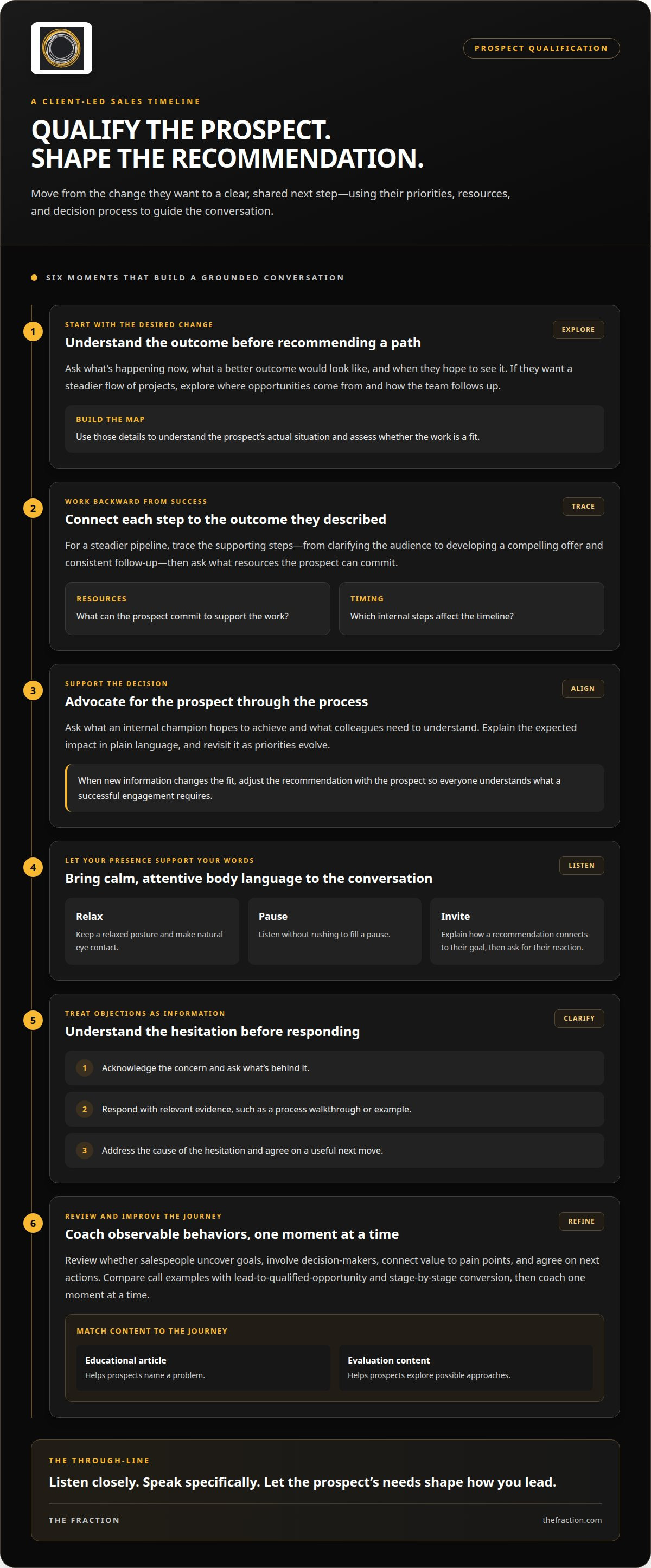
- Start with the change the prospect wants. Ask what’s happening now, what a better outcome would look like, and when they hope to see it…then, if an agency owner wants a steadier flow of projects, explore where opportunities come from and how the team follows up. Those details give you a map, so your recommendation reflects the prospect’s actual situation and your sales team can assess fit carefully.
- Work backward from the outcome. If success means a steadier pipeline, trace the steps that could support it, from clarifying the audience to developing a compelling offer and consistent follow-up…then ask what resources the prospect can commit and which internal steps affect the timeline. Learning how to project authority in a sales process means tying each recommendation to those priorities, so every step leads toward the outcome they described.
- Be the prospect’s advocate through the decision. Ask what an internal champion hopes to achieve and what colleagues need to understand, then explain the expected impact in plain language and revisit it as priorities evolve. If new information changes the fit, adjust the recommendation with the prospect…because this may take extra discussion, but it helps everyone understand what a successful engagement requires.
- Let your body language give your words room to land. Keep a relaxed posture, make natural eye contact, and listen without rushing to fill a pause…then speak at a measured pace and pause after explaining a recommendation. For example, describe how your approach connects to the prospect’s stated goal, then invite their reaction. That steady presence shows how to project authority in a sales process with confidence and composure.
- Handle objections as useful information. Acknowledge the concern, ask what’s behind it, and respond with relevant evidence, such as a process walkthrough or example…because repeating a pitch, interrupting, or rushing a decision can make the conversation feel forced. Curiosity creates a better rhythm: understand the hesitation, address its cause, and agree on a useful next move.
- Coach observable behaviors and content by journey stage. Managers can review whether salespeople uncover goals, involve decision-makers, connect value to pain points, and agree on next actions…then compare call examples with lead-to-qualified-opportunity and stage-by-stage conversion, and coach one moment at a time. Blog content can also support the journey: an educational article helps prospects name a problem, while evaluation content helps them explore possible approaches.
Building rapport through humor and genuine communication
Rapport grows when the conversation feels like two people thinking together, so bring warmth, curiosity, and room for humor…like a good rhythm section, each person contributes, and the whole exchange gets easier to follow.
-
Establish Credibility and Trust
Begin with a relevant observation about the prospect’s world, then give them room to explain how it applies. If a complex project involves internal teams, ask how those groups work together and where coordination goes smoothly…you’re creating a genuine conversation, with their answers shaping what you explore next, so stay curious and follow their lead.
Use examples as conversation starters, too, because a brief story about a common challenge can prompt the prospect to share their context, and their response reveals which details matter most to them.
-
Communicate Confidently Without Arrogance
Share your point of view in clear, everyday language, then make space for the prospect’s perspective. You might say, “I’m seeing a pattern here, and I’d love to hear how it looks from your side.” That phrasing shows you’ve formed a useful perspective while keeping the discussion open…confidence is like a sturdy table, supporting the conversation while leaving room for everyone.
When a topic gets complex, pause to check that your explanation is clear, and a quick “Am I making sense?” invites collaboration and gives the prospect an easy opening to add nuance.
- Let humor follow the prospect’s cues. A light comment about a shared, low-stakes moment can make a meeting feel less formal, but keep it kind and relevant. If a prospect jokes about calendar overload, you might smile and say, “The calendar’s clearly running the company today.” Then return naturally to the topic…humor works like seasoning, where a little can add warmth to the conversation.
- Show genuine interest in the person behind the role. Ask what drew them to the project, what their team cares about, or how they prefer to make decisions, then listen for a detail you can follow up on, such as a launch milestone or team priority. Remembering and revisiting it makes the exchange feel personal while keeping your attention on what matters to them.
- Make room for a natural conversational pace. Use the prospect’s words, match their level of formality, and let a short pause do its work. If they speak broadly, start at a high level; if they want detail, explore the mechanics together…that flexibility keeps the discussion human and lets you define ideas collaboratively, especially when project managers or internal specialists join.
For a more natural path from conversation to client decision, explore a sales process that feels natural.
Planning presentations, proposals, and client meetings
A strong meeting plan gives the conversation a clear route while leaving room for the prospect’s priorities. Treat the agenda, presentation, and proposal as connected parts of one decision.
-
Project Authority Across Communication Channels
Prepare each channel around one clear message and the prospect’s decision. In email, use a subject line that names the topic, then state the purpose and requested action. On video calls, check your camera, sound, framing, and shared materials before joining. In a presentation, follow a simple sequence: the prospect’s context, your recommendation, and the value it supports.
To project authority across email, video calls, and presentations, use specific language, measured delivery, and recommendations tied to the prospect’s needs. Make sure each channel sets realistic expectations and avoids unsupported promises.
-
Set Agendas and Guide the Sales Process
Send a short agenda before the meeting, outlining its purpose, topics, and decisions needed. At the start, ask the prospect to review it and confirm it makes sense. Guide the discussion through each item, adjusting when the prospect introduces relevant context. This gives the meeting structure without making it feel scripted.
To set a clear agenda and guide the sales process, name the intended outcome, invite the prospect’s input, and agree on what the conversation should resolve. If a key decision-maker is absent, identify their role and include their questions in the next step.
- Build the presentation around the decision. Choose evidence that helps the prospect evaluate the proposal instead of filling slides with every feature. For example, if a team wants to reduce handoff delays, show how the recommended approach addresses that workflow. Explain assumptions and dependencies so everyone involved can assess the plan against their expectations.
- Make the proposal easy to evaluate. Organize it around the problem, scope, deliverables, responsibilities, and implementation path. Spell out what the work includes and how changes will be handled. If an integration or internal resource is required, describe its role plainly. Clear boundaries help the prospect understand the commitment before discussing a contract.
- Use the meeting to surface concerns early. Leave time for questions after presenting the recommendation, and ask which parts need more context. If a prospect loses confidence because an assumption is unclear, address it directly before moving forward. A calm explanation, supported by relevant evidence, keeps the discussion focused on the decision rather than pressure.
- Close with a decision path. Summarize what the group agreed, what remains open, and who owns each action. If the proposal needs revision, specify the change and the next review point. The prospect should leave knowing whether they’re evaluating scope, confirming resources, or preparing to discuss contract terms.
Recapping conversations and documenting next steps
A clear recap turns a conversation into a working record, so prospects and sales teams can move forward with the same understanding…think of it as a shared map, showing what’s settled, what’s still open, and where each side goes next. Use each follow-up to capture decisions, open points, responsibilities, and the next milestone, so the conversation keeps moving instead of fading into everyone’s separate version of events.
- Record the decision and its context. After each call, capture what the prospect agreed to, what’s still undecided, and why, because “reviewing the proposal” and “approving the proposed scope” can sound close but point to very different places. That difference gives managers a clearer view of the opportunity, so the next conversation starts from the prospect’s actual position.
- Separate confirmed details from open questions. Group the recap into decisions, outstanding questions, and actions, so assumptions don’t quietly grow legs and turn into commitments. If the prospect mentioned an internal review, record who needs to contribute and what they’ll assess…that way, colleagues who missed the call can use the recap without mistaking speculation for an agreed fact.
- Assign every action to an owner and timeline. Name the person responsible and the date or milestone they’ve agreed to meet, so each action has somewhere to land. The salesperson might send a revised scope by Friday, while the prospect shares it with the decision team before their review…clear ownership makes follow-through visible and gives both sides a practical way to track progress.
- Confirm both sides share the same understanding. Before moving to the next step, ask whether the recap reflects the conversation as the prospect understood it, because a different expectation around the deliverable or sequence can create a gap later. If something’s off, sort it out before drafting a contract…that small check protects the relationship and keeps the sales process aligned with the customer’s expectations.
- Write for the people who will use the recap. A prospect may forward your message to a decision-maker who missed the call, so write in plain language and include the business context they’ll need. Instead of “phase two is blocked,” explain that “the launch plan depends on confirming the data handoff”…clear wording helps others assess the issue without needing the whole conversation reconstructed for them.
- Track changes in the opportunity record. Update the relevant sales system with the prospect’s current position, new stakeholders, changed priorities, and agreed actions, so the record stays close to what’s happening now. If the timeline shifts, capture the reason and revised milestone…then managers can coach from the actual conversation history instead of relying on memory or an outdated forecast.
- Close the loop on every commitment. Send a written summary after each call, then complete your assigned action when promised, because a recap only works when the follow-through matches it. If a deliverable changes, tell the prospect what changed and how it affects the next milestone…done consistently, the recap becomes more than meeting paperwork; it becomes a dependable record of both sides’ progress.
How can salespeople establish credibility and trust with prospects?
Trust takes shape in those moments a prospect can actually see and verify…from explaining where you fit to doing what you said you’d do, so your expertise becomes easier to judge before anyone commits.
- Explain where your solution fits. Show the conditions where your approach can meet expectations, then talk through the situations that call for a different plan. For example, explain which customer problem your service addresses and what depends on the prospect’s internal resources…because clear boundaries give prospects a much better way to judge fit, and your recommendation carries more weight than a sweeping claim.
- Make experience tangible. Give prospects evidence they can examine, like a relevant example, a process walkthrough, or a conversation with a satisfied customer, and connect each proof point to the concern they’ve raised. If you describe a successful implementation, walk through the challenge, the work involved, and the outcome in concrete terms, so the picture does the talking instead of an impressive-sounding label.
- State what your team can contribute. Spell out which people, expertise, and time you can commit to the project…because if a prospect expects hands-on support, they’ll want to know who’s leading the work and how responsibilities are shared. That gives the buyer a realistic picture of delivery, and helps your team keep its promises inside what it can actually take on.
- Confirm readiness before making commitments. Before you agree to a launch plan, check that the resources and expertise are there to support it. For example, a project involving a technical integration needs people who can assess and complete that work, so if there’s a resource gap, talk through its effect on scope or timing before it turns into a surprise after signing.
- Make expectations visible to everyone involved. Summarize the intended outcome, responsibilities, and open assumptions in language the prospect can share internally…because a finance leader and an operational lead may be looking at different risks, and explaining how the proposed work relates to each concern helps everyone evaluate the same proposal.
- Let follow-through reinforce your claims. Deliver the information you promised, clear up misunderstandings promptly, and explain any change that affects the agreed plan. If new information changes your recommendation, for instance, show what changed and why…because every reliable action is another brick in the bridge between what you say and how you’ll work after the sale, making credibility a visible pattern.
The Fraction: A sales process that doesn’t feel like selling
The Fraction helps professionals build a sales process that feels like a useful conversation, with automated and AI lead generation systems, a compelling offer, and support for attracting prospects and guiding them toward a decision. So, when you understand how trust develops but want a more consistent way to start conversations, think of the process as a path: lead generation opens the door, a well-shaped offer gives the conversation direction, and genuine communication helps clients assess the fit. The Fraction can help bring those pieces together around the value you bring.
Make trust part of how you grow
Your next opportunity is to make trust a deliberate part of your sales culture, so each prospect experiences the same clarity and care, whoever leads the conversation. To understand how to project authority in a sales process, treat it as an operating principle that carries through every interaction, from the first hello to the follow-up and all the little moments in between. That shift gives your expertise a consistent presence, from first contact through the prospect’s decision about what comes next.
Build on that principle by listening for when prospects hesitate, which questions they return to, and the language they use to describe value. Those signals can help refine how your business communicates, making each conversation more relevant and your market position easier to understand. Authority grows through choices clients can see, and your next move can make those choices more intentional.
So strengthen the process one conversation at a time, and with a clear point of view and room for genuine dialogue, you can build a more confident path forward.
Frequently Asked Questions
Timing: How do you know it’s not too soon or too late in the sales process?
Move forward when the prospect’s questions show they’re ready for the next decision, because questions about implementation, internal alignment, or how an approach would work signal growing interest. If they’re still defining the problem, keep exploring before you present a final recommendation, and if decision-makers are comparing solutions, clarify what remains unresolved. So the right timing follows the prospect’s readiness and decision process, with each next step building on what they’re ready to consider.
What if an agency owner is the one doing sales?
An agency owner can make sales part of the operating system, like a recurring rhythm that supports delivery rather than competing with it. Set aside time to review active opportunities, prepare for client conversations, and follow up on agreed actions, so each conversation has room to move forward. For example, schedule a planning session before a proposal meeting. As the agency grows, document the questions and decision points that help prospects assess fit, making the process easier to share.
What is authority in sales?
Authority in sales means helping a buyer make an informed decision through sound judgment and relevant expertise, like a guide who knows the terrain and can point out the trade-offs along the way. It grows when you explain what matters to the buyer and keep the discussion grounded in the business problem. For example, a trusted advisor can explain why a simpler approach may suit a prospect better than a more elaborate solution, even when both are technically possible, so the buyer can make a decision with the right context.
What does projecting authority mean in a sales process?
Projecting authority means making your expertise clear throughout the buyer’s experience, from the first exchange to a decision, so the prospect can see how you think and what your work requires. A concise explanation of why you recommend one option, for instance, makes your reasoning visible, and consistency across emails, meetings, and follow-through makes that expertise easier to recognize. It’s like leaving a clear trail of your thinking, so the buyer can follow how you arrived at your recommendation.
How should salespeople lead discovery calls and ask authoritative questions?
Lead discovery by setting a clear purpose, then asking questions that uncover the business impact behind the prospect’s request. If a buyer asks for more leads, explore what happens after a lead arrives and where the current process loses momentum. Follow their answer with a focused question, then share a tentative observation for them to confirm or correct, so the conversation stays collaborative and gains useful direction as you go.
What role do expertise, case studies, and social proof play in sales authority?
Expertise explains the reasoning behind a recommendation, while case studies show how similar challenges have been approached, and social proof can add context when it’s relevant. Choose an example that meaningfully matches the prospect’s situation, such as a similar business model or operational challenge. Then explain what the example illustrates and where the prospect’s circumstances differ, so the proof works like a useful reference point and supports your judgment.


