

The strongest case for marketing automation starts with the revenue and customer journey leaders already care about, so keep the technology in the passenger seat and use it to map the way forward...connect a specific business goal to process gaps, then explain how you’ll measure progress.
Management will scrutinize the investment, so show where the value comes from with a focused proposal, a business case grounded in historical performance, and measures that link marketing activity to pipeline, acquisition, and retention. Case studies can make the logic more tangible, like a test drive that shows what a phased investment could demonstrate before a wider rollout.
Key Takeaways
- Build a proposal around a specific business goal, the capacity to put it into practice, and the teams whose work the system will touch, so it fits the business like a tool built for the job.
- Connect campaign activity to commercial measures, so management can see how marketing feeds the pipeline and supports customer growth.
- Track awareness, acquisition, and retention together, so you can follow more of the customer journey than engagement metrics alone can show.
- Use historical funnel data to see where leads move forward, get stuck, or drop away, then put investment where it can close a clear gap.
- Use case studies to make the investment logic feel real, while treating projected outcomes as estimates that depend on their assumptions.
1. What should a marketing budget proposal include?
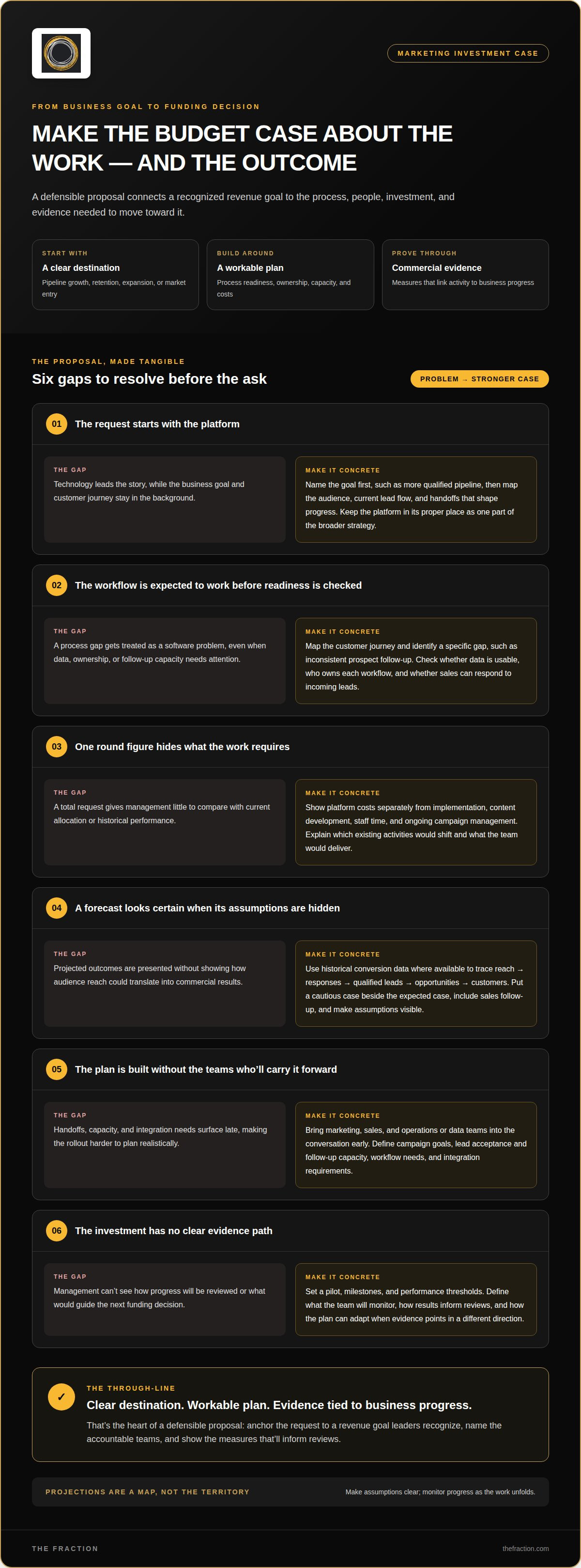
A strong proposal connects a business goal to the people, budget, and steps it’ll take to get there. If the priority is more qualified pipeline, start with the audience, current lead flow, and the handoffs that shape progress…so management can see the opportunity clearly, with the platform in its proper place as one piece of a broader marketing strategy.
Check readiness first, because automation works best when the underlying process has solid foundations. Map the customer journey, then find a specific gap, like inconsistent prospect follow-up. Check whether customer data’s usable, who owns each workflow, and whether sales can respond to incoming leads. If content or ownership needs work, fold it into the implementation plan, so the budget covers the whole journey from launch to execution.
Build the budget around the work involved, with each element out in the open. Separate platform costs from implementation, content development, staff time, and ongoing campaign management. Compare the request with current marketing allocation and historical performance. For example, a new-market proposal can show which existing activities would shift, what the team would deliver, and how those changes support the chosen goal…giving management a more useful comparison than a round figure on its own.
Forecast each option through the commercial pathway, using historical conversion data where it’s available. Estimate how audience reach could lead to responses, qualified leads, opportunities, and customers, and talk through the assumptions at each stage. Put a cautious case beside the expected case, including the role of sales follow-up. These are projections, more like a map than the territory itself, so make the assumptions clear and show what the team will monitor as the work progresses.
Bring affected teams into the conversation early, so the plan’s built with the people who’ll carry it forward. Marketing can define campaign goals and workflow needs, while sales clarifies lead acceptance and follow-up capacity. Operations or data teams can flag integration requirements. That collaboration supports a realistic rollout, with a pilot, milestones, and performance thresholds…then management can see how progress will guide the next funding decision and how the team will adapt if results point in a different direction.
Anchor the request to a revenue goal leaders recognize, such as pipeline growth, retention, expansion, or market entry. Tie the proposed budget to that goal, name the accountable teams, and define the evidence that’ll inform reviews. That’s the heart of a defensible proposal: a clear destination, a workable plan, and measures that connect investment to business progress.
2. How do you build a business case for increased marketing investment?
Look, build the case around the link between campaign activity and the business outcome leaders care about, because a click is one little breadcrumb in a much bigger customer-journey map. Trace the path as a chain: an email nurture may prompt a prospect to book a conversation, which may create an opportunity, so define the intended next step before launch and give each campaign a clear role in moving things forward.
Start with a baseline and keep comparisons consistent, so you’ve got a steady measuring stick rather than a different ruler for every campaign. Record current response, qualified leads, opportunity progression, and sales outcomes for comparable campaigns, using a consistent audience and measurement period. For an existing-account campaign, separate results from new-prospect activity so the figures tell a useful story about each audience. Add context like seasonality or sales-process changes, which can shape outcomes and help executives read the evidence in the right light.
Connect campaign records with sales outcomes wherever systems allow, and distinguish sourced pipeline from influenced pipeline. Attribution can get messy, but directional evidence still gives you a useful trail to follow: engagement, opportunity progression, sales feedback, and customer-journey activity can show how a campaign contributes. For example, a case-study download followed by relevant outreach may lead to further engagement, while later opportunity movement adds another signal, so together these details give you a fuller picture of the campaign’s contribution.
Measure social media according to the campaign’s purpose, because the right yardstick depends on what you’re trying to move. Links and page views show whether people moved from a post to its destination, while likes and shares capture interaction. If the goal is qualified inquiries, define the meaningful action before launch, then review relevant visits and subsequent leads alongside social engagement. A post may attract useful attention before inquiries appear, so compare similar audiences and campaigns to see how that attention develops.
To assess automation ROI, compare the value associated with a workflow with the resources required to run it, like weighing what comes through the front door against what it takes to keep the door open. Include platform use, campaign production, staff effort, and sales follow-up, then assess qualified leads, opportunity progression, and customer revenue connected to the workflow. Make assumptions visible and separate direct results from influenced outcomes, so the calculation stays easier to interpret and the commercial case stays grounded.
Bring these measures together in a dashboard executives can act on, pairing an early signal, such as engagement, with a later outcome, such as qualified opportunities. Then review where prospects slow down and adjust the message, timing, or sales handoff. If the acquisition pathway needs a more connected foundation, automated lead-generation systems may fit into that broader strategy.
3. Tracking brand awareness, acquisition cost, and retention
Track awareness, acquisition, and retention as connected stages in the customer journey. Impressions and engagement can offer useful signals about audience exposure and response. Compare these measures across channels and campaigns, then follow prospects through conversion and repeat business. A launch, for example, may build demand before producing sales, so early awareness measures provide context for later results. Tracking each stage helps management understand how marketing investment supports growth.
Calculate customer acquisition cost by dividing marketing spend by new customers gained during the same period. One example uses $50,000 in quarterly marketing spend and 100 new customers, producing a $500 acquisition cost per customer. That figure becomes more useful when compared with earlier periods, channels, or customer groups. Keep the calculation consistent, and distinguish new customers from returning ones. If sales follow-up or other factors shaped conversion, include that context when interpreting the result.
Retention adds another important measure. Track repeat purchases, renewals, expansion, or customer activity over consistent periods, then compare those outcomes with campaigns reaching existing customers. For example, a lifecycle email may prompt a customer to use a service again; monitor engagement alongside subsequent account activity. Automation can schedule relevant follow-up based on customer behavior, helping teams see how ongoing communication relates to retention. Separate observed activity from revenue it may influence.
Include time savings in the business case. Compare the manual steps in a process with those handled by an automated workflow, such as follow-up after a prospect completes a form. Record staff effort before launch and review the same tasks after implementation. Include workflow setup, content preparation, platform management, and sales response. This gives leaders a fuller picture of cost and capacity instead of treating automation as a software decision alone.
Trade shows offer a practical example of connecting channels to outcomes. In the 12 months before an event, 90% of attendees hadn’t met face-to-face with an exhibiting company. Connect event leads with later opportunities and customer outcomes, then compare the resulting cost and progression with other acquisition channels. That makes event performance easier to interpret within the wider strategy.
Address cost, timing, risk, and proof through a defined review plan. Start with a limited workflow, establish a baseline, and set milestones to assess lead response, conversion, and staff effort. Record dependencies such as sales follow-up, then adjust the workflow when results reveal friction. This gives management evidence at each stage and grounds the next investment decision in observed performance rather than expectation.
4. Using historical performance and funnel data
Historical records turn a forecast into a side-by-side look at what actually happened. Start with the stages your organization tracks, such as impressions, engagement, contacts, leads, sales opportunities, and customers, then trace where each campaign entered the funnel and how far prospects moved along. For example, compare a campaign that generated many contacts but few qualified opportunities with one that produced fewer contacts and stronger sales progression…that contrast can point to a specific gap automation could help address.
Keep comparisons consistent, like using the same ruler to measure every campaign. Use the same definitions for leads, qualified opportunities, and customers, and record the period and audience covered by each result. When a lead definition changes, performance can look stronger or weaker even as customer behavior stays the same. Separate new prospects from existing accounts, and distinguish campaigns by channel or target audience, so management gets a usable baseline and can see where lead generation, nurturing, or follow-up could improve.
Read the funnel as a sequence, like following a prospect’s path through a series of doors, rather than focusing on a single conversion figure. If historical data shows many contacts but few sales opportunities, examine qualification criteria and the handoff to sales. If opportunities progress but rarely become customers, review later-stage communication and sales feedback. Marketing automation can help define funnel stages and monitor effectiveness, while marketing and sales agree on what each stage means…that shared understanding gives a dashboard a clear foundation for showing performance.
Include data quality and privacy in the same operating picture. Map the customer information each workflow uses, why the audience receives a message, and how consent or opt-out preferences are recorded. For example, a nurture campaign should use relevant audience data and respect recorded communication choices. Collect information that supports the intended interaction, and define who can maintain or use it. Clear ownership reduces avoidable data errors and gives teams a practical basis for reviewing campaign records.
Event data can add context to historical lead records. Capture attendee or lead details through the event process, then connect those records with later campaign engagement, sales opportunities, and customer outcomes. For instance, a trade-show contact who downloads a related case study can receive relevant follow-up before sales engagement. The resulting timeline helps show how the event contributed to progression while distinguishing an initial interaction from a completed sale.
Use the findings to refine the next forecast. Identify the stage with the clearest friction, select a workflow to address it, and compare results with the historical baseline. Review data quality, campaign engagement, qualified leads, and opportunity progression together. If a workflow changes lead volume but sales feedback indicates weaker fit, adjust targeting or qualification logic. This evidence-led cycle helps management assess what automation improves, where performance remains constrained, and what merits further investment.
5. Marketing automation case studies
A useful case study reads like a clear field report, with the problem, the workflow, and the evidence all lined up like markers on a trail. Start with a specific business challenge, such as inconsistent follow-up after a prospect requests information, then describe the existing process, where delays or missed handoffs showed up, and which audience the campaign served. From there, explain the automation change and how the team evaluated it, so management can follow the reasoning instead of simply admiring a headline result.
For example, an illustrative workflow might send relevant follow-up after a prospect downloads a case study. Define its audience, message, trigger, sales handoff, and measurement period, then compare the new process with the existing approach using available records. Measures might include engagement, qualified leads, opportunity progression, and staff effort. Think of this as a map for structuring evidence, with the example showing the route rather than reporting a company result.
Make the analytics traceable, like a thread management can follow from campaign activity through funnel stages, with sourced opportunities clearly separated from influenced ones. Include the starting baseline and measurement criteria, then explain any changes in targeting, content, or sales follow-up. If the evidence shows stronger engagement but limited movement into qualified opportunities, say so plainly. A case study earns credibility when its findings and boundaries travel together.
Management also needs to see what the team learned, because that’s where a case study becomes a compass for the next decision. A workflow may reveal that prospects engage with useful content but need a clearer next step before speaking with sales. Another may show that existing customers respond to relevant lifecycle messages. In either case, describe the adjustment the team made and the next measure it planned to watch, turning the case study from a victory lap into a practical record of decisions and iteration.
Use a concise evidence template: business goal, prior process, workflow change, audience, measurement approach, observed result, and next action. Add the relevant time period and explain factors that affected performance, such as sales capacity or a campaign change. A board update could also mark an operational milestone, such as welcoming the 1,000th customer, then explain how marketing activity contributed to the journey. Keep contribution and sole cause clearly distinguished.
Make the takeaway transferable. State which conditions supported the result, which assumptions shaped it, and what another team would need to adapt. One workflow may make a strong pilot, while a broader investment calls for evidence across additional campaigns and funnel stages. This honest framing gives leaders a more useful basis for deciding what to scale, refine, or pause.
The Fraction
The Fraction helps professionals connect marketing investment to a clearer path to winning clients, so when a proposal points to gaps in lead generation, follow-up, or the offer itself, The Fraction brings those pieces together like gears in a well-built machine. That can include automated, AI-driven lead generation, a sales process built around natural, useful conversations, and a compelling offer and service designed to win clients quickly.
Turn to The Fraction when you’re ready to move from making the business case to shaping a practical client-acquisition approach…because the aim is to strengthen the connection between the value you offer, the prospects you reach, and how conversations progress, giving your growth strategy a clear commercial foundation.
Make the next investment decision with confidence
Think of approval as the first marker on a learning trail…as the work unfolds, use what the system reveals to shape the next decision: which assumptions held, where teams needed support, and what deserves refinement. That gives management a clearer basis for adapting as customer and sales behavior develops, while the original proposal becomes a starting point the team can build on.
A practical framework for how to justify marketing automation spend should evolve with the business, like a map that gets clearer as you travel. Bring new evidence into future planning, revisit the outcomes leadership values, and let the next investment reflect what the organization has learned. That’s how a proposal can grow into part of a lasting growth strategy, carrying the learning forward with each new decision.
So take the next step deliberately, grounded in the evidence you’ve built…move forward with clarity, and let each decision strengthen the foundation for the next.
Frequently Asked Questions
How do you justify your marketing budget to management?
Look, frame the request as a decision management can evaluate, with a clear business objective and defined options, so they can see the whole map before choosing a route. Show what the team can deliver with current resources, what additional investment would enable, and which activity would be deprioritized if funding stays flat. Make the decision and tradeoffs visible, then explain how leadership will review progress…that gives executives a practical basis for approval, revision, or postponement.
How can I justify marketing spend when results take time?
Separate early signs of progress from outcomes that take longer to emerge, like tracking the stepping stones on the way to the destination. For a campaign supporting a lengthy sales cycle, early evidence might include target-account engagement or sales conversations, while closed revenue remains a later measure. Agree on review points before launch and explain how each signal relates to the intended outcome, so management can assess progress in stages and see how the pieces are adding up toward business impact.
How do you attribute sales and revenue to marketing campaigns?
Use consistent campaign identifiers in customer and sales records, then connect relevant interactions to accounts and opportunities. Review the sequence of touchpoints alongside sales-team input, since a campaign may support a decision without initiating it…think of it as tracing a path, rather than pointing to one footprint. Distinguish direct campaign responses from opportunities that encountered campaign content along the way. This gives leadership a more balanced view of marketing’s contribution and helps account for the many interactions behind a complex sale.
How do you build a business case for increased marketing investment?
Start with a business constraint the proposed investment can address, such as an underdeveloped market segment or limited follow-up capacity. Then describe the operational change: which audience the team will reach, what activity will change, and how sales will handle resulting interest. Include expected decision points and what the organization will learn from each, so management can follow the logic like a clear trail from investment to action. That lets leaders assess the request as a business initiative, with its own purpose and learning, rather than as an isolated marketing purchase.
What Makes a Marketing Budget Increase Defensible?
A budget increase is defensible when it addresses a defined business priority and explains why existing resources call for additional support. For instance, a new audience may require different messaging, campaign development, or sales coordination. Show the expected effect as a forecast, identify key dependencies, and state what evidence would prompt a change in direction. Grounding the request in business need and decision criteria gives leaders a clearer basis for weighing alternatives, like laying the options side by side on a table.
What marketing metrics best demonstrate ROI to executives?
Choose measures that inform the decision executives need to make, instead of bringing every dashboard metric into the room. For a pipeline-growth initiative, show qualified opportunity movement and sales progression; for an existing-customer program, emphasize retention or expansion. Add a supporting operational measure, such as time spent on manual follow-up, if efficiency is part of the rationale. Segmenting results by audience or campaign can help explain what drives the overall picture, like zooming in to see what’s shaping the wider view.
What should a marketing budget proposal include?
Include the decision requested, business objective, proposed scope, resource requirements, and teams accountable for delivery. Add the forecast assumptions and conditions that could affect them, such as sales capacity or data readiness. A short executive summary can state the recommendation, with supporting details explaining the rationale and alternatives…think of it as the headline on a map, with the finer routes underneath. Close with the review process so leaders know how they’ll assess the investment after implementation begins.
How do you calculate ROI for marketing automation?
Use a consistent formula: subtract the investment from the value attributed to the automation, then divide the difference by the investment. Define which costs and outcomes count before calculating; for example, separate platform and implementation resources from revenue linked to the workflow. Where available, use contribution or margin alongside revenue, since those measures bring delivery costs into the picture. Compare the result with a relevant baseline and explain attribution assumptions.


