

Your technical depth can be your strongest sales asset…when you connect it to the problems and priorities buyers care about. Think of a sales process as a map through unfamiliar terrain, guiding the conversation from what’s at stake to a meaningful next step, so selling can feel more like solving a problem together than delivering a pitch.
And if you’d rather talk about your product than navigate objections, budgets, or an uncertain close, that instinct makes sense…these conversations can feel like a different language, even when you know your solution inside out. But a deliberate process gives you a path through discovery, helps you translate technical strengths into customer value, respond thoughtfully to concerns, and agree on next steps, so you can build trust and advance well-qualified deals without losing sight of the work your expertise does best.
Key Takeaways
- Use sales conversations to get underneath the buyer’s problem and urgency, so you can see whether your solution really fits what they need.
- Connect your technical strengths to the customer’s business priorities, and be candid about the tradeoffs and limitations along the way.
- When budget concerns come up, tie the proposed solution back to the buyer’s business case, so they can see the value they need to see.
- Keep deals moving by agreeing on a clear next step, who owns it, and when it’ll happen, so everyone knows where things stand.
- Be intentional about your role in sales…bring your expertise in where it builds buyer confidence, while keeping the conversation anchored in the customer’s needs.
1. Clarifying the purpose of a sales conversation
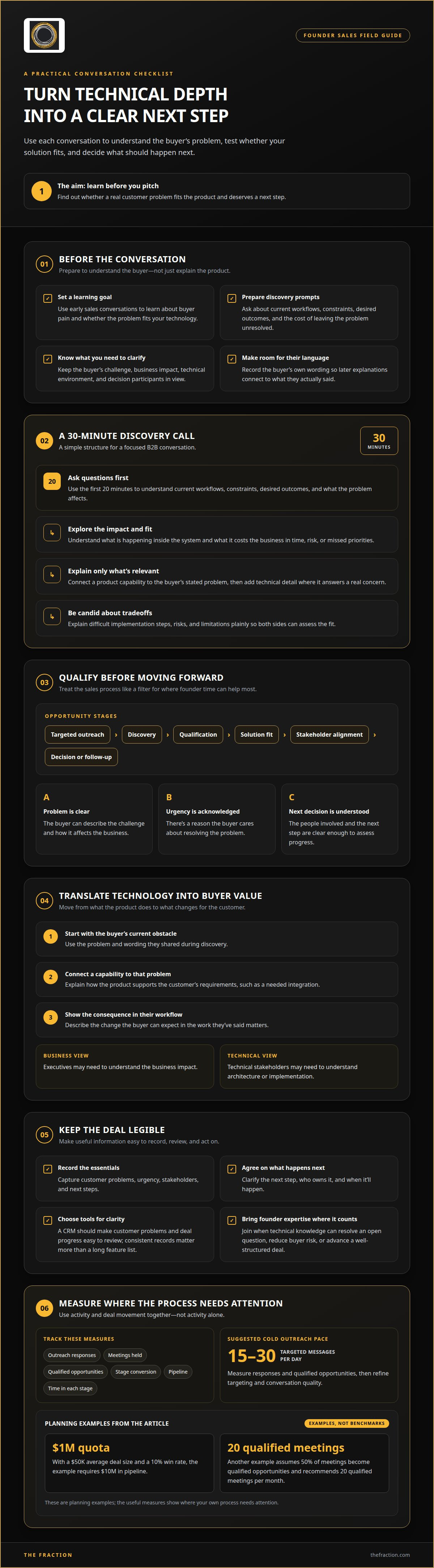
For an early-stage founder, each sales conversation should test whether a real customer problem fits the product and deserves a next step. The goal is learning from early sales, rather than building a blueprint for reaching 50 million USD in ARR. Before booking 10 to 20 meetings, prioritize starting conversations and understanding buyer pain. A technical founder can identify quickly when a customer’s problem falls outside the technology’s fit, then move on.
A focused B2B conversation can begin with a 30-minute discovery call. Use it to understand the buyer’s challenge, its business impact, the technical environment, and who else will shape a decision. Keep the discussion anchored in the customer’s problem before explaining the product. If a proposed solution has difficult implementation steps, risks, or limitations, explain those plainly so both sides can assess fit.
For an early-stage startup, choose a CRM and sales tools that make customer problems, urgency, stakeholders, and next steps easy to record and review. Consistent records matter more than a long feature list: they help the team act on useful information without creating unnecessary administration.
A sales process for technical founders works like a qualification filter: it helps identify which conversations merit founder time and which need more discovery first. A professional can turn early customer learning into repeatable stages before the company hires sales representatives. Early reps can arrange meetings, guide deal progression, and secure next steps, but they’ll still need founder support where product expertise or credibility matters. That role differs from scaling an organization with 10 or 50 sales reps.
A sales process for technical founders should move from targeted outreach to discovery, qualification, solution fit, stakeholder alignment, and a defined decision or follow-up. Move an opportunity forward based on evidence: the buyer’s problem is clear, urgency is acknowledged, and the next decision is understood. Join a conversation when your technical knowledge can resolve an open question, your authority can reduce buyer risk, or your presence can advance a well-structured deal.
Track measures that reveal where deals advance or stall: outreach responses, meetings held, qualified opportunities, conversion between stages, pipeline, and time in each stage. One example pairs a $1M annual quota with a $50K average deal size and a 10% win rate, requiring $10M in pipeline. Another assumes 50% of meetings become qualified opportunities and recommends 20 qualified meetings per month. These are planning examples; the useful measures show where your own process needs attention.
When starting cold outreach, the suggested pace is 15 to 30 high-quality, targeted messages per day. Measure responses and qualified opportunities, then refine targeting and conversation quality; activity alone can’t show whether the right buyers are engaging.
2. Communicating from the customer’s perspective
Earn a buyer’s attention by connecting product details to their operational reality. Texas A&M University Engineering describes effective technical sales as translating technical details into customers’ business language. Start by understanding the problem in two dimensions: what is happening inside the system, and what the issue costs the business in time, risk, or missed priorities. A feature becomes relevant when the buyer can see how it changes their situation.
Identify and qualify potential customers by looking for patterns across conversations: recurring problems, a clear fit with your technology, and buyers who can explain why resolving the problem matters. Separate curiosity from a real opportunity by exploring urgency, technical compatibility, decision participants, and the outcome the buyer wants. For example, interest in faster data processing becomes more meaningful when the buyer explains which workflow is delayed and what that delay affects.
Effective discovery calls need a deliberate sequence. The guide recommends using the first 20 minutes to ask questions before introducing the product, so the founder hears the customer’s language before shaping a response. A professional can prepare prompts about current workflows, constraints, desired outcomes, and the cost of leaving the problem unresolved, then listen for details that clarify fit. One vendor-call example has the representative talking for 80% of the conversation, a useful reminder to leave space for the buyer’s account.
Let questions build on one another rather than sound like a checklist. If a customer says a process is unreliable, ask where failures occur, who handles them, and what a successful process would change. The answers reveal whether the issue is technical, operational, or both, and whether your product addresses the actual priority. Record the buyer’s own wording to make later explanations more specific and easier to evaluate.
To explain a complex product in a sales pitch, move from capability to consequence: describe what the product does, connect it to the buyer’s stated problem, and explain the expected change in their workflow. Instead of detailing the architecture first, explain how it supports the customer’s required integration, then add technical depth where it answers a real concern. A concise story bridges the buyer’s current obstacle and a relevant solution.
The U.S. Bureau of Labor Statistics describes sales engineers as explaining a product’s technical aspects and how it solves a specific customer problem during presentations. Apply the same customer-centered logic by adapting detail to the room: executives may need the business impact, while technical stakeholders may need to understand architecture or implementation. Keep both views connected so technical depth reinforces the business case rather than taking the conversation off course.
Before a presentation, the professional can map each major product capability to a customer-stated need, a practical outcome, and a question that tests whether the explanation landed. That structure keeps the pitch responsive, not scripted, while giving the buyer a clear route to assess relevance. For a more customer-focused sales approach, make each technical explanation answer the concern the buyer has actually raised.
3. Responding to objections and budget concerns
An objection is a chance to understand what the buyer needs before making a decision. First uncover whether the concern involves unclear value, implementation risk, stakeholder confidence, or budget priorities. Each concern calls for a different response, so clarify what the buyer means before addressing it. “Too expensive” could mean the business case needs more detail, or that the buyer’s priorities have shifted.
For a technical concern, the founder can explain how the proposed solution works, where implementation is hardest, and what tradeoffs the customer accepts. That candor gives the buyer a clearer basis for assessing risk. A professional can help translate the technical answer into decision language, then check whether the explanation resolved the concern. If the buyer still hesitates, a focused follow-up question can uncover what remains uncertain.
A budget objection often signals that the value case needs more definition. The professional can work with the founder and champion to connect the proposed solution to measurable business outcomes, then test the assumptions with the buyer. One example describes a manufacturing deal whose champion strengthened the business case from 3x ROI to 5x+. The lesson is to build a credible case around customer priorities and support each assumption with evidence.
Another hypothetical example uses a 10x ROI business case to address a budget concern. That figure illustrates one possible case; the buyer’s own assumptions must support the projected return. A professional helps clarify which costs, expected outcomes, and internal priorities shape the decision, then presents the reasoning so stakeholders can examine it. If the customer’s numbers don’t support the proposed value, the team can revisit fit or scope.
To help technical founders set pricing and prepare proposals for early customers, a professional grounds the recommendation in the customer’s problem, desired outcome, solution scope, and delivery tradeoffs. The proposal then reflects what both sides have discussed, with assumptions and limitations made clear. Sending a formal quote asynchronously is described as the wrong move 95% of the time, so review the offer together and invite questions before it becomes a document without context.
A founder can add credibility late in a well-qualified deal by validating the business case with senior buyers or addressing a difficult objection. One example describes a seller saying they had built about 50 business cases this year for customers of a similar size and shape. Relevant experience can help a buyer assess the reasoning, while every claim remains grounded in what that customer has shared.
Keep your response simple: acknowledge the concern, ask what’s driving it, answer with relevant evidence, and agree on what would resolve it. If the buyer raises budget, explore priorities and business impact before discussing scope changes. If risk is the issue, explain mitigation and limitations. This structure ties each response to the buyer’s decision and gives the conversation a clear path forward.
4. Setting clear next steps for deals
A conversation should end with a shared action, an owner, and a date. Without those three pieces, a promising discussion can drift while each side assumes the other will follow up. The salesperson owns deal progression, including next steps, timelines, and closing mechanics. A professional makes that ownership visible, so a technical founder can contribute expertise without carrying every administrative detail.
Build a repeatable pipeline by defining what evidence moves an opportunity from one stage to another. A discovery conversation may establish a problem, while a later discussion confirms decision participants, technical fit, and the buyer’s decision path. Give each stage a clear exit condition and record the next action. This turns a collection of meetings into a process the team can inspect and forecast.
Calendar design also supports reliable follow-through. A 30-minute discovery call can occupy a 45-minute calendar block, with 10 minutes for preparation and five minutes afterward. The preparation gives the salesperson time to review the buyer’s context; the post-call space supports accurate notes and a prompt recap. That structure helps preserve deal details while the conversation remains fresh.
When a technical founder joins, the salesperson should set the agenda, time-box technical depth, and bring the discussion back to outcomes and next steps. For example, the founder might address an architecture question, then the salesperson confirms what the buyer needs to decide. This keeps technical expertise valuable and the meeting purposeful, rather than letting one implementation detail take over the entire conversation.
A professional can help founders build a repeatable sales pipeline by documenting stage criteria, ownership, follow-up actions, and decision timing. Revenue forecasting then draws on evidence from active opportunities, such as confirmed buyer needs, decision milestones, and known timing, rather than optimism alone. The forecast becomes more useful as the team records consistent information and revisits changes in each deal.
Consider a deal with a 45-day sales cycle. If the buyer’s next internal review is scheduled, the salesperson can record its date, the stakeholder responsible, and what information they need beforehand. If that review slips, the forecast and follow-up plan should change accordingly. The example shows why timing belongs in the opportunity record, not solely in a founder’s memory.
Your participation should create permission, not pressure. A charismatic or visionary founder can build executive alignment, while the salesperson follows with a concrete plan. That plan might identify who will share technical information, which stakeholders need a conversation, and when the buyer expects to make a decision. Tie each action to a milestone the customer has confirmed.
Before closing a meeting, the salesperson can summarize the decision path aloud: the agreed action, the person responsible, and the scheduled follow-up. For a technical discussion, that could mean the founder answers an open implementation question while the salesperson arranges the next buyer conversation. A clear recap gives everyone the same map, and each subsequent update shows whether the deal is advancing.
5. Reframing founders’ attitudes toward selling
Selling can feel like stepping away from the work that created your product, but here’s a more useful way to look at it…you’re solving a customer’s problem, learning what matters, deciding whether your solution fits, and helping the buyer make an informed choice. Each conversation becomes a kind of compass, pointing to whether your product’s relevant, rather than another performance of persuasion.
Common mistakes include joining poorly qualified deals, assuming urgency, and walking into conversations without a clear purpose. You can also become the rescue act when a deal stalls, which feels like progress but can hide gaps in qualification or buyer alignment. So define when your involvement brings unique expertise or credibility, and what outcome it should move forward.
Start by setting clear role boundaries. If you’re sales-savvy, you’ll generally want to stay out of early discovery, product demos, and ongoing deal management. As a technical or product founder, focus on validating architecture, technical fit, or implementation for sophisticated buyers, while the salesperson leads commercial framing and deal progression…that way, you’re contributing where your knowledge carries the most weight.
To avoid sales mistakes, make qualification and decision points visible before you join. Confirm the buyer’s explained the problem and urgency, the next decision’s understood, and you can credibly answer a specific question. If those pieces are missing, the salesperson should address the gap first, so your presence adds value instead of becoming a lever to push the deal.
This structure turns selling from an identity test into a repeatable business responsibility. Bring your product judgment, customer insight, and authority to the moments where those strengths matter, while developing sales skills through deliberate practice…like any skill, it gets stronger with reps. For example, an executive conversation may call for your credibility, while routine follow-up stays with the salesperson.
Good founder involvement also creates permission rather than pressure. A visionary founder can help establish executive alignment, then leave the salesperson to agree on a concrete plan with the buyer. That plan records who’ll act, what decision comes next, and how the conversation will progress…so everyone’s reading from the same map. Your contribution stays defined, useful, and bounded.
After each conversation you lead, review what moved forward and what’s still unresolved. Did you clarify a technical risk, strengthen buyer confidence, or uncover a new decision-maker? Those observations help refine your future involvement, so the team learns from each deal instead of relying on instinct alone.
In a mature sales process, your participation’s intentional and repeatable, while customer fit remains the guide. Selling becomes part of building the company: a disciplined way to learn from buyers, communicate value, and advance sound opportunities. So you can lead without carrying every sales task yourself.
The Fraction: A sales process that doesn’t feel like selling
The Fraction helps technical founders build a sales process that feels like a natural extension of solving customer problems…because if you’ve validated that your solution addresses a real need but conversations still stall around positioning, follow-up, or finding the right prospects, a clearer process can connect those pieces, like the missing link in a chain.
The Fraction develops compelling offers and services and provides automated, AI-driven lead generation systems to support client acquisition, so you can communicate value in the buyer’s language, create a clear path through sales conversations, and build a system that fits how you work. It’s a practical next step when you’re ready to make sales more consistent while keeping your technical expertise front and center…like a compass guiding the process without taking the wheel.
Contact The Fraction to talk through a sales approach that fits your business.
Build a sales discipline that grows with the company
Your next stage of growth can start with a different question…what should customer conversations make possible across your business? Get a clearer read on buyer priorities, and you can shape how you position your expertise, which opportunities deserve your attention, and how confidently your team moves from interest to a decision.
A sales process for technical founders can become part of your company’s operating architecture, like a sturdy bridge connecting what you learn from the market with what you build in product and engineering. And as your market understanding deepens, that process can evolve too, so it supports the business you’re building instead of leaning on one person’s instincts.
So if you’re ready to shape that approach around your business, start a conversation with The Fraction.
Your technical expertise can lead the way… and a deliberate sales system can help it reach the customers it’s built to serve.
Frequently Asked Questions
How can a professional help technical founders handle objections and negotiate with business buyers?
A professional helps the founder get to the concern underneath the buyer’s objection, prepare a response that actually fits, and keep the negotiation tied to the business outcome you agreed on. So if a buyer raises a security review, they can help pin down what the review needs, work out who needs the technical details, and coordinate a focused response, rather than letting the conversation sprawl. And when changes to scope or terms come up, they can help weigh the tradeoffs so each one supports a clear decision instead of quietly weakening the offer by default.


