

AI can surface a long list of prospects while your pipeline stays quiet, and names plus predicted signals are just the first stepping stones toward understanding buying intent. If you're working out what to do when AI lead generation fails, trace the gap from data quality to verified intent, then tailor follow-up to what each prospect has actually shown you.
The gap may come from stale contact details, weak buying signals, generic outreach, or follow-up that stops after the first attempt, so treat it like a connected system: clean the inputs, validate the reason for reaching out, follow up with relevant context, and use results to refine the process. That way, you can pinpoint where relevance is slipping instead of treating every quiet lead as the same problem.
This article explains how to respond to weak AI-generated leads with thoughtful follow-up, cleaner data, verified intent, and ongoing optimization, turning a list of names into a more considered path toward real conversations.
Key Takeaways
- Build follow-up around each prospect’s timing and signals, so an early “later” can turn into a useful next conversation.
- Treat lead generation like an ongoing process, refining your approach as you learn which moves create meaningful conversations.
- Keep contact data current, so even well-targeted outreach has a solid foundation to land on.
- Check buying intent before prioritizing a lead, and let real sales feedback sharpen how you score leads.
- Review the process as you go, spot where it loses relevance, then adjust the data, messaging, or nurturing that needs attention.
1. Lead nurturing and structured follow-up
AI-generated leads may arrive before a prospect’s ready to buy, so an immediate sales pitch can miss the moment. If you’re deciding what to do when AI lead generation fails, look at what happens after the first contact. Lead nurturing gives prospects a relevant next step and keeps promising conversations moving at a pace that fits their decision process, more like a steady conversation than a sprint to the finish.
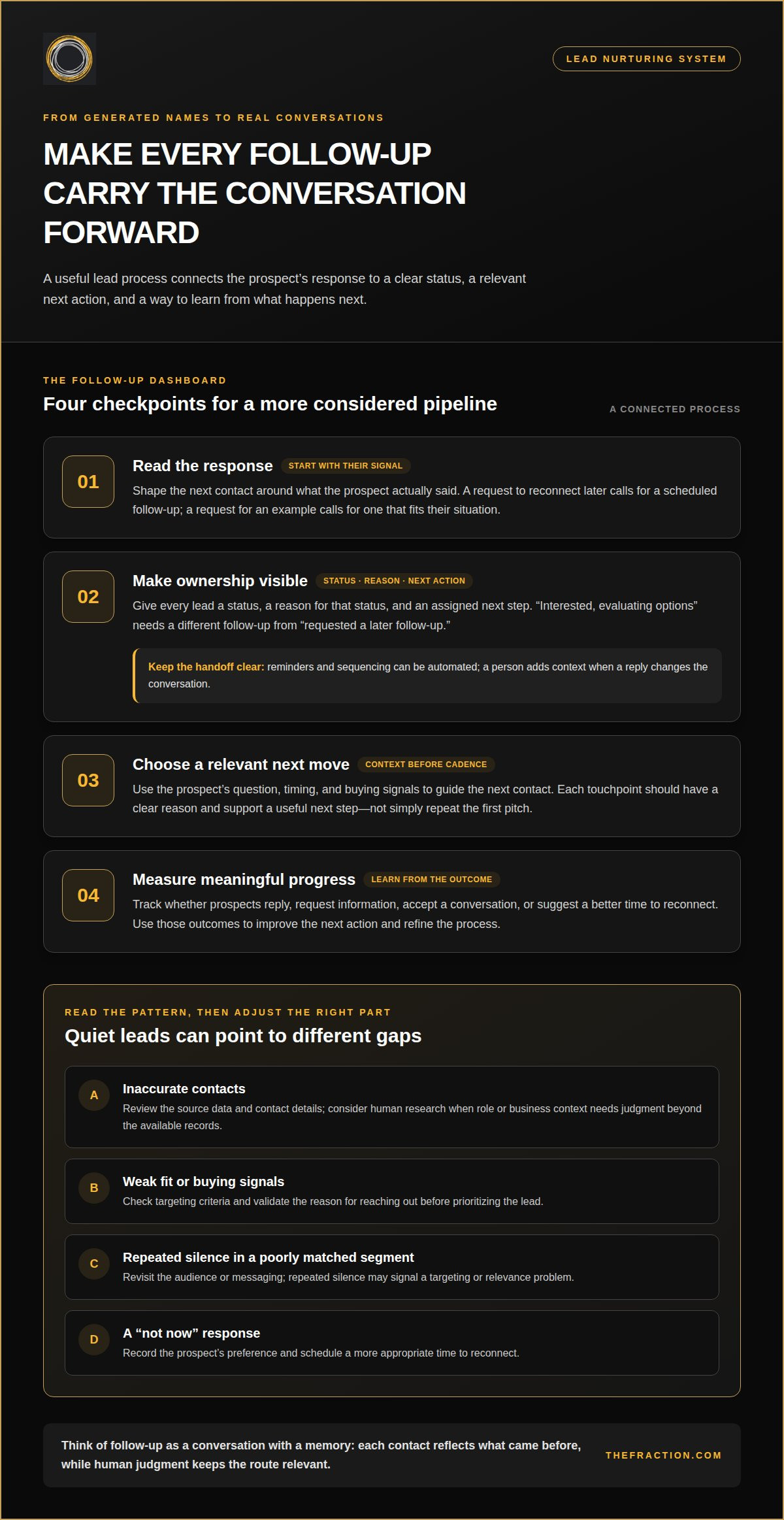
Start with the prospect’s response and shape your next contact around it. If someone asks you to reconnect later, record that preference and schedule a follow-up. If a prospect requests an example, send one that fits their situation before suggesting a meeting, so each message has a clear reason to keep the conversation moving.
A structured process also needs clear ownership, like a relay where everyone knows who’s carrying the baton and where it’s headed. Assign each lead a status, a reason for that status, and a scheduled next action. “Interested, evaluating options” calls for different communication than “requested a later follow-up,” so the sales team can address the prospect’s question and choose an appropriate next step.
Time constraints can make follow-up inconsistent, even when the first outreach is relevant. So, when you’re figuring out what to do when AI lead generation fails, make every next action visible and assigned. Automation can handle reminders and sequencing, while a person adds context when a reply changes the conversation…like a navigator adjusting the route as new information comes in. That keeps follow-up organized and human judgment in the loop.
Consider changing vendors or adding human lead research if reviews repeatedly reveal inaccurate contacts, irrelevant prospects, or outreach that misses buying signals. First identify whether the cause is source data, targeting criteria, or follow-up. Human research can help when understanding a prospect’s role or business context calls for judgment beyond the available records.
Measure follow-up by meaningful progress. Track whether prospects reply, request information, accept a conversation, or suggest a better time to reconnect. A “not now” response can guide your next action, so treat it like a signpost pointing to a better time; repeated silence across a poorly matched segment may signal a targeting or messaging problem. Each touchpoint should support a useful next step.
Effective nurturing works like a conversation with a memory, where each contact reflects what came before. A clear process, timely follow-up, and relevant examples help turn AI-generated names into informed sales conversations, while keeping human attention focused where judgment matters.
2. Treating lead generation as a long-term strategy
AI lead generation works best as a learning system, with each campaign giving the next one a little more to work with…think of it like tuning an instrument, where every pass helps you hear what needs adjusting. The first launch provides an initial signal, and subsequent campaigns show whether targeting, positioning, and timing fit the market. Reviewing campaigns in cycles keeps one weak batch in perspective and helps identify which part needs adjustment.
Set a business objective before comparing tools or providers, so you’ve got a clear compass for the decisions ahead. A firm seeking more qualified discovery calls, for example, needs different criteria from one building awareness with a new audience. Define a suitable lead, what counts as progress, and how sales feedback will inform the system, then review those measures consistently and look beyond list size when judging success.
How do you compare AI lead generation tools and providers? Look at how each handles your target audience, data sources, qualification logic, integrations, reporting, and human review. Ask how the system works and how its performance will be evaluated against your objective. A polished demo can catch your eye, but the real test is how well the process fits your sales approach.
For a long-term view, separate early learning from business results, like sorting the first clues from the finished picture. A campaign may attract attention and draw prospects with needs that don’t fit. Another may generate fewer responses and lead to more relevant conversations. Record the difference and refine the audience, offer, and follow-up, so each review ends with a specific decision, such as narrowing the segment or changing the message.
What privacy and marketing rules apply to AI-generated leads in the United States? Requirements can depend on the data collected and communication channel, so account for applicable privacy, consent, opt-out, and truthful-marketing obligations. Keep data use aligned with its stated purpose, and seek qualified legal review when questions arise about a campaign or data practices.
What does AI lead generation software cost, and what ROI is realistic? Pricing varies with capabilities, data access, integrations, and service scope, so compare total operating costs alongside feature lists. Estimate ROI using attributable revenue and qualified opportunities, with software, implementation, and staff time in the same picture. Results depend on conversion quality and the sales process.
Review the strategy as market conditions and buyer responses change. If the same audience repeatedly rejects the offer, revising the offer may matter more than changing the technology. If qualified prospects engage but stall, examine the sales handoff and next-step clarity. For a broader view of executive growth strategy, connect lead generation decisions to the business direction they’re meant to support.
3. B2B contact-data quality and decay
Even a strong targeting model loses precision when its contact records age. B2B contact data is commonly estimated to decay by approximately 25-30% annually. People change roles, companies restructure, and business email addresses become outdated. A lead list can resemble a map with old street names: the destination may still exist, but the route needs updating.
An AI system can produce plausible records from incomplete or outdated inputs. A contact’s name and employer may look right even if their title, department, or decision-making role has changed. An operations leader who has moved companies, for instance, may no longer influence the purchase you’re pursuing. Generating more records won’t fix a mismatch in the source data.
Start by defining the fields that make a record useful for your sales process. A practical B2B profile might include the person’s name, current company, role, business contact details, and a clear reason the account fits. Add the date each record was last reviewed, so older contacts can be prioritized for refresh. Choose fields that reflect your audience and offer instead of relying on a generic template.
Assess records against consistent criteria before outreach. Distinguish missing information from conflicting information because each requires a different response. A missing job title may need enrichment; an email linked to a former employer needs correction or removal. Keep the original source and review status visible so the person following up understands why the contact was selected.
Data quality also depends on relevance and accuracy. A current email address for someone outside your target market still creates wasted effort. Compare the company’s needs, the contact’s responsibilities, and the relevance of your offer. In a survey of B2B marketers, 68 percent identified increasing lead quality as their highest lead generation priority. That focus reflects a central point: a useful record must be both accurate and relevant.
Set a refresh cycle for AI-sourced records based on risk and use. Recheck contacts before a new campaign, prioritizing records that have bounced, changed roles, or produced contradictory replies. If an account remains valuable but a contact has moved, update the person and company relationship separately. This preserves useful account context while keeping contact details current.
Track recurring data problems that disrupt outreach. If invalid addresses cluster around one source, review it; if job titles routinely miss the buying role, refine the targeting criteria. These patterns reveal whether you need stronger inputs, clearer definitions, or better review. Clean contact data provides a reliable foundation for intent scoring and sales conversations.
4. Buying intent verification and lead scoring
An AI score works like a prioritization signal, helping teams decide where to focus, but the evidence behind it matters just as much…a prospect might visit a pricing page to research, while another requests a proposal after a specific business change, so connect each score to evidence the sales team can interpret and act on.
Start by defining what “ready” means for your business, because a strong-fit account, for example, may match your target market, include a relevant decision-maker, and describe a problem your offer addresses. Then separate fit from intent: fit describes who the prospect is; intent reflects what they’re doing now, and keeping those signals distinct helps sales see why a lead ranks highly.
Build a score from observable signals tied to the buying process, so a direct request for a conversation carries more weight than a general content visit. Repeated engagement with a specific service may add context, while a dated job title can signal lower confidence, and visible scoring logic helps sales tell whether a ranking reflects marketing activity or a meaningful buyer action.
Sales teams can struggle to trust AI-qualified leads, but a concise explanation gives them something concrete to work with. For example, “high fit, requested a proposal, confirmed responsibility for the project” gives a representative a clear starting point, while “high intent, score 87” leaves the reasoning hidden and the next conversation harder to shape.
Use human review when a signal needs context, because a prospect may download a guide for a colleague, attend an event as a vendor, or visit a page while doing internal research. A model may interpret these as buying activity, but a representative can ask a focused question to clarify the situation, record the answer, and use it to calibrate future scoring.
Review score quality against outcomes that matter to revenue, with engagement as one useful signal among several. Track whether high-ranked leads become qualified opportunities, whether sales accepts them, and where promising prospects lose momentum, so if a segment scores highly but produces poor conversations, you can revisit the fit criteria or signal weights before giving it higher priority.
Keep score categories clear, such as “researching,” “evaluating,” and “requesting a next step,” and map each category to a distinct sales action. A researching contact may need relevant information; someone evaluating options may benefit from a direct discussion; a proposal request calls for prompt, personal follow-up, so marketing and sales can agree on these definitions and revisit them as buyer behavior changes.
Strong verification makes lead scoring a shared decision framework, with clear evidence behind each ranking and room for sales feedback to refine it. That way, AI helps direct attention while people judge the nuances that shape a real buying conversation.
5. Continuous optimization and feedback loops
AI lead generation needs a feedback loop, because a campaign’s first output is only a starting point. One machine-learning model produced a 0.01% lift in conversions, despite a much higher expected lift. The practical lesson is to compare predictions with actual sales outcomes, then adjust the parts that underperform.
What metrics should you track to evaluate AI lead generation performance? Track qualified-lead rate, sales acceptance, meeting progression, opportunity conversion, and campaign-attributed revenue. Include response quality and disqualification reasons so the dashboard explains why results changed, not just whether they did.
Use a consistent review cycle. Connect campaign records to sales outcomes, compare results by audience, source, message, and offer, then choose a specific adjustment. If one audience replies but rarely advances, for example, refine qualification criteria before expanding that segment. Changing one variable at a time makes improvements and declines easier to explain.
What should a professional assess when fixing AI lead generation targeting and prompts? Compare the intended buyer with actual qualified opportunities, check whether prompts describe relevant roles and business needs, and inspect examples of poor-fit results. Then revise targeting criteria or prompt instructions, test the change, and review lead quality with sales.
A useful feedback loop captures what happens after handoff. Sales can label a lead as a fit, wrong role, weak need, mistimed, or ready for discussion. These labels provide concrete evidence instead of broad reactions such as “the leads feel off.” If representatives flag the same mismatch repeatedly, update the underlying criteria.
Record every adjustment and its reason. For example, note that a campaign shifted toward a specific business need after sales feedback showed the previous message attracted general researchers. Compare the next results using the same measures. This creates a clear path from observation to decision and helps distinguish a useful change from random variation.
Optimization also depends on the offer behind the outreach. If relevant prospects engage but don’t take the next step, the message may be clear while the value proposition remains difficult to act on. Review the audience’s stated problem, the promised outcome, and the next step together. Each should connect as part of one growth system.
With a review process in place, performance becomes a sequence of decisions rather than a one-time verdict. Strengthen your lead-generation strategy
The Fraction: Automated & AI lead generation systems
The Fraction helps professionals strengthen lead generation when weak targeting, inconsistent follow-up, or an unclear offer limits results. Its Automated & AI lead generation systems connect prospecting with a sales process that feels more like opening a useful conversation than delivering a hard pitch, so outreach can lead to the right conversation with the right prospect.
When generated leads show little intent or prospects engage without a clear reason to move forward, the offer and service can be refined alongside the lead-generation process. The Fraction develops compelling offers and services designed to win clients quickly, aligning what prospects need with a clear next step.
If you’re ready to discuss a more considered approach to lead generation, contact The Fraction.
Give your next decision a clear direction
If you're deciding what to do when AI lead generation fails, start with the business outcome you want the system to support, because that outcome becomes your compass…guiding which conversations to prioritize and how to assess progress, while helping you spot meaningful improvements among all the activity that looks impressive on a dashboard.
Bring the people responsible for growth into the same conversation, so sales, marketing, and leadership can share what they see across the customer journey…and, like pieces of a map coming together, reveal where the strategy needs greater alignment. With that clarity, you can choose a purposeful next step that moves the business forward and gives your tools and tactics a clear job to do.
When you’re ready to discuss how your lead generation can better support your business direction, Contact The Fraction.
A thoughtful system grows from deliberate choices and continued learning, so focus on the conversations that move the business forward…and let each decision build a stronger foundation for growth.
Frequently Asked Questions
What does AI get wrong?
AI can mistake activity for buying intent and fill gaps with assumptions, so a prospect researching vendors for an internal comparison may look ready to buy after visiting product pages. Generated summaries can miss context too, like a contact’s role in the decision. Look, treat AI signals as clues, then use a relevant human conversation to understand what the prospect actually needs.
How can a professional diagnose why AI lead generation is failing?
A professional can trace a lead from its original source through qualification, outreach, and sales disposition, then pinpoint where relevant prospects first drop away. If well-matched accounts enter the process and sales rejects them after discovery, for example, qualification may need a critical buying condition. Comparing accepted and rejected leads by campaign and audience can help isolate the cause.
How can a professional improve lead quality when AI generates poor-fit leads?
A professional can compare successful client engagements with the leads the system generates, then sharpen fit criteria and disqualifiers. If strong clients share a particular business challenge, use that need to guide targeting more precisely than broad industry labels. And reviewing poor-fit records can reveal which criteria to adjust before outreach begins.
How can a professional audit AI-generated lead data for accuracy and compliance?
A professional can review where each record came from, when it was collected, which fields were verified, and how the information will be used. They can also examine applicable privacy and marketing requirements for the data and outreach channel, including consent and opt-out handling where relevant. Clear records of sources, permissions, corrections, and suppression requests make the review more useful and easier to maintain.
How can a professional follow up on AI-generated leads more effectively?
A professional can tailor each follow-up to the prospect’s last meaningful action and offer a next step that fits. If someone requests an example of a service outcome, send a relevant example and invite a focused discussion about their situation. Keep the interaction history available to the person following up, so each message builds on the conversation and carries it forward.


