

What if the best Seamless.AI alternative gives you fewer names but a clearer path to the executives you actually want to reach? When you’re comparing seamless ai alternatives for executive contact data, a huge database can feel like a warehouse with every shelf packed and no useful signposts. Questions about accuracy can make each contact harder to trust, too.
Look beyond list size. The right fit depends on how you prospect, how you verify contact details, and whether you need contact records alone or a tool that also supports outreach. This guide compares the options through those practical lenses, so you can build a repeatable way to find, check, and prioritize relevant executive prospects.
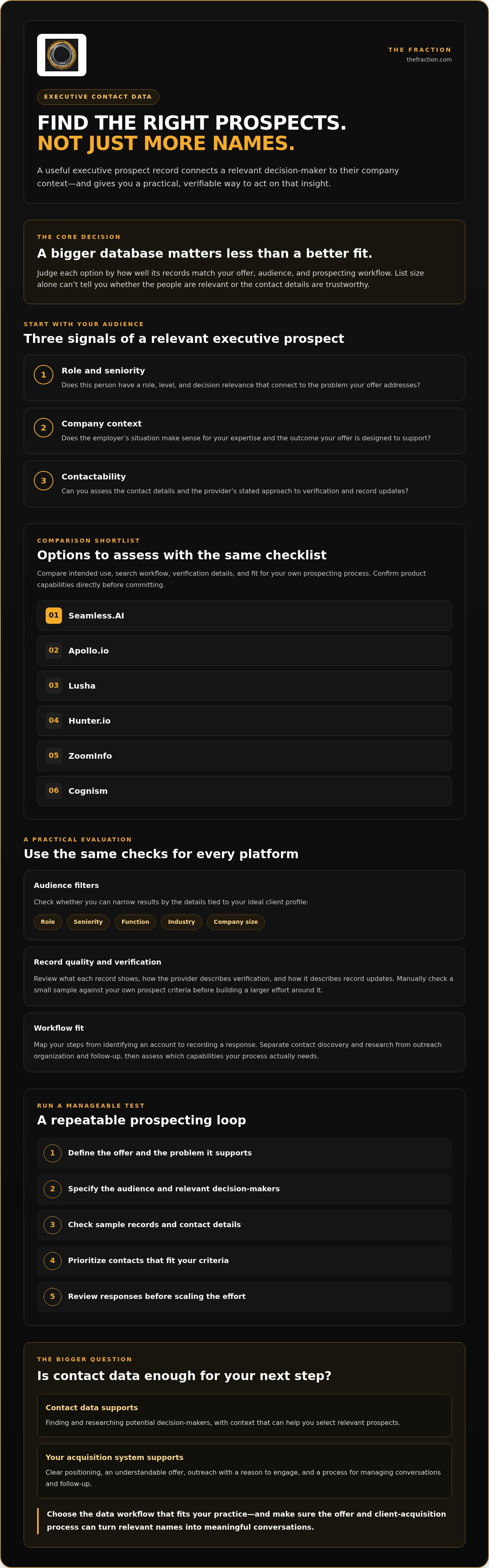
We’ll look at Seamless.AI alongside Apollo.io, Lusha, Hunter.io, ZoomInfo, and Cognism, focusing on workflow and the kind of buyer each tool may suit. If you’re building a fractional consulting practice, there’s a bigger strategic question, too: when is contact data enough, and when does your next step need to include a compelling offer and a broader client-acquisition system?
Key Takeaways
- Match executive prospect data to your offer and ideal audience, so role, company context, and contactability work together.
- Use a practical checklist to assess seamless ai alternatives for executive contact data, then test sample records against your own prospect criteria.
- Compare platforms by intended use, search workflow, and verification details. Confirm product claims before you commit.
- Run a manageable prospecting test: define the offer, specify the audience, check the data, prioritize contacts, and review responses before scaling.
- Decide whether a contact-data subscription fits your current needs or whether your offer, positioning, and client-acquisition process need a broader system.
Executive Data Needs for Fractional Consultants
Executive contact data helps you identify and research decision-makers. It can include details such as a person’s role and seniority, their employer, and ways to contact them. For a fractional consultant, the goal is to create a focused route to relevant conversations. A large list matters less than whether its records fit your expertise, offer, and the problem you solve.
That’s the practical lens for assessing seamless ai alternatives for executive contact data: treat each platform as a source of inputs, then ask how well those inputs support your prospecting process. These services sit within the broader Data as a Service (DaaS) model. For an independent expert, the useful question is more specific: can the information help you select and research the right people?
Which executive prospects are you actually trying to reach?
Start with your expertise, then define your ideal client profile and the outcome your offer is designed to support. Narrow the audience by seniority, company context, and decision relevance. For example, a broad search for “senior executives” could become a search for finance leaders at mid-sized firms facing a particular operational challenge, if that’s where your expertise and offer align. Each refinement makes the list easier to assess and gives your outreach a clearer reason to exist.
Role alone rarely tells the whole story. A senior title may look promising in a record, but the person’s responsibilities, company situation, and connection to the problem all affect whether they’re a plausible prospect. An email address or phone number gives you a way to contact them, but verification still matters. Incorrect details can undermine confidence in both the list and your outreach.
What contact data can and can’t solve
A data tool can support contact discovery and enrichment by helping you identify potential decision-makers and add context to a record. Your positioning, offer clarity, and sales conversations do different work. They explain why the right person should care, what outcome you can help create, and how a first conversation might be useful. A database can surface a name, but your offer and outreach give that contact a reason to engage.
Useful executive contact data connects a relevant decision-maker to their company context and gives you a practical, verifiable way to act on that insight. This definition keeps the focus on fit and actionability, rather than list size alone.
Fractional leaders and independent consultants often need a lean, repeatable prospecting process shaped around their own offer. A larger B2B sales team may have different requirements, such as shared workflows or broader account coverage, so its ideal platform may differ. The comparison ahead focuses on the independent expert’s decision: which data workflow supports a well-defined audience, and where does the rest of the acquisition system need to do more?
How to evaluate seamless ai alternatives for executive contact data
Start your comparison with your prospecting process, not a provider’s biggest database figure. As you assess seamless ai alternatives for executive contact data, use the same criteria for each platform. Then test whether its records and workflow fit the executives you’re trying to reach.
Check relevance and verification before record volume
Look for filters that can narrow results by role, seniority, function, industry, company size, or other details tied to your ideal client profile. Filters vary by provider, so confirm what’s available rather than assuming a platform can isolate your audience. Ask how the provider describes verification, record updates, and the information shown for each contact.
Before committing, manually review a small sample against your own criteria. Does each person appear relevant? Does their company context make sense? Can you assess the contact details using the provider’s stated verification process? A sample review gives you a practical read on list quality before you build a larger prospecting effort around it.
Match the platform to your actual prospecting workflow
Separate data access from prospecting execution. One tool might help you find or research contacts, while your overall workflow may also need to organize outreach and follow-up. Map your actual steps, from identifying an account to recording a response. Then check which capabilities support those steps and which are designed for larger sales teams.
For an independent consultant, a usable search, a way to assess records, and a clear place to track follow-up may matter more than a long feature list. Broader context on data-driven decision-making helps frame the principle: use what you learn from prospecting activity to inform your next choices, rather than collecting records without a defined purpose.
- Audience fit: Can you filter for the roles and company profiles your offer serves?
- Record confidence: What does the provider say about verification and updates?
- Usability: Can you move from finding a prospect to researching and prioritizing them?
- Workflow fit: Are outreach, follow-up, and integrations relevant to your process?
- Terms: Are current features, usage limits, contract terms, and pricing clear?
Run the same small test across your shortlist. Track which records meet your criteria and compare how easily each platform supports follow-up. Confirm current features, usage terms, and pricing directly with each provider before deciding, since plans and capabilities can change. If you’re also shaping an offer and acquisition process around your expertise, explore support for building a fractional consulting practice.
Seamless.AI alternatives compared: data platforms and prospecting options
Compare platforms against your specific audience and workflow, using the same practical test for each. When evaluating seamless ai alternatives for executive contact data, use the same ideal client profile and criteria across your shortlist. Separate confirmed product information from your own judgment about fit. Features, filters, verification practices, and terms can change, so confirm details with each provider before deciding.
Which alternatives suit a focused executive search?
Apollo.io and ZoomInfo are candidates to assess if you want contact data alongside broader sales workflows. Apollo is described as combining data and engagement, while ZoomInfo is described as offering deeper intelligence options. Cognism and RocketReach can also go on your comparison list, but check their current executive-search filters, workflow scope, and verification details directly. LinkedIn Sales Navigator can support professional role and company research. Confirm its current features and contact-data capabilities for your use case.
| Platform | Intended use to assess | Executive search and workflow | Verification details |
|---|---|---|---|
| Seamless.AI | Contact discovery | Confirm available role and company filters, integrations, and follow-up workflow. | Ask how records are verified and refreshed. |
| Apollo.io | Contact data with sales engagement | Research its current executive filters and which outreach steps are included in your plan. | Confirm verification approach and record-update details. |
| ZoomInfo | B2B data and broader go-to-market workflows | Assess whether its intelligence and workflow scope fit your target accounts, then verify available filters. | Ask how contact details are checked and updated. |
| Cognism | Executive-data candidate for comparison | Confirm current role filters, account context, and workflow capabilities. | Request current verification and refresh details. |
| RocketReach | Contact-data candidate for comparison | Research its current executive-search filters and workflow integrations. | Confirm how accuracy and updates are described. |
| LinkedIn Sales Navigator | Professional prospect and company research | Confirm current role and company search features, plus how you’ll manage outreach and follow-up. | Check which contact details are available and how you’ll verify them. |
How to present a fair alternatives comparison
Run one small sample search using your own audience definition. Compare role relevance, company context, reachable records, usability, and follow-up support. Label product claims as provider-confirmed or still requiring research, and keep your own fit judgments separate. For added context on provider practices, see Stanford HAI’s discussion of data brokers and compliance considerations.
A focused shortlist beats a feature-list marathon. Test the same audience in each tool, then choose the workflow that makes relevant prospects easiest to assess and act on.
Choose a contact-data workflow that fits your consulting practice
A contact database gives you names and context, but the workflow around it determines whether those records lead to useful conversations. Your offer sets the destination, your audience defines the path, and data helps you decide where to go next. For an independent consultant, a small, deliberate test can reveal more than expanding tools or outreach volume before the direction is clear.
Turn your offer into an executive prospect filter
Translate the business problem you address and the outcome your offer supports into observable company and role characteristics. If your work helps organizations improve a specific function, identify the types of companies where that challenge is relevant and the leaders likely to influence a decision. Keep the first audience narrow enough to research each prospect and explain why your outreach is relevant. Conversations with industry leaders can also help you check whether the audience and offer resonate before you build a larger list.
Build a repeatable research-to-conversation process
Use this five-step workflow as a manageable starting point for evaluating seamless ai alternatives for executive contact data and putting a suitable tool to work:
- Define the offer. State the problem you help solve and the outcome you’re equipped to support.
- Specify the audience. Turn that offer into role, seniority, company, and context criteria.
- Test the data. Review a small sample, checking relevance and verification status before relying on the records.
- Prioritize prospects. Record the source, fit rationale, and next action for each person you choose to pursue.
- Review responses. Look at the conversations and feedback, then refine the audience, message, or offer where needed.
A simple tracking sheet or CRM can hold the working details: where the record came from, why the person appears relevant, whether you’ve checked the contact information, and what you plan to do next. Keep human review in the loop before sending messages or treating a record as qualified. That way, automation supports your judgment instead of quietly replacing it. If responses are limited, examine the whole chain: audience fit, offer clarity, message relevance, and follow-up.
Once the process produces useful learning, decide whether more automation, additional data access, or a wider outreach workflow belongs in the next stage. Apply the same offer-first thinking to every prospecting channel you use.
When an executive contact database needs a broader acquisition system
A contact-data subscription can be a useful fit when your offer and ideal audience are clear, and your main bottleneck is finding and researching relevant decision-makers. But if your audience still feels broad, your offer is hard to explain, or follow-up happens inconsistently, adding another database may not solve the problem. The gap could be in the wider acquisition system, where the offer, prospecting approach, and sales conversations need to work together.
Signs the gap sits beyond contact discovery
Look at what happens before and after a name enters your list. Can you describe the organizations that benefit from your expertise and the executive roles connected to the problem you solve? Can you explain your offer in terms of a relevant outcome? Do you have a useful next step for a prospect who responds? If those pieces are still taking shape, a database can supply useful inputs, while your audience definition, positioning, and follow-up process remain open questions.
That distinction matters as you compare seamless ai alternatives for executive contact data. A relevant record can help you research a prospect. Your offer explains why your expertise fits their situation, and your sales process guides a thoughtful conversation forward. Data is one component of the route from your expertise to a clear offer and a consistent way to engage potential clients. Software and support can help build that route, while specific client or revenue outcomes depend on many factors.
Explore support for building a fractional practice
The Fraction serves a different need from a contact-data provider. It builds fractional consulting practices through a done-with-you process that can include developing the offer, shaping client-acquisition systems, establishing sales processes, and setting up automation. The work is broader than choosing a database: the practice is co-built from offer through delivery, and clients retain their systems, automations, content, and infrastructure.
Here’s a useful decision point: if your offer and prospecting process are established, evaluate data tools against your workflow. If you’re still clarifying who you serve, what you offer, or how you’ll guide interest into a sales conversation, consider whether a broader practice-building process better matches the work ahead. The Fraction builds fractional consulting acquisition systems, so you can explore whether that support fits your next step.
Build Your Next Step Around the Practice You Want
The strongest choice among seamless ai alternatives for executive contact data depends on how well a tool fits your audience, verification needs, and day-to-day prospecting workflow. Start with a focused test, learn from the records and conversations, and use what you discover to refine your targeting and offer.
If your next challenge reaches beyond contact discovery, The Fraction takes a broader, done-with-you approach to building a fractional consulting practice, from offer development through client acquisition and delivery. Its Custom Proof of Concept includes interviews with 10 industry leaders using a provided framework before payment. Explore the program to see whether it fits your needs.
Choose your tools with intention, then build a system around the expertise you’ve already earned.
Frequently Asked Questions
What is the best alternative to Seamless.AI for executive contact data?
The best fit depends on the roles, companies, and prospecting workflow you need. To compare seamless ai alternatives for executive contact data, use the same ideal-client profile, confirm current filters and verification details, and inspect sample records before choosing. For a fractional consultant, relevant contacts and a workable follow-up process can matter more than headline database size. Assess how well each provider supports your actual priorities.
Is Apollo.io a good alternative to Seamless.AI for finding executives?
Apollo.io is a candidate worth comparing, especially if you want to assess contact-data access alongside prospecting and sales-workflow capabilities. Check its current executive filters, coverage, verification information, and usage terms against your target audience. Features and plans can change, so confirm details directly with the provider before deciding. Database size is one point of comparison; record and workflow fit for your market matter, too.
How do I compare executive contact data providers?
Start with a clear ideal-client profile, then test each provider against the same roles, functions, company criteria, and workflow. Review sample records, ask how verification and updates work, and confirm integrations and usage terms. Keep provider-confirmed product facts separate from your own test results, so your shortlist reflects actual relevance and usability. This consistent approach helps you weigh practical fit alongside provider claims and feature lists.
Can LinkedIn Sales Navigator replace an executive contact database?
LinkedIn Sales Navigator may support professional research and help you identify relevant people. Its fit depends on your workflow and the tool’s current capabilities. Compare the research time required, the information available, and how you’ll manage follow-up. Some prospecting processes combine research tools with contact-data providers. Check current product details and terms directly, then choose the approach that best supports your audience, research needs, and follow-up process.
How can I verify executive contact data before outreach?
First, check whether the person’s role and company still match your target criteria. Then review the provider’s stated verification process and any available record-update details. Manually inspect a small sample before building a larger list, and record the data source and your reason for considering each prospect a fit. A human review step helps you assess relevance to your offer and check contact details before outreach begins.
Do fractional consultants need an AI contact-data tool to find clients?
An AI contact-data tool can support prospect research as one input to client acquisition. A consultant also benefits from a clearly defined audience, a relevant offer, and a thoughtful process for starting and following up on conversations. If those foundations are in place, compare tools against your workflow. If they’re still taking shape, refine your positioning and process alongside your data choices so each part supports the next.


