

If you’re thinking about how to monetize corporate experience, start by asking which business problems your experience helps solve. Years of work can give you valuable judgment and skills, but a buyer needs to understand what you can do for them, what the work involves, and why it matters now.
That’s where experienced professionals can get stuck. Your expertise may span several functions, so choosing one service can feel difficult. Finding prospective clients can also be hit-or-miss, and selling may feel unfamiliar after years of working within an organization. Treat the transition as a practical build: identify a business need, test whether buyers care about it, and shape your experience into a service they can evaluate.
This guide explains how to identify the outcomes your experience can support, define a consulting offer, and create a practical way to find and qualify prospective clients while you’re still employed. You’ll also learn how buyer conversations can sharpen your offer and how a clear client-development process can make sales discussions more useful and less pressured.
Key Takeaways
- To learn how to monetize corporate experience, connect the skills and decisions you’ve repeated to a specific buyer problem and a meaningful business outcome.
- Shape your expertise into an offer with a defined buyer, clear scope, and intended outcome, so prospective clients can quickly understand its relevance.
- Compare fractional leadership, project consulting, advisory work, and productized services by delivery style, buyer need, and fit with your current employment.
- Use conversations with potential buyers to learn their priorities, current approaches, and decision criteria, then refine your offer before making a major career move.
- Build a practical client-acquisition path that links targeted prospecting with relevant outreach, discovery, and consistent follow-up.
How to Monetize Corporate Experience by Finding Its Commercial Value
Your corporate career has given you more than a job title. It has helped you develop methods and judgment you can apply to business problems in different organizations. To understand how to monetize corporate experience, identify what you can help another organization accomplish, then connect that capability to a need a buyer recognizes. That’s the practical basis of consulting. This management consulting overview offers useful context on the field.
Review your work in operations, finance, sales, strategy, or another function. Which problems came up repeatedly? What did you do, and what changed as a result? Perhaps you helped a team improve a handoff, gave leaders clearer information for a decision, or identified where a sales process was slowing down. Your job title describes your role; a potential client is more interested in the repeatable skills and judgment you can bring to a problem.
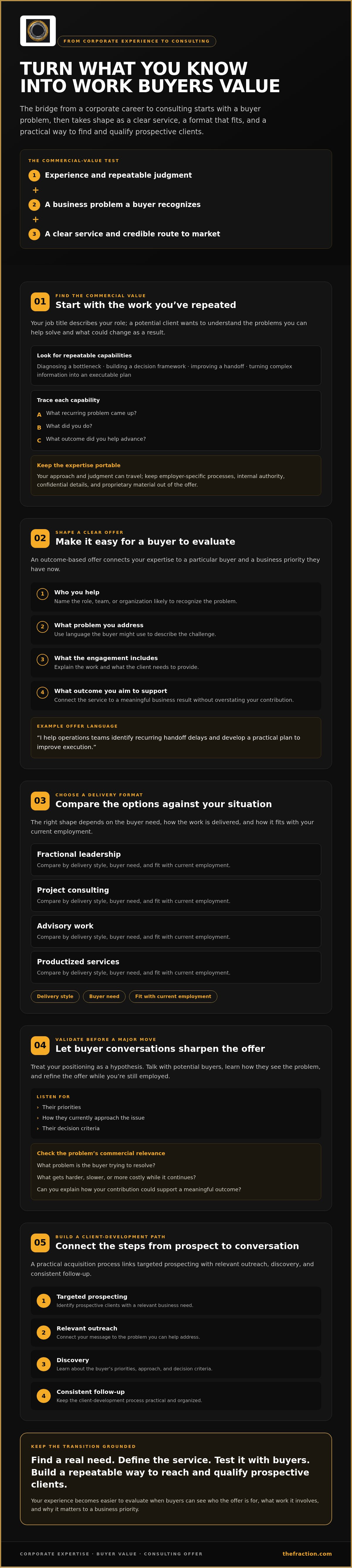
Expertise becomes monetizable when it creates buyer value, takes the shape of a clear service, and has a credible route to market.
Which parts of a corporate career can become consulting expertise?
Start with capabilities you can use across organizations: diagnosing a bottleneck, building a decision framework, improving a handoff, or turning complex information into an executable plan. Keep your methods separate from employer-specific processes, internal authority, confidential details, and proprietary material. Your approach and judgment can travel; internal documents and private context cannot.
For each capability, note the recurring problem, the action you took, and the outcome you helped advance. A finance professional, for example, might describe how clearer forecasting inputs supported better-informed planning decisions. Keep the example focused on your contribution and broad enough to protect sensitive information. If the result was a team effort, describe it that way rather than claiming sole credit.
How to connect your experience to a buyer’s urgent problem
Your expertise has commercial potential when it meets a buyer’s current need. For each capability, identify the role or organization most likely to recognize the problem and have a reason to seek outside help. A sales leader may want to understand where promising prospects stall. An operations team may be tracing recurring delays. A strategy lead may need better decision inputs before choosing a direction.
Describe the challenge in language a buyer might use, then ask:
- What problem is the buyer trying to resolve?
- What gets harder, slower, or more costly while it continues?
- Can I explain how my contribution could support a meaningful outcome?
Prioritize problems you can explain clearly and address credibly. That gives you a practical starting point for a consulting service. You can refine the direction as you learn how buyers describe the problem and assess its value.
Turn Corporate Expertise Into a Clear, Outcome-Based Consulting Offer
Once you’ve identified where your expertise could help, give it a shape a buyer can evaluate. A useful offer explains who you help, what problem you address, what the engagement includes, and what outcome you aim to support. Your experience matters, but buyers also need to see how it applies to a business priority they have now.
Instead of leading with a broad claim like “I bring strategic leadership,” name the buyer and the problem: “I help operations teams identify recurring handoff delays and develop a practical plan to improve execution.” This gives a prospective client something concrete to respond to and helps you define the boundaries of the work.
An outcome-based offer turns your skills into a defined service for a particular buyer, designed to support a meaningful business result.
Choose a buyer and problem your experience can credibly address
Your functional expertise is the raw material, but the buyer’s need helps determine what to offer. A finance professional might apply forecasting experience to a business that needs clearer planning inputs. A sales leader might help a team identify where qualified opportunities are stalling. Begin with problems you are equipped to address, then treat your positioning as a hypothesis to test with potential buyers.
Shape expertise into a productized service
Make the engagement specific. Explain what’s included, what the client needs to provide, how the work will unfold, and how you’ll assess progress. A forecasting engagement, for example, could include reviewing the current planning approach, identifying gaps in the inputs, and recommending a clearer process. The buyer can then picture the work and decide whether it fits, rather than trying to assess open-ended hourly support.
As you refine the offer, check that the scope and intended outcome match. Make sure you can explain both without relying on corporate shorthand. If you’d like practical support building an offer alongside client acquisition, explore consulting offer and client-acquisition support.
Compare Ways to Monetize Corporate Experience Through Consulting
After identifying the value you can offer, choose how to deliver it. One buyer may need ongoing leadership, another a defined project, and another access to your judgment on key decisions. Each model affects the scope, working rhythm, client access, and fit with your current employment. Choose based on both the buyer’s need and the way you want to work.
Fractional, project-based, and advisory work: how the models differ
Fractional work provides ongoing, part-time functional leadership when a business needs senior capability over time. Project consulting addresses a defined problem through an agreed scope and intended outcome. Advisory work gives a client structured access to your perspective and decision support, with clear boundaries around availability and responsibility. A productized service packages repeatable work into a consistent scope and delivery process.
| Model | Structure and buyer need | Fit to consider |
|---|---|---|
| Fractional leadership | Ongoing, part-time leadership for a function or business priority. | Fits leaders who want sustained involvement and have capacity for regular client access. |
| Project consulting | A defined engagement to address a specific challenge and deliver an agreed result. | Fits focused expertise, bounded scope, and a clear beginning and finish. |
| Advisory work | Scheduled access to expertise for perspective, decisions, or direction. | Fits strategic input, with responsibilities and access agreed in advance. |
| Productized service | A repeatable service delivered through a consistent scope and process. | Fits work you can standardize while adapting to each buyer’s context. |
Choose a model that fits your strengths and working constraints
Consider the work you enjoy and the responsibility you’re prepared to take on. Do you want to lead implementation, solve a contained problem, guide decisions, or deliver a repeatable process? Then consider your available capacity, the amount of client access required, your employment commitments, and how reliably you can deliver the work. Fractional leadership often requires regular interaction, while a well-scoped project can make the workload easier to define in advance.
Set fees with the scope, buyer value, delivery responsibility, and market feedback in mind, rather than borrowing a rate from a different engagement model. As you choose, also map how the right buyers will find and evaluate your service. A focused client-acquisition system can connect your offer to a practical route to market.
Validate Your Consulting Offer Before Making a Career Move
A promising idea is a starting point, not proof that buyers will pay for it. Testing your offer helps you learn how potential clients describe the problem, whether they are already investing effort or resources in it, and what would influence a decision to hire outside support. Use a learning loop: identify a buyer, have market conversations, refine the offer, and test interest with a clear next step.
Use market conversations to test the problem and offer
Approach conversations with curiosity and let buyers describe the need in their own words. Ask questions such as: “What’s taking priority for your team right now?” “How are you handling this today?” “What would shape a decision to bring in outside support?” and “What outcome would make this work valuable?” Their answers can show whether your offer addresses a real need or whether you need to rethink the problem.
Look for patterns across conversations: recurring problems, existing effort or spending, and a clear route to the person who makes the decision. One person’s interest can help you improve your wording, but it is only one signal. Compare it with what other buyers say and whether they are prepared to take a next step.
Buyer interest is a useful signal to investigate; a confirmed client commitment is evidence that someone has agreed to move forward.
A structured research process can help make these conversations more consistent. The Fraction’s custom proof-of-concept process includes interviews with 10 industry leaders using a provided framework. It gives professionals market input and a personalized strategy before payment, helping them assess a consulting direction.
Build a measured transition plan while employed
You can develop the foundation in deliberate steps while you’re still in your current role. Keep consulting research and work separate from employer time and resources, protect confidential information, and review the commitments and boundaries attached to your employment before pursuing outside work. Let your experience inform your method, but keep employer-specific material out of your offer, examples, and client conversations.
Choose a pace that fits your actual schedule. Refine your positioning, speak with potential buyers, and test outreach in manageable blocks. Record what earns a reply, what prompts questions, and where interest fades. This feedback can help you adjust both the offer and your client-development approach before making a larger career decision. Treat the transition as a series of informed decisions, not one dramatic leap.
Build the Client-Acquisition System That Turns Expertise Into Revenue
A strong offer needs a route to the people who can use it. Client acquisition works best as a connected process, not a string of hopeful introductions. Your positioning explains why the conversation is relevant, outreach opens it, discovery helps both sides assess fit, and follow-up clarifies the next step.
Create a repeatable path from prospect to client
Identify organizations and decision-makers likely to recognize the problem your service addresses. Then map a simple path from first relevant contact to a qualified conversation, a proposal or other agreed next step, and follow-up. Each interaction should help you understand whether the buyer recognizes the issue, whether it matters now, and whether your service fits the need.
Set a cadence you can sustain alongside your current commitments. Reserve regular time to identify prospects, send thoughtful outreach, follow up on open conversations, and review your pipeline. Note which messages earn responses and what questions arise in discovery. Use that information to improve your message and offer. Market learning, positioning, and sales should reinforce one another: each conversation can make the next one more relevant.
Automation can support repeatable tasks such as organizing prospect information, prompting follow-up, and tracking conversations. Use it to improve consistency and leave time for the human work: listening carefully, applying judgment, and responding to the buyer’s priorities. A low-friction sales process is a focused business discussion with a clear purpose and an agreed next step.
When structured implementation support can help
Building a client-acquisition system while shaping an offer can be demanding, especially when you’re balancing a corporate role and a new consulting direction. The Fraction’s done-with-you model helps experienced professionals co-build their consulting practice, from offer development to business infrastructure. Support includes playbooks, automation setup, and client-success guidance. Clients retain ownership of their systems, automations, content, and infrastructure.
If you want practical implementation alongside strategy, explore fractional business-building support.
Turn Your Experience Into a Consulting Business, One Clear Step at a Time
Learning how to monetize corporate experience starts with connecting what you know to a buyer’s meaningful problem. Shape that expertise into a focused service with a clear scope and intended outcome. Then use market conversations to refine the offer and a repeatable client-acquisition process to reach prospective clients.
You can build this foundation thoughtfully, testing your direction and developing your client pipeline while you’re still employed. The Fraction’s done-with-you model supports offer development, market interviews, playbooks, and automation setup, with clients retaining ownership of their systems and assets.
Your corporate experience is a starting point, not a finished offer. Define the business problem you can solve, test your approach with potential buyers, and build a client-development process that fits your goals.
Frequently Asked Questions
How do I monetize corporate experience as a consultant?
To monetize corporate experience as a consultant, connect a proven capability to a specific buyer problem, then shape it into a service with a clear scope and intended business outcome. For example, experience improving operational handoffs could become a focused engagement to help a team identify delays and create a practical improvement plan. Test your offer through conversations with potential buyers, then use their feedback to refine your positioning and client-acquisition approach.
Can I build a consulting business while keeping my corporate job?
Yes, you can begin developing a consulting business while keeping your corporate job, provided the work fits your schedule and respects your employment commitments. Start with manageable blocks of time for market conversations, offer development, and prospecting. Keep employer information and resources separate from your consulting work, and consider how outside activity fits your responsibilities. The Fraction’s program is designed to support professionals who build while employed, with outreach scheduled around their circumstances.
What corporate skills can I sell as a consulting service?
Skills that help organizations solve consequential problems can form the basis of a consulting service. Examples include improving operations, supporting financial planning, strengthening sales processes, clarifying strategy, and helping teams make better decisions. Connect the skill to a buyer’s need and explain the contribution you can credibly make. Package repeatable methods and judgment, while keeping employer-specific processes, confidential information, and proprietary materials out of your service and examples.
How do I price consulting based on my corporate experience?
Set consulting fees by considering the agreed scope, the value the work is designed to support, your delivery responsibilities, and feedback from prospective buyers. Years of experience can strengthen credibility, but they don’t define the fee on their own. Clarify what the engagement includes, what the client needs to provide, and how progress will be assessed. As you test the offer, use buyer conversations to learn whether the scope and value are clear enough to support a purchasing decision.
Do I need to quit my job before finding consulting clients?
No, you can begin exploring and validating a consulting offer before leaving your job. Start by speaking with potential buyers, refining your positioning, and testing appropriate outreach in time you can realistically commit. Keep your employer’s confidential information, systems, and resources separate, and review your employment commitments before taking on outside work. This measured approach helps you gather market feedback and build a clearer picture of client interest before making a larger career decision.
How do I find clients for a consulting business built on corporate experience?
Begin with a clear offer and a defined picture of the buyers likely to need it. Identify relevant prospects, reach out with a message tied to their business priorities, and use discovery conversations to assess fit and agree on a next step. Follow up consistently and review which messages lead to useful conversations. Automated and AI-powered lead-generation systems can support prospect identification and follow-up, while your judgment and personal communication guide the buyer relationship.


