

High-value conversion is not an act of persuasion; it's the logical result of a well-architected authority ecosystem. You've likely spent decades honing your expertise, yet the prospect of selling often feels like a regression into a frantic hustle culture that compromises your professional standing. It's exhausting to waste time on low-quality leads or fear that your outreach looks desperate. You deserve a sales process that reflects your executive caliber, providing the stability, prestige, and autonomy you've earned.
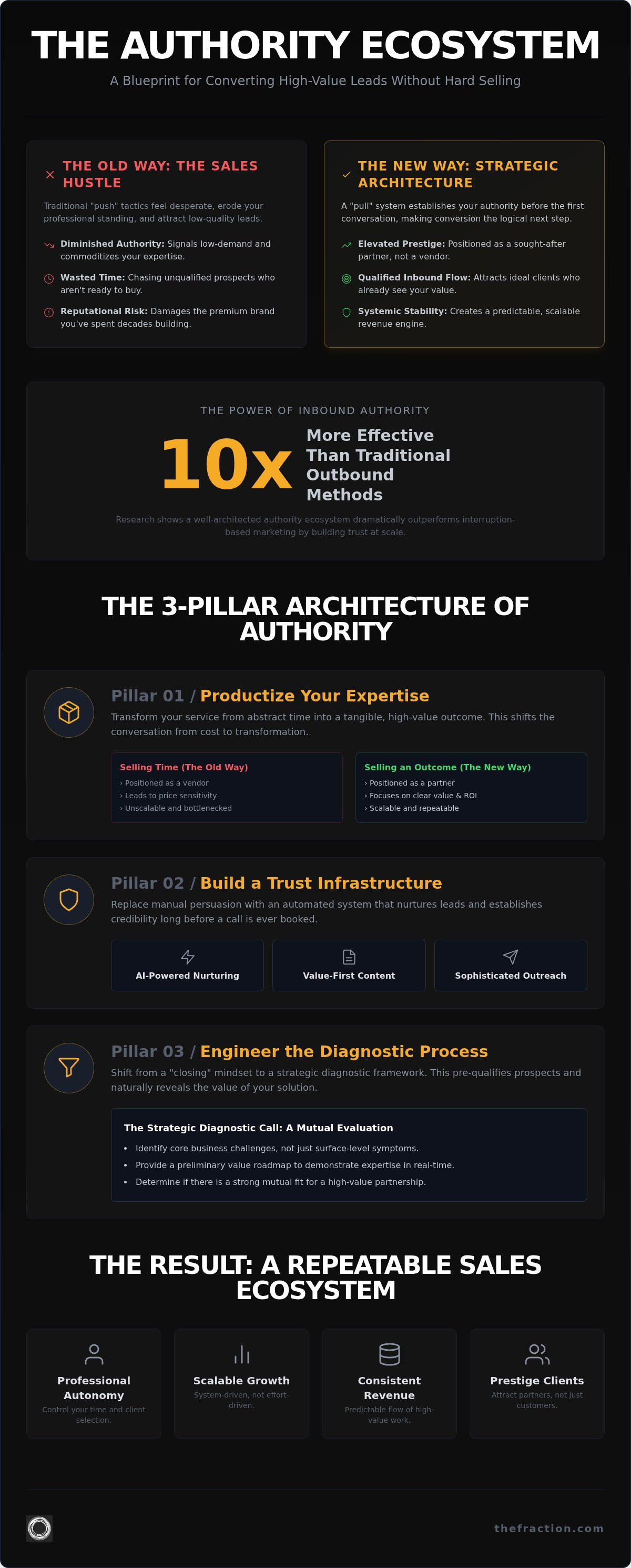
This guide demonstrates how to master the art of converting leads without hard selling by transitioning from manual persuasion to strategic architecture. You'll learn to transform your client acquisition into a sophisticated, AI-driven system that establishes authority before you even step into a meeting. Research shows that inbound lead generation is 10 times more effective than traditional outbound methods, and we'll show you how to capture that efficiency. We'll examine the integration of lead scoring, automated nurturing, and premium positioning to ensure your revenue becomes as consistent as your expertise. By the end of this article, you'll have the blueprint for a repeatable system where high-value clients don't just find you; they ask to work with you.
Key Takeaways
- Understand why traditional sales tactics erode your authority and how to align your client acquisition with your executive caliber.
- Build a three-pillar authority framework for converting leads without hard selling, transforming your expertise into a structured, high-value offer.
- Leverage AI and automation to maintain top-of-mind status and conduct sophisticated outreach that avoids the pitfalls of generic spam.
- Shift from a closing mindset to a strategic diagnostic framework; this process pre-qualifies prospects and reveals the inherent value of your solution.
- Establish a repeatable sales ecosystem that provides the infrastructure for professional autonomy and scalable growth.
The Expertise Paradox: Why Hard Selling Fails High-Value Professionals
High-level professionals often face a unique challenge: the very tactics that work for commodity products fail when selling high-value expertise. This is the Expertise Paradox. When you lean into aggressive persuasion, your perceived authority diminishes. In high-ticket consulting, your value is intrinsically tied to your status as a peer and a problem solver. If you appear desperate to close a deal, you inadvertently signal that your services are not in demand. Mastering the art of converting leads without hard selling requires a fundamental shift from a "push" mentality to a "pull" authority system that leverages your existing prestige.
The psychological barrier here is significant. Corporate leaders are conditioned to identify value and solve problems, not to be "closed" by emotional appeals or high-pressure tactics. Traditional sales methods often feel manipulative or cheap to an executive audience. Many professionals struggle with the initial phase of lead generation because they associate it with cold, impersonal outreach that contradicts their professional identity. To succeed, you must move away from interruption-based marketing and toward a system where your expertise does the heavy lifting before the first conversation ever occurs.
The Reputational Cost of Desperation
Hard selling signals a low-demand environment. For a seasoned executive, adopting the persona of a persistent vendor erodes the professional premium you've spent years building. High-value clients are not looking for vendors to manage; they are looking for partners to lead. When you use generic B2B sales scripts, you are essentially telling the prospect that you are a commodity. Authority-First Sales is the strategic alignment of expertise and intent. By leading with value rather than a pitch, you maintain the prestige necessary for high-ticket engagements and avoid the reputational risk of looking like just another salesperson in a crowded inbox.
Moving Beyond the "Salesman" Archetype
Your corporate background is your most significant asset in this transition. You've spent years diagnosing complex organizational problems and implementing solutions. Reframing the sales call as a strategic diagnostic session allows you to operate within your zone of genius. Instead of "closing," you are evaluating fit and providing a preliminary roadmap. This shift transforms the dynamic from a transaction to a consultation. Transitioning from manual, hustle-based outreach to a systemic lead flow ensures that you are only speaking with pre-qualified prospects who already view you as an authority. This is the cornerstone of converting leads without hard selling, allowing you to build a business that is both scalable and professionally fulfilling.
The Architecture of Authority: A Three-Pillar Framework for Conversion
High-value conversion is not a manual task list; it's a technical infrastructure. When your sales process relies on personal persuasion, you're building on sand. A sophisticated authority ecosystem replaces the need for "closing" with a structured environment where the choice to work with you becomes the only logical conclusion for the prospect. This framework rests on three critical pillars: a productized offer, a trust-based infrastructure, and a low-friction entry process. By aligning these elements, you achieve the goal of converting leads without hard selling, shifting the burden of proof from your verbal pitch to your systemic presence.
Pillar 1: Productizing Your Expertise
Selling your time is the most significant growth bottleneck for any high-level professional. When you sell hours, you're positioned as a vendor, which inevitably leads to price sensitivity and the need for hard selling. To bypass this, you must transform your expertise into a specific, measurable outcome. A productized offer solves a precise corporate pain point with a clear roadmap, making the value proposition undeniable. This shift is essential because the sales process for consultants often fails when the prospect cannot visualize the final result. When you sell a transformation instead of a labor-intensive service, the sales conversation shifts from "how much do you cost?" to "when can we start?"
Pillar 2: Building the Trust Infrastructure
Trust is not earned during the sales call; it's cultivated long before the first meeting. In 2026, data shows that customers consume an average of five to seven pieces of content before they ever engage with a representative. Your trust infrastructure must automate this education process. Using AI-powered lead nurturing, you can deliver strategic insights and case studies that address the prospect's specific challenges in real time. This system identifies high-intent leads by tracking engagement patterns, allowing you to focus your energy only on those ready for a peer-level diagnostic. This automated credibility building ensures that by the time you speak, the prospect already views you as the definitive expert in your field.
The final pillar, a low-friction process, removes the psychological barriers that prevent executives from taking the first step. This involves clear calls to action and a seamless transition from a passive observer to an active participant in your ecosystem. When these three pillars operate in unison, they create a "sales-less" environment where your authority does the heavy lifting. If you're ready to move beyond the hustle and build a more scalable professional future, you can explore how to architect your own authority system to secure high-value clients with precision.
Leveraging AI and Automation for Low-Friction Lead Nurture
Maintaining a consistent presence in a prospect's consciousness shouldn't require manual labor. When you rely on personal reminders to follow up, you're tethered to a process that doesn't scale and often feels like pestering. AI and automation serve as the technical backbone of your authority, acting as an "Invisible Salesman" that handles up to 80% of the conversion work. This technical infrastructure ensures that your insights reach the right desks at the right time, effectively converting leads without hard selling by replacing manual persistence with systemic precision. It allows you to remain "top of mind" without ever appearing desperate for a response.
Sophisticated Outreach Automation
Generic LinkedIn spam is the antithesis of executive positioning. Truly sophisticated automation uses AI to craft warm introductions based on deep data analysis rather than templated flattery. For fractional leaders, personalization at scale is the only way to maintain a premium reputation while expanding reach. AI algorithms can now identify specific "trigger events," such as corporate leadership transitions, funding rounds, or shifts in market share, to initiate contact when the need for your expertise is most acute. This moves your outreach from an unwelcome interruption to a well-timed strategic solution. By the time a prospect responds, they've already been filtered through a lens of relevance that manual searching simply cannot match.
The Automated Nurture Sequence
Once contact is established, the goal shifts from introduction to education. An effective nurture sequence provides a steady stream of high-value content that solves small problems for the prospect, building a "debt of value" before any commercial discussion begins. Statistics from 2026 indicate that AI-assisted nurturing programs can shorten the average sales cycle by 31% compared to manual efforts. By integrating the AI-driven lead generation strategy, you can use engagement data to segment leads based on their actual readiness to buy. The system tracks content consumption patterns, identifying when a prospect has shifted from passive curiosity to active intent. This ensures that you only invest your personal time into strategic sessions with prospects who have already been vetted and educated by your system, preserving your status as a high-value partner rather than a hungry vendor.
Engineering the Strategic Diagnostic: Converting Without "Closing"
The concept of "closing" is a relic of high-volume commodity sales that has no place in the repertoire of a high-value expert. When you've architected your authority correctly, the final conversation is not a battle of wits but a clinical assessment. This is the culmination of converting leads without hard selling, where the transition from prospect to client feels like a natural evolution rather than a pressurized event. By engineering a strategic diagnostic, you maintain your professional standing while ensuring that every engagement begins on your own terms. This process transforms the traditional sales call into a high-level consultation that reinforces your premium positioning.
The process begins with rigorous pre-qualification. Your automated systems, as discussed in previous sections, have already filtered for intent and budget, leaving you to focus solely on the diagnostic framework. During this session, your objective is to uncover the root cause of the prospect's organizational pain. You aren't selling a service; you're providing a prescription. This prescription is built on a tripartite structure: the diagnosis of the current state, the strategic roadmap for change, and the expected measurable outcome. When the solution is presented as the only logical response to the data revealed during the call, traditional objections rarely manifest.
The Power of the Diagnostic Question
Effective diagnostics shift the power dynamic from the buyer to the expert. By asking targeted questions that reveal the financial and operational cost of the status quo, you lead the prospect to their own conclusion. You should focus on "The Gap"-the distance between where they are and where they need to be. For example, asking "What is the measurable impact of this problem remaining unsolved for another six months?" forces the prospect to quantify their own risk. You aren't persuading them to buy; you're helping them realize they can't afford to stay where they are. The best "close" is simply a mutual agreement on the next strategic step in the implementation of the solution.
Removing Final-Stage Friction
Complexity is the enemy of conversion at the final stage of the sales cycle. Once the diagnostic is complete and the prescription is accepted, the transition to onboarding must be seamless. This involves simplifying contracts, automating payment structures, and providing immediate post-signature value. When you handle pricing discussions with executive confidence, you reinforce the prestige of your offer. Automated onboarding is a critical trust-builder; it demonstrates that your business is a well-oiled machine capable of handling the client's needs from day one. This systemic approach allows you to step away from the "hustle" and focus on high-level delivery. If you're ready to stop "selling" and start diagnosing, you can implement a sales process that doesn't feel like selling to secure your next high-value engagement.
Scaling Your Professional Impact with a Sales Ecosystem
Scaling a high-value consulting practice is often misunderstood as a human resource challenge. In the corporate world, growth usually requires more headcount, larger sales teams, and broader departmental support. For the fractional expert or subject matter architect, however, scaling is an infrastructure challenge. True professional leverage comes from building a technical ecosystem that operates independently of your manual effort. This transition marks the shift from being a corporate employee who relies on a company's brand to becoming a system-backed professional who relies on a proprietary authority engine. By implementing a sales ecosystem, you ensure that converting leads without hard selling becomes a predictable, repeatable function of your business rather than a source of constant anxiety.
A system is inherently more reliable than "hustle." While individual energy fluctuates, an architected ecosystem maintains a steady pace of identification, outreach, and education. This allows you to move from the front lines of business development to a position of strategic oversight. You're no longer the one doing the heavy lifting of prospecting; you're the executive reviewing the high-intent data and conducting the final diagnostics. The Fraction serves as the strategic architect in this transition, providing the AI-powered tools and frameworks necessary to automate the complex mechanics of lead acquisition and conversion.
Building for Professional Autonomy
Professional autonomy is the ultimate luxury for the high-level expert. It's the psychological freedom that comes from knowing exactly where your next client is coming from without having to compromise your reputation. By automating your lead flow, you maintain a premium positioning that manual "chasing" would otherwise erode. This technical and strategic infrastructure ensures that your outreach remains sophisticated and your authority remains intact. The Fraction specializes in implementing these AI-driven systems, allowing you to focus on delivering high-impact results while the ecosystem handles the persistent work of converting leads without hard selling.
Your Strategic Roadmap to 2026
As we move through 2026, the divide between manual practitioners and system-backed professionals is widening. Data from this year indicates that businesses integrating AI-powered marketing automation generate 512% more marketing-qualified leads than those relying on traditional methods. Now is the time to evaluate your current sales bottlenecks. If your revenue depends on your ability to manually follow up or overcome objections in real-time, your growth is capped by your own calendar. Implementing an AI-driven conversion system is not just a technological upgrade; it's a strategic necessity for anyone looking to redefine their professional impact. You can begin this transformation today and build your automated sales ecosystem with The Fraction to secure your future as a high-caliber, autonomous leader.
Architecting Your Professional Autonomy
The transition from a manual hustle to a systemic sales ecosystem is the definitive step toward long-term professional stability. By resolving the expertise paradox and implementing a three-pillar authority framework, you shift the focus from persuasion to clinical diagnosis. This infrastructure allows you to maintain your executive prestige while AI handles the relentless work of identification and nurture. You've learned that converting leads without hard selling is not about better scripts; it's about a better architecture that pre-qualifies prospects and establishes trust at scale.
Your expertise is too valuable to be spent on low-level business development tasks. The Fraction provides the strategic blueprint and AI-driven tools necessary for high-value subject matter experts to reclaim their time and focus on high-impact delivery. It's time to implement a sales process that doesn't feel like selling. You can automate your lead flow and convert clients with ease by exploring The Fraction’s AI Sales Systems. The path to a scalable, autonomous practice is ready for your leadership. The systems are built, and the growth you've envisioned is entirely manageable with the right framework.
Frequently Asked Questions
How do I convert leads if I hate the idea of being a salesperson?
You convert leads by transitioning from a vendor mindset to a diagnostic partner mindset. This approach focuses on solving complex organizational problems rather than pushing services. By implementing a technical system for converting leads without hard selling, you allow your infrastructure to handle the initial persuasion. This ensures that when you finally speak with a prospect, you're conducting a high-level consultation rather than a sales pitch, preserving your professional prestige.
Can AI automation really maintain a personal touch for high-value clients?
Sophisticated AI automation enhances personalization by leveraging deep data rather than generic templates. By identifying corporate trigger events, such as leadership changes or funding rounds, the system initiates contact at the exact moment your expertise is most relevant. This ensures your outreach feels like a timely strategic solution rather than an unwelcome interruption. High-value clients appreciate relevance and efficiency, which a well-architected AI system provides with far greater precision than manual effort.
What is the difference between a hard sell and a low-friction sales process?
A hard sell relies on psychological pressure and persuasion to overcome resistance, whereas a low-friction process relies on authority and alignment. In a low-friction environment, the prospect has already been educated by your trust infrastructure before the first meeting. The goal is to make the decision to work with you the only logical conclusion for the prospect. This systemic approach removes the need for "closing" techniques, replacing them with a mutual agreement on strategic next steps.
How do I handle price objections without sounding defensive?
You handle price objections by anchoring your fee to the financial impact of the problem you've diagnosed. When a prospect questions the investment, you must redirect the conversation to the cost of the status quo. If the organizational pain you've identified costs the company significantly more than your solution, the price becomes a secondary concern. Handling these discussions with executive confidence reinforces your premium positioning and ensures you're viewed as a high-caliber professional investment.
What tools are essential for an automated lead generation system in 2026?
An effective system in 2026 requires an AI-powered CRM, sophisticated LinkedIn automation tools, and content platforms that track visitor intent. These tools must work in unison to identify, reach, and nurture prospects without your manual intervention. Lead scoring adoption has reached 54% among top-tier firms because it allows experts to focus only on high-intent opportunities. Integrating these technical building blocks creates a scalable sales ecosystem that supports your professional autonomy and long-term growth.
How long does it take to see results from an AI-driven sales system?
While automated outreach can generate initial meetings within the first few weeks, a fully mature AI-driven sales system typically requires 90 days to reach peak efficiency. This period allows the AI to gather sufficient engagement data to refine its lead scoring and nurture sequences. During this time, your trust infrastructure is being built, creating the "debt of value" necessary for high-ticket conversions. Once established, the system provides a predictable flow of leads, ending the cycle of inconsistent revenue.
Is it possible to land fractional clients without cold calling or networking?
It is entirely possible to secure fractional engagements by replacing manual networking with an authority-based inbound engine. Statistics show that inbound lead generation is 10 times more effective at converting leads without hard selling than traditional outbound methods. By productizing your expertise and building a technical infrastructure that demonstrates your value upfront, you attract high-caliber clients who seek your specific outcomes. This allows you to scale your impact without the exhaustion of "hustle" culture or cold calling.


