

Look, the best b2b data enrichment tools for outbound sales are the ones that can take a useful prospect record and help carry it all the way into a real sales conversation, with reliable contact details, email verification, and a clean handoff into your CRM and outreach workflow. Think of enrichment like the wiring behind your pipeline...a provider can bring in plenty of data, but when the connections between prospecting and execution work, that data can actually move.
So you’re right to focus on coverage and accuracy, because stale or incomplete records can turn a carefully built outbound plan into a cleanup project, and that’s a bit like laying track only to find the train can’t get through. In this guide, we’ll compare tool types, walk through single-provider and waterfall workflows, and look at how email verification and automation fit in...so you can match the setup to your team and pipeline goals.
Key Takeaways
- Choose enrichment tools based on how well they fit your full outbound workflow, from finding prospects through to getting accurate records into your CRM.
- Use the same criteria to compare data providers, so you can weigh coverage, freshness, verification, and how easily each one connects with your existing systems.
- Consider waterfall enrichment when one provider leaves important fields blank, and let additional sources fill those gaps in a defined sequence.
- Build email verification and record maintenance into your prospecting workflows, so you can reduce avoidable cleanup and keep your outreach data useful.
- Measure performance by looking at usable records, team effort, and how smoothly enriched data supports outreach and pipeline execution.
What Are Lead Enrichment Tools, and Why Do B2B Sales Teams Need Them?
Lead enrichment tools add professional details to contact and company records, giving outbound teams more context for their next move…think of each record as a map, where coverage, field quality, and verification show you how useful it’ll be when sales gets moving.
Contact and Company Enrichment
Contact enrichment can add a person’s role, business email, or phone details, while company enrichment adds context like industry, size, or location. Together, they connect a person to an account, so sales teams can tailor outreach to the organization instead of treating someone like an isolated name. Providers differ in market coverage and regional depth, so a broad database and a regional specialist can each be the better fit, depending on how you prospect.
For small businesses and startups, look for a tool that covers your target accounts and the fields your sales process actually uses. Compare the same sample records across providers and see which one gives you the most useful contact and company details.
Enrichment Data Types
Account and contact data identify organizations and people; firmographic data describes companies through attributes like industry, size, and location. Technographic data shows which technologies a company uses, while intent data signals potential interest…they’re different lenses on the same account, and their value comes down to the decisions your team needs to make.
For example, firmographics can help you define account fit, while technographics can guide technology-specific targeting. Intent signals may help with timing, but they work alongside verified contact details and a clear reason to reach out, like another instrument in the band rather than the whole song.
Consumer and Professional Contact Enrichment
Consumer enrichment focuses on people in personal contexts; professional contact enrichment connects people with work roles and organizations. For outbound sales, household details may do less for you than a business address and an account relationship. A business-focused provider can link a finance leader to the company and role that matter for your campaign.
Compare records against professional use cases, like identifying operations leaders at target accounts, instead of judging a tool by its total record count alone.
European coverage calls for a closer look at country-level data and GDPR-related compliance processes. Cognism is one provider teams may consider for European prospecting, so compare its coverage of the countries and professional fields that matter to your target market.
| Provider option | Contact coverage | Company context | Potential fit |
|---|---|---|---|
| Broad business database | Wide market reach | Multiple firmographic fields | Varied target markets |
| Regional specialist | Focused country coverage | Local company context | Specific markets |
| CRM-native enrichment | Existing CRM records | Account-aligned fields | Workflow simplicity |
| Intent-focused provider | Contact and account signals | Interest context | Timing signals |
Pricing plans and free trials vary by provider, data access, and contract terms, so compare what each plan includes for the way your team works. Accuracy shifts as records age…B2B contact data decays at an estimated rate of 25-35% annually, and refreshing existing CRM records every 30 to 90 days can help keep details current. In Validity’s 2026 survey of 500 B2B and B2C marketing professionals, 62% reported revenue loss directly because of poor CRM data quality.
Waterfall enrichment and multi-provider workflows
A waterfall workflow sends records through data sources one after another, so each provider can fill gaps left by the previous one. Real-time enrichment fits inbound forms, chatbots, and live prospecting, while bulk processing handles existing records and APIs connect enrichment to other systems.
Configurable Enrichment Workflows
Think of a configurable workflow as a relay: each source gets the baton when a required field is missing or fails your rules. So set the provider order, priority fields, and routing for incomplete records. A missing verified email, for example, can trigger another lookup, while a complete record moves forward.
Those same rules can help keep your CRM tidy: map fields consistently, flag duplicates, and route incomplete records for review. In HubSpot or another CRM, define which source can update each field, so automation fills gaps while preserving useful information.
Real-Time, Bulk, and API Enrichment
Real-time enrichment fits inbound forms, chatbot conversations, and live prospecting, with latency ranging from under a second to several seconds. Bulk enrichment processes existing CRM records in batches, and API access lets connected platforms request or pass data through a workflow.
So match the method to where records enter your process: immediate lookups for live prospects, batch updates for CRM cleanup, or API access for custom connections. Capabilities vary by tool, and a strong bulk workflow may not support an immediate prospecting step.
AI-assisted enrichment can classify records, prioritize missing fields, or inform routing, but its usefulness depends on the systems connected and the data they share. In Salesforce’s 2026 State of Sales research, 51% of sales leaders using AI said disconnected systems were slowing their AI initiatives. That’s why the workflow needs to connect the CRM, prospecting tools, and sales engagement platform, like joined tracks keeping a train moving.
Start with your CRM as the record hub, then connect prospecting and enrichment platforms through native integrations or APIs. Define required fields, provider order, and rules for blanks, conflicts, and duplicates. For example, route a record with a company name but no role to another source, then send unresolved records for review rather than marking every field complete.
Measure the workflow by usable records and the manual effort it removes. You can assess a data enrichment tool by whether it reduces a RevOps team’s manual data-entry time by 15%. Track that measure alongside completeness and routing errors, so automation improves the handoff instead of simply moving incomplete records faster. If you’re aligning lead generation with a more deliberate sales process, explore a more coordinated sales workflow.
Prospecting, email verification, and sales outreach
Outbound prospecting works best when contact and company records give you enough context to make each message feel relevant, because a good prospect list is a bit like a map...the more useful detail it gives you, the easier it is to find the right route. Email verification, phone coverage, and sales engagement capabilities all shape how reliably teams can turn those records into thoughtful outreach.
Enrichment tools find business emails and direct-dial numbers by matching a person or company against professional data sources, then returning available fields. Verification checks whether an email appears deliverable, while the right decision-maker and current contact details are separate questions. So treat verification and enrichment as two distinct steps in your prospecting workflow.
Compare providers using a shared prospect list and the same target roles, so you’re comparing apples with apples. For example, measure whether a tool can find direct-dial numbers for 40% of a team’s VP-level contacts, then assess those results alongside role and company matches. A big pile of phone records has limited value when the numbers point to outdated roles or the wrong account.
Email verification should happen before a record enters an active sequence, with failed or uncertain addresses routed for review. B2B data decays at a rate of 2.1% per month, and roughly 22.5% of B2B records become inaccurate each year, so verification and refresh practices belong throughout prospecting...they’re ongoing maintenance, not a one-time list-cleaning task.
Outbound platforms can connect enrichment with email sequencing, CRM updates, and sales engagement. AI-powered prospect research can help organize company context or suggest message angles from available signals, but sales representatives should stay in control of claims and personalization. A technology signal, for instance, can point you toward an opening line, but the message still needs a clear, relevant reason for contacting that person.
Include GDPR, CCPA, and CAN-SPAM in your campaign compliance review, alongside the source of enriched data, intended use, recipient location, and outreach channel. Assess these factors before activating a list, and build suppression handling into the workflow so excluded contacts stay out when a later import comes through. The specific review depends on the campaign and applicable requirements.
Validity’s 2026 survey found that 67% of respondents said poor data had contributed to delayed or scrapped campaigns. To keep avoidable disruption from tripping up a launch, define a launch gate for every outbound list:
- Confirm the contact matches the target role and company.
- Verify business email addresses before sequence enrollment.
- Route uncertain phone or email records for review.
- Apply campaign suppression rules before outreach begins.
With these steps in place, teams can evaluate prospecting tools on more than database size...look at verified contact coverage, useful company context, and how well each platform supports marketing and sales outreach.
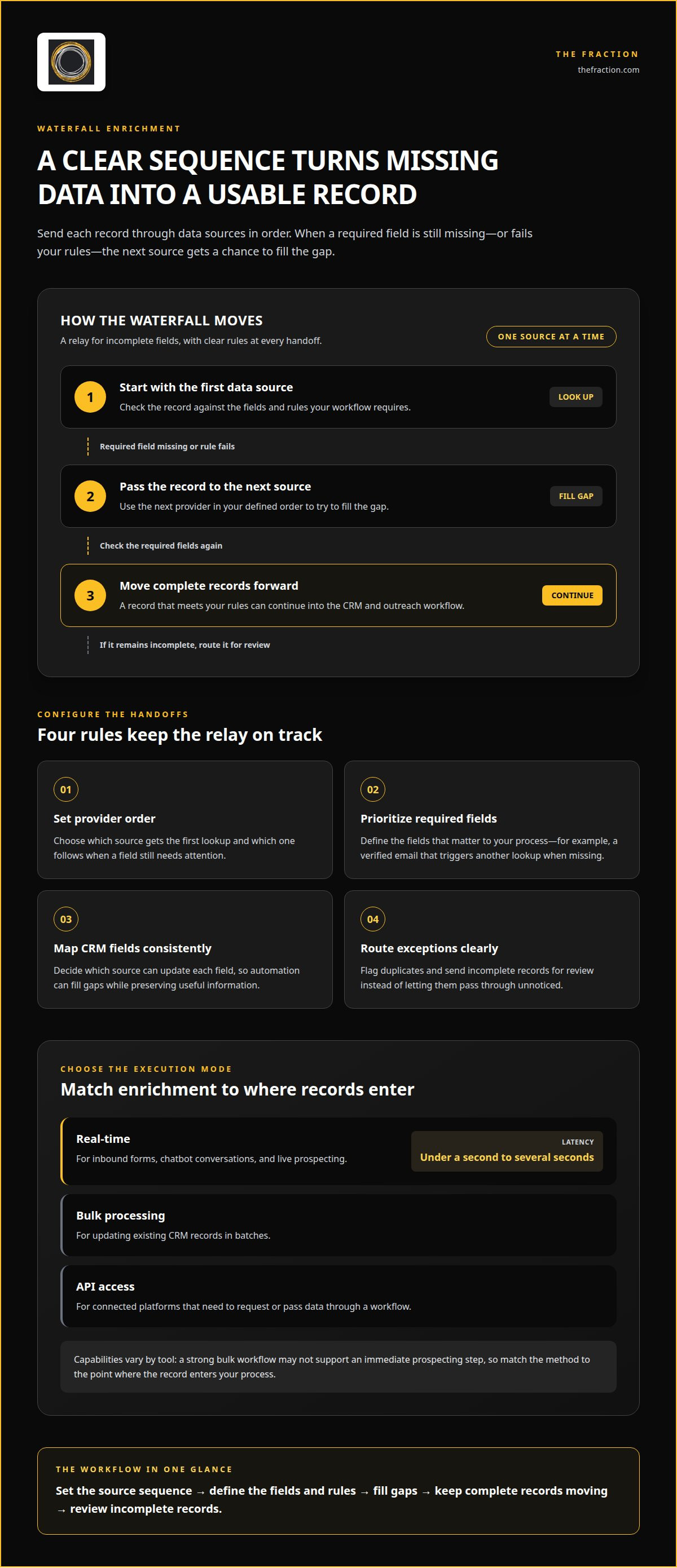
Waterfall enrichment across data providers
A waterfall workflow sends each record through selected sources in sequence, so later providers can fill the gaps earlier ones leave behind…and how well that works comes down to source order, field priorities, match rules, and the way your workflow handles conflicting results.
Start by deciding what a usable record looks like for your team, whether that means a matched contact, current role, company domain, verified business email, or some combination of those fields. Then pick two to three vendors and run the same control list of 100-200 contacts through each one, so you can see which source adds usable fields, where coverage overlaps, and where your sequence still has gaps.
Think of multi-provider sourcing like a relay…each source gets the record when a required field is missing or falls short of your rules. A practical sequence might request company details first, add contact-role information next, and then verify the email, with field-level rules that let a later source fill a blank while protecting a stronger value already in place.
That distinction matters when accuracy’s on the line, because two databases can return different titles or company details when their records were collected or refreshed at different times. Keep the source and update date attached to key fields, then send conflicts for review when they could affect account fit or outreach, and have your workflow spot duplicates before they become extra CRM records.
AI-assisted waterfall enrichment can help prioritize the next source, classify fields, or flag inconsistent records…for example, an AI step could spot a missing company domain and send the record to a source suited to company matching. Keep the rules visible and reviewable, so your team can see why a source was selected and fix bad matches instead of relying on an opaque score.
Integrations shape how smoothly the sequence runs across a CRM, enrichment database, and sales engagement platform, so check how each connection passes field values, source details, verification status, and failed-match outcomes. A native integration may make routine updates simpler, while an API can give your team more control when a custom route fits better.
Overage terms shape the workflow too, because providers may count lookups, records, or returned fields differently, and the same waterfall can use data credits at different points. Set stopping rules for when required fields are complete, and filter out records that fall short of your match criteria before they move to another source.
- Define required fields and acceptable match criteria.
- Test providers on the same control list.
- Set source order, overwrite rules, and stopping conditions.
- Track usable fields, conflicts, duplicates, and lookup consumption.
Look at these measures together…the best waterfall adds useful context with dependable accuracy, manageable integrations, and clear control over data use.
Pipeline results from enriched data and automated execution
Enrichment starts moving the pipeline when accurate account context lands with the right seller before outreach, so a record works like a useful map when firmographic fit, contact details, and the next action all connect in one workflow. For example, a technology company can route accounts by industry and size, then automatically assign matching contacts…so assess commercial value by how well the data carries the team into action.
How can teams measure the ROI of data enrichment for outbound sales? Compare a defined group of enriched accounts with a similar group handled through your existing process, then track usable records, replies, meetings, qualified opportunities, and pipeline created. Include platform costs and manual work, and review results by account segment, so you’re looking at the whole picture instead of one campaign total.
Use a consistent measurement window and clear attribution rules, so a reply or opportunity connects back to the relevant account and outreach. Track the full sequence like stepping stones: records accepted, contacts reached, positive responses, meetings held, opportunities created, and revenue won. B2B email marketing has a 2.4% conversion rate, but outcomes depend on audience, offer, message, and conversion definition…so treat that figure as context for the conversation, not a forecast for your team.
Automation should move qualified records forward and send exceptions to a human for review, so the workflow works like a good sorting hat. For instance, an Apollo workflow could send a well-matched account into a sequence after required fields pass validation, while an incomplete record returns to enrichment. That way, automation moves each row according to its readiness, and sales teams can see where a human touch still matters.
Pipeline measurement also needs to follow the way buying decisions happen. Gartner estimates vendor conversations account for 17% of the B2B buying journey, while buying committees include 11+ people across business functions. Enrichment can help map relevant contacts across accounts, but contact volume is only one piece of the picture…measure whether the right stakeholders move into meaningful sales conversations and whether opportunities progress.
For AI-enabled execution, check whether CRM fields and connected systems can support the workflow you have in mind. Validity’s 2026 research found only 21% of marketers said their CRM data was very well prepared to support AI. Its 2026 survey also found 39% selected continuous, automated monitoring as the capability most likely to improve confidence in CRM data. Together, these findings point to data readiness and ongoing monitoring as measurable parts of the operating model…like checking the foundations before adding another floor.
- Compare enriched and existing workflows using consistent account criteria.
- Track pipeline stages, team effort, and opportunity quality together.
- Review automation exceptions and data readiness alongside campaign results.
The Fraction: A sales process that feels like a real conversation
The Fraction connects lead generation to a sales process that feels natural, so enriched prospect data has somewhere useful to go...into relevant conversations with the right people. If your tools are spotting promising accounts, but your offer or follow-up feels disconnected, it’s like having a map with no clear route, so the next step is aligning the system around who you serve, what you offer, and how that value reaches the right prospects.
That work can include automated and AI-powered lead generation systems, a compelling offer and service, and a sales process built around useful conversations, where pressure gives way to a clear reason to engage. Think of enrichment as the map and the sales process as the route...both need to lead a prospect somewhere that makes sense.
If you’re ready to bring your lead generation and sales approach together, contact The Fraction.
Turn your data workflow into a stronger growth engine
Look, the next step is getting your data workflow pointed at a clear commercial strategy, so every enriched record helps answer a real question: which account deserves your attention, what makes your offer relevant, and how you might start a useful conversation. The strongest b2b data enrichment tools for outbound sales fit into that bigger picture…where targeting, messaging, and follow-through work together like parts of the same engine, instead of pulling in different directions.
That alignment starts with a focused view of your best-fit prospects and the value you can bring them. From there, lead generation gives you a steadier path to relevant conversations, and a clear offer gives prospects a reason to keep going. Think of the workflow as an operating system…tools are the components, but strategy is what gets them working together.
So if you’re ready to shape the next step around your business, start a conversation with The Fraction.
A considered system can make prospecting a more deliberate, sustainable part of your growth…so you’ve got a clearer path to keep moving.
Frequently Asked Questions
What makes the best data enrichment tool?
Look, the best tool gives your team dependable data for the decisions it actually makes, so the longest feature list may matter less than getting useful, current records for the right profile. Start with a clear target, such as identifying finance leaders at companies using a particular technology, then check whether the tool returns records that fit. And consider how easily staff can correct mismatches and whether the data slots into your existing sales process.
Does enrichment automatically make a record ready for outreach?
Enrichment adds information, so it’s one input to outreach readiness, alongside fit, context, and a relevant reason to make contact. A record could have a verified business email yet belong to an account outside your target market, so check account fit, contact role, message relevance, and campaign rules before starting a conversation.
What makes enrichment a platform decision?
Enrichment becomes a platform decision when it shapes where prospect data lives, how teams access it, and which systems rely on it. For example, marketing’s field definition may differ from the sales team’s account qualification criteria, so agree on shared ownership for important fields, which system is authoritative, and how corrections move across connected tools.
What are the best B2B data enrichment tools for outbound sales in 2026?
There’s no single best option for every outbound team in 2026, so start with the names and providers that fit your market and workflow. Cognism and Apollo are among the names to evaluate, alongside providers focused on particular markets, data types, or CRM workflows. Build a shortlist around your target accounts and the fields your sales process needs, then compare actual results against those criteria. A tool’s fit comes down to your market and operating setup.
Which B2B data enrichment tools integrate with Salesforce, HubSpot, and sales engagement platforms?
Shortlist tools with a native connector or API that supports the records and workflow your team needs across Salesforce, HubSpot, and its sales engagement platform. Then check, for example, that account and contact fields map as intended and updates flow in the direction your process requires. Integration quality also comes down to error handling and duplicate management, so look beyond the connection label.
How should a sales team choose and implement a B2B data enrichment tool?
Start with a defined prospect profile and a small set of required fields, then test candidate tools against the same sample records. Compare field coverage, match quality, verification, and the effort required to correct errors, so you can choose the workflow that fits your CRM and outreach process. Assign ownership of data rules, monitor record performance after launch, and use campaign feedback to refine the setup.
How do leading B2B data enrichment tools compare on contact and company data coverage?
Coverage varies by provider, so compare broad databases with regional specialists that may offer focused country coverage and local company context. Use the same sample records to check usable professional contact details and company fields such as industry, size, and location.


