

Lead generation moves potential customers from that first flicker of interest toward a meaningful next step, and automation can keep the journey moving by qualifying and nurturing leads, organizing customer data, and helping leaders decide where their time and investment will do the most good. So, building a business case for lead generation automation means connecting those capabilities to the work that needs doing and the outcomes the business values.
Before you add another system to the sales process, get clear on the problem it should solve and how the business will measure success, so better follow-up, clearer lead prioritization, and a stronger view of how activity contributes to revenue can turn automation from a promising idea into a practical operating decision.
You’ll learn what lead generation involves and how automation can support B2B growth through qualification, nurturing, and centralized data, then look at the costs and return on investment that can shape a credible business case. Think of it like drawing the blueprint before building…so every part of the system has a clear purpose.
Key Takeaways
- Give your sales team a clear pipeline map, so lead scores point them toward the conversations with the strongest fit.
- Let prospect behavior steer automated follow-ups, like laying down the next useful stepping stone in a buyer’s journey.
- Shape the business case around investment and outcomes, so the cost of automation connects to the value it may help create.
- Bring lead and account details into one shared picture, so marketing and sales are working from the same map.
- Judge automation by the room it creates for strategic work and the sturdy growth system it helps build.
1. How do lead qualification and nurturing work?
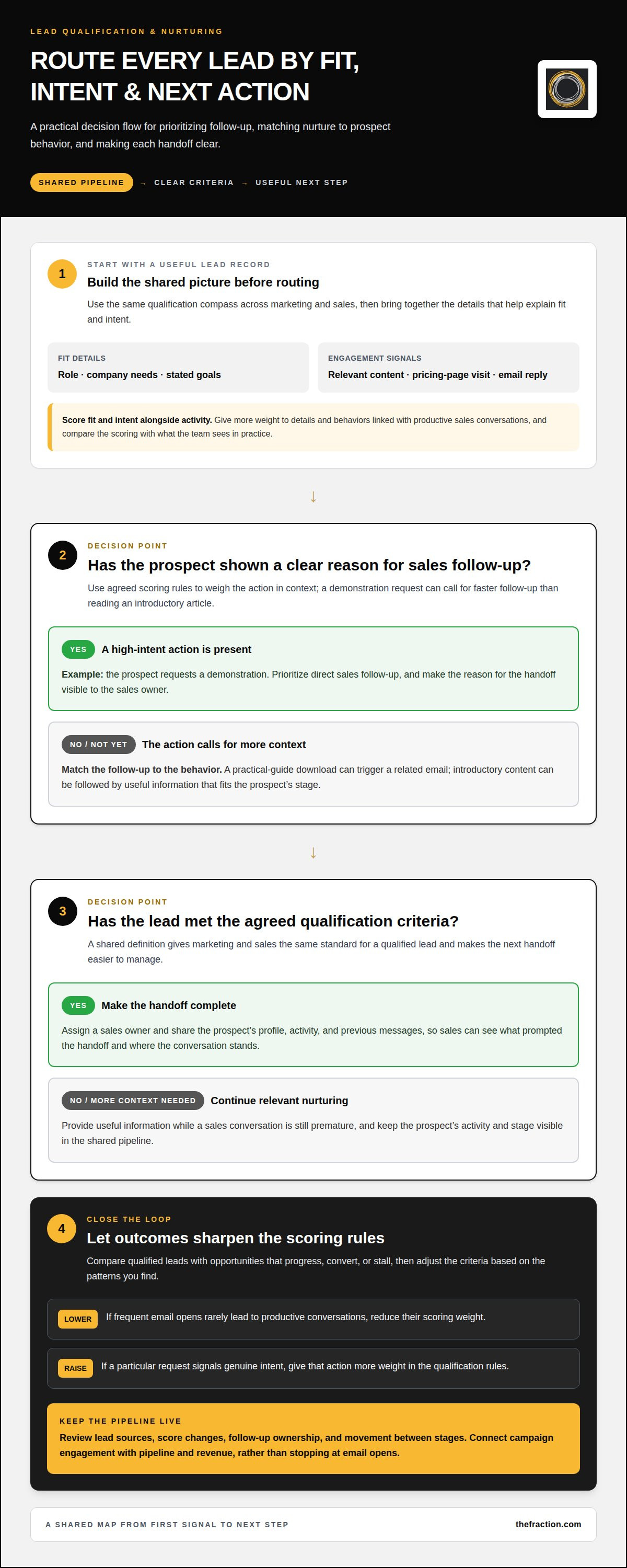
Lead generation brings potential customers into view, and qualification helps you spot who fits your offer…then nurturing keeps the conversation moving with a useful next step, like a relevant email or product demonstration. Think of the pipeline as a shared map, where each stage shows what’s happened, what comes next, and who owns the handoff, so your sales team can find promising opportunities in a crowded contact list.
Start qualification with clear criteria tied to your audience and service, so everyone’s using the same compass. A B2B team might look at a prospect’s role, company needs, stated goals, and engagement with relevant content, then pair those details with behavior, like a pricing-page visit or reply to an email. Those signals give the scoring engine a practical sense of direction, so it can weigh fit and intent alongside activity.
Lead scoring turns your qualification criteria into a prioritization signal…give more weight to details and behaviors linked with productive sales conversations, then compare the results with what your team’s seeing. For example, a decision-maker requesting a demonstration may call for faster follow-up than someone reading an introductory article. Scoring gives the team a consistent way to compare opportunities, so you can decide which conversation to move forward first.
Automation can update scores as new actions happen and trigger outreach based on those signals. A prospect who downloads a practical guide could receive a related email, while a demonstration request could prompt direct sales follow-up. Match each message to the prospect’s action and stage, so nurturing feels like a connected conversation, with a clear reason behind every email.
Clear records at each handoff make the pipeline easier to manage, kind of like passing a well-marked map from one person to the next. When a lead meets agreed criteria, the system can assign a sales owner and share the prospect’s profile, activity, and previous messages. Sales can see what prompted the handoff and where the conversation stands, while a nurture track can provide relevant information to leads who need more context before a sales conversation makes sense.
Use outcomes to refine your lead-quality criteria, because the pipeline gets sharper as you learn from what happens next. Compare qualified leads with opportunities that progress, convert, or stall, then look for patterns in role, need, and engagement. If frequent email opens rarely lead to productive conversations, reduce their scoring weight; if a particular request signals genuine intent, give that action more weight in the qualification rules.
Treat the pipeline as a live dashboard…review lead sources, score changes, follow-up ownership, and conversion between stages. These checks show whether automation is surfacing relevant prospects or simply moving names through a system, so a shared definition of a qualified lead gives marketing and sales the same standard. That makes handoffs clearer and future adjustments more practical.
2. Marketing automation for B2B lead generation
Marketing automation connects campaign activity across email, landing pages, and other channels, so messages can go out on schedule, audience segments stay organized, and responses land in one workflow. Someone downloads a guide…so they receive related content, while a demonstration request sends a nudge to sales. That gives marketing and sales a shared view of prospect engagement, rather than leaving the pieces scattered across separate campaigns.
In the United States, automated lead generation can involve email, calls, texts, and personal-data handling, so the rules depend on the channel, audience, and location. Think of compliance review, clear data-use practices, and respectful opt-out handling as the guardrails on the road…they help keep campaigns on track and build trust, because people are more likely to engage when they understand how their information will be used and what contact to expect.
So, implement automation in stages. First, define campaign goals, success measures, and ownership…then map the prospect journey and choose tools that can support it. Connect the data sources, build the landing page and message workflows, and test every handoff before launch. Start with one campaign or repetitive task, review the results, and expand as the process becomes clear.
Reporting turns activity into decisions, so track how many prospects arrive from each channel, what actions they take, and how many move toward a sales conversation. Analytics should connect campaign engagement with pipeline and revenue, rather than stopping at email opens. Multi-touch attribution can show how channels contribute at different points in the buyer journey, helping teams adjust investment based on outcomes, not just clicks.
That figure’s only one piece of ROI…connect it to lead quality, conversion, customer value, and ongoing tool and campaign costs. Automation implementation costs vary with system complexity, integrations, content needs, and internal capacity, so a credible estimate starts with those project components.
Content gives each workflow something useful to deliver. A practical article, webinar, or guide can attract an audience, while a focused landing page explains the value and prompts a next action. But automation’s a megaphone for the process underneath it, so weak messages or incomplete data get scaled right along with everything else. Review campaign results and update content and workflows as audience behavior changes. For a broader growth framework, explore a structured approach to business growth.
3. Automation pricing and return on investment
Look, automation costs go beyond the platform subscription, so lay out software, integration, setup, training, content, and ongoing campaign management as separate cost lines. Then stack those costs against measurable benefits, like staff time freed up from repetitive tasks, improved conversion, and revenue from new customers, so decision-makers can see the full investment instead of just the software bill.
When you compare platforms and vendors, run them through the same checklist: workflow fit, integration needs, reporting, usability, support, and total ownership costs. A team focused on automated email nurturing may care most about segmentation and campaign analytics, while a team coordinating several channels may need broader workflow integration…like choosing the right tool for the job, every feature should support a defined business action.
To calculate ROI, subtract the total investment from the financial benefits, then divide the result by that investment. For payback, divide the initial investment by the monthly net benefit, but make room for the time it takes to implement workflows and produce measurable outcomes…otherwise, your spreadsheet may make the system look like it pays back sooner than it does.
Say a business generates 6,000 new sales leads per year and 120 paying customers per year. Treat those figures as assumptions in an example, then swap in your own lead volume, customer conversion, revenue, and cost inputs.
Those assumptions matter because even a small shift in conversion or customer value can move the whole picture, so build a practical model that compares current performance with a scenario where automated nurturing improves follow-up or lead prioritization. Keep every assumption visible, and separate additional revenue from cost savings so the sales team can see which strategies are driving the projected return.
Scalability belongs in the investment calculation too, because a workflow that supports one campaign may need more integrations, content, or oversight as channels and audiences grow. Start with a defined process, measure engagement and behavior, then expand where results support further investment…that way, the financial case stays tied to what the business actually needs.
For a credible business case, put the baseline, projected scenario, total costs, and measurement period side by side. Building a business case for lead generation automation gets more practical when every expected benefit has a clear calculation and owner, while uncertain assumptions stay easy to adjust as results come in.
4. Bringing lead and account data together and filling in the gaps
When contact records are scattered, it’s harder to see the whole relationship a prospect has with your business…a marketing platform might have the email response, while the CRM holds the sales conversation and account details. Bring those records together and you get a fuller picture for each potential customer, so the team can see what happened, where it happened, and what follow-up’s already underway.
Start by deciding which fields each system should capture, so you’ve got a clear map instead of a pile of mismatched details. A lead record might include contact details, role, company, source, and recent engagement, while an account record can hold the bigger company picture, including its relationship with multiple prospects. Clear definitions matter, because if systems record job titles differently, teams can struggle to segment audiences or figure out who owns the next action.
CRM integration should move relevant information between marketing and sales systems in both directions…think of it like a two-way street, where a sales update about a prospect’s needs can shape the next marketing message, while a new campaign response shows up in the CRM. That shared flow helps both teams work from current information, rather than keeping separate versions of the relationship.
Automated enrichment can add or update details in lead and account profiles as new information comes in. A prospect’s role or company information can change, so refreshing records keeps the context useful over time. Enrichment can support personalization and prioritization, but the whole thing rests on the quality of the underlying data…incomplete or conflicting records can travel through connected systems just as easily as accurate ones.
Before you expand automation, set up a simple data flow: capture a new contact, match it to an existing account, update the right records, and route the information to the relevant team. For instance, when two contacts from the same company respond to separate campaigns, account matching can bring their interactions into one company view…like putting the pieces of the same puzzle on one table. Coordinated follow-up gets easier, and related conversations are less likely to be treated as unrelated leads.
Governance keeps that shared view dependable, so assign ownership for key fields, define how to handle duplicate records, and decide which system controls each type of information. Marketing might manage campaign source, while sales maintains opportunity status. Those rules give staff a consistent way to collect and update details, rather than leaving everyone to invent their own workarounds.
Centralized data also gives you a stronger way to measure what’s happening. When campaign source, account details, and sales outcomes connect, teams can trace how prospects move from initial capture toward a commercial conversation. Keep reviewing failed matches, missing fields, and duplicate records as part of ongoing maintenance…clean, connected profiles give automation a stronger foundation for relevant outreach and better-informed decisions.
5. Benefits and business value of lead generation automation
The real business value comes from making the path from first interest to a sales conversation work better, so a connected campaign can capture a response, send relevant follow-up, and give sales the context they need for the next step. But a faster workflow’s only useful if it brings the right prospects into the pipeline…so look at its effect on qualified opportunities, conversion, and revenue.
Start with capacity. When you automate repetitive tasks, like sending planned follow-up emails or updating lead records, you can free up time for strategic planning and creative work. For example, a marketing specialist could take the time they used to spend copying campaign responses and put it toward improving a landing-page message…like clearing the brush so the better work has room to grow. The benefit gets bigger when that saved effort improves the customer journey.
Automation can also make the experience feel more consistent across campaigns. Someone who downloads an industry guide could receive a related case example, while someone asking for a conversation follows a different path…so each person gets content that fits what they’ve done. A relevant next step can keep a prospect moving, but a mismatched message can interrupt their interest.
Think of the customer acquisition cycle as a series of connected stages, from initial engagement through purchase. If a handoff or follow-up keeps stalling, automation can help keep things moving by assigning ownership or prompting the next action. So make the business case specific: identify the delay or manual task you’re addressing, then track whether prospects move more smoothly through that stage.
Revenue is the real test of campaign performance. Say a landing page attracts responses, but few turn into sales opportunities…more traffic would just pour more water into a leaky bucket. The better question is whether automation helps you deliver relevant information, spot promising engagement, and support conversations that lead to commercial outcomes. Compare campaign costs with the pipeline and revenue that follow.
Build your evaluation around a baseline and a defined review period, then track lead quality, stage progression, completed follow-up, staff time spent on repetitive work, and campaign-related revenue. After you automate a focused process, compare those measures…so you can separate meaningful business value from activity counts, like emails sent or landing-page visits, and see where to expand.
A strong case treats automation like an operating engine: it connects campaign activity to measurable outcomes and makes room for higher-value work. If the process improves follow-up but still leaves the path to qualified opportunities or revenue unclear, revisit the workflow, audience, and offer before scaling.
The Fraction: Automated & AI lead generation systems
The Fraction helps professionals build a more structured path from prospect interest to client conversations, using automated and AI-powered lead generation systems. When manual follow-up, unclear positioning, or disconnected steps make growth harder to manage, the sales process gives you a more natural way forward, built around a compelling offer and service.
It’s a good fit for businesses ready to improve how they attract and nurture potential clients, while grounding the process in a clear offer and useful conversations. The Fraction helps shape the lead-generation system alongside your route to market, so the pieces work together and support the way you want to grow.
So, get in touch with The Fraction and talk through how its approach could fit your lead generation goals.
Turn the business case into a clear next move
Choose one pressure point in your growth process as the starting point. It might be an unclear handoff, follow-up that depends on someone remembering, or a campaign whose contribution to revenue is hard to trace. Keep that first move focused, so your team can connect a specific improvement to the work and make a considered call on what comes next.
Building a business case for lead generation automation is most useful when it leads to an operating decision, rather than a document that sits on a shelf. Give the next step an owner, a clear purpose, and a way to assess progress, then use what you learn to shape the broader growth plan. Start with one process, then build from there…a well-chosen starting point can create direction and momentum.
Your next growth decision can begin with one practical step, and you’re equipped to take it with clarity.
Frequently Asked Questions
What is lead generation?
Lead generation is the work of finding and attracting potential buyers who might have a need your business can meet…so, for a B2B service, you might draw a decision-maker to a useful article, then give them a clear way to ask for more information. You’re creating a path from that first bit of interest to a relevant business conversation, rather than just gathering contact details and hoping something happens.
How do lead qualification and nurturing work?
Qualification helps you work out whether a prospect fits your target customer profile, while nurturing keeps the connection useful as they weigh their options. A prospect at a small company, for example, might need something different from a leader at a larger organization…so qualification points you toward the right next step, and nurturing can give them relevant material, like a case example, while they figure out whether your solution fits.
How do you measure the success of your lead gen strategy?
Look at whether lead generation brings in relevant opportunities and contributes to business outcomes, rather than just making a lot of noise. Track lead sources, the proportion that become sales opportunities, the time between first engagement and a sales conversation, and revenue associated with resulting customers…then read those measures together, like pieces of the same puzzle, to see whether a channel is attracting the right audience or simply generating activity.
What business problems can lead generation automation solve?
Automation can help with operational bottlenecks like inconsistent follow-up, repetitive data entry, and campaign activity scattered across different places. Say a webinar attendee’s response is sitting in one tool while sales conversations happen somewhere else…a connected workflow can route that engagement into the right process. It can also make recurring outreach more consistent, so staff have more time for work that calls for judgment and expertise.
What metrics should a lead generation automation business case include?
A useful business case brings together investment, efficiency, and commercial measures. Include platform and implementation costs, staff time spent on manual tasks, lead-to-opportunity conversion, customer acquisition cost, sales-cycle duration, and campaign-attributed revenue. And when you build a business case for lead generation automation, record the baseline and measurement period too…that gives decision-makers a clear before-and-after view of actual results against the proposal’s assumptions.
How much do lead generation automation tools and implementation cost?
Costs depend on the tools you choose and the work it takes to fit them to your process. A simple workflow may need fewer integrations and less setup than a system coordinating several channels, data sources, and sales handoffs…so break out software, implementation, integration, training, content, and ongoing management. That way, you can see the full investment and which costs might change as requirements expand.
What data, CRM, and marketing technology integrations are required?
Integrations should connect the systems you use to attract, record, and follow up with prospects. A typical setup might link a website or landing page, email marketing, analytics, and a CRM, with relevant information moving between marketing and sales. Decide which system owns each field, like campaign source or opportunity status, and spell out how records are matched, updated, and handled when duplicates appear…think of it as deciding which system gets the final say.


