

Building a fractional consulting practice starts with creating value clients can see, buy, and come back for…because moving from an executive role to independent work can give you more freedom, but it also asks you to turn years of expertise into a clear offer and a reliable way to reach the right organizations. It’s a bit like building a bridge between what you know and what a client needs, you’ve got to make the crossing clear.
So here’s the practical path: define the outcomes you help clients achieve, shape your expertise into offers that can scale while holding onto their value, and build relationships through thoughtful, consistent outreach. This article walks through those choices and the business infrastructure behind them, so you can build a more resilient practice instead of riding a string of one-off engagements…with a clearer way to communicate your value, create lasting client relationships, and build an independent consulting business around the work you do best.
Key Takeaways
- Translate your expertise into the outcomes clients care about, so prospective clients can see where you fit and what you bring to the table.
- Build repeatable business systems and scalable offers around the work clients need most, so you’re not reinventing the wheel each time.
- Keep showing up with consistent, relationship-focused outreach, because opportunities often grow through conversations over time.
- Treat your practice like a business, with thoughtful ways to manage client acquisition and keep the work moving forward.
- Look at the problems organizations need solved and the roles that can solve them, rather than letting industry labels do all the thinking for you.
1. Defining a clear vision and communicating client value
Building a fractional consulting practice starts with a clear answer: what changes for clients because of your work? A job title describes your history, while a client outcome shows why an organization might engage you. One independent consultant worked in corporate marketing for four-and-a-half years before going independent, and that kind of transition calls for translating experience into a focused promise. Think of your vision as a compass, guiding each offer and conversation toward the value you want to create.
Start by identifying the business problem you solve, the leader who owns it, and the outcome they need. For example, a marketing executive might help a company clarify its market position and align campaigns with business priorities. That connects your expertise to a decision the organization recognizes. “I advise on marketing” lists an activity; “I help leadership focus marketing on its growth priorities” gives the client a result to picture. Keep the claim grounded in what you can deliver.
Next, define the boundaries of your value. Write down the decisions you can guide, the work you can lead, and the conditions your contribution depends on. A fractional finance leader, for example, might help a founder understand cash flow, with the scope shaped by the company’s needs. Clear boundaries make your offer easier to understand and help both sides assess fit. They also distinguish your strategic contribution from a broad list of tasks.
Turn that thinking into a simple message with three parts: the client you serve, the challenge you address, and the change your work supports. For instance: “I help growing software companies clarify marketing priorities, so teams can focus on the right opportunities.” This is a positioning example, not a promise of a specific result. Choose wording that is concrete enough to picture and simple enough to repeat.
Evidence can sharpen your message. Describe a relevant project, the decision you influenced, and the business context, while protecting confidential details. One independent consultant had been running a practice since 2013, showing how a clear professional direction can extend beyond a single corporate role. Focus on your reasoning and contribution, and explain how they supported the work. A concise example gives prospective clients something concrete to assess.
Finally, test your vision in real conversations. Ask a prospective client which problem feels most urgent, then listen for phrases they use repeatedly. Compare those words with your offer and adjust the wording when the connection feels unclear. One consultant’s clients were affected by venture-backed SaaS fundraising contractions in 2023, and all clients were lost at once in 2025 following budget cuts attributed to geopolitical factors. These events show why a clear explanation of value matters across changing business conditions. A defined client, problem, and outcome give your practice a stronger foundation for its next decision.
2. Building business infrastructure and scalable offers
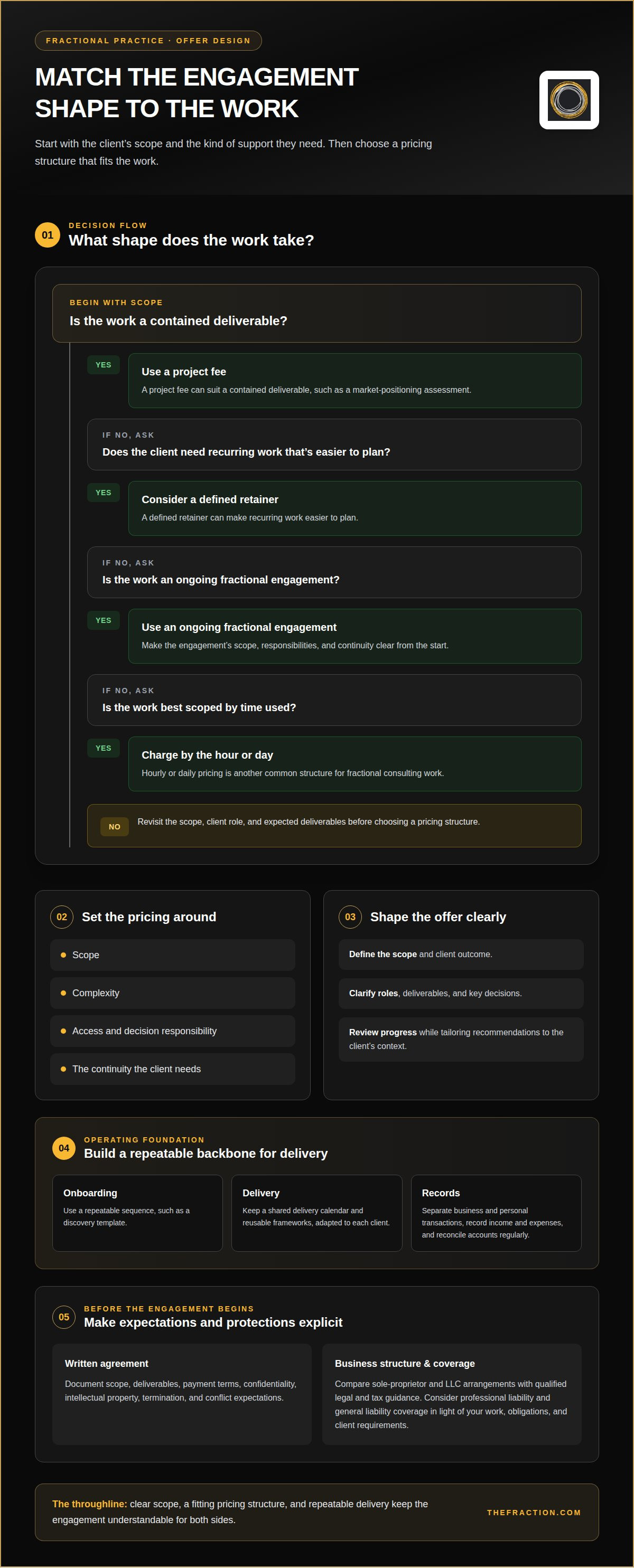
Think of your infrastructure as the operating system behind each engagement…when the process is clear, you’re making fewer of the same decisions over and over, so your expertise stays focused on client work. Start with a defined offer, a repeatable onboarding sequence, and a shared delivery calendar. For example, a strategy consultant might use a discovery template, a planning document, and scheduled leadership reviews, creating consistency while leaving room to tailor the work.
Build offers around a defined scope and client outcome, so the work has a clear shape from the start. For example, you might provide a market-positioning assessment followed by an implementation advisory engagement. Clarify the client’s role, your deliverables, key decisions, and how you’ll review progress…a repeatable core gives you a reliable foundation, while tailored recommendations keep each engagement relevant to the organization.
A personal library of reusable frameworks can make delivery more efficient, like having the right tools within reach when the work gets moving. Collect tools from your work and adapt them to each client’s context. A planning framework, for example, might organize questions about priorities, resources, and execution. Use templates as a springboard, then shape the final work around the client’s objectives and constraints.
For contracts and protections in the United States, document scope, deliverables, payment terms, confidentiality, intellectual property, termination, and conflict expectations in a written agreement. Consider professional liability and general liability coverage in light of your work, contractual obligations, and client requirements. Your coverage choices should reflect the risks involved, so insurance becomes part of the operating design.
Fractional consultants commonly charge by the hour or day, set a fixed fee for a project, use retainers, or agree on ongoing fractional engagements. Set pricing according to scope, complexity, access, decision responsibility, and the continuity a client needs. A defined retainer can make recurring work easier to plan, while a project fee can suit a contained deliverable.
When choosing a business structure, compare sole-proprietor and LLC arrangements with qualified legal and tax guidance, since liability and tax administration can differ. Keep business and personal transactions separate, record income and expenses, and reconcile accounts regularly. A bookkeeping system, for example, can track invoices, client payments, and project expenses together, giving your tax professional organized records.
Plan capacity with a delivery calendar that records each client’s meetings, preparation, and follow-through. Reserve time for business development and administration, then compare new commitments against that calendar. Define conflict boundaries before accepting overlapping work, including protections for confidential information and competing client interests. Recurring revenue is easier to manage when agreements clarify renewal, scope, and review points.
Once the offer and delivery model are clear, shape a compelling consulting offer around a specific client need, with a scope you can explain and deliver consistently.
3. Consistent, relationship-focused outreach
Find clients by building trusted relationships around a clear business problem, so warm introductions, thoughtful direct outreach, and useful follow-ups can open relevant conversations. A fractional finance consultant, for example, might connect with founders facing unclear forecasting and share a practical question to get things moving. Aim for a credible exchange that feels like opening a door, rather than pushing through it with a pitch.
Start with a focused relationship map, including former colleagues, industry peers, investors, attorneys, accountants, and leaders in your target market. Note how each person knows your work and which organizations they understand, then choose a small group for personal outreach. Mentioning a shared project or a specific company challenge makes your note feel more considered than a generic announcement.
Make your first message easy to answer, so the other person has a clear path into the conversation. Briefly explain the problem you address, why you’re contacting them, and one useful next step. For example, ask whether a company is reviewing its customer-retention approach instead of vaguely asking for “any leads.” A specific question gives the recipient context and lets them respond without committing to a sales meeting.
Set a simple follow-up rhythm, and track each contact, your last conversation, the agreed next step, and a relevant reason to reconnect. Send a useful article, share a perspective, or refer to a challenge they mentioned, so a calendar reminder can keep promising conversations from disappearing during client delivery. Make each follow-up personal, concise, and connected to the other person’s priorities.
Relationship-building can take time, but a prospective organization may reconnect long after an earlier conversation, when it’s ready to work together. Professional goodwill can outlast immediate timing, so keep a light record of meaningful exchanges and stay in touch thoughtfully, giving the relationship room to develop.
Use conversations to learn as well as introduce your work. Ask how the organization defines the problem, what it has already tried, and which decision needs support, then listen for urgency, decision ownership, and the cost of leaving the issue unresolved. These details help you assess fit and shape a relevant proposal, so each contact gets an offer grounded in their situation.
Make outreach sustainable by reserving time for it alongside client work. A regular review of open conversations can reveal useful next steps, such as sending a requested example or arranging an introduction. Track meaningful progress, including replies, referrals, and meetings, so you’re measuring movement in the relationship, not just messages. If conversations repeatedly reveal a mismatch, adjust your audience, message, or offer.
A weekly review can keep this work moving, and case structures should be actionable rather than abstract, with each bucket focused on what the candidate would do. When profit declines, consider costs alongside revenue.
4. Creating a resilient independent consulting practice
Think of your fractional practice as a business you’re building, with several clients as part of the mix, and you’ll plan differently for client transitions, quieter periods, and growth. A consultant who relies on one organization for most income has a different risk profile from one serving several clients, so map your revenue sources and spot where one change could knock the whole setup off balance.
Build resilience through your client mix and engagement timing, like putting a steady advisory engagement alongside a separate, clearly scoped project. Make sure the work fits your capacity and expertise while spreading your dependence across more than one client’s priorities. Review your pipeline alongside current commitments, so upcoming transitions show up before your calendar starts looking empty.
Keep business development moving while you’re delivering client work, because a satisfied client may refer you, but referrals alone leave your pipeline running on someone else’s clock. Set aside recurring time to reconnect with former colleagues, share relevant insights, and follow up on open conversations. A simple pipeline record works like a map, showing which relationships need attention and which next steps you’ve agreed.
Plan for change with practical scenarios…what would you do if a client paused work, delayed a decision, or changed leadership? For each possibility, identify an operational response, such as revisiting the scope, adjusting delivery time, or contacting active prospects. This working plan gives you a steady hand on the wheel, so you can respond deliberately instead of rebuilding your approach under pressure.
Protect the value of your expertise with clear delivery boundaries. Define which leadership meetings you attend, what preparation they require, and how urgent requests enter the schedule. If a client’s needs expand, talk through the change before taking on more work, so the quality of your contribution stays strong and your commitments across engagements stay realistic.
Document the parts of your work that can carry forward, like reusable onboarding questions, decision logs, and project templates stored in organized folders, with each client’s confidential material kept separate. A written handoff process can smooth the runway when an engagement concludes. These habits take the load off your memory and make new projects easier to manage.
Review the business alongside the client work, looking regularly at income sources, active opportunities, delivery commitments, and time spent on operations to spot pressure points. Repeated proposal work that leads to few conversations, for example, may signal a mismatch in your audience or offer. Use these observations to improve how the practice runs, rather than simply adding more hours.
Resilience comes from an operating model you can adjust, with client relationships kept active, commitments managed deliberately, and each engagement treated as part of a wider business. Then a client’s decision can prompt a considered adjustment, while your expertise and professional direction remain the foundation of the practice.
5. Which industries and roles have the strongest demand for fractional consultants?
Demand shifts from market to market, so start with the problem a company needs to solve, because that’s the compass pointing toward the right kind of fractional work. A growing software firm may need marketing leadership before it can support a full-time executive, while a professional services company may need operational expertise during a delivery change. Either way, urgency, budget, and access to internal leadership shape the opportunity.
Technology businesses offer clear examples of work suited to fractional expertise. A software company may need a chief marketing officer to sharpen positioning or a chief technology officer to guide product priorities, while a finance leader might help founders interpret cash flow and plan investment decisions. These roles fit when an organization needs experienced judgment and responsibilities with clear edges.
Professional services firms can have leadership gaps tied to specific priorities, too. A consulting firm, for example, may need sales leadership to improve its business development process, while an accounting firm may seek operational expertise as it changes how it delivers client work. So start with the business challenge you can help define and solve, then see where the industry label fits.
Consumer businesses offer another practical example. A retailer planning to enter a new market might need marketing direction, while a manufacturer could need supply-chain expertise during a process redesign. In both cases, the fractional role should connect directly to the decision or workstream calling for senior-level input, like a key turning point on a map. A desire for “more growth” becomes a consulting opportunity once the company defines what that means.
Common fractional titles include chief financial officer, chief marketing officer, chief technology officer, chief operating officer, chief revenue officer, and chief human resources officer. The title signals an area of leadership, but the actual scope shifts from one organization to another. One company may need a CFO to improve reporting, while another needs support with financial planning.
To identify a strong-fit market, compare three factors: the problem you solve, the buyer who owns it, and the moment that makes action necessary. A healthcare organization considering a new service line may need operational or financial expertise, while a software company preparing a product launch may need marketing or revenue leadership. These examples show possible needs across industries.
Test your focus in conversations with decision-makers. Ask which initiative is delayed, what expertise the team lacks, and what outcome leadership needs. When a company can describe a clear project and decision owner, your fractional role may have a defined place. When the need is still broad, refine the scope before proposing an engagement.
Build a compelling offer around a leadership problem you can address and the work clients need completed.
The Fraction
The Fraction helps professionals turn their expertise into a clear offer and a steadier path to clients. If your positioning feels hard to explain or outreach brings inconsistent conversations, a structured approach can connect what you do best with the organizations looking for that expertise.
The Fraction brings compelling offers and services together with automated, AI-driven lead generation systems and a sales process that feels like a natural conversation. So you’ve got a clearer path from explaining your value to starting relevant client conversations, with lasting client fit at the heart of it.
If you’re ready to strengthen that foundation, contact The Fraction to discuss your consulting practice.
Shape the Next Stage of Your Practice
As you continue building a fractional consulting practice, leave room to refine your direction as client needs and your priorities become clearer. Notice which conversations open meaningful possibilities, which work draws on your strongest contribution, and which decisions would make your practice more sustainable. This lets you adjust with intention instead of treating every opportunity as a reason to reshape the whole business.
Your experience is an asset. Its value becomes clearer when you put it to work in a setting that suits your strengths. Choose work that reflects the contribution you want to make, and let each thoughtful decision strengthen the practice you’re building. Independent work can become a lasting expression of your expertise, shaped by the clients you serve and the impact you choose to create.
Keep moving with purpose; a considered next step can open a strong new chapter.
Frequently Asked Questions
How do you package fractional consulting services into clear offers and scopes?
Look, package your service around a defined client situation, a decision to improve, and the work you’ll lead…so the offer feels like a clear path, not a grab bag of tasks. For example, a marketing offer might help prepare a company for a product launch, with leadership planning and campaign priorities as deliverables. Spell out what the client provides, which decisions stay with them, and how you’ll handle requests beyond scope, so both sides have the same map to follow.
What are the main risks of building a fractional consulting practice, and how can they be reduced?
The big risks are leaning too heavily on one client, fuzzy responsibilities, uneven demand, and overlapping client interests…so think of your practice like a table that needs more than one leg. Keep several professional relationships active, record commitments in a capacity plan, and agree on confidentiality and conflict boundaries before engagements begin. For example, a consultant serving two companies in the same sector can set information-sharing limits early. Review your pipeline and workload regularly, so you can spot pressure while there’s still room to adjust.
What are typical fractional consulting rates, retainers, and pricing models in the United States?
Fractional consultants commonly charge hourly or daily, by fixed-scope project, through retainers, or for ongoing fractional engagements…so there are a few different ways to shape the fee. Set it according to scope, complexity, access, decision responsibility, and the continuity the client needs; the material gives no typical rate amounts.


