

A high-ticket sale can take six months to over a year, so if you're figuring out how to sell high-ticket services without feeling pushy, think of the process like building a bridge one steady plank at a time…buyers need room to understand the value, weigh the decision, and move forward at a pace that fits the investment. Trust and clarity make that crossing feel possible.
And when the decision cycle stretches out, it can feel like momentum's gone quiet, especially after you've put real expertise into shaping a strong service…but pressure can muddy the water just when a considered purchase calls for confidence. Steady, genuine communication keeps the relationship warm while the buyer weighs priorities, questions, and internal decisions.
So here's the work: build trust before making an offer, explain value in plain language, and stay engaged through a longer sales cycle, with simple materials that support a real conversation. The principle's straightforward…make the decision easier to understand, and the next step can feel natural rather than forced.
Key Takeaways
- Build familiarity through useful, consistent communication before presenting an offer, so the conversation has a foundation of trust.
- Use the words prospects use to describe their priorities and obstacles, then connect your service to the outcome they care about.
- Keep complex decisions moving by clarifying who is involved, what needs to be resolved, and what a sensible next step looks like.
- Let focused sales materials support the conversation rather than burying your offer beneath elaborate launches or long pages.
- Qualify for fit by understanding the prospect’s needs, readiness, and decision criteria before making a recommendation.
1. Building trust and relationships before making an offer
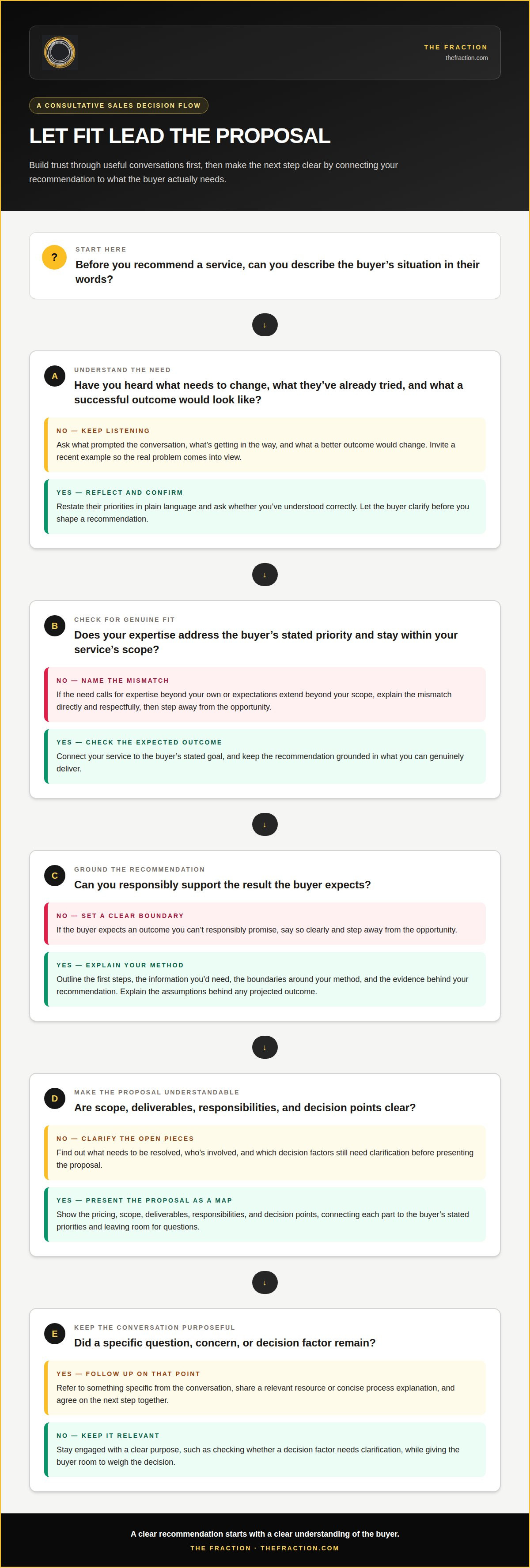
Build trust through useful conversations before you introduce a proposal, so you can hear what the buyer needs to change, what they’ve already tried, and what a successful outcome would look like. A consultant might hear a goal such as increasing sales, for example, then discover that the real obstacle is an unclear offer.
That’s consultative selling: the buyer’s situation shapes the conversation, so your questions and recommendations follow what they actually need. Reflect their priorities in plain language and ask whether you’ve understood correctly, giving the buyer room to clarify and helping you see whether your expertise is a genuine fit.
To explain value and return on investment in a way that feels grounded in the buyer’s reality, connect your service to their goals and to the costs or opportunities they identify. The National Council for Mental Wellbeing advises that sharing accomplishments and compelling data can demonstrate impact and cost-effectiveness, so use relevant evidence and explain the assumptions behind any projected outcome.
Present pricing and a proposal with a clear account of scope, deliverables, responsibilities, and decision points, then connect each part to the buyer’s stated priorities and leave room for questions. A proposal should work like a map, showing what the engagement covers and how the work connects to the intended outcome.
Follow up by referring to a specific point from your conversation, sharing a relevant resource, or asking whether a decision factor needs clarification. If implementation concerns came up, for example, send a concise explanation of the process, then agree on the next step together so every follow-up has a clear purpose.
Case studies, testimonials, and guarantees can build confidence when they offer credible context, so describe the original challenge, the work performed, and the outcome in a case study. Choose testimonials that speak to relevant buyer concerns, and state guarantees your service actually provides, with clear terms.
Confidence comes from explaining your method, the boundaries around it, and the evidence behind your recommendation. If a prospect asks how you’d approach a challenge, outline the first steps and the information you’d need, because clear boundaries make your expertise more credible, especially when you describe the results your method can responsibly support.
When a buyer’s needs call for expertise beyond your own, their expectations extend beyond your service’s scope, or they’re looking for outcomes you can’t responsibly promise, step away from the opportunity. Explain the mismatch directly and respectfully, so both sides can focus on fit and keep the conversation grounded in what you can genuinely deliver.
2. Authentic communication and customer language
A buyer’s language gives you a practical place to start, because people often describe a problem differently from the industry experts who’ve spent years naming it. A finance leader might say, “We have another spreadsheet nobody trusts,” while a consultant calls it a reporting issue…so keep the buyer’s phrase and ask what makes the situation so difficult to resolve.
Learning how to sell high-ticket services without being pushy starts with listening for the meaning tucked behind a prospect’s words. Ask what prompted the conversation, what’s getting in the way, and what a better outcome would change…then, if they say, “Our pipeline is unpredictable,” explore what that disrupts before explaining your approach. Think of it like following a trail of breadcrumbs: their words can lead you to the problem underneath.
Separate the visible symptom from the underlying need, because a firm asking for more leads might have too few inquiries, poor-fit prospects, or an offer that’s hard to understand. Those are different problems, so ask for a recent example…a specific situation can show you which part of the buyer’s process needs attention.
Reflect what you hear without turning the conversation into an echo, because repeating every phrase can sound rehearsed, while connecting the buyer’s words to a relevant observation shows you’re listening. You might say, “You’re getting interest, but the right buyers aren’t moving forward. Let’s look at where the offer stops feeling clear.”
Stakeholders may view the same decision through different lenses, a bit like looking at the same map from opposite sides of the table. An executive may focus on strategic priorities, while an operations lead considers changes to existing workflows…so ask each person what a successful decision needs to address, then explain your service in terms that fit their role. Keep the scope consistent while making its value clear.
Use the buyer’s own phrases to make your offer easier to understand, and trade broad language such as “strategic transformation” for a concrete description, like helping a leadership team turn scattered priorities into a clear plan. The practical answer to how to sell high-ticket services without being pushy is to connect a real buyer concern with work you can genuinely deliver.
After each conversation, record the prospect’s exact wording, their questions, and where they hesitated…then revise one part of your explanation and notice whether the next prospect understands it more easily. Treat it like a focused messaging test, refining one asset at a time.
If your offer still sounds polished but distant, shape a compelling offer around customer language, so the words buyers use connect naturally to the service you provide.
3. Challenges of long sales cycles and complex decisions
A high-ticket sales cycle can stretch from six months to over a year, so progress tends to come through several considered decisions…think of it as a series of gates, rather than one big yes. High-ticket evaluations and approvals typically take between six and twelve months, while some large contracts take multiple years, and transactions that close in under three months are rare, which makes a clear decision path far more useful than constant urgency.
Each gate brings different stakeholders looking for different evidence, a bit like a relay where everyone needs the baton before the next person can move. A finance leader may focus on investment priorities, while an operations lead considers implementation demands, so a clear answer for each person helps the decision keep moving, even when your service addresses a genuine business need.
Invented deadlines, unsupported scarcity, repeated follow-ups, and pressure to decide before stakeholders have reviewed the proposal can make buyers question your judgment. So agree on a specific next step together, and you’ll keep momentum through a shared plan instead of making the conversation feel like a countdown.
When a prospect says the price feels too high, ask which part of the investment is difficult to justify…they may need a clearer connection between the work, the business priority, and the expected value. If they need more time, agree on what they’ll review and when a follow-up would be useful.
Before you send another explanation, map the decision: who owns the problem, who approves the investment, and which questions remain unresolved. If a department leader supports a project but finance needs a cost rationale, for example, prepare a concise summary connecting the proposed work to the buyer’s stated goals.
Long gaps can create doubt when the original business case changes, so keep communication relevant by sharing an update tied to an active concern, such as a revised scope or clearer implementation sequence. Each message can help the buyer evaluate the decision and move toward the next step.
Set mutual milestones to replace open-ended “checking in.” After a proposal review, confirm whether the next step is a stakeholder discussion, scope clarification, or decision meeting. If priorities shift, reset the timeline together…that way, the process feels like a shared plan, like you’re moving the same cart forward together.
Keep your own expectations grounded, too. A nine-month period can test enthusiasm, so use agreed milestones to track real progress. If the buyer has no active need, decision owner, or realistic path forward, pause the pursuit and leave a clear route back if circumstances change.
For clearer conversations through complex decisions, explore a structured approach to sales conversations, where each next step supports the buyer’s evaluation.
4. Selling through direct conversations and focused materials
A high-value service can sell through a direct conversation, a clear offer, and focused sales materials...think of those pieces as a well-marked path that guides the right buyer forward, one step at a time. A consultant, for example, can explain the problem they solve, describe their approach, and invite a relevant prospect to discuss fit.
Start with a short offer statement that names the buyer, the challenge, and the intended outcome. “We help leadership teams clarify priorities and turn them into an execution plan” gives prospects more to evaluate than “we provide strategic transformation.” Keep your promise specific to work you can deliver and easy to repeat.
A useful sales page can be brief, giving the buyer’s likely problem, your approach, and a clear next step. Someone evaluating a systems project should quickly understand the challenge you address and what kind of conversation comes next, so every sentence helps the right reader recognize the relevance.
Give prospects a concise decision brief that answers their recurring questions. Explain why the work matters now, what distinguishes your method, and what a first conversation will clarify...so buyers have something useful to share internally without wading through a dense presentation.
Content can support sales with a practical post about a common challenge, a short email explaining your approach, or a focused case study that shows prospects how you think. For example, explain why an engagement might begin by clarifying the offer before building a lead-generation process.
Keep every asset aligned. If a LinkedIn post describes one outcome, your offer page and decision brief should express the same core idea. When a bold promise meets vague language, buyers feel friction, so consistent wording helps them connect an initial insight to the service itself.
Let real conversations show you where more detail is needed. If prospects repeatedly ask how implementation begins, add a short explanation to your materials. If they ask who benefits most, describe the conditions that make your service relevant. Build each asset around observed questions to keep your message useful and focused.
Then make the next step easy to understand. A closing line such as “If this matches your priority, we can discuss whether the approach fits” leaves control with the buyer. For a sales conversation built around a clear offer, keep the message focused on relevance and one practical next action.
5. How do you qualify prospects before pitching a high-ticket service?
Look, qualifying is diagnosis before recommendation…like checking the blueprint before you start building, because the same-looking problem can call for completely different work. Start by asking what prompted the prospect to seek help now, and listen for what’s changed. A leadership team facing stalled growth may need something different from a team refining a process that’s already working, so that distinction helps you see whether your expertise fits the problem they actually have.
Then listen for the business challenge and what it’s getting in the way of…ask what the issue disrupts, who feels its impact, and what the team’s already tried. “We need better leads” could mean too few inquiries, poor-fit prospects, or an offer that’s confusing people, and each points toward a different solution, so get curious about the cause before you pitch.
And while you’re learning about the problem, find out how the decision gets made. Ask who owns it, who’ll use the service, and who weighs in on approval, because the person feeling the pain and the person signing off may be looking at different parts of the picture. If a department leader supports the work but finance evaluates the business case, both perspectives matter…you’ll have a much more relevant conversation than if you send a proposal to someone without decision authority.
Next, ask what needs to happen before the prospect can act. Maybe the team needs stakeholder alignment, more internal capacity, or a clearer priority among competing projects…those constraints shape the right next step, even if they don’t rule out a fit. Sometimes an exploratory conversation is the best way to get the pieces in place before anyone gets to a proposal.
Get clear on what the prospect expects from the engagement, too…ask what they’ll contribute, which outcomes matter, and how they’ll assess progress. A buyer looking for a partner to refine an offer is bringing a different set of expectations from someone hoping for effortless results, so make the responsibilities and decision criteria clear before you get much further.
Then see whether the challenge and your method fit together. Explain how you’d approach the problem at a high level, and ask what feels relevant or what’s missing. If a firm wants qualified conversations but has an offer prospects struggle to understand, that connection needs attention before you get into execution…a strong fit starts with a problem your service can solve.
Before you recommend anything, play back what you heard…name the priority, its impact, who’s involved in the decision, and the main constraint, then give the prospect room to correct you. Something like, “The priority is clearer positioning, while the leadership team needs agreement before implementation.” If you’ve got the wrong end of the stick, go back to discovery rather than pushing ahead with a pitch.
So when the need, expectations, decision path, and service scope line up, you can move forward. If the request falls outside your expertise, the buyer expects unsupported results, or key stakeholders are missing, pause and explain the mismatch respectfully, then offer a useful next step…perhaps reconnecting once the team’s defined its priority.
The Fraction: A sales process that doesn’t feel like selling
The Fraction helps professionals build a sales process that feels more like a clear conversation than a hard sell…with a compelling offer and a way to connect the pieces. When lead generation feels inconsistent or prospects struggle to see why an offer fits, The Fraction’s automated and AI-driven lead generation systems can give you a more structured path to qualified conversations.
So, turn to The Fraction when you’re ready to connect your offer, lead generation, and sales conversations into a more cohesive approach…so potential clients can understand the value and decide whether the service suits their needs.
Contact The Fraction to discuss your sales process.
Build a sales approach that fits your expertise
Look, learning how to sell high-ticket services without being pushy starts with deciding what kind of business you want to build, and your sales process can reflect the quality of your expertise…giving the right buyers room to understand the fit and choose their next step with confidence.
So take one practical step: identify where a promising conversation tends to lose clarity. Prospects may need a sharper explanation of your value, or the path from initial interest to a meaningful discussion may feel fragmented…like a bridge that needs a clearer way across. That’s a useful place to refine your approach, because small improvements in clarity can reshape the buyer experience.
As you strengthen that foundation, focus on the conversations you want more of and the expertise you want to bring forward. A thoughtful sales system can make professional growth more intentional, so your next opportunity builds on work you’re already equipped to do.
Move forward with clarity, and let each conversation make the path to the right client feel a little more like a well-marked road…one you can travel with confidence.
Frequently Asked Questions
How long is a typical high-ticket sales cycle?
A high-ticket sales cycle can stretch from six months to over a year, with evaluation and approval commonly taking between six and twelve months… and some large contracts take multiple years. The timeline depends on how many decision-makers are involved, how complex the work is, and how the buyer handles approvals. So, agreeing on meaningful milestones, like stakeholder reviews or scope decisions, can make the wait easier to manage.
What are some common examples of high-ticket sales?
Think enterprise software contracts, business strategy engagements with management consultancies, and large-scale manufacturing systems… purchases where the business decision carries real weight, several stakeholders are involved, and fit and implementation get a detailed review. A specialized advisory engagement can be high-ticket too, when it addresses a consequential organizational need. The category depends on the buyer and context, so the same service can carry different significance across markets.
What counts as a high-ticket service, and what are typical price ranges?
A high-ticket service is a substantial investment relative to the buyer’s situation, the scope of work, and the value the engagement is meant to create. There’s no single price range that defines it across every industry, so prices vary with complexity, deliverables, expertise, and buyer needs. To assess an offer, look at what work it includes, which business challenge it addresses, and how the buyer will evaluate its value.
What questions should you ask to understand a prospect’s needs and budget?
Start by asking what prompted the search for help, what the current problem affects, and what outcome would make the work valuable. Then, to understand the budget, ask how the organization plans to evaluate the investment and whether an approval process or spending limit shapes the decision. You can ask who else needs to weigh in, too… so you surface priorities and constraints without asking prospects to share more financial detail than they’re comfortable with.
What is a consultative sales process for high-ticket services, step by step?
A consultative process moves from discovery to a tailored recommendation, then toward a clear decision. First, clarify the buyer’s challenge and desired outcome; next, understand the stakeholders, constraints, and decision criteria. Summarize what you’ve heard and invite corrections. Then recommend a suitable scope, explain its responsibilities and boundaries, and work through open questions. Finally, agree on a next step together, like a stakeholder review or proposal discussion, so the buyer can weigh the decision deliberately.


