

Your next consulting client probably won’t come from sending more LinkedIn messages. Automated LinkedIn outreach for consultants works best as part of a thoughtful system that helps you find relevant people and prepare useful conversations, while keeping your judgment and professional reputation firmly in the driver’s seat. Because LinkedIn’s rules make third-party tools that automate connection requests or messages a real account risk, build a human-led pipeline where AI supports your research and you guide each interaction.
If your corporate income feels capped, consulting leads arrive unpredictably, or your years of experience are difficult to package into a premium offer, you’re not alone. You already have valuable expertise. The missing piece is often the commercial structure that turns it into a clear outcome clients can buy, supported by consistent, credible outreach.
In this article, you’ll learn how AI can support a more deliberate path toward a $30K monthly consulting practice without making your LinkedIn presence feel robotic or salesy. We’ll cover how to shape an outcome-based offer, present your expertise credibly, and create a human-in-the-loop lead-generation system for bringing qualified conversations into view. The goal is a well-run practice, not another full-time job.
Key Takeaways
- Build automated linkedin outreach for consultants around relevant, human-reviewed conversations, so your system supports your executive reputation instead of making it feel scripted.
- Package your expertise as a clear, outcome-based service, giving prospective clients a sharper reason to engage than an hourly list of your experience.
- Choose a focused set of tools to organize prospecting and follow-up, and keep human judgment involved wherever your professional credibility is on the line.
- Strengthen your LinkedIn presence with experience-based insights that demonstrate how you think, rather than treating constant posting as the price of visibility.
- A done-with-you approach can help you shape the offer and lead-generation system together, turning the move toward consulting into a more deliberate, structured process.
Why the Standard Approach to Automated LinkedIn Outreach for Consultants is a Massive Growth Bottleneck
If your outreach sounds like a junior SDR’s mass pitch, you’re spending an executive reputation built over years on a volume game. As a director or VP, your advantage is understanding complex business problems and knowing how to open a relevant conversation with someone who may be facing one. Build a relationship process where every message has a clear reason to exist and reflects the expertise behind your offer.
The idea behind social selling is a useful foundation: using social platforms to find, connect with, and nurture prospects. For consultants, the relationship is part of the infrastructure. Like an architect studying a site before designing a structure, first learn about the prospect’s context and establish relevance. Then decide whether a conversation makes sense. That sequence builds credibility before you invite someone to discuss your services.
The ‘Corporate Noise’ Trap and Why Your Messages Are Being Ignored
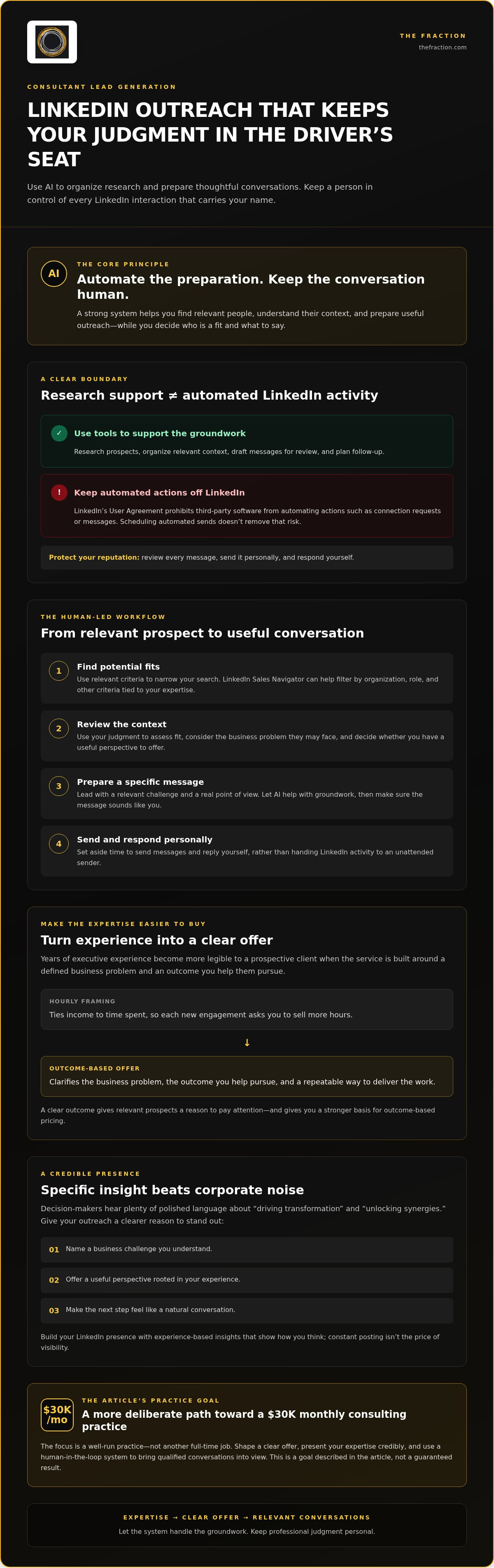
Decision-makers already hear plenty of polished language about “driving transformation” and “unlocking synergies.” Another message built from boardroom clichés is easy to ignore. Specificity gives your outreach a reason to stand out: name a business challenge you understand, offer a useful perspective, and make the next step feel like a natural conversation. Write as you’d speak to a peer, with clear language and a real point of view. AI can help organize and personalize the groundwork, but the message should still sound like you.
The Fear of the ‘LinkedIn Jail’ and How to Stay Safe
Keep the distinction clear: automation can support research, prospect organization, message drafting, and follow-up planning. Botting automates actions on LinkedIn, such as sending connection requests or messages. LinkedIn’s User Agreement prohibits third-party software from automating those activities, and scheduling automated sends doesn’t remove that risk. Keep a person in control of LinkedIn activity, review every message for relevance, and treat account access as part of your professional reputation.
You can still have a process working in the background while you’re at your day job. It can help identify potential fits, surface useful context, and prepare thoughtful outreach for your review. Then you can send messages and respond personally during the windows you’ve set aside, rather than clicking “connect” throughout the day and hoping the right people appear. That’s the practical version of automated LinkedIn outreach for consultants: a system that saves research time without handing your professional judgment to an unattended sender.
Replicating Your Executive Brain with the Fractional 1of1 Formula™
Your best consulting work likely draws on patterns you’ve learned to recognize over years: warning signs inside a business, decisions that unlock progress, and the steps that help a team move forward. The Fractional 1of1 Formula™ turns that expertise into the foundation for a focused, repeatable service, then connects the offer to AI-supported lead generation. Outreach can carry your message to relevant prospects, but a clear outcome gives them a reason to pay attention.
That’s the strategic foundation for automated linkedin outreach for consultants. LinkedIn Sales Navigator can help you narrow your search by organization, role, and other criteria relevant to your expertise. Your judgment then helps you decide who is a genuine fit, what problem they may be facing, and what insight could make a conversation useful. A focused shortlist is more valuable than a noisy list when you’re building trust around high-value work.
Replacing Hourly Billing with Outcome-Based Pricing
Hourly billing ties income to time spent, so each new engagement asks you to sell more hours. A productized offer gives your expertise a clearer shape: a defined business problem, an outcome you help a client pursue, and a repeatable way to deliver the work. That makes the value easier for a prospective client to understand and gives you a stronger basis for outcome-based pricing.
Start by writing down the problem you solve best, the business impact of solving it, and the steps you use to get there. Then shape those elements into a focused offer you can explain in a conversation. Check that a prospective client can understand who the service is for, what it addresses, and what working together involves. For a deeper look at shaping an offer, explore High Value Offer Development.
Using AI to Personalize Your Outreach at Scale
AI can help organize prospect research and surface context, such as a person’s role, stated priorities, or a company change you’ve identified through appropriate sources. Verify those details before using them. Then write a message in your own voice that explains why you’re reaching out and opens a useful conversation. Avoid treating an AI-generated detail as proof that you understand someone’s situation. IABC offers practical ideas for using LinkedIn to grow your consulting business.
A low-friction sales process gives prospects a sensible next step, while your system helps prepare and qualify conversations for human follow-up. One client booked 24 strategy calls in their first month, an example of how a process can create meaningful conversations when the offer and targeting work together. If you’re ready to shape your offer and lead-generation system with support, learn more about building a consulting practice.
The Essential Tech Stack for Professional Service Sales Automation
You don’t need a maze of apps stitched together with digital duct tape. You need a small, dependable stack where every tool has a clear job and you can see whether the process is creating useful conversations. Think of it as an executive dashboard: a few well-chosen tools help you make decisions, while disconnected metrics add noise.
For many consultants, LinkedIn Sales Navigator is a practical starting point for identifying potential prospects. Use available filters to narrow your search around your expertise, such as industry, role, organization size, or other relevant criteria. Review the results and save suitable people in focused lead lists. Each list should have a reason for connection, not just a high profile count. From there, organize research and follow-up tasks, then review and send LinkedIn messages yourself. Third-party software that automates LinkedIn activity can put your account at risk, so use tools to support your judgment, not as unattended senders.
Build Around the Prospect, Not the Software
Before adding a tool, map the path from finding a potential client to deciding whether a conversation makes sense. What information do you need? Where will you record it? What is the next step that a person will review? A contact manager or prospecting platform may help organize that context. Before committing, compare its data practices, export options, and ongoing fees. For example, a service such as Apollo.io may support prospect research, while LinkedIn-specific scripts that automate platform activity call for particular caution.
Configure the System for Accountability
A done-with-you build-out can help with the technical setup while keeping you involved in decisions about your audience, message, and follow-up process. The system should make it easy to see who has been researched, which conversations need a response, and whether suitable prospects are engaging. That’s more useful than counting automated sends, and it gives you a chance to adjust your targeting or message before a small problem grows.
Be specific about what ownership means. Keep control of your positioning, message templates, and process documentation, and confirm whether prospect records can be exported from the tools you use. Software access may depend on an ongoing subscription, so check the terms before you build your workflow around a platform. For outreach that extends into telemarketing, consult the FTC’s guidance on the Telemarketing Sales Rule. It covers a different channel, so don’t treat it as a blanket rulebook for LinkedIn.
That’s the practical architecture behind automated linkedin outreach for consultants: research and organization can follow a considered workflow, while meaningful outreach stays personal and accountable. If you want support building an AI lead-generation system around your consulting offer, explore consulting lead-generation systems.
How to Build a Credible LinkedIn Presence While Still in Your Corporate Role
You can start shaping a consulting presence while you’re still in a corporate role, but treat discretion as a professional responsibility, not a promise that your employer will never notice. Review your employment policies and conflict-of-interest requirements. Protect confidential information and keep consulting work separate from company time, devices, and materials. That’s a firmer foundation than hoping nobody notices.
Your profile is the front door to your future practice. Make it clear which business problems you help solve, who you work best with, and what your experience helps you see. Like the sign on an architect’s studio, it should describe the work you’re equipped to do, rather than list every job you’ve held.
The ‘Stealth Mode’ Profile Makeover
Start with a focused headline that describes your expertise through the problems you solve. Shape your About section around the outcomes and perspective you bring. Update your experience accurately, keep employer details and achievements factual, and remove confidential information. You can review an example of authority positioning for ideas on presenting expertise clearly.
Share concise, experience-based observations at a pace you can sustain. For example, a post could explain a recurring operational challenge, a signal that helps identify it, and a practical question leaders can ask. That gives people a view into how you think without turning your profile into a full-time content studio. Clear and relevant beats long, polished fluff.
Use a Proof of Concept to Learn Before You Pitch
Before building your offer around assumptions, speak with 10 industry leaders who resemble the people you hope to serve. Ask how they experience the problem, what they’ve tried, and what a useful outcome would look like. Listen for repeated language and priorities, then use those patterns to refine your offer. Treat the conversations as research, and be transparent about your purpose so the discussion stays respectful and useful.
Market research can help you test whether your expertise addresses a real priority and make a later business conversation more relevant. A Proof of Concept call can help assess fit and clarify the opportunity before any payment changes hands. With automated linkedin outreach for consultants, AI can help organize research and prepare follow-up, while you review messages and make the human decisions that protect your credibility.
Transitioning to a $30K/Month Practice with a Done-With-You Partner
A library of videos can provide ideas, but turning years of expertise into a consulting practice takes more than collecting advice. It’s like renovating a house while you’re still living in it: you need a clear plan, practical support, and a working system that fits your schedule and strengths. A done-with-you model brings you into the build, so the offer, lead-generation process, and sales conversations take shape around the expertise you already have.
A $30K monthly practice is a target, not a promised result. Progress depends on your offer, market response, and the work you put into building and running the system. The Fraction’s stated 30-Day System Build Guarantee and 10X ROI Guarantee are program commitments. Review their terms carefully so you understand what each covers before making a decision.
The Co-Building Model: Why Implementation Matters
Self-paced learning can leave you with a stack of notes and no clear answer about which offer to lead with, who to approach, or what to do when a prospect responds. A co-building process turns those decisions into practical assets and actions, with your expertise and judgment shaping the system. You’re an active partner in the work, not a passive observer waiting for a course to create momentum.
Before choosing a partner, ask who’ll work directly with you, how often you’ll review progress, what you’ll build together, and what support continues after implementation. Clarify ownership as well: ask which systems, content, data, and automations you’ll control, and whether any tools require ongoing subscriptions. Clear answers help you understand the work and responsibilities involved.
A Practical Roadmap Toward Greater Independence
Think of the transition as a sequence of milestones, not a guaranteed countdown to a contract. First, define the business problem your experience is best suited to solve and test it through conversations with potential clients. Next, shape what you learn into a focused, outcome-based offer and establish a credible LinkedIn presence. Then build a prospecting and follow-up process for human-reviewed outreach. Use responses from the market to refine your message and sales conversations.
That’s where automated linkedin outreach for consultants can support the journey. AI may help organize research and prepare follow-up, while you remain responsible for the judgment and relationships that can lead to an engagement. A qualified conversation or a growing pipeline can be meaningful progress. The timing and value of any contract depend on fit, demand, and execution.
If you’re ready to explore a co-building approach to your consulting offer and lead-generation system, learn about The Fraction’s consulting practice system.
Turn Your Expertise into a Practice You Can Build On
The strongest automated linkedin outreach for consultants starts with a clear, outcome-based offer, then uses thoughtful research and human-reviewed outreach to open relevant conversations. Pair that with a credible LinkedIn presence and a focused tech stack, and your corporate experience can become the foundation for a consulting practice with a more deliberate approach to growth.
A done-with-you build can help turn that plan into a working system, with your expertise shaping the offer and your judgment guiding client conversations. The Fraction’s 10X ROI Guarantee means the program continues until you book contract value equal to ten times your investment. Its 30-Day System Build Guarantee offers a full refund if the complete system isn’t built within 30 days. Review the terms to understand how each guarantee applies.
If you’re ready to explore how your experience could translate into a consulting offer and lead-generation system, take a practical first step: learn about The Fraction’s custom Proof of Concept call.
Frequently Asked Questions
Is automated LinkedIn outreach safe for a senior executive's reputation?
It can support your reputation when it helps you identify relevant prospects and prepare thoughtful, personal conversations. But third-party tools that automate LinkedIn connection requests or messages can put your account at risk, so keep human judgment involved and avoid mass, generic sends. Build credibility with a clear profile, a focused offer, and useful insights that reflect your expertise. Your professional name is an asset, so protect it as carefully as your account.
Can I really build an automated system while I'm still working a full-time corporate job?
Yes, you can build a consulting practice while employed, provided you manage the transition carefully. The Fraction schedules outreach for evenings to help avoid conflicts with your workday. You should also review your employment policies and keep consulting work separate from company time, devices, and confidential information. A system can organize research and follow-up, while you review messages and handle conversations during the time you’ve set aside.
How much income can I realistically expect in my first year as a fractional consultant?
There’s no guaranteed first-year income. Results depend on your expertise, offer, market demand, and sales execution. The Fraction reports that new consultants typically close 1–2 productized-service clients at $10,000–$15,000 upfront, with $5,000–$7,500 monthly retainers. Treat those figures as a reference point, not a promise. Start by validating a specific business problem and shaping an outcome-based offer around the value you can credibly deliver.
Do I need to be a tech expert to set up LinkedIn automation?
No, you don’t need to be a tech expert to build a lead-generation system. The Fraction’s done-with-you program includes automation setup and training, alongside strategic support and accountability. Your role is to bring your expertise, clarify the clients you want to reach, and review how the system represents your judgment. LinkedIn activity should remain human-reviewed, since third-party automation of messages or connection requests can risk account restrictions.
What happens if the automated outreach doesn't generate any calls?
If calls aren’t booked after you’ve made an active effort, The Fraction’s stated lead-generation assurance is to generate leads at no additional cost. The system should also help you assess where prospects are dropping off, whether the audience fits, and whether your offer is clear. Ask for the written terms so you understand what counts as active effort, what support is provided, and how the assurance applies to your situation.
How do I avoid looking like every other spammy 'consultant' in my prospects' inboxes?
Lead with a specific business problem you understand, then write as you’d speak to a thoughtful peer. Reference relevant context accurately, explain why you’re reaching out, and make the next step easy to accept or decline. Avoid generic claims, invented personalization, and repeated templates. A strong profile and clear outcome-based offer do much of the work before a message arrives, because prospects can see what you help solve and why your experience matters.
What is the 10X ROI guarantee and how does it actually work?
The Fraction’s 10X ROI Guarantee means the program continues until you book contract value equal to ten times your program investment. The stated guarantee has no time limit and no upsells. It refers to contract value booked, not a promise of collected revenue or a particular income outcome. Review the official terms to understand how qualifying contracts and the investment amount are defined before making a decision.
Do I need to spend thousands of dollars on LinkedIn ads to get results?
No, LinkedIn ads aren’t presented as a requirement for the approach described here. The system focuses on a clear consulting offer, targeted prospect research, a credible profile, and relevant outreach, with human review guiding conversations. You can evaluate paid advertising separately if it fits your strategy and budget. First establish who you serve, what outcome you offer, and how you’ll assess whether your lead-generation activity is producing qualified conversations.


