

What if a prospective-client conversation felt less like presenting a case and more like laying a clear map on the table, with both of you deciding whether the destination makes sense? A consultative sales process without pressure gives your expertise room to do its best work: uncover what’s at stake, connect the problem to a relevant service, and agree on a clear next step while leaving the buyer in control.
Selling your expertise can feel awkward or transactional. A conversation may begin with promise, then drift into a vague “we’ll be in touch,” with priorities and fit unresolved. A stronger conversation has a clear structure: it surfaces what matters, checks whether your experience and service match the problem, and gives the prospect room to make a thoughtful decision.
In this article, you’ll learn how to guide a prospect from a useful first conversation to a mutually informed decision. You’ll find practical questions, ways to clarify your offer, and methods for agreeing on next steps that respect the buyer’s timing and choice. You’ll also see how a clear offer and a well-defined prospect fit make pressure-free conversations more specific and useful.
Key Takeaways
- A consultative sales process without pressure helps you clarify a prospect’s needs, assess fit, and choose a next step together.
- Use active listening and concise reflections to confirm you understand the prospect’s context, priorities, and desired outcome.
- Keep buyer agency central by making recommendations when you have enough context and leaving room for a clear yes, no, or later.
- Move through five stages: prepare, explore, clarify, recommend, and agree on the next step.
- Connect your positioning, offer, outreach, and follow-up so each conversation supports a coherent consulting practice.
What Is a Consultative Sales Process Without Pressure?
A consultative sales process without pressure is a structured conversation that helps a prospective client clarify their needs, assess whether your expertise and service fit, and choose a next step with you. Rather than proposing a solution before you understand the situation, ask, listen, reflect what you’ve heard, and offer a recommendation based on the prospect’s priorities.
Sales covers a broad range of activities and approaches, including how a seller and buyer move through a decision. Within that wider sales process, consultative selling puts discovery first: understand the situation, then discuss whether a service could address it. The conversation has direction, but the prospect’s context shapes the recommendation and pace.
How consultative selling differs from a traditional pitch
A traditional pitch may start with a prepared presentation and move straight to the offer, as if the problem and solution were already clear. A consultative conversation starts by exploring the prospect’s situation, priorities, and desired outcome. The recommendation follows from what they’ve shared.
You can still be direct. If there’s a strong fit, explain why and suggest a practical next step, then leave the decision with the buyer. If the need, timing, or fit points elsewhere, say so plainly. The goal is to help both parties understand the options, not to steer the prospect toward a predetermined answer.
Why experienced consultants can feel uneasy about selling
Deep expertise and business development draw on different professional skills. Someone accustomed to leading from inside an organization may be fluent in solving complex problems, yet less comfortable explaining that value to a prospective client. A first sales conversation can feel like a change of identity instead of another place to apply sound judgment.
Unclear positioning can add friction. When an offer is too broad, even a capable professional may describe their work in generic terms, leaving the prospect unsure how it relates to their problem. A repeatable conversation structure provides a steady frame, while your expertise supplies the insight and judgment. For example, prepare to explain who your service is for, what outcome it supports, and what work is included. That makes it easier to connect the prospect’s needs to a specific offer.
The aim is simple: make the problem clearer, check whether your service fits, and agree on what happens next, if anything. For experienced professionals, a consultative sales process without pressure turns business development into a disciplined exchange of information. You can make a confident recommendation while giving the buyer a real choice.
How Buyer-Led Consultative Sales Conversations Build Clarity
A useful sales conversation moves through a few connected questions: What’s the prospect’s context? What impact is the issue having? What change do they want? Does your service fit? What next step would be useful? The prospect’s answers set the pace, so discovery feels like a dialogue rather than a checklist to complete before presenting an offer.
Active listening keeps the discussion grounded. Give the person room to explain, then reflect the essentials in their language: “It sounds like the delays are affecting both delivery and your team’s capacity. Have I understood that correctly?” A concise summary lets them confirm, add nuance, or correct your interpretation before you make a recommendation.
Ask questions that reveal business impact
Begin with the current situation, then let each answer guide your follow-up. You might ask, “What’s happening now?” and then, “How is that affecting the work?” or “What would you want to change?” To understand timing, ask what makes the issue important now rather than supplying a reason for urgency yourself. Before recommending anything, summarize the issue and invite correction. This pause can prevent the conversation from proceeding on your assumptions.
For instance, a prospect may describe a delivery bottleneck and then explain that it limits their ability to take on suitable work. Their stated impact and desired change give you a clearer basis for discussing fit. This is the practical centre of a consultative sales process without pressure: questions build understanding, and understanding gives your recommendation a sound basis.
Connect the problem to a clear, relevant offer
Your ideal client profile helps you recognize which problems your expertise and service are designed to address. With that focus, connect the prospect’s desired outcome to a defined scope, a clear way of working, and an understandable measure of value. A productized offer gives a relevant problem a concrete path forward. Then check that the prospect’s needs match what you provide, including what falls outside the scope.
If your offer still feels broad, explore high value offer development as a way to sharpen the connection between your expertise and a buyer’s priorities. For a wider view of how the conversation fits into a consulting practice, see the consultant sales process. If you’re shaping a more coherent practice around your experience, explore a consulting practice system as one possible next step.
Consultative Selling Versus Pressure: How to Tell the Difference
A conversation can sound thoughtful and still become pressure if the prospect’s agency fades from view. The clearest test is who controls the decision. Consultative selling makes room for questions, options, and an informed choice; pressure steers the buyer toward the seller’s preferred outcome. A deadline the buyer identifies can be a valid reason to act promptly. Urgency becomes a mismatch when it comes from the seller’s agenda rather than the prospect’s circumstances.
Use this comparison to check the conversation’s direction:
| Conversation element | Buyer-led guidance | Seller-led pressure |
|---|---|---|
| Question purpose | Understand context, priorities, and fit. | Lead the prospect toward a predetermined answer. |
| Recommendation timing | Offer a recommendation after hearing enough to understand the situation. | Present a solution before the prospect’s needs are clear. |
| Choice | Make room for questions, consideration, a no, or a later decision. | Frame agreement as the only acceptable outcome. |
| Follow-up | Reflect the agreed next step and respect the buyer’s timing. | Repeatedly push for a response or reopen a settled objection. |
Signals that a sales conversation is becoming high-pressure
Notice when an objection gets overridden instead of explored. If a prospect raises a concern about scope, timing, or fit, pause and ask what’s behind it. Then respond to that specific concern. A recommendation made before you understand the situation can sound like a preloaded answer. Likewise, urgency that doesn’t reflect the buyer’s circumstances can make even a relevant offer harder to trust.
Buyer-led urgency is different. The prospect may explain why resolving the issue matters now. Your role is to determine whether your service fits that need and timing. The reason for moving forward belongs to the buyer; your recommendation helps them assess the path.
What a genuinely consultative conversation protects
A strong consultative sales process without pressure protects the prospect’s ability to ask, compare, consider, and decline, while giving you room to qualify honestly. If the work is a poor fit, saying so can prevent both parties from committing to an engagement that misses the need. A respectful no, or a later conversation by mutual agreement, can be a good outcome because the decision is clear and voluntary.
Quick test: buyer-led clarity helps the prospect understand the problem, fit, and available next step. Seller-led pressure narrows their choices to secure a yes. If you’re building a consulting practice and want a more coherent system for your offer, client acquisition, and sales, explore consulting practice support.
A Five-Stage Consultative Sales Process for Your Next Conversation
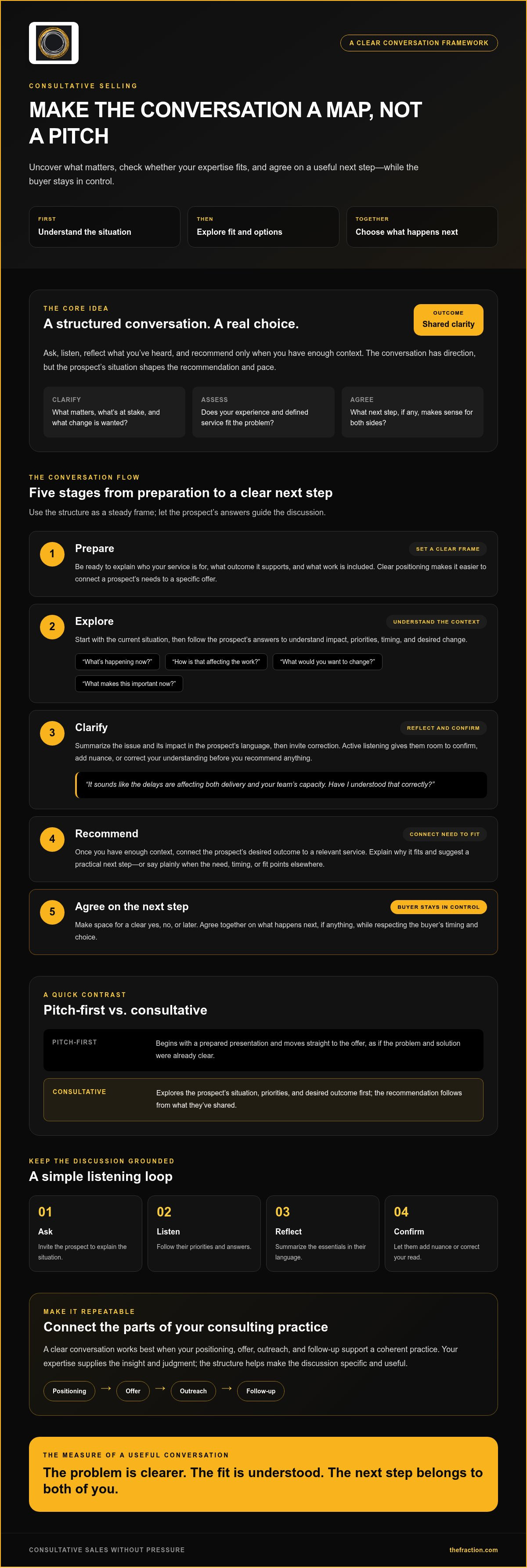
A useful conversation needs a route, with room to change direction when the prospect shares something unexpected. Treat these five stages as a guide, not a script: prepare, explore, clarify, recommend, and agree on a next step. If you’re building a consulting practice alongside your current work, this sequence can make each conversation purposeful without requiring you to invent the whole process on the spot.
Prepare and explore before discussing a solution
Before you meet, review what you know about the prospect’s role, business context, and reason for connecting. Then open by agreeing on what would make the conversation useful: “What would you like to make sure we cover today?” Their answer gives you a starting point. From there, explore the situation before discussing a solution.
- Prepare. Review what you already know and ask yourself, “What would help me understand whether there’s a fit?” Be ready to start with curiosity rather than assumptions.
- Explore. Invite the prospect to explain what’s happening, what they’d like to change, and which constraints or decision factors matter. Try, “Could you walk me through what’s prompting this now?” Use the answer to choose relevant follow-up questions.
- Clarify. Reflect the challenge and its impact in the prospect’s words, then check: “Have I got that right, or would you describe it differently?” Their confirmation or correction tells you whether you have enough shared understanding to consider an approach.
- Recommend. Ask permission to offer your view, perhaps with, “Would it be useful if I shared an approach that might fit?” Connect one recommendation to the outcome they described, and explain its scope and limits. Pause for questions before moving on.
- Agree on the next step. Ask, “What feels like the most useful next step from here?” Confirm who will do what and when. If the fit isn’t there, say so with care and close the loop respectfully.
Recommend, confirm fit, and agree on a next step
The stages give you a steady rhythm, while the prospect’s answers tell you when to stay curious and when to move along. Your recommendation can be direct and still leave the choice with them: explain your reasoning, state the limits, and give them space to respond. That’s the heart of a consultative sales process without pressure. Both sides can see the fit, the options, and the next step, while the conversation remains human.
Turn a Consultative Sales Process Into a Repeatable Consulting System
A strong conversation works best as part of a larger system. Your positioning helps the right prospects recognize themselves, your offer gives their problem a clear shape, your outreach opens a relevant dialogue, and your sales process helps both sides assess fit. When these elements support one another, a consultative sales process without pressure becomes easier to deliver consistently.
Repeatability comes from documenting the useful parts, not memorizing every line. Keep a simple record of your core discovery questions, the signals that indicate a good prospect fit, and the follow-up steps you agree on. Then use your judgment to adapt the framework to each person and situation. The process provides consistency without requiring every conversation to sound the same.
Build consistency without making conversations sound scripted
A lightweight follow-up system can preserve context while giving prospects room to decide. After a conversation, record the problem discussed, the prospect’s priorities, open questions, and the next step, including who owns it and the timing you agreed on. A reminder can help you follow up as promised. A concise, personal message can refer to the prospect’s specific concern instead of sending a generic nudge.
Automation can organize notes and prompt timely follow-up, but the relationship still depends on relevant, accountable communication. Use systems to support the conversation, not to make decisions for you. The Fraction’s done-with-you approach co-builds consulting-practice infrastructure, including systems and automations. Clients retain their systems, automations, content, and infrastructure.
Decide whether outside implementation support fits
Building the pieces yourself can work if you have the capacity to develop your positioning, offer, client acquisition, and sales process in a coordinated way. Outside implementation support may suit you if you want to co-build those connected parts rather than rely on passive lead delivery or a self-paced course. Consider how much ownership you want in the build and what kind of support fits your working style.
A practical next move is to review your process from first outreach through follow-up. Identify where context gets lost, where the offer feels unclear, or where the next step becomes vague. That gives you a focused place to improve, whether you refine the system independently or explore a collaborative practice build-out.
Make Your Next Sales Conversation Clearer and More Useful
A consultative sales process without pressure gives your expertise a practical path into the conversation: prepare with intention, explore the prospect’s context, clarify the need, recommend a relevant approach, and agree on a next step together. The structure keeps the discussion moving, while active listening and buyer choice keep it grounded in what matters to the prospect.
The conversation works best when it connects to the rest of your consulting practice. Clear positioning helps the right people recognize their problem. A well-defined offer makes your service easier to understand, and thoughtful follow-up preserves context without rushing a decision. Each piece supports the others.
If you’d like collaborative support building those connected pieces, The Fraction co-builds consulting-practice infrastructure with clients through a done-with-you approach.
You already have the expertise. A clear, repeatable system can help you bring it into prospective-client conversations with confidence and respect for the buyer’s choice.
Frequently Asked Questions
How do you sell consulting services without sounding pushy?
Start with the prospect’s situation and desired outcome, then connect your recommendation to what they’ve told you. For example, summarize the challenge and ask whether you’ve understood it before describing how your service could help. Explain the scope clearly, answer questions directly, and agree on a next step only if it’s useful to both sides. A well-defined offer also helps you explain specifically which problem you solve.
Can consultative selling work for high-value professional services?
Yes. Consultative selling can suit high-value professional services because it gives both parties room to understand the problem, proposed approach, and fit before deciding. This is useful when the service relies on expertise and addresses a complex business need. A clear offer, thoughtful questions, and an honest explanation of scope help the prospect assess the recommendation rather than relying on a rehearsed pitch.
What questions should you ask during a consultative sales conversation?
Ask questions that reveal context, and let the prospect’s answers guide the discussion. You might begin with, “What prompted this conversation?” then ask, “What’s happening now?” “How is that affecting the business?” and “What would you like to change?” Explore timing and decision considerations with curiosity. Before suggesting a service, summarize what you heard and invite the prospect to correct or add to your understanding.
How do you recommend a service without pressuring a prospect?
Make the recommendation after you understand the prospect’s priorities, then explain how the service relates to the outcome they described. You could say, “Based on what you’ve shared, this approach may fit because…” and clarify what it covers and where its limits are. Invite questions and let the prospect decide whether to proceed. A relevant recommendation gives the buyer useful information and space to choose.
How can you proceed when a prospect needs more time to decide?
Ask what information or time would help them decide, then agree on whether and when a follow-up would be useful. You might answer an open question, share the details they requested, or leave the decision with them for now. Record the agreed next step and respect the timing. If the prospect prefers to pause or declines, accept that clearly. A voluntary decision is more useful than an agreement made under pressure.
Is consultative selling suitable for professionals who dislike sales?
Yes. Consultative selling can feel more natural for professionals who prefer problem-solving to pitching because it draws on skills they already use: listening, asking focused questions, and applying judgment. A repeatable framework can make business development feel less like improvisation while leaving room for a genuine conversation. Clear positioning matters too. When you can explain who your service helps and how, you can discuss your expertise with greater confidence.


