

The platform with the longest feature list can still be the wrong fit for your agency’s client-acquisition process. In the woodpecker vs lemlist for agency client acquisition decision, the practical question is whether your workflow depends on focused email outreach or coordinated, multichannel sequences, and how either approach can help turn relevant conversations into qualified sales opportunities.
Compare automation, deliverability, channels, and cost before you commit. A poorly targeted campaign can generate activity without bringing your agency closer to a suitable client. The tool is one part of the process: your ideal client profile, offer, contact data, timing, follow-up, and sales process all affect whether outreach leads to a useful conversation.
This comparison looks at Woodpecker and lemlist through the stages of agency acquisition, from selecting prospects and building campaigns to managing replies and assessing fit. You’ll find ways to evaluate each platform against your workflow, details to verify before buying, and a practical approach to choosing software as part of a coherent system for creating qualified client conversations.
Key Takeaways
- Choose Woodpecker or lemlist based on your agency’s target accounts, outreach motion, team capacity, and sales follow-through.
- Compare the platforms against the work your acquisition process requires, then verify current features, integrations, limits, and plan details before you commit.
- For woodpecker vs lemlist for agency client acquisition, assess which tool fits your defined workflow rather than choosing by feature count alone.
- Use a five-step decision checklist to clarify your ICP and offer, map the workflow, check requirements, and pilot a representative campaign.
- Connect your software choice to the wider acquisition system, including your offer, audience, outreach, automation, and sales funnel.
Woodpecker vs. lemlist: Start with the agency acquisition job
Start with the work your agency needs the tool to support: which accounts matter, how you want to reach them, who will run the process, and what happens after someone replies. That’s the useful starting point for woodpecker vs lemlist for agency client acquisition. The platform should support a clear path from identifying a suitable prospect to holding a qualified sales conversation.
Agency client acquisition is a connected process: define your ideal customer profile (ICP), identify relevant accounts, make a clear offer, conduct outreach, handle responses, and move suitable prospects toward a discovery call and proposal. This broader process sits within lead generation, but a platform handles only part of the journey. An outreach platform helps an agency execute contact and follow-up. The acquisition system determines whom it reaches, why they should care, and what happens next.
What does an agency need its outreach tool to do?
Map the work before comparing tools. Prospect research helps you decide which accounts fit. Contact management keeps relevant details accessible. Sequences organize outreach and follow-up, while response handling ensures replies reach the right person. Then assign an owner to each task: the founder, a team member, or a process supported by automation. Your team structure affects the access, visibility, and review process you need.
Trace the handoffs, too. When a prospect replies, where is the conversation recorded? Who decides whether it merits a discovery call? How does the call outcome inform a proposal or follow-up? If the path from inbox to CRM to sales conversation has gaps, automation can move work through those gaps without fixing them. Before buying, check both vendors’ current documentation for feature availability, plan limits, integrations, and setup requirements your workflow depends on.
Why the tool choice starts with the acquisition motion
A clear ICP helps your team select accounts and shape outreach around a prospect’s likely priorities, rather than sending the same broad message to everyone. Your offer gives the prospect a reason to respond. If you can’t clearly explain who it helps and what problem it addresses, either platform may help you send more messages without making them more relevant.
Define the motion first: audience, offer, channel, owner, and next step. Then compare Woodpecker and lemlist against that blueprint, checking current vendor documentation as you go. An AI-driven lead generation strategy can help connect audience definition, outreach, and sales follow-through into one coherent process, with the platform playing its proper role within the system.
Compare Woodpecker and lemlist by workflow, not feature-list volume
A long feature list may look impressive, but the useful question is which capabilities your agency will use in its day-to-day workflow. For woodpecker vs lemlist for agency client acquisition, list the tasks you need to complete, then verify each platform’s capabilities, plan requirements, and limits in current vendor documentation before comparing them.
| Workflow need | Woodpecker | lemlist | What to verify |
|---|---|---|---|
| Sequences and channels | Email-focused outreach, with LinkedIn outreach available as an add-on. | Campaigns can combine email, LinkedIn, calls, SMS, and WhatsApp. | Which channels and sequence steps your selected plan supports. |
| Personalization | Check the current options against the personalization your campaigns require. | AI features include personalization and sequence-generation support. | How each platform handles your message fields, editing, and human review. |
| Team workflow | An Agency Panel is available for managing multiple clients. | A unified inbox brings replies from different channels together. | Client separation, permissions, reply ownership, and reporting access. |
| Integrations | Listed connections include HubSpot, Pipedrive, Calendly, and Zapier. | Listed CRM connections include HubSpot and Pipedrive, with API access. | Whether the connections support your required data fields and handoffs. |
| Analytics and setup | Confirm current reporting details and setup requirements. | Confirm current reporting details and setup requirements. | Available metrics, exports, onboarding resources, support, and plan limits. |
The practical distinction is workflow fit, not feature count. If email and client-level campaign oversight cover the core job, extra channels may add setup and review without solving a real bottleneck. If your team coordinates activity across several channels, test those transitions directly. A feature label alone won’t show whether the platform supports every handoff your process needs.
Assess the work behind the tool
Before a pilot, decide who will build campaigns, maintain contact data, review replies, and own follow-up. A capable platform still needs people to make these decisions. Run a representative campaign and note where the team switches systems, repeats work, or needs information that isn’t easy to find. Check onboarding documentation and support options directly with both vendors. For commercial email, also review the FTC’s CAN-SPAM Act compliance guidance.
For a closer look at lemlist for professional outreach, apply the same workflow questions. If you’re working out how your offer, audience, automation, and sales steps fit together, explore done-with-you acquisition system building.
Woodpecker vs. lemlist: Match each option to your agency’s needs
A platform can make a defined outreach process easier to run, but your strategy still determines which accounts deserve attention and why they might respond. Think of the tool as the vehicle and your positioning as the route. A more capable vehicle can help you travel, but it can’t choose a worthwhile destination for you.
That’s why woodpecker vs lemlist for agency client acquisition has no universal winner. The better fit depends on your agency’s channel mix, your team’s capacity to operate the platform, and the coordination your acquisition workflow requires. Use the trade-offs below as a starting point, then confirm current capabilities and plan conditions directly with each vendor.
When does a focused outbound workflow fit an agency?
A focused approach may suit an agency that knows its target accounts, has a clear offer, and wants to run a defined, email-led process. Woodpecker is positioned around cold email, with LinkedIn outreach available as an add-on according to the product information. That focus may suit a team that wants to concentrate on campaign execution. Someone still needs to build and review campaigns, manage responses, and adjust targeting based on what happens.
- Potential advantage: A narrower channel requirement can make day-to-day campaign work and ownership easier to define.
- Potential trade-off: The agency needs people and processes for setup, reply handling, and ongoing review. Check which capabilities are included in the selected plan.
When should an agency prioritize broader workflow coordination?
If your acquisition motion spans email, LinkedIn, calls, or other supported channels, lemlist’s multichannel positioning may fit that requirement. But channel availability and integrations show ways to connect activity. They don’t guarantee that contacts are well chosen, that a CRM captures every useful sales signal, or that your offer will resonate. Test the handoffs: can the team see who owns a reply, record the next action, and move a suitable prospect into the right CRM stage?
- Potential advantage: A broader channel mix may suit a team coordinating several outreach activities within one workflow.
- Potential trade-off: More channels can mean more campaign decisions and review work. Assess your team’s capacity before treating breadth as a benefit.
Clear positioning, relevant prospects, and consistent follow-through make any outreach tool more useful. For agencies shaping that wider process, a professional service sales automation system can connect outreach activity with the sales steps that follow, while keeping strategy and lead quality grounded in the agency’s own decisions.
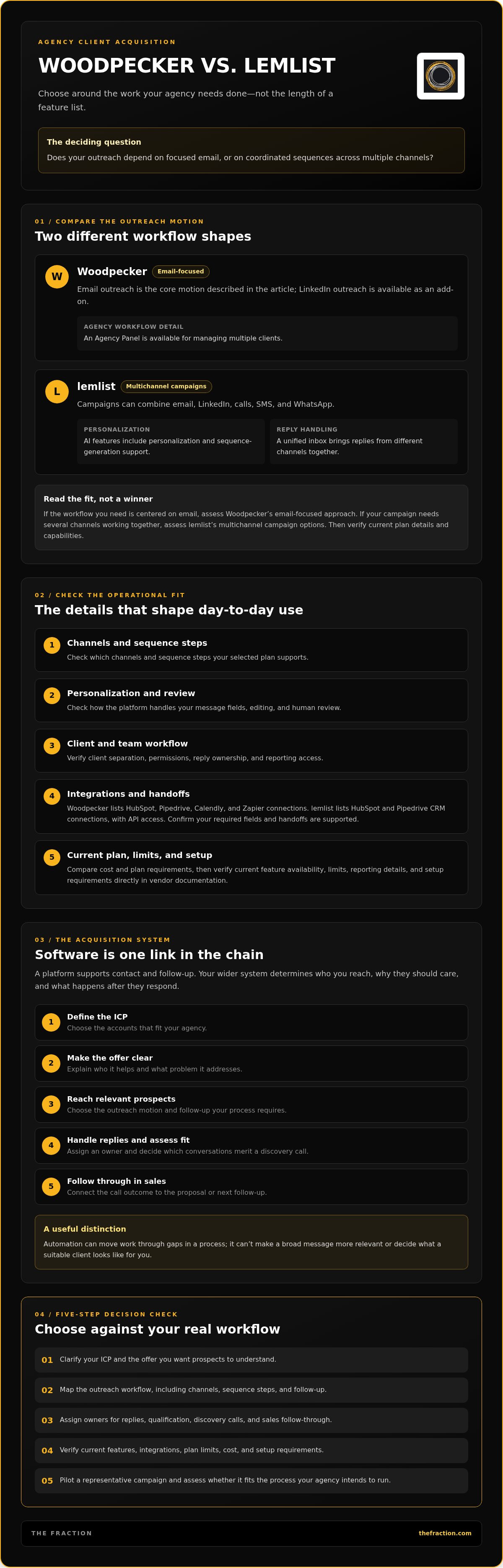
Use this decision framework before choosing Woodpecker or lemlist
Give both platforms the same test, using your agency’s actual acquisition workflow as the measure. This keeps the woodpecker vs lemlist for agency client acquisition decision grounded in fit, rather than letting an impressive feature list steer you toward a tool your team can’t use well.
Score the options against your agency’s requirements
Work through these five steps in order. Record what you can verify for each platform so assumptions don’t quietly turn into purchase criteria.
- Define your ICP. Describe the organizations and decision-makers your agency intends to reach. Include the account details your team needs to identify a good fit.
- Clarify the offer. State who it helps, what business problem it addresses, and why a qualified prospect might take a conversation. Clear positioning gives your test something meaningful to communicate.
- Map the workflow. Trace the path from prospect selection through outreach, reply handling, CRM updates, discovery, and the next sales step. Assign an owner to every handoff.
- Verify tool requirements. Rank must-haves ahead of optional features and interface preferences. For each platform, record vendor-documented capabilities, plan dependencies, limits, integrations, support conditions, and unanswered questions.
- Pilot and review. Run a small, representative test before moving the wider agency workflow into either tool. Review both the campaign experience and what happens after a prospect responds.
Validate the full path in a pilot
Use relevant messaging and real responsibilities. Name who checks contact data, reviews replies, decides whether a response is qualified, and updates the CRM or follows up. Include human review of targeting and message relevance so automation supports sound judgment instead of carrying an unchecked process forward.
Measure progression, not just activity. Check whether the pilot reaches suitable accounts, generates qualified replies, and creates sales conversations that merit a next step. A high volume of sends or responses tells only part of the story. Connect each useful signal to the ICP and offer you defined at the outset.
Before adopting a platform, confirm current vendor terms, plan limits, integration details, and support conditions in the vendors’ own materials. Compare the evidence with your must-haves. Mark verified capabilities clearly and ask the vendor about anything that remains unclear before you commit. This gives your decision a clear record and makes the trade-offs easier to explain to your team.
If you’re building the broader acquisition system around your tool choice, explore done-with-you lead-generation and sales systems.
Build the acquisition system around your Woodpecker or lemlist decision
The right choice in woodpecker vs lemlist for agency client acquisition comes down to fit: the capabilities you’ve verified against the workflow your agency has defined. Either platform can support outreach execution, but consistent client conversations depend on the system around it. That includes a well-positioned offer, a specific ideal customer profile, and clear follow-through when a prospect responds.
What needs to work beyond the outreach platform?
Start with the offer and audience, then build campaigns that make sense for both. When an agency serves a defined type of client with a clear business problem, it can select relevant prospects and shape outreach around a meaningful reason to talk. Assign responsibility for each handoff so prospects move through the process with care:
- Prospect selection: Identify accounts that fit the agency’s ICP and offer.
- Personalization: Check that each message reflects the prospect and the reason for reaching out.
- Replies and qualification: Assign an owner to review responses and decide which conversations merit a next step.
- Follow-through: Connect qualified interest to the sales process, including discovery and proposals.
That operating design matters more than adding another layer of automation. The Fraction’s done-with-you model brings offer development, ICP segmentation, acquisition systems, configured automation, and a structured sales process into the same build-out. Clients retain their systems, automations, content, and infrastructure, so the work is designed around a system the business owns.
When should an agency seek implementation support?
Strategic support may help when you have a clear growth objective and expertise to bring to market, but need to connect audience, offer, outreach, automation, and sales into a working acquisition system. That means hands-on system building, rather than access to software alone or general executive coaching. The aim is to shape and implement the underlying process while your agency makes an informed choice about which outreach platform fits its requirements.
If your next step is building a coherent client-acquisition system around your offer and ideal audience, explore strategic client-acquisition support.
Build a client-acquisition system that fits your agency
The right answer to woodpecker vs lemlist for agency client acquisition comes from matching verified platform capabilities to your real workflow, your team’s capacity, and the way you want to create qualified sales conversations. Start with a well-defined ICP and a compelling offer, then confirm each tool’s current features and plan limits before testing it in a representative pilot.
Keep the bigger picture in view: prospect selection, outreach, response ownership, and sales follow-through work together. A tool can support execution, while your acquisition system gives it direction. The Fraction’s done-with-you business build-out connects offer, acquisition, and delivery systems. Clients retain their systems, automations, content, and infrastructure.
With a clear offer, a defined audience, and a process your team can own, you can choose a platform with greater confidence and build a stronger foundation for consistent client conversations.
Frequently Asked Questions
Which is better for agency client acquisition, Woodpecker or lemlist?
Neither platform is universally better. The right choice depends on your agency’s outreach workflow, team capacity, and required channels. Woodpecker may suit an email-focused process, while lemlist may fit teams coordinating outreach across multiple channels. Compare both against your actual acquisition requirements, then verify current features and plan limits in vendor documentation. For woodpecker vs lemlist for agency client acquisition, workflow fit matters more than feature count alone.
Can Woodpecker and lemlist support an agency outreach workflow?
Yes. Both can support outreach execution, though their channel approaches differ. Woodpecker is positioned around cold email, with LinkedIn outreach available as an add-on according to the product information. lemlist supports campaigns combining email and other channels, including LinkedIn, calls, SMS, and WhatsApp, subject to plan details. An agency still needs a process for choosing prospects, reviewing replies, qualifying interest, and following up.
How should an agency compare Woodpecker and lemlist features?
Start with must-haves: the channels you’ll use, the personalization process you need, who will manage replies, and how campaign activity should connect with your CRM. Then check integrations, reporting, setup requirements, and plan limits in current vendor materials. For example, verify that the CRM connection supports the handoffs your sales process requires. Treat optional features as secondary until you’ve tested the core workflow.
Do Woodpecker or lemlist guarantee agency clients?
Client outcomes depend on reaching suitable prospects with a relevant offer and following up thoughtfully. Woodpecker and lemlist support outreach execution. The platforms can help organize campaigns, but qualified conversations also rely on sound targeting, accurate contact data, and a clear sales process. Assess progress through qualified replies and sales conversations, then use a representative pilot to see how well the complete workflow supports your agency’s goals.
Can a small agency use either platform without a sales team?
Yes, a founder or small team can manage outreach if someone takes clear responsibility for prospect research, campaign setup, reply review, and follow-through. Automation can help organize repeatable execution, but a person still needs to judge relevance and decide which conversations deserve a next step. Start with a manageable workflow that fits your capacity, then confirm the tool’s current plan limits and support conditions before adopting it.
What should an agency define before buying an outreach tool?
Define your ideal customer profile, the offer you’ll present, and why a suitable prospect might take a conversation. Then map your outreach channels, campaign owner, reply-handling process, CRM handoffs, and measures of qualified progress. These decisions give you concrete requirements to test against each platform. Without them, it’s easy to prioritize attractive features while leaving your targeting, message, or sales follow-through unclear.
Should agencies choose an outreach tool before building their sales process?
Build at least a clear working version of your sales process before committing to a tool. Map what happens from prospect selection to outreach, reply qualification, discovery, and proposal, then choose a platform that supports those steps. You can refine the workflow during a pilot, but a defined path helps you test meaningful outcomes and assign ownership. Otherwise, software may organize outreach without clarifying how interested prospects become sales conversations.


