

Your first sales system is already in the founder’s chair: early conversations draw on what you know about the product and the people it helps. The challenge comes as the business grows and those conversations need to extend beyond you. Automating a founder-led sales process means turning a well-worn path into a map others can follow, while leaving room for them to find their own footing.
If you’re wondering how to keep the useful insight without becoming a bottleneck, start by turning what you’ve learned into conversations, follow-ups, and automation your team can use. That gives the process a backbone while allowing people to respond to each prospect as an individual.
This article explains founder-led sales and how to turn its insights into a scalable approach, from customer conversations and thoughtful follow-ups to automation that supports a growing sales team. We’ll build it piece by piece so the founder’s insight becomes something the whole team can use.
Key Takeaways
- Capture the founder’s strongest sales insights and turn them into clear qualification criteria that a growing team can apply consistently.
- Track win rates, sales cycle length, pipeline coverage, CAC, and LTV to see how the sales process is performing and where it needs attention.
- Use empathetic, question-led conversations to understand a prospect’s reasons to buy, choose your solution, and act now.
- Build follow-ups around the context and next step from each conversation, then automate the repeatable parts while keeping human judgment in the loop.
- Map how leads move through the existing process before choosing automation, so the system supports a sales approach that already makes sense.
1. What is "founder-led sales"?
Start with the sales record: who enters the pipeline, what stage they reach, and what moves them forward. A recommended initial pipeline contains 50 prospects, giving the founder a manageable group to track. For each prospect, log the organization, contact, source, current stage, and next action. That single record becomes a working map for sales calls, follow-ups, and later handoffs.
Define each stage by evidence, then set 2-4 exit criteria before moving a deal forward. For example, qualification might require a clear business problem, access to the decision-maker, and an agreed next step. A buyer’s stated timeline, such as a decision within 30 days, can also support an exit decision. Criteria make stage changes consistent and keep interest from being mistaken for progress.
Keep pipeline hygiene simple enough to maintain after every meaningful interaction. Record the deal amount, close date, stage, changes since the last review, next step, and biggest concern. Review won and lost deals to identify which signals appeared before each outcome. Looking at the 10-15 most recently closed-won deals can help shape CRM qualification criteria around actual buying evidence.
Stalled-deal alerts should prompt a decision, not just another notification. For example, if a deal has spent four days in qualification, prompt its owner to review the latest response and confirm the next action. If the prospect has gone quiet, the owner can follow up or revise the stage. If the delay has a clear reason, record it in the deal.
Track win rate by representative and deal size, sales cycle length, pipeline coverage, CAC, and LTV. Win rate shows how often opportunities become customers; sales cycle length tracks the time to a decision. Pipeline coverage compares opportunities with the sales target. CAC is customer acquisition cost, while LTV estimates customer lifetime value. Together, these measures help assess how efficiently you acquire customers.
Read the metrics as connected signals. If sales cycles lengthen, inspect stage changes and outstanding next steps. If win rates vary by representative, compare qualification evidence and recorded objections. If CAC rises while LTV stays steady, examine which sources bring qualified prospects. Each pattern points to a question about the process, not an automatic reason to change software.
Automation risks include deliverability problems from poorly targeted or excessive outreach, as well as compliance concerns if consent or opt-outs are mishandled. Before launching a sequence, review the audience, messages, sending rules, and opt-out process. Keep a person involved when replies raise sensitive concerns.
2. Using founder-led sales experience to prepare for scaling a sales team
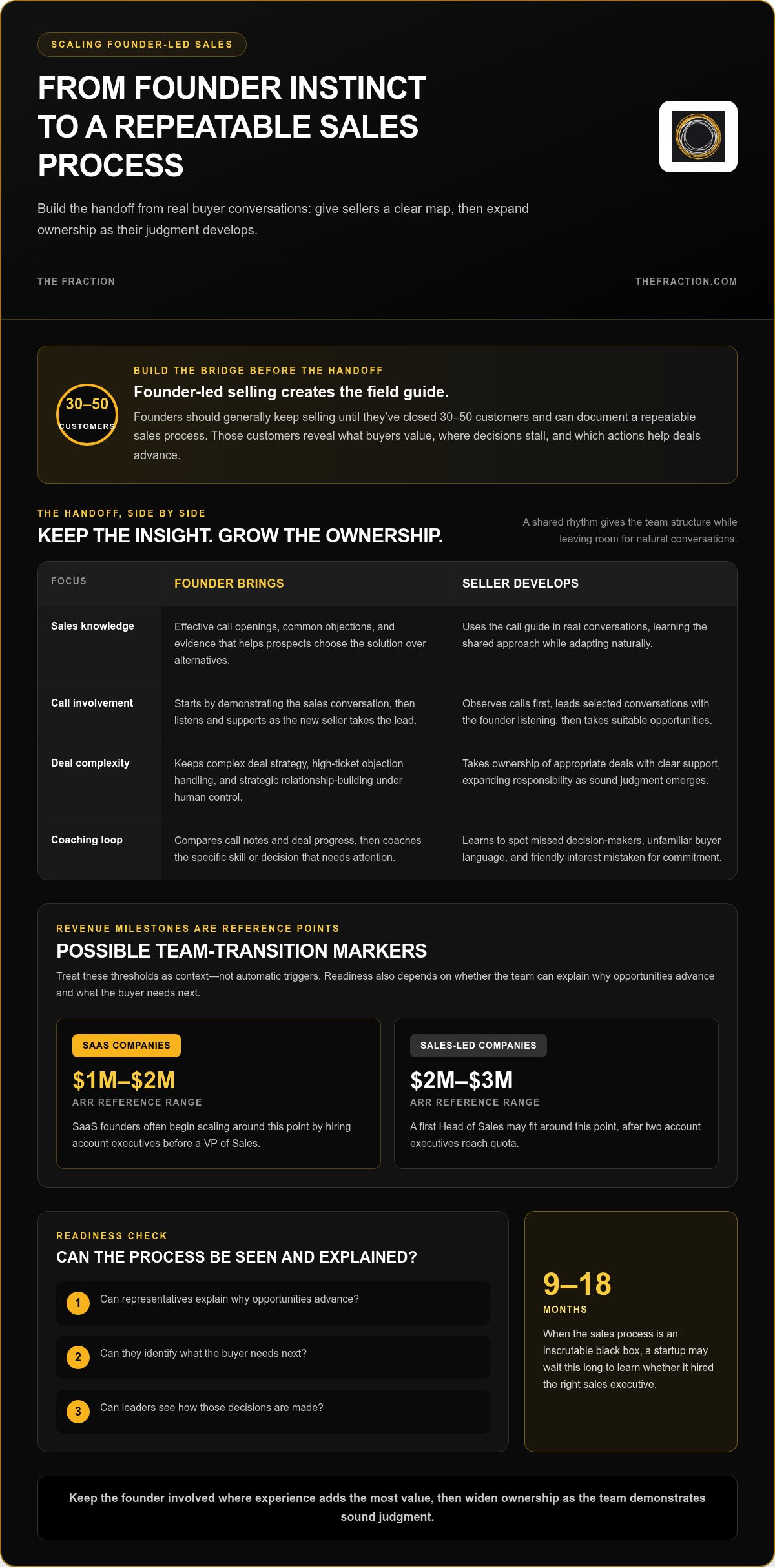
Before handing sales to someone else, build a bridge from founder experience to a process another person can follow. Founders should generally keep selling personally until they’ve closed 30-50 customers and can document a repeatable sales process. Those customers provide real examples of what buyers value, where decisions stall, and which actions help deals advance, so a new hire receives a map drawn from actual terrain.
Turn those examples into practical tools, then let a new salesperson test them in real situations. Capture effective call openings, common objections, and the evidence that helps prospects choose your solution over alternatives. A call guide should work like sheet music: it gives the team a shared rhythm while leaving each person room to perform naturally.
Make the handoff gradual. A new seller can first observe calls, then lead selected conversations while the founder listens, and eventually own suitable opportunities with clear support. Keep complex deal strategy, high-ticket objection handling, and strategic relationship-building under human control, where context and trust matter most. This staged transfer helps the team learn the founder’s judgment while developing its own.
Gaps tend to appear between what the founder knows instinctively and what a new hire can see. A seller might miss a decision-maker, use language buyers find unfamiliar, or mistake friendly interest for commitment. Compare call notes and deal progress, then coach the specific skill or decision that needs work. This feedback loop makes scaling an ongoing practice, not a single dramatic handoff.
Revenue milestones can help frame the timing, though they work as reference points rather than automatic triggers. Passing $1M+ annual recurring revenue is one possible transition point; SaaS founders often begin scaling around $1M-$2M ARR by hiring account executives before a VP of Sales. Sales-led companies may be ready for a first Head of Sales around $2M-$3M ARR, after two account executives reach quota.
Those thresholds alone can’t tell you whether a sales team is ready to carry the full motion. Look at whether representatives can explain why opportunities advance and what the buyer needs next, and whether leaders can see how those decisions happen. When the sales process becomes an inscrutable black box, a startup may wait nine to 18 months to learn whether it hired the right sales executive.
Keep the founder involved where their experience adds the most value, then expand ownership as the team demonstrates sound judgment. If results diverge, return to call reviews and coaching before adding more management layers. A sales process that feels natural can give that transition a clear structure, helping the team build confidence without making every conversation depend on the founder.
3. Empathetic, question-led prospect conversations
Strong sales conversations begin with curiosity, not a polished pitch. A founder can ask what prompted a prospect to explore a solution now, then listen for the problem behind that reason. For example, “What happens if this stays the same?” invites a more useful answer than listing features. Aim to speak for less than 30% of a discovery call, giving the prospect room to explain priorities in their own words.
Use the 3Ws as a flexible conversation guide: why buy anything, why choose this solution, and why buy now. Each “why” tests a different part of the decision, from the problem’s importance to the value of your approach and its timing. You don’t need all three answers in one call. Ask the question that fits the moment, reflect what you heard, and confirm your understanding before proposing a next step.
Test each answer with a “why not” question. If a prospect says the problem matters, ask what might keep it from becoming a priority. If they prefer your approach, explore what could make another option more appealing. These questions surface objections early, helping you distinguish a genuine barrier from a missing detail. Keep the exchange direct and respectful, and let the prospect’s reasoning guide the discussion.
Track whether conversations create forward movement, rather than judging them by enthusiasm alone. A suggested target is for 40-60% of sales conversations to become qualified opportunities. Then measure whether 50-70% of qualified prospects move to a proposal or trial stage, and whether 30-50% of proposals become closed deals. Treat these as diagnostic targets: a change between stages points to a question about qualification, fit, or the next step.
Operational metrics show where progress slows. Measure speed to lead, contact rate, qualification rate, booking rate, show rate, and close rate. For example, strong booking with weak show rates suggests reviewing reminders and meeting confirmations. A low contact rate calls for examining audience fit and outreach. These measures turn conversations into a revenue process you can evaluate, rather than a collection of disconnected sales calls.
Review metrics alongside call notes: a dashboard can show where conversion changes, but not why. Compare successful conversations with stalled ones. Did the prospect name an urgent problem, understand the proposed value, and agree to a specific next action? If qualified prospects stop before proposals, listen for an unresolved objection or a gap in the offer. Adjust one part of the process, then see whether the next group of conversations moves differently.
Keep human interaction at the center as the team applies these patterns. Questions provide context, metrics show whether the process is working, and thoughtful follow-through moves conversations toward a decision. Together, these elements help a growing team preserve the founder’s insight while adapting to each prospect’s needs.
4. Founder-inspired follow-up sequences
A founder’s follow-up works because it carries the thread of a real conversation forward. Start with a 3-5 message sequence, using the prospect’s stated problem, objection, and agreed next step as its raw material. That gives each email a reason to exist, rather than making the prospect feel they’ve entered a generic selling machine. The founder’s voice becomes a repeatable motion when the team can see what to say and why.
Personalization starts with useful context, not just a first name in a template. After a sales call, record the prospect’s goal, concern, decision timing, and any helpful resource. Use those details to shape a relevant recap or example. If a prospect raises onboarding delays, for instance, address that concern directly in the follow-up and refer to the next agreed discussion.
A practical sequence might begin with a personalized recap and next step on day one. On day three, send something useful, such as a relevant insight or an answer to an objection. On day seven, send a final nudge with a specific question connected to the conversation. Each contact offers a distinct reason to reconnect while keeping the prospect’s priorities central.
There’s also guidance to send the first post-call follow-up on Day 3, then contact the prospect on Day 7 with a specific question. Apply that timing to your actual sales motion: a day-one recap can confirm the conversation, while the day-three message provides the first substantive follow-up. Keep the sequence focused on what the prospect needs next, so each touchpoint advances rather than repeats the discussion.
Automate repeatable steps only after defining the human judgment behind them. A CRM can create a recap task when a call ends, queue a value-based email for day three, and remind the owner to send the day-seven question. Pause or adapt the sequence when the prospect replies, books a meeting, or raises a new objection. These conditions help prevent automated messages from continuing after the conversation changes.
Review replies and stalled opportunities to see which messages prompt useful responses. If prospects repeatedly ask the same question, add a clear answer to the relevant follow-up. If an email gets no response, compare its timing and context with the original call before changing the entire sequence. Often, the biggest improvement comes from adjusting one message that feels manual, mistimed, or disconnected from the buyer’s reason to act.
Founders can automate personalized outreach by combining CRM details with templates based on real prospect conversations, then using replies and meeting activity to guide the next step. Keep the structure consistent, but tailor the examples, value, and question to each prospect’s situation. This reduces repetitive work while preserving the direct, human quality that made founder-led selling effective.
5. Sales automation system architecture
Build the system around the lead’s journey, from first signal to sales handoff. Map the existing process before choosing software so each step solves a real problem. For example, a LinkedIn response could create a prospect record, assign an owner, and trigger a timely follow-up task. That connects lead capture to a relationship instead of collecting names without action.
Think of the system as connected layers. The CRM holds the record; integrations bring in lead and activity data; automation handles routing, reminders, and routine updates; reporting shows where prospects progress or stall. Assign an owner and a clear next action at every transition. If a prospect raises a complex objection, route the response for human judgment.
For an early-stage startup, the right CRM and sales automation tools support the current sales process without adding unnecessary complexity. Prioritize contact records, pipeline visibility, task reminders, email and calendar connections, and simple workflow triggers. A small team can start with one central CRM and a few reliable integrations, then add functionality as hiring and growth create new needs.
Startup tool costs depend on factors such as user seats, contact volume, automation limits, integrations, and support. Pricing is provided after a quote request, and those requirements shape the overall cost. Compare the capabilities your process actually needs instead of choosing software based on a long feature list.
Automate routine coordination while keeping relationship-building personal. Useful tasks include lead capture, record creation, routing, meeting reminders, follow-up tasks, and approved email templates. Leave replies to nuanced questions, sensitive objections, and unusual buying situations to a person. Templates can draw on a prospect’s stated problem or recent conversation, but the sender should confirm each message fits before sending.
A practical rollout can be completed in 30 days. First map the process and define what data each step needs; then configure the CRM, connect essential tools, and test the handoffs with real examples. Monitor handoffs closely for the first two weeks after launch. If a LinkedIn inquiry lands with the wrong owner or an email trigger fires after a reply, correct that workflow before expanding it.
Keep the system simple enough to understand. A founder should be able to trace a prospect from source to next action, see where responsibility changes, and spot when a system task needs human attention. That visibility makes automation easier to improve as the team grows and gives hiring decisions a clearer operational foundation.
The Fraction: Automated & AI lead generation systems
The Fraction helps turn founder insight into a more structured path to client acquisition with automated and AI-driven lead generation systems. If you know what resonates in sales conversations but still manage every lead, follow-up, and next step yourself, building a repeatable process around that knowledge is a natural next step.
The Fraction also develops a sales process that doesn’t feel like selling, alongside a compelling offer and service designed to win clients quickly. These elements work together: lead generation brings prospects into view, the process guides useful conversations, and the offer gives prospects a clear reason to move forward.
If you’re ready to build on the insight you’ve gained from sales conversations, contact The Fraction to discuss a practical next step.
Let founder insight become a growth system
The next stage is giving your sales knowledge a life beyond your own calendar. Choose one part of your workflow to strengthen first, then use real prospect responses to guide improvements. You might refine the offer, clarify the next step, or make lead follow-up more consistent. Small, deliberate changes keep the system grounded in the conversations that reveal what buyers value.
The Fraction can help build automated and AI-driven lead generation systems, a sales process that doesn’t feel like selling, and a compelling offer and service designed to win clients quickly. Together, these elements create a practical framework: lead generation brings prospects into view, the process guides useful conversations, and the offer gives prospects a clear reason to move forward.
A thoughtful approach to automating founder-led sales process tasks keeps the founder’s insight at the center while making repeatable work easier to manage. As you consider automating founder-led sales process workflows, start with the part of the sales journey that would benefit most from greater consistency.
Your experience is the starting blueprint. With a clear process around it, your team can keep building with purpose and confidence.
Frequently Asked Questions
What is "founder-led sales"?
Founder-led sales is a model in which the founder leads customer acquisition and early sales conversations. Close contact with the product and customer problem helps the founder identify the language, concerns, and use cases that matter to buyers. For example, a founder might notice that prospects respond more strongly to a specific business outcome than to a feature description, then use that insight to refine future conversations and sales materials.
How do founders sell without being pushy?
Keep sales conversations useful by asking permission to explore a problem before recommending a solution. Ask what the prospect has already tried, what remains difficult, and what a useful outcome would look like. Then connect your offer to their stated priorities, explain where it fits, and invite them to choose a next step. This makes the discussion feel like problem-solving rather than pressure.
How do you follow up without being annoying?
Make each follow-up useful by adding context, answering a question, or confirming an agreed next step. If a prospect asked about implementation, send a concise answer rather than a generic “checking in” message. Record replies and preferences, and pause scheduled outreach when the prospect responds or declines. A relevant message respects their attention and gives them a clear way to continue.
What is a founder-led sales process?
A founder-led sales process is the path a founder uses to move a prospective customer from initial interest toward a decision. It can include where leads come from, how the founder assesses fit, what happens during a sales call, and how the next step is agreed. For example, a founder might record what prompted an inquiry, the main concern raised, and the action both parties accepted.
How can founders automate lead capture, qualification, and routing?
Connect lead forms and other approved sources to a central CRM, then use rules to assign an owner and create a follow-up task. Qualification fields can capture fit, urgency, budget signals, service interest, and readiness for a next step. For example, route a strong-fit inquiry with an immediate need for prompt personal review, while incomplete records trigger a task to gather missing information before handoff.
How do you automate scheduling, proposals, and sales handoffs?
Use scheduling links so qualified prospects can choose an available meeting time, then connect bookings to calendar records and reminders. Proposal workflows can create a draft from approved service details and call notes, but a person should review the scope and commitments before sending. For a handoff, pass the prospect’s goals, decision criteria, open questions, and agreed next action to the new owner so the buyer doesn’t have to repeat the conversation.
What metrics should startups track when automating founder-led sales?
Track conversion and operating measures, then compare them by lead source and sales owner. Speed to lead, contact rate, qualification rate, booking rate, show rate, and close rate help pinpoint where prospects drop out. Pair them with sales cycle length, win rate, pipeline coverage, CAC, and LTV to connect process performance with business economics. A source with fewer leads may still be valuable if it produces better-fit customers.
How should a startup transition from founder-led sales to a repeatable sales team process?
Transfer responsibility in stages, using real calls and deal reviews to show how the founder makes decisions. Start with shadowing, then let a teammate lead selected conversations while the founder observes. Review what the buyer said alongside the resulting next step. Before expanding ownership, give the team call examples, qualification guidance, and a clear escalation path for unusual objections. This creates a shared method while leaving room for sound individual judgment.


