

What if the most reliable path to consulting clients starts with your expertise, then gives it a clear route to the right buyers? A founder-led sales system can turn years of leadership experience into qualified conversations, but when your offer lives mostly in your head and lead generation depends on your personal effort, the pipeline can feel like a tap you keep reopening instead of a business you can build around.
If selling feels uncomfortable after years in a corporate leadership role, that makes sense: you’ve spent your career delivering results, and now you’re also expected to explain why a client should choose your expertise. The answer is a clearer path from the problem you solve to the outcome a buyer can understand, so the conversation feels more like solving a business problem together than delivering a pitch.
In this article, you’ll learn how to shape your expertise into a compelling offer, use outcome-based pricing to make the decision easier to assess, and create a repeatable process for qualified sales conversations. We’ll also look at how systems can support consistent follow-up while you retain control of your content, automations, and business infrastructure, giving your pipeline room to grow without relying on memory and effort alone.
Key Takeaways
- A founder-led sales system links your expertise and credibility to deliberate, repeatable client-acquisition activities.
- Use ideal-client segmentation to focus your business-development effort on organizations with needs your expertise can address.
- Compare ad hoc selling, system-supported founder selling, and delegation by considering control, consistency, and buyer trust.
- Build in practical stages, from understanding the market to reviewing your sales process, with a tangible output at each step.
- The Fractional 1of1 Formula™ brings together five parts of a consulting practice, while its done-with-you approach helps you build and retain control of your business assets.
What a Founder-Led Sales System Means for a Consulting Practice
A founder-led sales system is a deliberate process that brings a consultant’s expertise and credibility into repeatable client-acquisition and sales activities, guiding the right prospects from initial awareness toward a clear buying decision. Think of it as a well-marked route instead of a collection of disconnected conversations: your expertise earns attention, while the process helps you decide whom to approach, what problem to discuss, and how to follow up.
For an experienced consultant, that distinction matters. You may already know how to recognize a costly operational bottleneck, a leadership gap, or a strategic decision that’s stalled, because you’ve seen those problems play out inside organizations. But a buyer can act on that insight when the commercial path is clear: the problem is specific, the value of addressing it is understandable, and the next conversation has a purpose. The broad foundation is captured in Sales principles, while consulting sales also depends on translating specialist knowledge into a relevant conversation and a credible offer.
Why a consultant’s expertise belongs at the center of founder-led sales
Your experience gives you useful context before a prospect has fully explained the issue. You can ask sharper questions, distinguish a visible symptom from a more consequential business problem, and explore what a better outcome would mean for the organization. That kind of discovery feels less like delivering a pitch and more like bringing a clear lens to a complicated decision.
When your observations connect to a buyer’s priorities, trust has room to develop. You can explain how you’d approach the challenge, what the engagement is designed to change, and where your expertise fits, while keeping the conversation grounded in the client’s situation. Your credibility is the engine, and the system is the framework that helps it reach the right people and supports consistent follow-through.
That framework can carry practical work around your expertise, including organizing prospect information, prompting timely follow-up, and keeping useful conversation details accessible. You remain the human voice in discovery and offer discussions, while repeatable infrastructure takes routine work off your mental desk.
Where founder-led selling becomes difficult to sustain
Pipeline activity can become hard to repeat when outreach happens only between client engagements, follow-up depends on memory, and each new conversation starts from scratch. A warm introduction might lead to a valuable discussion, but without a clear next step and a way to maintain momentum, the opportunity can drift while client delivery takes priority.
Positioning creates another point of friction. If your description leans on broad experience or a list of capabilities, a buyer may struggle to connect it to a pressing business outcome. For example, “I advise on operations” gives less direction than explaining the operational challenge you help address and the result the engagement is designed to support.
Look, that’s a design problem, and design problems can be worked through. A founder-led sales system gives your expertise a repeatable path into the market, with clearer decisions about whom you serve, how you describe the value, and what happens after each conversation. The aim is a pipeline led by your professional judgment, with infrastructure that makes consistent action easier.
How the Founder-Led Sales System Connects Expertise to Client Conversations
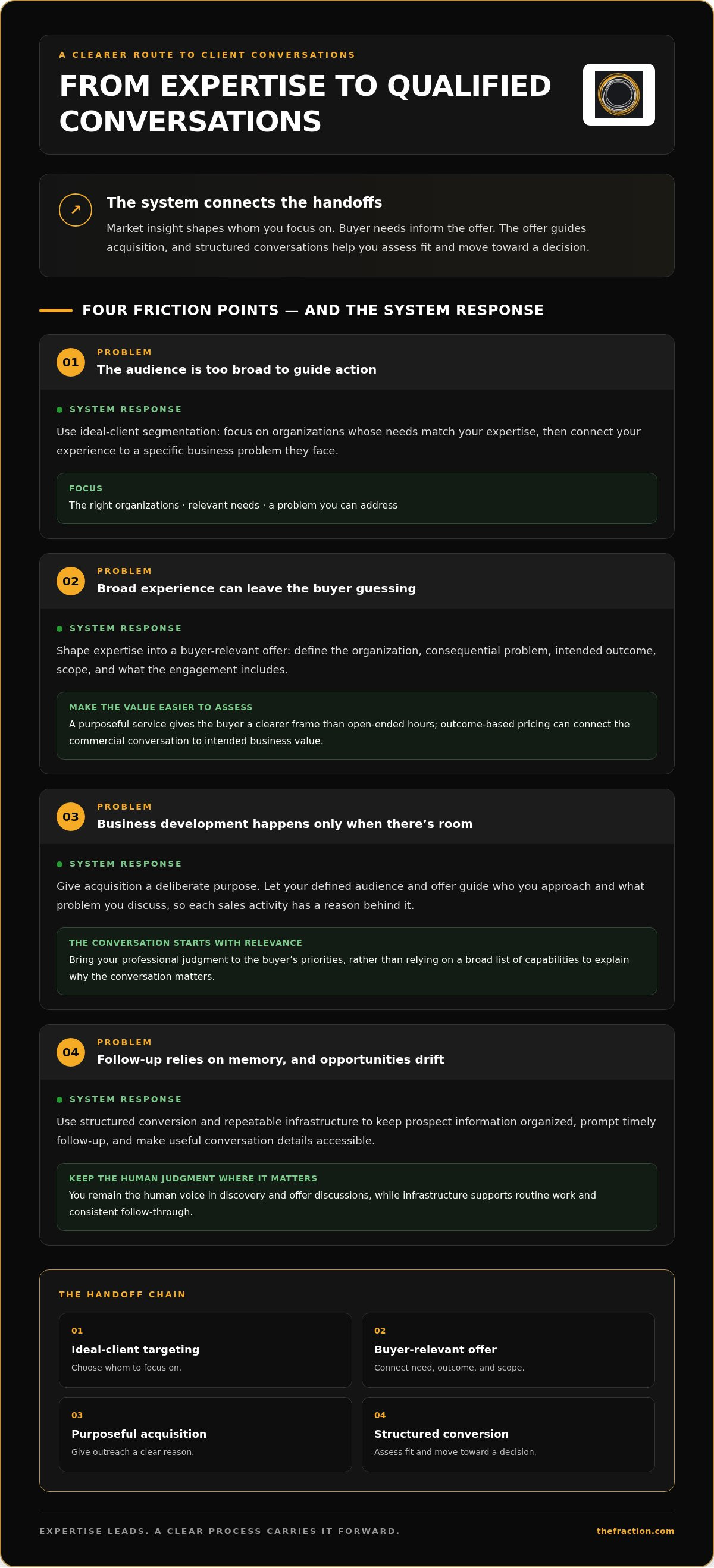
A useful sales system works like a chain of handoffs: each decision gives the next stage better material to work with. Your market insight shapes whom you focus on, those buyers’ needs inform the offer, the offer guides acquisition, and the conversations that follow help you assess fit and move toward a decision. When the links are clear, each sales activity has a purpose, and every interaction can help you learn what to do next.
A founder-led sales system connects ideal-client targeting, a buyer-relevant offer, purposeful acquisition, and structured conversion so expertise can move consistently from first contact to qualified opportunity.
Turn expertise into a specific, buyer-relevant offer
Start with a defined kind of organization, a consequential problem it faces, and the business outcome your work is designed to support. For example, a consultant with deep operational experience might focus on organizations where unclear processes are slowing execution, then shape an engagement around helping leaders create a more workable operating approach. The sharper that connection, the easier it is for a prospective client to understand why the conversation matters.
Productizing your expertise gives that conversation a sturdy frame. Clarify the intended result, the scope of the work, and what the engagement includes, so a buyer can assess it as a purposeful service and understand its value without estimating open-ended hours. Outcome-based pricing can reinforce that frame by connecting the commercial conversation to the work’s intended business value.
And the offer can evolve with what you hear. If several relevant conversations surface the same obstacle, or buyers consistently ask what a successful engagement would change, those signals can help you refine the audience, scope, and language. Treat the offer like an architectural plan: ground it in your expertise, then adjust it as real market feedback reveals where the design needs greater clarity.
Connect client acquisition with a structured sales funnel
Once the offer has a clear shape, acquisition can focus on organizations where the problem is relevant. Targeted outreach, useful content, and relationship-building each create a possible entry point; the aim is to open a purposeful exchange with a relevant prospect. A response or referral then becomes an input for the next stage: learning more about the situation and deciding whether the engagement fits.
A practical funnel gives those conversations a sequence, from initial interaction to discovery, qualification, offer discussion, and a clear next step. Each stage has a job: discovery surfaces the business context, qualification assesses alignment, and the offer discussion connects the proposed work to the buyer’s priorities. For a deeper look at how consultants can shape these conversations across the sales journey, explore The Fraction’s consulting practice-building approach.
The result is a connected path, with your judgment leading and the process carrying handoffs, follow-up, and useful learning from one conversation to the next. If you’re shaping that path around your own expertise, The Fraction’s practice-building support helps you develop the offer and acquisition infrastructure alongside your consulting practice.
Founder-Led Sales System Options: Ad Hoc Selling, Systems, or Early Delegation
There are three broad ways to run consulting sales: handle it as opportunities arise, build a repeatable process around your own selling, or hand parts of the work to someone else. Each choice affects your control, consistency, and the trust buyers place in the conversation, so the right move depends on how clearly you can explain your offer and how repeatable the sales journey has become.
Ad hoc founder activity: You control each interaction and bring your judgment directly to prospects, but outreach and follow-up can vary with client work and available attention. Buyer trust can grow through direct access to your expertise, while the pipeline may rely heavily on you remembering what happens next.
System-supported founder selling: You remain the main voice in high-value conversations, with agreed stages and tools supporting targeting, organization, and follow-up. This adds consistency while keeping your expertise visible to buyers, and gives you a clearer view of where prospects are in the process.
Early delegation: Another person takes on some selling activity, which can distribute tasks, but they need a clear offer, audience, and process to represent your expertise accurately. Control shifts, and buyer trust depends partly on how well the delegated conversation reflects your judgment and value.
Think of these options as different ways to carry the same load. A system can support your decisions before another person takes over any part of the journey, and automation can help organize prospect information or prompt follow-up while you lead discovery, assess fit, and discuss the work. The key is matching the tool to the task.
When founder-led sales is the right operating model
Founder-led selling fits especially well when a buyer’s decision depends on your specialist judgment, your understanding of organizational complexity, or your ability to interpret a situation in real time. Those early conversations also give you direct feedback: which problems prospects describe, what they ask about the offer, and what outcomes matter most. If prospecting happens sporadically or follow-up slips between engagements, that’s a signal to add repeatable support around your selling.
What to systematize before delegating or automating
Before adding tools or handing off conversations, capture the foundations someone else would need to follow:
- Ideal-client profile: the organization and decision-maker whose needs align with your expertise.
- Defined offer: the problem you address, the intended outcome, and the work included.
- Agreed sales stages: what happens from first interaction through discovery, qualification, and a clear next step.
Then separate repeatable coordination from work that needs context. A tool can help keep prospect details organized and follow-up visible; your judgment belongs in conversations that call for nuanced questions, interpretation, and a tailored discussion of fit. For a practical way to shape that infrastructure around your consulting practice, explore The Fraction’s practice-building approach.
How to Build a Founder-Led Sales System in Practical Stages
Look, build this like a route with signposts, where each stage gives you something concrete to carry forward, so you can see what’s taking shape and adjust based on real conversations. The core build stages are market understanding, offer design, acquisition setup, sales execution, and regular review.
- Define the market. Describe the organizations, decision-makers, business context, and needs that align with your expertise. Output: a concise ideal-client profile you can use to assess potential fit.
- Test the problem. Speak with relevant industry leaders about the challenges they’re handling, the impact those challenges have, and how they describe a useful outcome. Output: a record of recurring needs, buyer language, and unanswered questions.
- Shape the offer. Use those conversations to refine the audience, scope, intended outcome, and value of the engagement. Output: an offer description a prospective client can understand and discuss.
- Set up acquisition. Choose how you’ll reach relevant prospects, organize outreach and follow-up, and track responses. Output: a simple acquisition playbook with clear next steps.
- Run and review the sales process. Use defined stages to guide conversations from first interaction through qualification and offer discussion, then review what buyers respond to. Output: a working sales process and specific questions to improve next.
Start with buyer definition and market-informed offer design
Your ideal client profile should describe more than an industry label; include the business context where your experience can make a difference, the needs you’re equipped to address, and the conditions that allow an organization to benefit from your work. Then use structured conversations to test possible offer directions. Ask leaders how they frame the challenge, what it affects, and what a helpful change would look like. Their answers can help sharpen your scope and outcome language before you scale outreach.
Keep the offer flexible enough to learn, but clear enough to evaluate. If people understand the problem you address yet ask what the engagement actually includes, that’s useful feedback about scope. If they describe the challenge in different language, reflect their words in the offer and see whether the connection becomes clearer.
Set up outreach, follow-up, and learning loops
LinkedIn Sales Navigator can support targeted prospect research as one part of a deliberate acquisition process; the tool helps you focus your attention, while your criteria and message explain why a particular organization is relevant. Playbooks and scripts can capture repeatable actions and useful prompts, and configured automation can support consistent follow-up, while you bring judgment to each meaningful exchange.
Review the quality of conversations regularly: which prospects show a relevant need, what questions recur, and where does the discussion lose clarity? Use those signals to refine your targeting, offer, or follow-up approach. A founder-led sales system becomes more useful as a learning loop, with each conversation informing the next version of the process.
How The Fraction Helps Build a Founder-Led Sales System
Building a consulting practice around your expertise involves more than choosing a tool or writing a few outreach messages; it’s closer to building a working business, with the offer, client acquisition, sales process, and delivery connected. The Fraction works as a done-with-you partner, co-building that infrastructure with experienced professionals so the resulting founder-led sales system reflects their expertise and supports consistent execution.
The work is guided by the Fractional 1of1 Formula™, a five-part method that brings together:
- Outcome-based pricing
- Ideal-client segmentation
- A productized offer
- Client acquisition
- A systematized sales funnel
Each part has a place in the broader practice, giving you a way to align the commercial foundation with the experience you bring to clients. The aim is a coherent build from offer through delivery, with strategic support and practical infrastructure developed alongside you.
What hands-on system building includes
The collaboration combines strategic work with implementation support: you work with a strategist and dedicated client-success manager through weekly one-to-one sessions, while playbooks, scripts, and automation setup help turn decisions into usable business-development infrastructure. Tools and automations are configured as part of the build, and you retain account control, so the systems and working assets remain connected to your practice.
You also retain your systems, automations, content, and infrastructure permanently, without ongoing licensing fees. That ownership gives you control over the foundation you’ve helped build, rather than making your pipeline dependent on an ongoing license for its core assets.
How to assess fit and understand the stated guarantees
This approach suits experienced professionals ready to shape their expertise into a consulting offer and actively use the system they build. The work is collaborative: your insight informs the offer and conversations, while the supporting infrastructure helps organize execution. If you’re looking for a passive route where someone else carries the business-development effort, this model may be a different fit than you have in mind.
The 30-Day System Build Guarantee provides a full refund if the complete system isn’t built within 30 days. The lead-generation assurance is also tied to your active effort: if calls aren’t booked after your active effort, The Fraction generates leads at no additional cost. These terms describe specific conditions and responses, rather than a guarantee of client revenue or a particular business result.
So if you’re ready to co-build the offer, acquisition process, and infrastructure around your expertise, explore the executive program and consider whether its hands-on approach fits the practice you want to build.
Put Your Expertise to Work in the Market
Your next move can be simple: choose one buyer group you understand well, then start a thoughtful conversation about a business challenge where your experience could matter. Listen for the words people use, the outcomes they care about, and the questions that shape their decisions, because those details can guide how you present your work and where you focus your attention.
That’s how a founder-led sales system gains momentum, one informed decision at a time. You’re building a business around the judgment and perspective you’ve developed over years, and each deliberate step can make that expertise easier for the right clients to recognize and act on. Build a consulting practice that draws on what you already know and gives your best work room to travel further.
If you’re ready to shape that structure with experienced support, take a closer look at the executive program.
Your expertise has lasting value, and with a thoughtful next step, you can build a consulting practice that gives it room to grow.
Frequently Asked Questions
Can I build a founder-led sales system while I’m still employed?
Yes, you can begin building a founder-led sales system while you’re employed, using carefully scheduled time for research, offer development, and conversations. The Fraction structures outreach for evenings and LinkedIn activity to avoid employer conflicts. For example, you might set aside a regular evening block to speak with industry leaders and refine your offer, while keeping your consulting activity distinct from your current role and responsibilities.
Does founder-led sales mean I have to make every sales call myself?
Founder-led selling keeps your expertise and judgment central to the sales approach, while repeatable tasks can be supported by systems, tools, or another person. You might lead a discovery conversation where your experience helps uncover the business issue, while scripts and organized notes support preparation and follow-up. As your offer and process become clearer, you can decide which activities are ready for support and which benefit from your direct involvement.
Can AI be part of a founder-led sales system without making outreach feel generic?
Yes, AI can support research, organization, and follow-up while you remain responsible for relevance and judgment. For example, use tools to organize information about a prospect, then write or review the message yourself so it reflects their business context and your genuine reason for reaching out. The founder-led sales system stays personal when technology supports preparation and consistency, while you bring your understanding of the buyer to each meaningful interaction.
Do I need a large personal brand or a big social media following?
A large following can help extend your visibility, while a clear profile and useful expertise-based content can also establish credibility. The Fraction’s guidance is that a well-written LinkedIn profile and one or two solid, experience-based posts can provide a useful foundation. Focus on making your expertise easy to understand: describe the business problems you know well, share a practical perspective, and help relevant people see where a conversation could begin.
How do I know whether my founder-led sales system is working?
Look for evidence that the process is creating useful buyer conversations and helping you learn, rather than judging it by activity alone. Track whether the right kinds of prospects respond, whether discovery reveals a relevant need, and whether follow-up moves qualified opportunities toward a clear next step. If conversations repeatedly stall at the same point, use that pattern to revisit your targeting, offer language, or process.
What happens if calls aren’t booked after I put the system into action?
Review your activity to see where the path is losing momentum, from targeting and outreach through replies and scheduling. The program’s stated lead-generation assurance addresses this situation, with its terms explained in the previous section. Keep a record of outreach, responses, and follow-up so you can assess what’s happening and make the next adjustment from a clear picture of your pipeline.


