

What if the lead-generation model that books the most meetings leaves you with the least durable pipeline? That’s the question behind comparing belkins alternatives for professional service lead generation, because a calendar full of calls only matters when the right people understand the value of your expertise and the system keeps working as your practice grows. If you’re weighing a done-for-you agency against software or a hands-on build, the real trade-off is bigger than who sends the outreach: it’s what you’re building around your offer, your sales process, and your future client relationships.
It’s reasonable to want support that protects your time and professional credibility, especially when your best work depends on a clear, high-value offer rather than a pile of loosely matched conversations. The right model connects your expertise to a defined audience, a compelling outcome, and a repeatable path to qualified opportunities, like building a bridge you can keep using instead of renting a ride across it.
This comparison looks at audience fit, execution, and ownership, so you can see what each approach asks of you, what infrastructure remains afterward, and which model may suit a solo or fractional consulting practice. You’ll also see how a done-with-you system can bring market research, offer development, and hands-on acquisition implementation together, rather than treating outreach as a stand-alone task.
Key Takeaways
- Define what you need the system to produce, from relevant conversations to a repeatable client-acquisition process, before comparing providers or tools.
- Use belkins alternatives for professional service lead generation to compare who handles targeting, offer strategy, messaging, follow-up, and sales infrastructure.
- Choose between outsourced execution, DIY software, and co-building by matching the work involved to the support you need and the capabilities you want to develop.
- Assess your offer before increasing outreach, so prospects can connect your expertise to a clear business outcome.
- Explore how The Fraction’s Fractional 1of1 Formula™ brings offer development, ICP segmentation, outcome-based pricing, acquisition, and a systematized sales funnel into one build-out.
Belkins Alternatives for Professional Services: Start With the Outcome You Need
Before comparing Belkins alternatives, get clear on the business outcome you’re building toward. A sales team may need a steady flow of meetings for several representatives, while a solo consultant or fractional leader may need a sharper offer, relevant conversations, and a client-acquisition process they can keep using. The distinction matters because booked meetings are one form of delivery; a durable consulting pipeline also depends on the expertise, offer, and sales infrastructure behind those meetings.
A lead-generation model is the combination of who does the work, what gets built, which assets the client retains, and who carries the sales conversation forward. That definition gives you a practical lens for comparing outsourced execution, software, and hands-on system building. For a foundational overview of what lead generation is, see how it connects prospect identification with the wider marketing and sales process.
For belkins alternatives for professional service lead generation, the central question is whether the model helps translate your expertise into qualified opportunities or primarily supplies outreach activity. Your knowledge is the raw material; the offer shapes it into a valuable outcome, and prospect targeting brings that outcome to people with a reason to care. Leave one piece unclear and outreach can feel like turning up the volume on a radio tuned between stations.
What professional-service buyers need from lead generation
Senior professionals often bring years of functional experience, but buyers don’t purchase experience in the abstract. They’re looking for help with a defined business problem, from someone whose background gives them confidence in the proposed outcome. So the work begins by identifying who benefits most, what pressure or opportunity they’re facing, and how your expertise can address it through a clear, specific offer.
That clarity gives outreach a credible reason to start a conversation. A fractional leader, for example, might frame a service around solving a particular operational challenge for a defined kind of organization, instead of leading with a broad list of past responsibilities. Some professionals build a practice while still employed, which makes a focused system especially useful: each conversation and business-development task needs to serve a clear purpose.
Why an agency alternative should match your business model
A team with dedicated sales roles may value delegated prospect research and meeting generation, while a solo consultant may need support connecting positioning, outreach, follow-up, and a confident sales conversation. Those are different operating models, even if both want qualified opportunities. Think of it like choosing between a catered meal and a well-equipped kitchen: one emphasizes delivered activity, while the other can help build a repeatable capability.
Personal credibility carries particular weight when your buyer is an executive evaluating your judgment, not just a service description. Generic outreach can put that credibility at risk, while a relevant message grounded in a well-defined offer gives your expertise room to lead. A model that respects your voice and strengthens your client-acquisition process can help turn experience into a practice you can build on. That’s the foundation of effective lead generation for fractional leaders.
Compare Belkins Alternatives by Execution, Offer Strategy, and Ownership
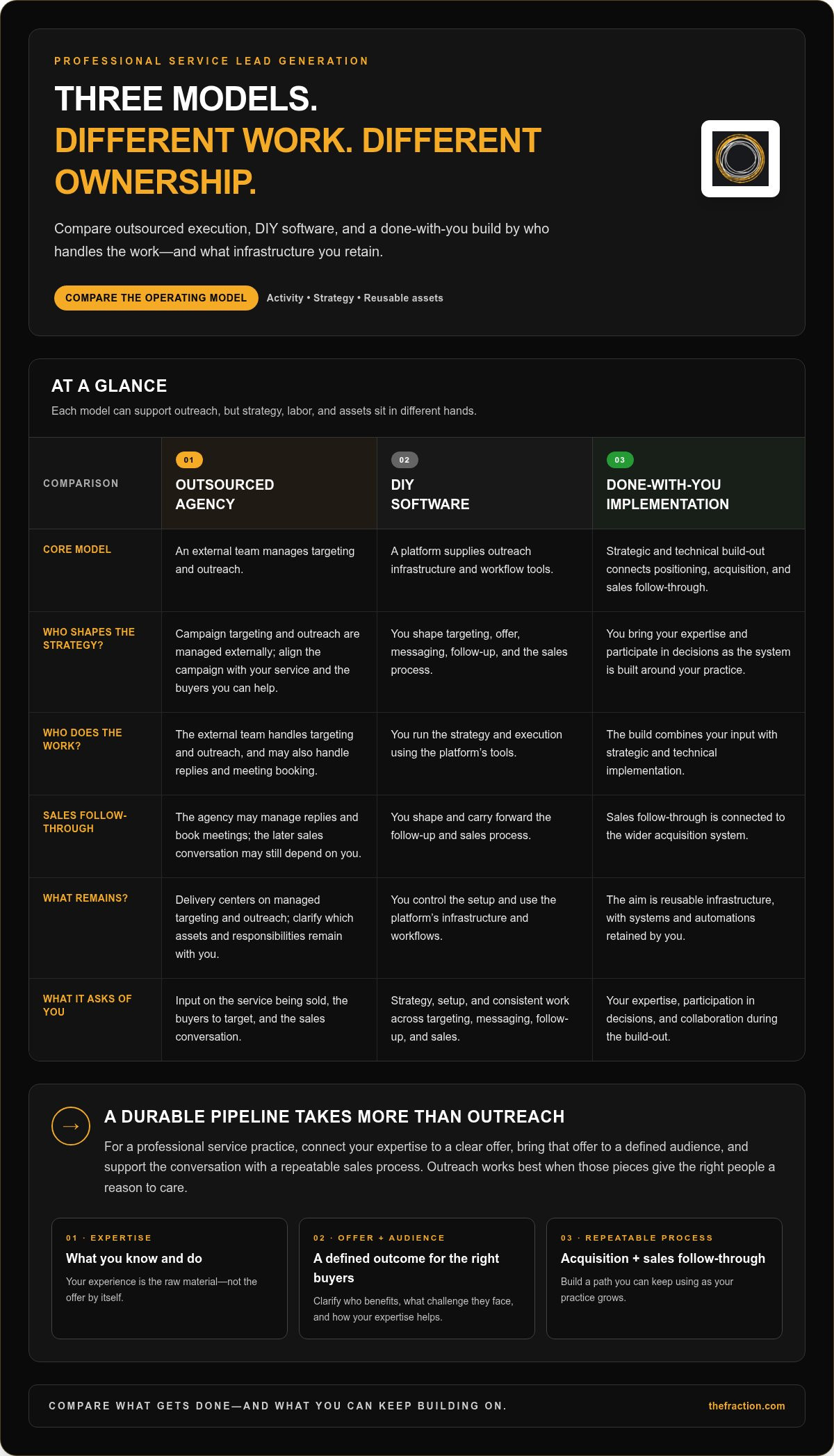
Once the outcome is clear, compare the operating model behind it. An agency, a software platform, and a done-with-you build can all support outreach, but they put strategy, labor, and reusable assets in different hands. For belkins alternatives for professional service lead generation, that distinction helps you see whether you’re buying activity, acquiring tools, or building a client-acquisition capability around your practice.
Outsourced agency delivery
Targeting and outreach are typically managed by an external team, which may also handle replies and meeting booking. Offer development and the later sales conversation may still depend on your input, so align the campaign with the service you want to sell and the buyers you can help.
DIY software
The platform provides outreach infrastructure and workflow tools, while you shape targeting, offer, messaging, follow-up, and sales process. You control the setup, but results depend on the strategy and consistent work you bring to it.
Done-with-you implementation
You bring your expertise and participate in decisions, while strategic and technical build-out connects positioning, acquisition, and sales follow-through. The aim is reusable infrastructure designed around your practice, with you retaining the systems and automations.
Ownership means continued access to the systems, automations, and content that support acquisition, so you can keep using and refining those assets as your practice evolves. That’s a different measure of value from the number of meetings booked during a campaign, because meeting volume by itself doesn’t show whether prospects fit your offer, have a relevant business need, or can become suitable clients.
Outsourced lead-generation agencies and managed outbound
A managed agency can take operational weight off your calendar by coordinating prospect research, outreach, reply handling, and meeting scheduling. That can suit a business with a sales team prepared to take qualified conversations forward, while a solo consultant still needs a clear role in shaping the offer and leading the sale. Think of the agency as a skilled engine room: it can move outreach forward, while your expertise and sales judgment steer the vessel.
So assess offer alignment alongside outreach capacity. If a campaign describes a broad capability where buyers need a specific outcome, more activity may simply carry an unclear message farther. Strong execution starts with a relevant audience and a service promise that fits the problem those prospects are trying to solve.
DIY tools and done-with-you acquisition systems
DIY tools give you the controls, but you’re still designing the route: who to target, what to say, how to follow up, and how to handle a sales conversation. A done-with-you approach pairs your market and functional expertise with strategic guidance and hands-on implementation, connecting the offer, targeting, automation, and process into a working system. If you’re shaping that approach, explore this AI-driven lead-generation strategy as a way to combine technology with deliberate acquisition design.
Address the Main Trade-Off: More Meetings or a Practice You Can Own?
More meetings can create momentum, but a consulting practice grows through the decisions you make around those conversations: which problems you want to solve, how you explain your value, and what you learn from prospective clients. A system that involves your active participation asks for time and judgment, while giving you a chance to strengthen the business-development skills that carry from one conversation to the next. Think of it like learning to read the terrain as you travel, rather than simply counting the miles.
That participation can make outreach more useful because you hear the language buyers use, the questions they ask, and the concerns that shape their decisions. Instead of treating every response as a win-or-lose result, use it as information. A thoughtful reply may point toward a stronger message, a sharper audience, or a different way to describe the outcome your service supports.
How to assess lead quality beyond booked meetings
A booked call is a beginning; the conversation itself shows whether the prospect and your offer are aligned. After each discussion, note the buyer’s role, the business challenge they described, how pressing it seems, and whether your service speaks directly to it. A practical review might ask: did the prospect recognize the problem, understand the outcome, and see a reason to explore a next step?
Then compare what you hear across conversations. If several prospects ask for help with the same adjacent challenge, that may be a cue to revisit how you frame the offer. If they understand the problem but struggle to see why your approach fits, your explanation may need more clarity. Keep the feedback loop simple and consistent, so each exchange informs the next round of messaging before you increase activity.
What ownership and hands-on support can change
Hands-on support can help you move through unfamiliar setup decisions while staying involved in the judgment calls that define your practice. You bring the context only you have, then use strategic guidance to turn it into practical choices about audience, language, and follow-up. It’s a little like working with an experienced navigator: you’re still steering, but you can make decisions with a clearer view of the route.
That balance matters for senior professionals whose credibility is part of the buying decision. Your sales conversation can feel like a useful exchange between peers when you ask focused questions, listen for the business issue beneath the first request, and explain where your expertise fits. A considered consultant sales process can help you guide that discussion with confidence, without making it feel like a hard sell.
As you assess belkins alternatives for professional service lead generation, consider how much you want to learn by taking part in the process. The right level of involvement can help you build judgment alongside pipeline activity, so you’re better equipped to interpret market signals and shape the next conversation.
Use This Decision Framework to Choose a Belkins Alternative
Choose a model by identifying the constraint that’s slowing your consulting practice, because the right support for an untested idea looks different from support for an offer that’s ready for more consistent outreach. Think of it like choosing the right tool for a job: define the result you need, then consider how much guidance, execution, and involvement will help you get there.
Use these five criteria to compare belkins alternatives for professional service lead generation:
- Define the goal: Decide whether your priority is starting relevant conversations, testing an offer direction, improving follow-up, or creating a steadier business-development routine.
- Clarify the offer: Identify the audience, business problem, and outcome your service addresses. If those pieces still feel broad, prioritize market conversations and positioning work before increasing outreach.
- Assess the support: Map the work you want help with and the decisions that need your judgment. Consider how often you’ll work together and what guidance is available as you implement.
- Compare ownership: Consider which strategic decisions you’ll understand and be able to manage over time, including how targeting, messaging, and follow-up are adjusted as you learn.
- Evaluate fit: Match the model to your current capacity, stage, and willingness to participate, then consider how it supports the practice you want to build.
Choose by goal, offer clarity, support, decision-making, and fit, and the options become easier to distinguish: outsourced execution can suit a need for delegated activity, software can suit someone ready to design and run the process, market research can help test an offer, and co-building can combine strategic input with implementation.
Match the model to your current consulting stage
If your offer still feels uncertain, structured market conversations can help reveal which problems buyers describe, what outcomes matter to them, and where your expertise may fit. With a clearer offer, identify the bottleneck: perhaps prospecting feels inconsistent, or perhaps follow-up and sales conversations need more attention. If you’re employed, factor in the time you can realistically commit and shape a business-development rhythm around your work commitments.
Test fit, evidence, and the work required from you
Consider how the model defines a qualified opportunity and adapts targeting to your ideal client profile. Then map your role across research, message approval, implementation, prospect conversations, and sales. This makes it easier to understand how the support connects with your expertise and where your attention will matter most. An automated business development system can organize repeatable steps, while your judgment keeps the offer and conversations grounded in your experience.
For experienced professionals ready to shape a consulting practice with active support, The Fraction’s done-with-you build-out brings offer development and client acquisition together. Explore the approach here:
How The Fraction Builds a Client-Acquisition System Around Your Expertise
For an experienced professional turning deep functional expertise into a consulting practice, The Fraction’s done-with-you build-out brings offer development and client acquisition into the same frame. The goal is to shape a practice around your strengths, then build the systems that help you reach relevant prospects and guide sales conversations, with you actively involved in the decisions and implementation. That makes it a distinct option among belkins alternatives for professional service lead generation for professionals who want support and lasting infrastructure.
From expertise to a productized consulting offer
The starting point is market understanding. A custom Proof of Concept call includes interviews with 10 industry leaders before payment, bringing real conversations into the process of exploring which problems matter and how your expertise could address them. Those insights can help sharpen the service offer before outreach takes center stage, so your message has a clear destination rather than a broad claim that could mean everything to everyone.
The Fractional 1of1 Formula™ brings together outcome-based pricing, ideal client profile (ICP) segmentation, a productized offer, client acquisition, and a systematized sales funnel. Each piece supports the next: pricing reflects the outcome you deliver, segmentation defines whom the offer serves, and the funnel gives relevant prospects a path from first contact into a sales conversation. Clear positioning can make those conversations feel more like a useful discussion about fit and less like a hard sell.
Build the system with support and retain its assets
Strategy needs somewhere to land, so the build-out pairs guidance with practical implementation, including playbooks, scripts, automations, and standard operating procedure (SOP) development. Think of it like putting in the wiring and floor plan of a house while you’re still shaping how each room will be used: the system is designed around your practice, and you remain part of the work rather than handing the whole business-development process away.
You retain the systems and automations, along with the content and infrastructure developed for acquisition, so those assets remain yours to use and refine. The program also sets out three guarantees: the 30-Day System Build Guarantee offers a full refund if the complete system isn’t built within 30 days; the 10X ROI Guarantee continues the program until booked contract value reaches ten times the program investment; and the lead-generation guarantee provides leads at no extra cost if calls aren’t booked after your active effort.
If you’re ready to build a consulting practice with your expertise at the center and hands-on support behind the acquisition system, assess your fit with The Fraction.
Build Your Next Stage of Growth on Purpose
Your next move can start with one clear question: what would make business development feel more aligned with the practice you want to build? Choosing among belkins alternatives for professional service lead generation is ultimately a decision about where you want to put your effort, what capability you want to strengthen, and how your expertise should shape the client journey.
Give yourself room to make that decision deliberately. Map the work you want to own, the support that would help you move forward, and the kind of conversations you want your offer to create. That simple exercise can turn a broad search for more leads into a focused direction for your consulting practice.
If you’re ready to explore a structured path, take the next step and consider how a system built around your experience could support your goals.
Your expertise already has value; with a thoughtful plan behind it, you can build a practice that reflects that value and moves you toward greater professional autonomy.
Frequently Asked Questions
Is a lead-generation agency a good fit for a solo consultant?
An agency can suit a solo consultant who has a clear offer, room to lead sales conversations, and a preference for delegating outreach work. Before deciding, map which parts of acquisition you want help with and which decisions depend on your expertise. For example, you might welcome support researching prospects while keeping control of how you explain your service and assess whether a potential client is a strong fit.
Can I build a consulting pipeline while I still have a corporate job?
Yes, you can develop a consulting pipeline alongside a corporate role by setting a manageable weekly rhythm and protecting time for business development. The Fraction schedules outreach for evenings and structures LinkedIn activity to avoid employer conflicts, so you can plan prospect research, follow-up, and conversations around your work commitments. A steady routine helps you make progress without asking every available hour to serve both your job and your future practice.
What happens to my lead-generation systems if I stop working with a provider?
With The Fraction, you retain the systems, automations, content, and infrastructure built for acquisition, so you can keep using and refining those assets. Make a practical inventory of the accounts, data, message templates, workflows, and documentation involved, and record who can access each item. That gives you a clearer continuity plan and helps you identify which parts of acquisition you can manage independently as your practice evolves.
Does AI replace the need for a strong consulting offer?
AI can support lead generation, while a strong consulting offer gives that activity direction and meaning. A useful offer makes it easy for a prospective client to understand the problem you address and why your experience is relevant. Treat AI like a capable assistant: it can help organize and support parts of your process, while your judgment shapes the promise, the audience, and the quality of each business conversation.
How does The Fraction determine which consulting offer to build?
The Fraction weighs your experience, the business problems you’re equipped to solve, and the kinds of outcomes prospective clients value. The team designs and tests possible directions using market conversations and Proof of Concept research, including interviews with 10 industry leaders using a provided framework. That gives the offer a practical foundation and helps you explain its value in language a decision-maker can recognize.
What if calls aren't booked after I put the lead-generation system into action?
Start by checking the quality and consistency of implementation: confirm that your target audience, message, follow-up, and outreach rhythm align with the plan. Then review responses for clues, such as prospects misunderstanding the service or showing interest in a different problem. The Fraction’s lead-generation guarantee provides leads at no extra cost if calls aren’t booked after your active effort, while those signals can also help you choose adjustments and bring clearer evidence into your next system review.


