

Look, the bigger contact database can still leave you with fewer numbers you’d actually want to call…because the real question in cognism vs apollo for verified b2b mobile numbers is what each provider means by “verified,” and how well those records match the people you’re trying to reach. If you’ve spent time chasing stale contacts or sorting through feature lists that blur verification and coverage together, you’ve felt the gap between a number on a screen and a useful next conversation.
So here’s the thing: “verified” can refer to different checking processes, and the signal only becomes useful when it fits your target roles, industry, geography, and outreach workflow. Cognism’s Diamond Data uses human phone checks, while Apollo’s verification is automated and reflects a point-in-time check; Apollo also brings prospecting tools into its platform, while Cognism feeds into a separate sales stack. We’ll compare those differences against your audience and process, so you can choose data that gives your prospecting a steadier foundation.
Key Takeaways
- In a cognism vs apollo for verified b2b mobile numbers comparison, assess what each platform means by “verified” rather than treating the label as a guarantee of a live answer.
- Separate number availability, identity match, direct-dial status, and whether a prospect can or will answer when judging record quality.
- Compare both platforms against the same target accounts, roles, and sample rules, then track verification evidence and usable records separately.
- Weigh data quality alongside audience fit, freshness, workflow, and the ability to act on each contact; a larger database alone won’t tell you which source serves your prospecting better.
- Connect your data source to clear targeting, a compelling offer, and consistent follow-up so your prospecting system has a reason to reach out.
What “verified B2B mobile numbers” actually means in a Cognism vs Apollo comparison
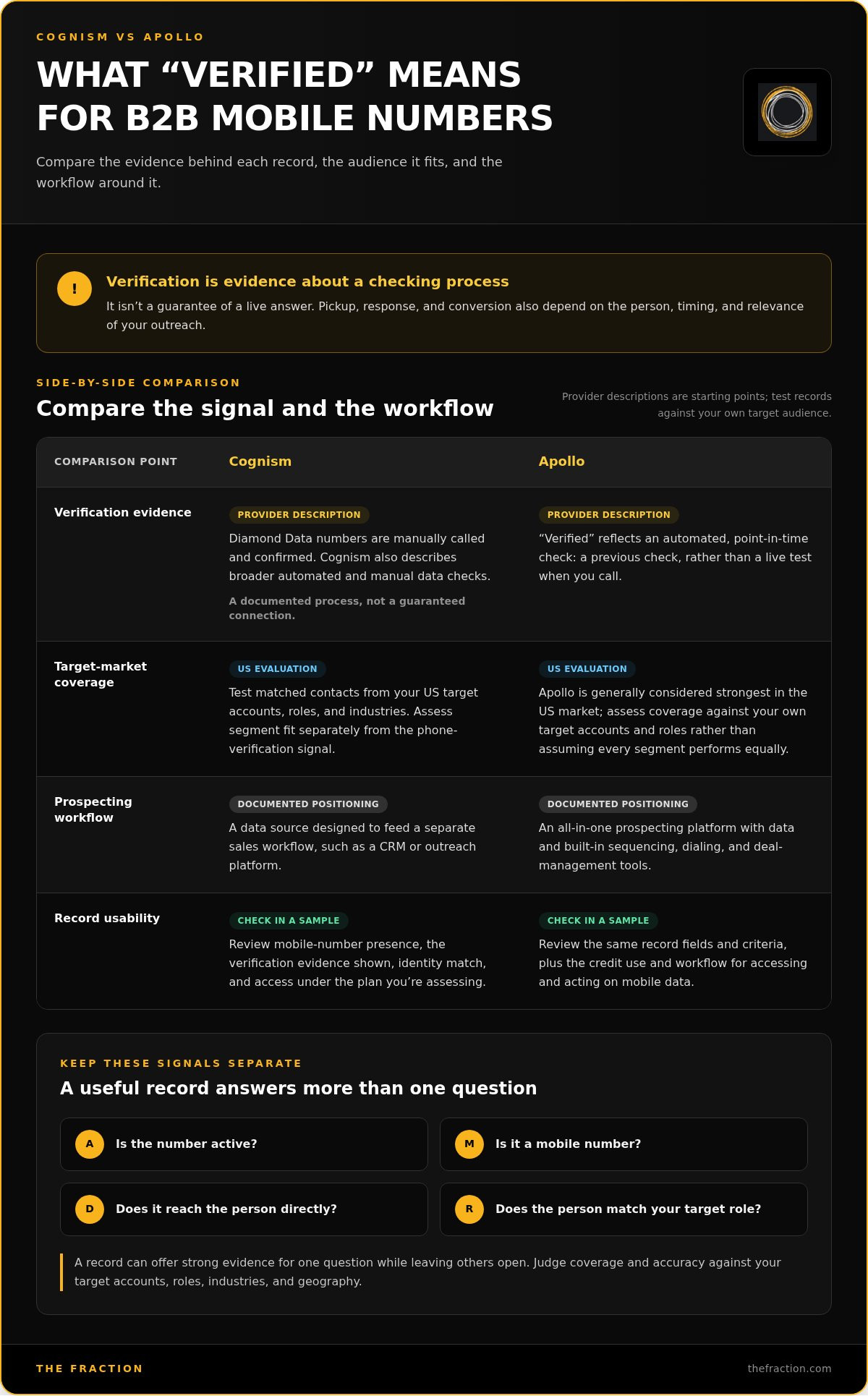
“Verified” describes a provider’s checking process and the evidence attached to a record, so think of it like a recent inspection of a road map: it helps you plan, while the journey still depends on the route and conditions ahead. Cognism says its premium Diamond Data numbers are manually called and confirmed, while Apollo’s “Verified” label reflects an automated, point-in-time check. Each method offers a different signal, and a live answer depends on factors beyond the check itself.
That distinction matters because four separate questions often get bundled into one reassuring label: is the number active, is it a mobile number, does it reach the person directly, and does that person match the role you want to speak with? A record may offer strong evidence for one question and leave the others open. A current number, for example, may belong to a company switchboard; a direct line may reach someone outside your intended buyer group; and a well-matched decision-maker may be unavailable or choose not to answer.
What phone verification can, and cannot, tell you
Manual checking can show that a number was called and confirmed through that process, while automated checks can indicate that a record met the provider’s stated criteria at the time it was checked. The useful question is what each signal establishes and how recently it was recorded. For Cognism, Diamond Data is the specific phone-verified tier; for Apollo, “Verified” refers to a prior check, giving you a point-in-time signal to interpret alongside your own results.
So, for cognism vs apollo for verified b2b mobile numbers, keep verification, identity match, direct-dial status, and contactability in separate columns when you assess records. Verification gives you evidence about the checking process; pickup, response, and conversion depend on the person, timing, and relevance of your outreach.
Why the target audience changes the answer
Data quality behaves more like a fitted key than a trophy database: its value comes from how well it opens the door to your actual audience. A broad directory may contain plenty of profiles, while your practical need is a narrower set of senior roles in a specific industry, company size, and geography. Judge coverage and accuracy against your ideal customer profile and buyer roles, rather than using total database size as a stand-in for fit.
Regional or industry-wide patterns also need to be tested against your own prospect set, because performance in one market or role can differ from another. Set your audience criteria first, then compare the relevant, usable records each source returns. That’s the foundation of sound B2B marketing principles: choosing whom to reach and why gives contact data a clear purpose, instead of letting the database define your market.
How Cognism and Apollo compare on mobile-number data and prospecting fit
For cognism vs apollo for verified b2b mobile numbers, compare the evidence behind each record and the workflow around it, rather than treating a feature list as a scorecard. The table separates platform descriptions from provider claims and points to what a hands-on sample still needs to establish.
| Comparison point | Cognism | Apollo |
|---|---|---|
| Verification evidence | Provider description: Diamond Data numbers are manually called and confirmed. Cognism also describes broader automated and manual data checks. This documents a process, not a guaranteed connection. | Provider description: “Verified” reflects an automated, point-in-time check. It indicates a previous check, not a live test when you call. |
| Target-market coverage | US evaluation: Test matched contacts from your US target accounts, roles, and industries. Assess segment fit through this sample, while treating phone verification as a separate signal about the checking process. | US evaluation: Apollo is generally considered strongest in the US market, but assess coverage against your own target accounts and roles rather than assuming every segment performs equally. |
| Prospecting workflow | Documented positioning: A data source designed to feed a separate sales workflow, such as a CRM or outreach platform. | Documented positioning: An all-in-one prospecting platform that includes data and built-in sequencing, dialing, and deal-management tools. |
| Record usability | Hands-on test needed: Check mobile-number presence, the verification evidence shown, identity match, and access under the plan you’re assessing. | Hands-on test needed: Check the same fields and record criteria, along with the credit use and workflow involved in accessing and acting on mobile data. |
Cognism: assess the phone-verification claim against your use case
Cognism’s phone-confirmation process is a meaningful evidence point if phone-led outreach is central to your work, but the practical question is how often it returns usable records for your specific buyers. Review current documentation for the mobile fields, US coverage, and access conditions you need, then test sample contacts from your target accounts and roles.
Apollo: assess record usefulness and workflow fit
Apollo’s automated verification and built-in prospecting workflow may suit a team that wants data and outreach tools together, while a separate data layer may fit an operation that already has its own sales stack. Compare equivalent US-based samples and record the mobile evidence, identity match, and usability separately; then weigh those results against how your team actually works.
There’s no universal winner here. A team prioritizing manually phone-confirmed records may value different evidence from a team prioritizing an integrated workflow, so let your audience and sample results carry the decision. If you’re building the targeting, offer, and follow-up process around whichever data source you choose, explore a done-with-you lead-generation system as one way to develop that wider acquisition engine.
Are verified mobile numbers worth prioritizing over database size or extra features?
A larger database can look like a bigger runway, but runway only helps if it points toward the right destination. More records don’t automatically create more qualified conversations: audience fit, record freshness, buying context, and your ability to follow up all shape whether a contact can move into a real prospecting process. The useful question is which limitation is slowing your team down today.
If phone outreach is a deliberate part of your sales motion, and reaching a specific role by mobile is central to that motion, verified mobile coverage may deserve more weight than a broad feature set. That’s especially true when poor contact data creates repeat work, such as checking numbers manually, correcting identity mismatches, or rebuilding lists before outreach. In that case, assess the record-level evidence for the roles and accounts you actually target, rather than relying on headline coverage.
When verified mobile coverage should carry more weight
Give phone-verification evidence priority when your team has a clear reason to call, a defined buyer profile, and a consistent way to act on the records. For example, a specialist targeting a narrow set of senior roles may get more value from a smaller pool of relevant, usable contacts than from a broad list with limited fit. Test whether the evidence and contact details hold up for your audience, then compare the time spent preparing each source for outreach.
When broader coverage or workflow capabilities may matter more
Broader functionality can be the stronger choice when several teams or channels share a prospecting workflow, or when consolidating data and outreach tools solves a practical operating problem. Apollo’s documented all-in-one positioning includes a contact database, email sequencing, a dialer, and deal-management tools; that breadth matters most when your team will actually use those capabilities. Cognism’s data-provider model may fit an operation that already runs its outreach through separate tools.
Map each capability to a real task before assigning it value. Does it support segmentation your team uses, provide information that changes whom you contact, or fit the systems your team already relies on? For integrations, available fields, and plan-specific access, use current product documentation and a hands-on test, since those details can affect the comparison.
So the cognism vs apollo for verified b2b mobile numbers decision is best treated as a test, not a universal preference for premium verification or maximum scale. Compare equivalent samples, then weigh usable records against the whole process: selecting the right people, giving them a relevant reason to talk, and following up consistently. That’s where data becomes part of a working acquisition system, rather than another impressive-looking database.
How to test Cognism vs Apollo with a fair mobile-number sample
A fair comparison holds the audience and evaluation rules constant, so each platform gets the same chance to show how its records work for your prospecting. Treat the test like a controlled route through the same terrain: change the data source, but keep the destination and measuring stick steady. That makes the results useful for your team, even if the sample is too small to settle every question.
Set up an apples-to-apples test
Before exporting contacts, define the ideal customer profile, seniority, industries, company types, and target geography you want to evaluate. Then apply equivalent account and contact criteria in Cognism and Apollo, and record your selection rules so the comparison doesn’t quietly favor whichever platform returns more familiar names.
- Set the audience. Write down the roles, industries, company characteristics, and geography you’re targeting.
- Match the accounts. Use the same target-account list and contact criteria in both platforms, applying the same exclusions.
- Log the test conditions. Record the date, source, fields reviewed, selection method, and any records excluded, so you can interpret the results later.
Keep the selection method consistent, too. For example, use a defined order of target accounts and evaluate the first eligible contact matching your role criteria in each platform, instead of hand-picking the strongest-looking records from one source.
Measure data quality and operational usefulness
Give each record a separate score for mobile-number availability, stated verification evidence, identity and role match, and duplicate status. Then define a “usable record” for your process: for instance, a contact with a mobile number, a matching identity and target role, and enough evidence for your team’s own data standard. Calculate the usable-record rate against all eligible contacts sampled, and keep each component visible so one strong signal can’t hide a weak one.
- 4. Track workflow fit. Note whether the record can move into your intended outreach process, including any extra review or data cleaning it requires.
- 5. Interpret with care. Treat a small sample as directional, then expand or repeat the test before making a broader conclusion. Record call outcomes separately, since a usable record doesn’t predict whether someone will answer or respond.
- 6. Review requirements. Before activating outreach, check current legal and platform-policy requirements with authoritative sources relevant to your target geography and channel.
This gives your cognism vs apollo for verified b2b mobile numbers evaluation a repeatable basis: same audience, same rules, distinct measures, and a clear record of what your team can actually use.
Build a dependable lead-generation system around the data you choose
A database supplies contacts; your strategy determines whom to reach, why they might care, and what happens after the first message. Think of the data source as one part of the engine, with your ideal customer profile, offer, targeting, and follow-up working together to move it forward. That’s the larger decision behind cognism vs apollo for verified b2b mobile numbers: which source can support a repeatable acquisition process for your consulting practice?
Turn contact records into a focused prospecting motion
Start with the buyer’s priority problems, then define the roles and organizations where those problems are most likely to matter. Shape a clear, compelling service offer around that audience, so your outreach has a relevant reason to begin a conversation. A well-matched mobile number can create an opportunity to connect, but the offer and message give that connection direction.
From there, connect your data criteria to a consistent prospecting workflow. LinkedIn Sales Navigator targeting and configured automation can support how your system identifies and organizes prospective buyers, while your follow-up process gives each contact a clear next step. These tools can create structure and leverage, but demand still comes from the fit between the buyer’s need and the value you communicate.
For a broader view of how targeting and offer design work together, explore an AI-driven lead generation strategy, then consider how professional service sales automation can help create a steady process for managing outreach and follow-up. Each framework serves the same larger aim: turning well-chosen contacts into a thoughtful, repeatable path toward a client conversation.
Know when to strengthen the system around the tool
If your audience definition keeps shifting, prospects can’t quickly see the value of your offer, or follow-up happens inconsistently, adding more contacts may simply give those gaps more room to grow. Treat those signals as part of the evaluation. Strengthening positioning, targeting, offer clarity, and follow-up can make the data you already have more actionable, while a new source can fill a genuine gap in coverage or workflow.
The Fraction’s done-with-you approach supports experienced professionals developing consulting practices by co-building the wider lead-generation and sales system, including offer development and a low-friction sales process. The aim is a connected acquisition foundation, with the client retaining ownership of their systems, automations, content, and infrastructure. Cognism and Apollo remain data-platform choices within that larger picture; the right choice depends on your audience, evaluation, and operating model.
Ready to build the targeting, offer, and follow-up infrastructure around your prospecting? Explore a done-with-you lead-generation system.
Choose data that strengthens your whole prospecting system
The right platform is the one that earns its place with your audience and workflow. A “verified” label describes a checking process, while a fair sample test shows whether records match your target roles and can be used in your outreach. Keep audience fit, record quality, and workflow usefulness in view together, and you’ll have a much clearer basis for choosing.
That’s the practical lens for cognism vs apollo for verified b2b mobile numbers: set the same criteria for both, measure mobile availability and identity match separately, and treat early results as directional. Then connect the data to a clear ideal customer profile, a valuable offer, and consistent follow-up, because contacts alone can’t tell prospects why a conversation matters.
The Fraction helps experienced professionals build that wider acquisition system, including LinkedIn Sales Navigator targeting and configured automation. Clients retain ownership of their systems, automations, content, and infrastructure, so the work supports a foundation they can continue to manage.
With a clearer audience and a repeatable process, your next prospecting decision can feel far more deliberate and much easier to act on.
Frequently Asked Questions
Is Cognism or Apollo better for verified B2B mobile numbers?
Neither is universally better; the stronger fit depends on your target audience and the verification evidence your team values. Cognism’s Diamond Data is described as manually called and confirmed, while Apollo’s “Verified” status reflects an automated, point-in-time check. Compare equivalent contacts from your target roles, industries, and geography, then weigh usable records and workflow fit. That’s the practical way to approach cognism vs apollo for verified b2b mobile numbers.
What does phone-verified data mean in B2B prospecting?
Phone-verified data means a provider applied a stated checking process to a phone-number record. The process may include a human phone call or automated checks, depending on the provider and data label. It’s evidence about how the record was checked, rather than a promise that the number will connect you to the right person. Number validity, mobile status, direct-dial access, identity match, and willingness to answer remain separate considerations.
Can verified B2B mobile numbers still be wrong or outdated?
Yes. A verification signal reflects a check at a particular point in time, and contact details or job roles can change afterward. A number can also be valid but belong to someone other than the intended contact, or fail to reach the person directly. Treat verification as useful evidence, then assess identity and role match in your sample. Keep call outcomes separate, since even an accurate number can go unanswered.
How do I compare Cognism and Apollo fairly?
Use the same ideal customer profile, target accounts, job roles, geography, and contact-selection rules for both platforms. Record when and how you collected each sample, along with any exclusions, then score mobile-number presence, verification evidence, identity match, duplicates, and usability separately. This keeps the comparison focused on your prospecting needs rather than differences in sample selection. Treat a small sample as directional, and repeat or expand it before drawing broader conclusions.
Does a larger B2B database mean better mobile-number coverage?
No. A larger database may contain more total records, but that doesn’t establish how many match your target roles or include usable mobile numbers. For a specialist targeting a narrow professional niche, useful coverage means relevant contacts that fit the intended audience and can move into the outreach workflow. Compare eligible records within your defined segment, rather than using overall database size as a stand-in for fit or quality.
Should consultants use a database like Cognism or Apollo for prospecting?
Consultants can use a contact database when it supports a clear, deliberate prospecting motion, especially if phone outreach is part of how they reach prospective buyers. Start with a defined audience and service offer, then assess whether the data helps identify relevant people and supports consistent follow-up. A database is one component of client acquisition; targeting, positioning, and a compelling reason to talk give those contacts direction.
What should I measure when testing B2B mobile-number data?
Track mobile-number presence, the provider’s stated verification evidence, identity and role match, duplicate records, and the usable-record rate as separate measures. Also note the effort required to prepare records for your intended outreach process. Keep pickup, response, and conversion outcomes separate from record quality, because a usable number can’t guarantee a conversation. Document the sample criteria and collection date so you can interpret and repeat the test consistently.


