

What if choosing among Martal Group alternatives has less to do with who can send the most outreach and more to do with what you want your business to own when the work is done? Look, if agency models are hard to assess before you commit, or all that prospecting activity still isn’t turning into qualified conversations, you’re asking the right question...and this guide to martal group alternatives for b2b sales prospecting will help you compare the paths forward based on how your business sells and how much control you want to keep.
Outsourced agencies can bring execution, prospecting software can put tools in your hands, and an owned system can connect your positioning, targeting, outreach, and sales process into an asset your business retains. Each path asks for a different balance of involvement, management, and long-term control, so the right fit depends on your expertise, your team, and the growth you’re working toward. We’ll look at those trade-offs, including a done-with-you approach to building an owned client-acquisition system, and how a clear offer and focused targeting can lead to more relevant sales conversations.
Key Takeaways
- Start with the sales outcome you need, then compare martal group alternatives for b2b sales prospecting by fit, control, and how they create qualified conversations.
- Compare agencies, software, and co-built owned systems by who handles strategy, targeting, messaging, execution, and ongoing optimization.
- Assess prospecting quality through audience precision, offer clarity, channel fit, and movement from a target account to a meaningful sales opportunity.
- Use a deliberate transition plan to preserve audience insights and response learning while building a more consistent operating rhythm.
- See how The Fraction connects offer development, market research, targeting, automation, and sales-process design into an owned system for experienced professionals building fractional consulting practices.
Martal Group alternatives: first decide what your prospecting needs to accomplish
Looking for an alternative to Martal Group often means there’s a mismatch somewhere in the operating model: the support may not fit your sales motion, the level of control may feel too limited, or the activity may not be creating the results you need. Before comparing providers and tools, name the outcome you want to change. Otherwise, it’s like choosing a new engine before deciding whether the vehicle needs more power, a clearer route, or a better driver.
Business-to-business (B2B) describes commercial activity between businesses, and B2B prospecting is the route from a chosen buyer to a qualified business conversation. A prospecting alternative is simply a different way to create those conversations, whether you need more execution capacity, stronger strategic direction, or an acquisition system your business retains.
Those outcomes can look quite different in practice: you might need more sales meetings, a stronger qualified pipeline, or an owned system connecting positioning, targeting, outreach, and follow-up. Get specific about the destination first, then compare the delivery model that could take you there.
What are you replacing: capacity, expertise, or the whole system?
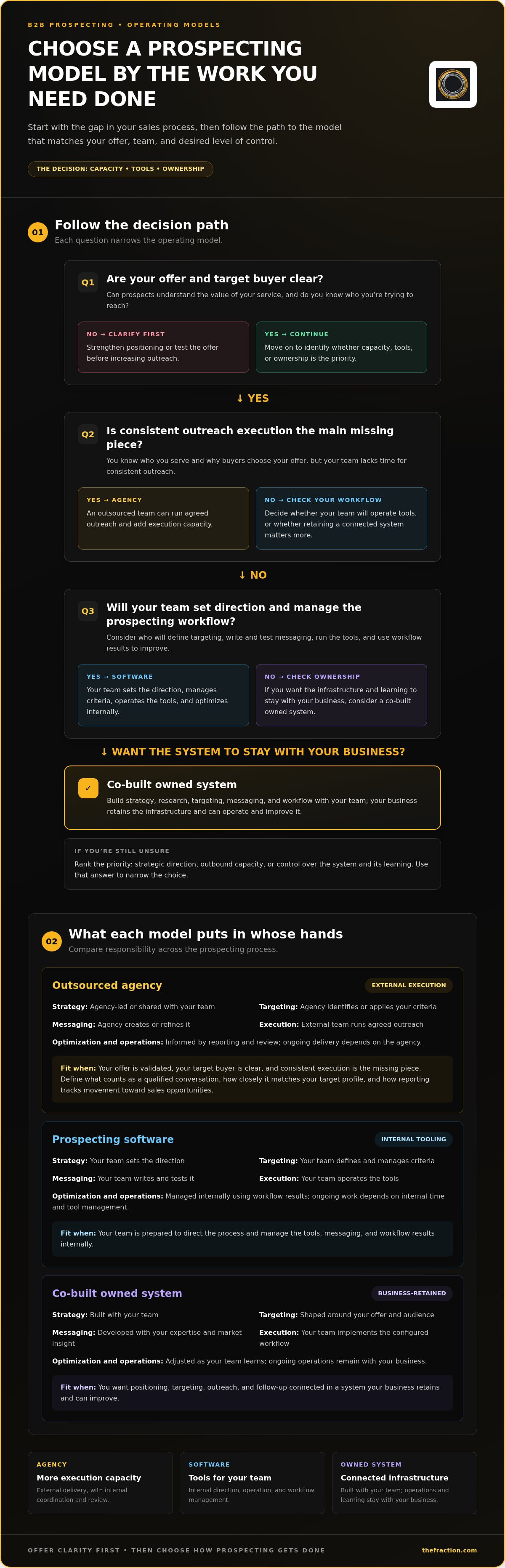
If you know who you serve and why buyers choose your offer, but you’re short on time for consistent outreach, the gap may be execution capacity. If prospects struggle to understand the value or urgency of your service, strengthen the positioning or test the offer before increasing outreach, so that added activity has a clear message and a better buyer-offer match. Before reviewing martal group alternatives for b2b sales prospecting, rank what matters most: strategic direction, outbound capacity, or control over the system and its learning. That answer narrows the field fast.
Which buyer and sales motion should the alternative serve?
Map the buying context before choosing a prospecting approach: are you targeting a defined set of complex accounts, speaking with senior decision-makers, or reaching buyers whose needs are easier to identify and address? Repeatable product sales may support a more standardized process, while high-value professional services often depend on trust, credibility, and a clear connection between the buyer’s challenge and your expertise.
For experienced professionals developing a fractional consulting practice, prospecting has to do more than fill a calendar. It needs to help the right buyer recognize a costly problem, understand the value of specialized experience, and feel comfortable starting a business conversation. So your offer, audience, and outreach need to work together, like parts of one well-designed bridge: precise targeting brings the buyer to the message, and a relevant offer gives them a reason to cross. This lead-generation strategy for high-value professionals can help you think through that connection before choosing a model.
Compare the three Martal Group alternative models: agency, software, and owned system
Here’s the key distinction: who carries the work, and who keeps the learning and infrastructure as the process develops? An agency can bring execution capacity, software gives your team tools to run a workflow, and a co-built owned system brings the pieces together while keeping the infrastructure with your business. The operating model determines who owns the prospecting process, from the decisions behind targeting to the follow-up after a prospect responds.
| Responsibility | Outsourced agency | Prospecting software | Co-built owned system |
|---|---|---|---|
| Strategy | Agency-led or shared with your team | Your team sets the direction | Built with your team |
| Targeting | Agency identifies or applies your criteria | Your team defines and manages criteria | Research and targeting are shaped around your offer and audience |
| Messaging | Agency creates or refines messaging | Your team writes and tests it | Developed with your expertise and market insight |
| Execution | External team runs agreed outreach | Your team operates the tools | Your team implements the configured workflow |
| Optimization | Informed by reporting and review with the agency | Managed internally using workflow results | Adjusted as your team learns from targeting and conversations |
| Ongoing operations | Depend on continued external delivery | Depend on internal time and tool management | Remain with your business to operate and improve |
When an outsourced B2B prospecting agency fits
An agency can be a strong fit when your offer is validated, your target buyer is clear, and consistent execution is the missing piece. You’re adding capacity, so agree on how activity connects to outcomes: define what makes a conversation qualified, how closely it should match your target profile, and how reporting will show movement toward sales opportunities. You’ll also need to coordinate internally and rely on the agency’s delivery, so clarify where your team stays involved and where the agency takes the lead.
When software or an owned acquisition system fits
Software makes sense when your team knows its audience and has the time and expertise to manage targeting, messaging, and follow-up. An owned system takes a broader view, connecting market research and offer development with outreach, automation, and sales conversations, so each part feeds the next instead of sitting in a separate tool. For a wider look at this connected approach, this professional service sales automation framework provides useful context.
For experienced professionals building a fractional consulting practice, co-building can bring structure to business development while keeping the expertise and infrastructure close to the business. The Fraction’s done-with-you owned-system build-out connects offer development, market research, targeting, automation, and sales-process design, with clients retaining the systems and infrastructure they build.
Evaluate Martal Group alternatives by fit, control, and qualified pipeline
Once you’ve narrowed the model, judge its fit by the quality of the path it creates, from the right audience to a useful sales conversation. A large activity count can look like a full pipeline from a distance, but it tells you little about buyer relevance, offer clarity, or whether your sales process can turn interest into an opportunity. Compare those foundations before treating outreach volume as progress.
How can you tell whether a prospecting approach fits your offer?
Start with the sale itself. A complex engagement involving senior decision-makers and a high-value professional service often calls for precise targeting and a trust-building conversation, while a more repeatable offer may support a standardized motion. Look for a clear line between a specific buyer problem and the outcome your service delivers; if that line still feels fuzzy, use early market conversations as evidence to refine the positioning before expanding outreach.
For experienced consultants, that feedback can reveal which business challenges buyers recognize, which language makes the offer clear, and where interest fades. Use what you learn to strengthen the offer and targeting, so the next round of outreach has a sharper compass.
Which measures reveal useful pipeline quality?
Track each stage separately, because each measure answers a different question: outreach activity shows whether the process is being run, booked calls show whether prospects agreed to meet, qualified opportunities show whether those conversations fit your buyer and service criteria, and contracted work shows whether a commercial decision followed. A booked call alone can’t establish qualification, and a qualified opportunity can’t prove that a contract will close. For the step from a reply to a productive sales conversation, this guide to the sales process for consultants offers useful context.
Use a decision matrix that weighs fit and ownership
Score each prospecting option against four criteria, putting the most weight on what your business needs most. For example, a solo professional may prioritize buyer fit and ownership, while a team with clear positioning and limited execution capacity may put greater weight on internal effort. Use the same criteria for every option, so agency promises, software features, and owned infrastructure sit on one decision map.
- Buyer fit: Does the approach reach the right decision-makers with a message tied to a real business problem?
- Control: Who owns the data, automations, scripts, and process, and who can adapt them?
- Internal effort: How much time and coordination will your team contribute to run and maintain the workflow?
- Market learning: Will feedback from replies and conversations help you improve targeting, messaging, and the offer?
As you assess martal group alternatives for b2b sales prospecting, trace reporting beyond activity and into pipeline movement, then clarify how implementation and ongoing support affect what your team learns and retains. That’s how you compare the full operating reality, instead of choosing based on a busy dashboard alone.
Plan a practical transition from an agency or disconnected tools
Changing a prospecting model works best as a handoff of knowledge, not a hard reset. Before you replace an agency or retire tools, capture what the market has already taught you: which buyer profiles respond, which messages earn a thoughtful reply, where conversations stall, and what follow-up has helped move a prospect forward. A prospecting transition should preserve learning, not just replace software.
For experienced professionals building a fractional practice, that knowledge is part of the business foundation. Use this sequence to move from broad goals to a measured operating rhythm, so every change has a reason and an owner.
- Step one, set the business goal. Define the commercial outcome you need from prospecting, such as creating qualified conversations with a particular type of organization or testing demand for a defined service. Choose a practical review period and decide what evidence would show that the new approach is moving in the right direction.
- Step two, clarify and validate the offer. Describe the target decision-maker, the pressing business problem they face, and the outcome your service addresses. Use structured conversations with industry leaders to test whether your language reflects the buyer’s priorities and whether the offer is clear. The Fraction’s market-research strategy, for example, includes interviews with 10 industry leaders. Use what you learn to refine the audience and value proposition before scaling campaigns.
- Step three, audit current outreach and preserve useful signals. Review account criteria, messages, replies, booked calls, objections, and follow-up history. Keep the patterns that reveal buyer interest, and separate them from activity that produced little relevant response. This gives your next targeting and messaging decisions a trail of evidence to follow, rather than asking the new process to start from a blank page.
- Step four, connect the workflow and assign ownership. Map the path from account selection to personalized outreach, response handling, and a low-friction sales conversation. Assign clear responsibility for strategy, targeting, messaging, execution, automation, and review; keep account access and process ownership with the business rather than relying on a personal account held by an external operator. That clarity makes day-to-day handoffs easier to manage.
- Step five, establish a measured operating rhythm. Set a recurring review to assess target-account fit, response quality, qualified conversations, and next steps. Record what the market is teaching you, agree on the adjustment to test, and revisit the result at the next review. This keeps optimization grounded in learning, rather than reacting to activity totals alone.
Use the same sequence to evaluate martal group alternatives for b2b sales prospecting: define the outcome, preserve the evidence, assign ownership, and choose a model your team can operate and improve over time.
Build an owned client-acquisition system
Build an owned B2B prospecting system with The Fraction
For experienced professionals turning deep functional expertise into a fractional consulting practice, The Fraction offers a done-with-you business build-out centered on an acquisition system the client retains. Think of it as building the bridge from what you know to the buyers who need it: the offer, research, targeting, automation, outreach, and sales process are designed to connect, so each part supports the next.
That makes this a distinct route among martal group alternatives for b2b sales prospecting. The Fraction works alongside clients to develop and implement the system, rather than operating as a done-for-you prospecting agency. Clients retain their systems, automations, content, and infrastructure permanently, with no ongoing licensing fees.
What does the co-built system bring together?
The Fractional 1of1 Formula™ ties the foundation of the business to its path to market. It brings together outcome-based pricing, ICP segmentation, and a productized offer, then connects those elements to client acquisition and a systematized sales funnel. In practical terms, market research helps shape the offer and define the right audience; targeting guides who the outreach reaches; automation supports the workflow; and the sales process gives interested prospects a clear next step.
The Custom Proof of Concept Call informs that foundation through research interviews with 10 industry leaders. Those conversations help test market language and offer direction before outreach is scaled, giving decisions about positioning and buyer fit a stronger basis than guesswork alone. Ongoing implementation support helps clients put the connected pieces into practice while keeping the underlying infrastructure in their hands.
Who is this owned-system approach designed to serve?
This approach is designed for experienced executives and consultants translating their functional expertise into a fractional service, particularly those ready to take an active role in shaping and implementing their own client-acquisition system. It suits professionals who want strategic structure and practical support while retaining ownership of the assets they build. Participants who are still employed can schedule outreach for evenings to keep business development separate from employer time.
The program includes two stated guarantees: the 30-Day System Build Guarantee offers a full refund if the complete system isn’t built within 30 days; the 10X ROI Guarantee continues until booked contract value equals ten times the program investment, with no time limit or upsells.
If you’re weighing an agency against building a system around your own expertise, consider whether you’re ready to develop the offer, learn from market feedback, and implement the process with support. That distinction helps clarify whether a co-built, owned system fits your goals and working style.
Turn your prospecting choice into a system you can build on
Your next move can be focused: choose the operating model that matches your expertise, the buyers you serve, and the level of ownership you want to carry forward. The right martal group alternatives for b2b sales prospecting decision gives you a practical direction, so your next outreach effort builds on what you’ve learned instead of sending you back to square one.
For experienced professionals shaping a fractional practice, that direction can start with one clear question: what needs to be true for a suitable buyer to understand your offer and feel ready for a useful conversation? Use the answer to guide your next step, whether that means refining the offer, sharpening your audience, or building a client-acquisition process around the strengths you already bring. Small, well-chosen improvements can give your business a stronger foundation to grow from.
If you’re ready to explore a co-built approach, take a look at how the system could fit your goals and working style.
You’ve already got valuable expertise. With a clear direction and a process you can keep developing, you can put it in front of the right buyers with greater confidence.
Frequently Asked Questions
What are the best alternatives to Martal Group for B2B sales prospecting?
The best choice depends on whether your main constraint is execution time, in-house expertise, or long-term control. Agencies can add outreach capacity, software gives your team tools to run campaigns, and a co-built system helps establish a repeatable process around your own offer. When comparing martal group alternatives for b2b sales prospecting, look at how each option fits your buyers and internal resources before choosing based on provider popularity.
How do I choose between a B2B prospecting agency and sales automation software?
Choose an agency when your team has a clear offer and needs another group to carry out prospecting work; consider software when someone internally can configure, run, and maintain the workflow. For example, if your team can define target accounts and write relevant messages but needs a way to organize follow-up, software may address that gap. If the work itself needs dedicated execution, agency support may be a closer fit.
Can a fractional consultant build a B2B prospecting system while still employed?
Yes, a fractional consultant can develop a prospecting system while employed by setting a realistic pace and keeping the work separate from their job. Start by identifying the time available for business development, then use that capacity to plan research, offer development, and outreach. Keep personal consulting materials and accounts distinct, and review relevant workplace expectations before acting, so the transition develops with care and clear boundaries.
Is an owned prospecting system a good fit for a small consulting practice?
An owned system can suit a small practice when the consultant wants to build repeatable client acquisition and is prepared to take part in operating it. It can be especially useful when the founder’s expertise needs to be translated into a defined offer, a focused audience, and a manageable follow-up process. A simple system with a few well-chosen steps can be easier to maintain than a large stack of disconnected tools.
What should I compare when evaluating B2B sales prospecting providers?
Compare each provider’s scope, process transparency, and handoff arrangements, then look at how their work connects with your own sales process. Clarify what counts as a qualified conversation, how audience and messaging decisions are made, what reporting you’ll receive, and how you’ll access useful data and campaign materials. These details reveal whether the engagement can support your business after the initial activity ends, rather than leaving knowledge scattered across reports and accounts.
How can I measure whether B2B prospecting is producing qualified opportunities?
Define qualification before outreach begins, using criteria such as buyer role, organization fit, stated need, and willingness to discuss a relevant next step. Then track how prospects move from initial response to a completed conversation and a sales opportunity. Review a sample of conversations regularly, because a calendar entry can look promising while revealing little about fit. Consistent definitions make trends easier to interpret and improve.
What happens when a prospecting agency or tool generates leads that don't convert?
Trace where progress stops before changing the whole setup. If the contacts match your audience but rarely reply, review the relevance and clarity of the message; if prospects respond but don’t qualify, revisit your targeting or qualification criteria. If qualified conversations stall, examine how the offer is explained and what next step is presented. Use those patterns to make one focused adjustment, then observe whether the quality of conversations changes.


