

More leads create growth when the business can carry them from first contact to a lasting client relationship. The practical answer to how to build a sales engine for a service business is to connect lead generation, CRM, customer service, pricing, operations, and sales reporting in one system, with each part supporting the next.
It makes sense to focus on winning leads, because new opportunities keep a business moving. But when follow-up, quoting, delivery, and reporting work as separate gears, momentum can fade before a promising prospect becomes a client. The engine’s strength comes from how well those pieces work together.
This guide explains what a sales engine includes, how its parts affect one another, and why mapping the sales process before adding major technology creates a stronger foundation. You’ll also see how customer service and clear pricing support conversion and repeat business, while reporting shows where the process is gaining traction and where it needs refinement.
Key Takeaways
- Map how prospects move from first contact to delivery before choosing major sales technology, so tools support a clear process.
- Use CRM records to organize prospect and customer details, track interactions, and make follow-up easier to manage.
- Connect customer service with account management to strengthen trust, encourage repeat business, and identify opportunities to grow existing relationships.
- Focus prospecting on the customers most aligned with your service, then match outreach to the way you want to build relationships.
- Review quotes, operational handoffs, and conversion data together to spot friction and understand which parts of the sales process need attention.
CRM and sales data management
A CRM gives a service business one shared place to organize prospect, lead, and customer information. It can track interactions so the team can see what has happened and what should happen next. Think of it as the engine’s dashboard: clear signals help the team spot open opportunities and choose a next move. A consultant who records an initial call, proposal discussion, and agreed follow-up date creates a clearer path than one relying on scattered inboxes.
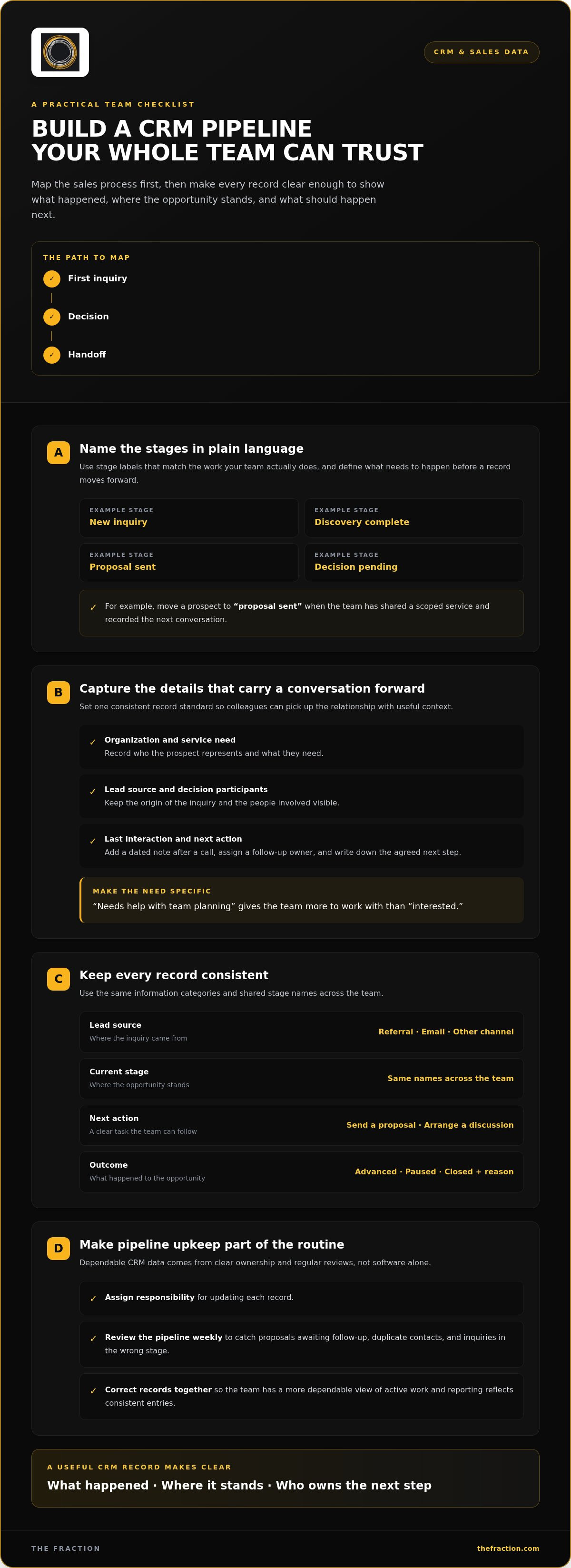
If you’re deciding how to build a sales engine for a service business, start by mapping the sales process from first inquiry through decision and handoff. Name each stage in plain language, such as “new inquiry,” “discovery complete,” “proposal sent,” and “decision pending.” Then define what moves a record forward. For example, a prospect advances to “proposal sent” when the team shares a scoped service and records the next conversation. This keeps CRM stages grounded in the team’s actual work.
Set a consistent record standard so everyone captures useful information the same way. A practical lead record might include the prospect’s organization, service need, source, decision participants, last interaction, and next action. For a consulting firm, “needs help with team planning” is more useful than “interested.” Add a dated note after a call, assign one person to follow up, and record the agreed next step. These habits give colleagues enough context to continue the conversation smoothly.
- Lead source: Record whether the inquiry came through a referral, email, or another channel.
- Current stage: Use the same stage names across the team.
- Next action: Enter a clear task, such as sending a proposal or arranging a discussion.
- Outcome: Note whether the opportunity advanced, paused, or closed, with a concise reason.
Data quality depends on ownership as much as software. Assign responsibility for updating each record, and make regular reviews part of the sales routine. During a weekly pipeline review, a manager can identify proposals awaiting follow-up, duplicate contacts, or inquiries in the wrong stage. Correcting those records gives the team a more dependable view of active work and makes later reporting more meaningful, because the figures reflect consistent entries and shared interpretations.
As you plan how to build a sales engine for a service business, make sure its operating structure can grow with the team. Before expanding sales responsibilities, clarify who directs the work and how accountability operates. The U.S. Department of Labor says worker classification under the FLSA depends on the economic realities of the relationship between worker and employer, making classification a compliance consideration as a team scales. A well-managed CRM supports clear handoffs, while thoughtful role design keeps the operating structure aligned with the sales process.
Customer service and repeat business
Service sales strategies vary with the work and the local market: a home services firm may emphasize scheduling and reliable delivery, while a consulting practice may focus on expertise and clear project outcomes. Local demand, customer expectations, and the way each service is delivered shape the right follow-up and account-management approach.
Common scaling mistakes include promising more capacity than operations can deliver, leaving customer concerns without an owner, and pursuing new leads while existing accounts lose attention. For example, if a client reports a missed project milestone, assign someone to own the issue, agree on a recovery step, and record the resolution.
Customer service influences sales after the initial agreement: a useful experience can build trust, encourage referrals, and support repeat business. Consider a bookkeeping firm that clearly explains a reporting issue and follows through on the agreed correction. The client has a reason to continue the relationship and a specific experience to describe when making a referral.
Account management gives repeat business structure instead of leaving future work to chance. After completing a project, review the client’s goals, the work delivered, and upcoming needs. A design consultancy might finish a website project, then discuss whether the client needs support with future content. Connect any additional service to a real requirement, so the client sees a practical next step rather than an unrelated pitch.
Build the relationship around a few clear service habits:
- Close the loop: After resolving a concern, summarize the outcome and confirm the agreed next step.
- Capture feedback: Ask what worked and what could improve after a completed engagement.
- Track commitments: Record promised deliverables, owners, and follow-up actions in the customer record.
- Recognize changing needs: During account reviews, connect new recommendations to the client’s stated goals.
These practices connect sales and delivery like gears. If a client repeatedly asks about the same service gap, share that pattern with the team responsible for the offer. If customers value a particular part of the engagement, make its value clearer in future sales conversations. Customer feedback can then inform both the client relationship and the way the business explains its service.
As the customer base grows, define who owns account communication and how service issues reach the right person. For example, a project lead can flag a delivery concern while an account owner coordinates the client update and records the follow-up. Clear ownership keeps important details from disappearing between sales and delivery and gives the client a more consistent experience.
For a service business refining those conversations, a sales process that feels natural can help connect client needs with relevant next steps, so growth builds on trust already earned.
Prospecting and lead generation
Define an ideal customer profile by describing the clients who benefit from your service and make the business commercially viable. Build the target market around their needs, business type, location, and buying triggers, then rank customer profiles by profitability.
For example, an IT consultancy might compare growing firms that need ongoing support with smaller businesses seeking one-off fixes. The profile becomes useful when it guides action: which prospects receive attention, what problem your message addresses, and which opportunities merit a discovery conversation.
Prospecting works best when it balances immediate demand with future awareness. The market figures here offer perspective: 5% of a market is looking to buy right now, while the remaining 95% sits outside the current buying window. The research also reports that 8 out of 10 buyers select brands they already recognize before looking for a solution.
A pipeline built only around people ready to buy can be fragile. Pair direct outreach with activities that help suitable prospects recognize a relevant problem earlier. A commercial cleaning firm, for instance, could contact facilities managers with a timely service offer while sharing useful guidance for organizations planning future facility changes.
Choose outreach based on the relationship and reach you need:
- 1:Many: Advertising, organic social, YouTube, and forums can introduce a service to a wider audience.
- 1:Few: Webinars, events, industry associations, town halls, and live quoting days create focused engagement.
- 1:1: Email, calls, and texts support direct conversations with specific prospects.
These routes work together like lanes on the same road. A webinar can introduce an approach, while a follow-up email explores whether it fits a prospect’s needs. An accounting firm might meet business owners at an industry association event, then continue with a direct conversation about their reporting challenges.
Keep prospecting focused, because unstructured activity can consume attention without advancing a sales conversation. Salespeople can spend 80% of their time on social media when their activity lacks focus. Define the audience, purpose, and next action for each channel, then review which interactions create qualified conversations.
Align marketing and sales around shared audience definitions and clear handoffs. If marketing attracts operations leaders, sales should know which message they received and what useful conversation to offer next. This continuity makes outreach feel coherent, while customer feedback can sharpen the ideal profile and show which market segments deserve more attention.
Quoting, pricing, and operational processes
A quote bridges a prospect’s problem and the work your team can deliver. For a marketing consultancy, it might specify campaign planning, deliverables, client responsibilities, and review points. Clear scope helps prospects understand what they’re considering and shows the delivery team what was promised. When the scope is vague, expectations can diverge before work begins.
Build each quote from the same core elements, then tailor the details to the prospect’s needs. Describe the outcome, included services, exclusions, assumptions, responsibilities, and next steps. A bookkeeping firm’s proposal might explain which records the client supplies and which reporting tasks the firm completes. This makes the offer easier to assess and gives both sides a shared reference during delivery.
For a service quote, the price depends on the scope and is provided after a quote request. Complexity, delivery effort, and required expertise shape the amount. Explain the basis for your recommendation in plain language so the prospect can connect the proposed work with the problem they described.
Timely quotes and clear pricing support client satisfaction and trust. A signature tool can make approval easier to manage, while configure, price, quote (CPQ) software can help produce accurate, timely quotes. The right approach depends on how the business scopes its work: a repeatable service may use standard options, while a custom engagement needs room for tailored requirements.
- Confirm the need: Record the prospect’s desired outcome and constraints before drafting.
- Define the scope: List deliverables, responsibilities, assumptions, and exclusions in clear terms.
- Check delivery capacity: Confirm the people, expertise, and schedule required for the proposed work.
- Set the next step: Explain how the prospect approves, asks questions, or moves into onboarding.
What sales process and follow-up cadence turn service-business leads into clients? Move from inquiry to discovery, tailored quote, prospect questions, decision, and onboarding, with a clear next action at every stage. Follow up after meaningful events, such as sending a proposal or receiving a prospect’s question, and make each message useful to the decision.
Operational handoffs complete the system. When a prospect accepts a proposal, pass the approved scope, commitments, and client context to the delivery lead. A consulting team, for example, can use a kickoff checklist to confirm goals, access, responsibilities, and milestones. The sales team can see whether the promised work has entered delivery, while operations can begin with the expectations the prospect approved. This connection helps protect the client experience as sales activity grows.
Reporting and conversion-rate analysis
A sales report is useful when it shows where opportunities move, stall, or disappear. Treat it like a control panel, with each measure tied to a decision. Tracking inquiry volume alone shows activity, but comparing inquiries with discovery conversations reveals whether prospects take the next step. A useful report makes that difference visible and gives the team a clear place to investigate.
Start with the stages already used in the sales process: inquiry, discovery, proposal, decision, and closed opportunity. Track how many opportunities enter and leave each stage, then compare conversion between adjacent stages. To calculate proposal conversion, divide accepted proposals by proposals sent and express the result as a percentage. Keep stage definitions consistent so “proposal sent” means the same thing for every salesperson and reporting period.
Conversion rates help locate bottlenecks, but the number alone rarely explains the cause. If discovery conversations progress while proposals often stall, review proposal clarity, scope, timing, and the prospect’s decision process. If inquiries rarely become conversations, examine lead relevance, response ownership, and the first message. The weakest stage points to a question to investigate, not an automatic instruction to increase activity.
A balanced sales dashboard can show the quantity, speed, size, and conversion rate of opportunities. Quantity describes pipeline volume; speed shows how opportunities progress; size indicates the value of potential work; conversion reveals movement between stages. A consultancy might compare proposal progress with typical project scope, then investigate whether delays occur during approval or after a particular type of inquiry.
- Volume: Count inquiries and qualified opportunities by source.
- Speed: Track time spent in each stage, using consistent date fields.
- Size: Compare opportunity value by service type or customer profile.
- Conversion: Review the share progressing from inquiry to discovery, proposal, and agreement.
Review the dashboard regularly with people who understand the work behind the figures. A sales lead can bring stalled proposals, an operations lead can explain delivery constraints, and marketing can clarify which campaign generated inquiries. Together, they can choose a specific adjustment, such as revising a discovery question or clarifying a proposal, then observe what changes in the next reporting cycle.
Record the decision alongside the metric so the team remembers why the process changed. If a consulting firm revises its proposal format, note when and why, then compare subsequent proposal progress. Regular analysis helps identify which sales strategies work and where improvement may be needed. Consistent interpretation also prevents one unusual opportunity from steering the entire system.
The Fraction: Automated & AI lead generation systems
The Fraction helps service businesses strengthen the path from prospect interest to a client relationship with automated, AI-driven lead generation systems. When lead flow needs more structure, these systems support client acquisition, while a compelling offer gives prospects a clear reason to engage.
The next pieces matter just as much: a sales process that doesn’t feel like selling, and a service shaped around what the right clients value. Together, they connect outreach to an offer and a relevant conversation, rather than a disconnected push for a sale.
If you’re ready to bring lead generation and client conversion together as one system, contact The Fraction to discuss your next step.
Make your next sales improvement deliberate
Understanding how to build a sales engine for a service business gives you a framework, but progress comes from choosing the next change carefully. Treat the engine like a working blueprint: identify where prospects lose momentum, decide what the team can improve, and give that change enough attention to learn from it. A focused adjustment to the offer, handoff, or sales conversation can create a clearer path for prospects and the people serving them.
The Fraction can help you create a more coherent approach to generating leads and converting them into clients. If your next step is to strengthen the connection between your offer and sales process, start a conversation with The Fraction.
Build with intention, learn from each conversation, and let a stronger system support the work you do best.
Frequently Asked Questions
What is a Sales Engine?
A sales engine is working well when a prospect’s experience stays coherent as responsibility passes between people and systems. Try a simple continuity test: if the person who handled the first conversation is away, can a colleague understand the opportunity and take the right next step? Clear records of context, commitments, and ownership help the business keep conversations moving and maintain a consistent client experience.
What are the core components of a sales engine for a service business?
The core components need clear ownership and reliable connections, so each contributes to the same commercial goal. Assign responsibility for the prospect experience, offer decisions, delivery capacity, and performance reviews. For example, if sales identifies a recurring client need, someone should decide whether the service offer needs to change. These connections make the system easier to manage as people join or responsibilities shift.
How do service businesses generate and qualify leads consistently?
Consistent lead generation starts with a shared qualification standard that helps the team distinguish a promising fit from a conversation that needs more discovery. Consider the prospect’s business problem, access to a decision-maker, urgency, and whether your team has the expertise to address the need. A brief qualification note after each conversation can capture these signals and help the team compare lead sources by the quality of opportunities they produce.
What sales funnel stages and conversion metrics should a service business track?
Choose clearly defined metrics and review them by service type or lead source to keep comparisons useful. For example, distinguish a referral opportunity from a campaign inquiry, then record why each opportunity advanced or stalled. This context can reveal whether a pattern relates to the audience, offer, or decision process. Keep measurement rules consistent across reporting periods and use the findings to choose one process question to review.
How should a service business price and package its services to improve sales?
Make packages easy to compare by explaining what each engagement is designed to accomplish and where its boundaries lie. A consulting firm might offer a defined starting engagement, then describe optional work that addresses needs beyond that scope. Explain how changes to deliverables affect the engagement, and connect the proposed fee to the expertise and work involved. This gives prospects a clearer basis for choosing the right level of support.
Which CRM and sales automation tools are best for small service businesses, and what do they cost?
The best CRM and automation setup fits your team’s workflow and can grow without making routine work cumbersome. Compare contact management, task automation, reporting, data export, integrations, user access, and support. Total costs depend on subscription structure, seats, implementation, and connected tools. Before choosing, test a typical workflow, such as routing a new inquiry and preparing a useful follow-up task, to see whether the system suits daily operations.
How can a service business build referrals, reviews, and repeat business into its sales engine?
Make referrals and reviews a deliberate part of moments when clients can describe the value they received. After a successful milestone, ask for specific feedback about the work and permission to share an honest review. For referrals, explain the type of client you can help and make an introduction easy. Record these conversations, then revisit client goals during renewal or planning discussions to identify relevant future work.


