

Enterprise leads come from a system built around the right decision-makers, a clear reason to talk, and follow-up that can carry a relationship forward. A lead generation system for engineering firms should connect targeted outreach with qualified appointment setting and a compelling offer, so EPC teams can start relevant conversations instead of collecting names that lead nowhere. Engineering sales cycles can last from 3 to 18 months, so the system also needs to keep prospects engaged beyond the first meeting.
If you’re responsible for growth, you know complex engineering projects depend on trust, technical credibility, and patient relationship-building. A lead generation system for engineering firms creates a repeatable path to those conversations while long buying processes unfold, instead of relying on referrals or sporadic outreach to fill the pipeline.
This article explains how to reach engineering decision-makers, qualify enterprise opportunities, and shape campaigns around a longer sales cycle. It also outlines what to assess when choosing a lead generation partner, so you can distinguish a coordinated system from activity that creates noise without moving good-fit prospects toward a meeting.
Key Takeaways
- Map the buying roles, project triggers, and proof points that matter to your ideal accounts, then build follow-up to sustain relationships through a complex sales process.
- Use LinkedIn outreach to open relevant conversations with engineering decision-makers, and qualify interest before moving toward an appointment.
- Shape outbound campaigns around clear account fit and tailored messaging, measuring qualified meetings and opportunity progress rather than raw lead volume alone.
- Assess campaign performance across outreach, engagement, appointments, and pipeline movement so you can refine the system as longer pursuits develop.
- When choosing an agency, look for a connected approach to targeting, offer development, appointment qualification, and ongoing campaign improvement.
Engineering firms’ long sales cycles and complex buying processes
Engineering pursuits can stretch across multiple planning and approval stages, so a CRM and marketing automation platform can help keep account activity connected. Engineering sales cycles may last from 3 to 18 months, while some pursuits run two to three years, making pipeline development more like tending a long project than closing a quick transaction.
Sales-Cycle Length and Pipeline Development
Build the pipeline around the prospect’s project timing, decision roles, and next useful action, because an early conversation can happen long before procurement begins. Engineering capital-project sales cycles can last 12 to 24 months, so track each account’s stage and movement rather than treating one meeting as proof of an immediate sale.
For each target account, record the project need, relevant stakeholders, current status, and agreed follow-up. A prospect waiting for a company to accept bids may need continued nurturing, while a team evaluating design support may be ready for a technical discussion. These distinctions help your team separate active opportunities from leads that are still developing.
Prospect Nurturing and Automated Outreach
Manufacturing sales cycles can last up to 18 months, so consistent, relevant engagement matters more than a sudden burst of messages. Use a marketing automation platform to schedule tailored follow-ups, then align each touch with the prospect’s project stage, whether they’re planning, budgeting, or preparing to accept bids.
Let automation maintain a consistent cadence while people provide judgment and context. A nurture sequence might share a relevant case study, ask whether project timing has changed, and route replies to the right sales owner. Before sending the next scheduled message, review recent engagement so the communication reflects the prospect’s situation rather than running on autopilot.
Follow-Up with Sales-Ready Leads
When a lead is actively seeking help, a response within about 30 minutes can support an immediate scheduling reply; a response within about 5 business hours is usually described as acceptable. Assign an owner and alert them when a prospect requests a conversation, so the inquiry has a clear route instead of sitting in a shared inbox.
Make the handoff simple: capture the project need, identify the right contact, and propose a relevant next step. If a prospect raises an engineering challenge, address it directly and suggest a focused discussion. Record the response and meeting outcome in the CRM, then use those details to improve follow-up across the pipeline.
LinkedIn outreach to engineering decision-makers
Define ideal clients by project type, technical need, geography, and buying role, then use that profile to guide LinkedIn outreach. Focus on organizations where your engineering capabilities address a clear operational or capital-project challenge, giving each conversation a relevant reason to connect.
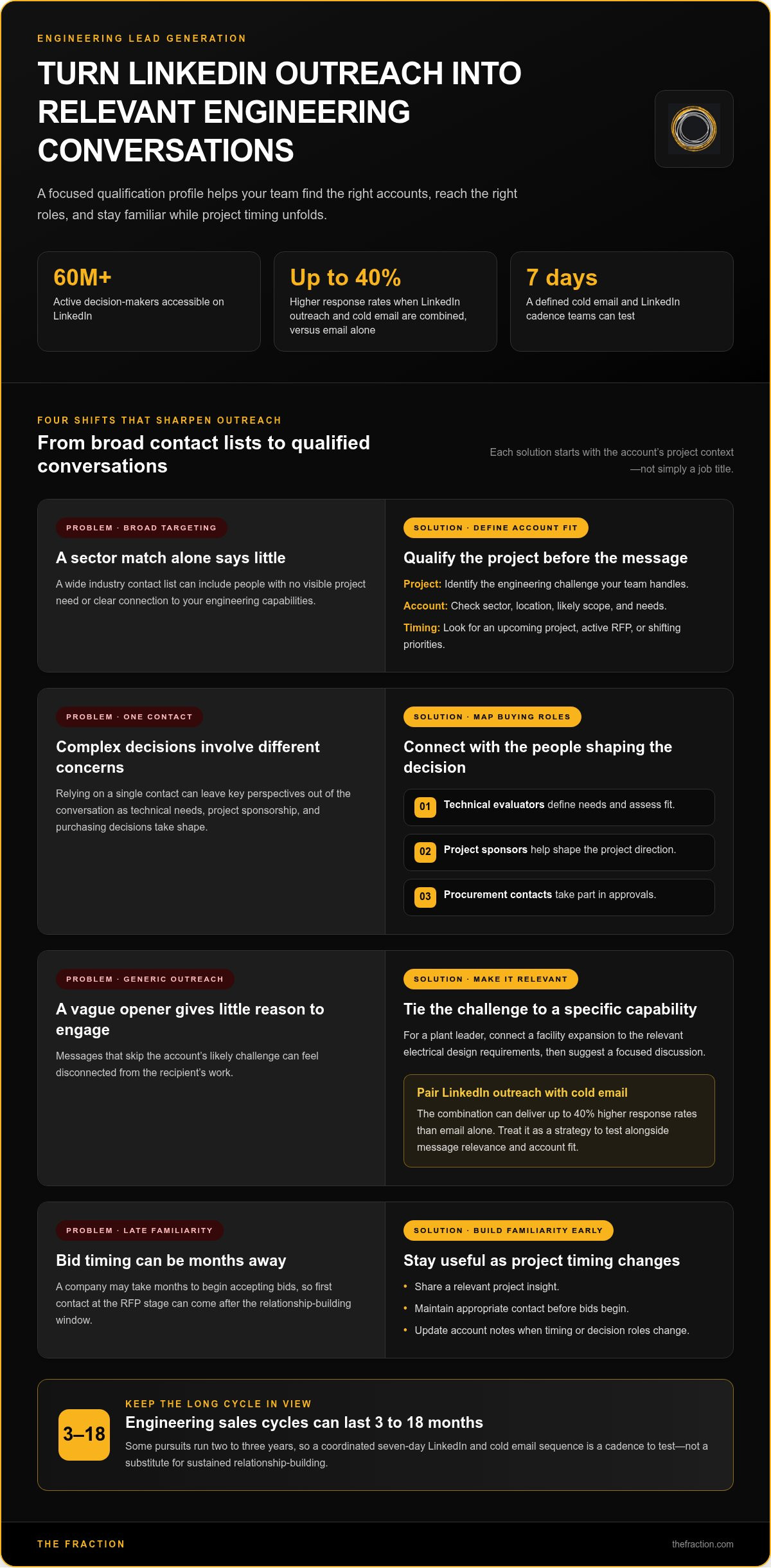
LinkedIn offers access to over 60 million active decision-makers, making account selection a useful first move. Identify target organizations, then map the leaders who define needs, evaluate technical fit, and approve projects, because each role brings a different concern to a complex buying process.
Build a practical qualification profile before contacting prospects:
- Project fit: Specify the engineering challenge your team handles, such as electrical design for a facility upgrade.
- Account fit: Prioritize organizations whose sector, location, likely project scope, and needs align with your capabilities.
- Buying roles: Identify technical evaluators, project sponsors, and procurement contacts who shape the decision.
- Timing: Note signs of an upcoming project, an active RFP, or a shift in operational priorities.
This profile helps distinguish qualified prospects from broad industry contacts. A facilities leader at a manufacturer planning an expansion, for example, may be a stronger match than an engineering executive with no visible project need. Tailor the message to the account’s context and the contact’s role.
LinkedIn outreach and cold calling can reinforce each other, with a message establishing context before a call clarifies whether a project is active and who else participates. Combining LinkedIn outreach with cold email can deliver up to 40% higher response rates than email alone, making coordinated channel use one strategy to test alongside message relevance and account fit.
Make the opening specific: connect a likely challenge to a relevant engineering capability, then suggest a focused discussion. A message to a plant leader, for example, could refer to a facility expansion and ask how the team is approaching electrical design requirements. Relevant details show why the conversation may matter to the recipient’s work.
RFP timing rewards preparation. A company may take months to begin accepting bids, so use LinkedIn to build familiarity beforehand: share a project insight, maintain appropriate contact, and update account notes as timing or decision roles change.
A seven-day cold email and LinkedIn sequence gives teams a defined cadence to test. Coordinate the touchpoints, personalize each message, and route replies into a timely follow-up; for a sharper bridge from outreach to a compelling offer, explore how to sharpen your offer.
Outbound lead generation and appointment setting
Outbound gives an engineering firm a deliberate route from a carefully selected account to a useful sales conversation. Strong campaigns connect account fit, relevant messaging, and clear meeting criteria. Each contact should bring a suitable prospect closer to a conversation your sales team can act on.
Outbound Lead Generation
Start with accounts that fit your capabilities, then build outreach around the problems those organizations may be working through. For example, an engineering firm serving manufacturers could prioritize companies with more than 100 employees, then research which operational or facility challenges match its expertise. That groundwork keeps the campaign focused on potential project fit instead of a large list of names.
A five-step cold email sequence delivered over 25 days gives your team a defined cadence to test. Each message can bring a fresh reason to engage, such as a relevant project insight, a question about current priorities, or a concise explanation of the challenge your team solves. Track replies and qualified conversations along the way, then use what prospects say to refine the next campaign.
Manufacturing opportunities can involve several stakeholders, each with a different perspective. An operations contact may identify an efficiency issue, an engineering leader may assess the technical approach, and procurement may guide the buying process. Record each role and its input so the sales team has a useful account picture before moving the conversation forward.
B2B Appointment Setting
B2B appointment setting turns a prospect’s response into a purposeful meeting, and the qualification beforehand shapes whether that conversation can move an opportunity forward. Clarify the organization’s project need, the contact’s role, and the reason for meeting; for a manufacturer, that might mean understanding whether a facility upgrade is under consideration and which technical lead should join.
A qualified appointment has a clear purpose, relevant participants, and an agreed next step, so share the account’s outreach history and stated need with the sales team before the meeting. Afterward, record the outcome while the details are fresh. Those handoff notes give an engineering partner a stronger starting point and keep discovery from circling back over information the prospect has already shared.
Appointment setting also creates a practical feedback loop for campaign development. If manufacturing prospects respond to a message about a particular operational challenge, compare that engagement with meeting quality and project fit. If booked conversations repeatedly involve contacts without an active need or influence, refine account criteria and qualification questions before expanding outreach.
Keep the process connected from first contact through meeting follow-up. A prospect’s response, context, and agreed next step all belong to the same sales journey. A CRM preserves that thread, while regular reviews reveal which accounts are advancing and which messages are leading to substantive conversations.
Performance-driven lead generation campaigns
Measure campaign activity against qualified opportunities and revenue progress. For engineering firms, reporting should connect each channel to the accounts reached, meetings held, and next steps recorded.
Multichannel Email and LinkedIn Campaigns
Email and LinkedIn can work together, with each touch adding context rather than repeating the same pitch. A campaign might introduce a project-specific insight by email, then use LinkedIn to share a relevant technical perspective or continue the discussion.
Engineering firms can compare account engagement across both channels and adjust messaging around actual replies. The market reports expected cold email performance of 45% open rates and 3.2% reply rates for engineering firms. Treat these as reference points for reviewing campaign performance, alongside the quality of replies and resulting opportunities.
Campaign Reporting and Analytics
A useful report shows how each campaign moves accounts from initial contact toward a sales conversation. Track delivered messages, replies, qualified meetings, opportunity status, and revenue outcomes, then review the same measures consistently across campaigns.
If email opens rise but qualified meetings remain flat, examine the offer, targeting, and call to action. If a prospect engages on LinkedIn after an email, record both interactions against the account. This shared view helps the sales team understand channel contributions across a long pursuit.
Lead Generation Costs and Benchmarks
Lead generation costs depend on campaign channel, targeting depth, audience fit, and the level of qualification required. Compare proposals by what qualifies as a lead or meeting, what work is included, and how results are reported, rather than judging by lead volume alone.
For performance context, the market reports that paid account-based marketing campaigns may generate enterprise meetings within 30 to 60 days. That gives firms a timeframe to assess against their own campaign goals, while cold email benchmarks provide another reference. Measure the actual cost per qualified opportunity using your campaign spend and resulting qualified opportunities.
Lead Qualification, Scoring, and Tracking
Score leads against practical fit signals: project need, technical relevance, account suitability, decision role, and timing. An account with an active project and a relevant engineering challenge should receive higher priority than an early-stage contact with no defined need.
Record each qualification signal, source channel, meeting outcome, and next action in the CRM. Review scores with the sales team as opportunities develop, since an account may become more relevant when project timing or stakeholders change. Consistent tracking turns campaign data into decisions about targeting, follow-up, and revenue potential.
For US email outreach, build campaign controls around accurate sender identification, truthful subject lines, clear opt-out handling, and careful management of collected lead data. Document data sources and suppression requests in the platform to apply these safeguards consistently.
Choosing an engineering lead generation agency
Choose a partner that connects targeting, outreach, qualification, and reporting in one operating system. The key test is whether its process fits your engineering services, buying roles, and project timelines.
To build a lead generation system, define ideal accounts, clarify the offer, select channels, establish lead criteria, and track each prospect through the pipeline. Review campaign performance and sales feedback together, then refine targeting and messaging as opportunities develop.
Common risks include prioritizing raw lead volume over fit, sending generic messages, and leaving follow-up ownership unclear. Long engineering pursuits also complicate attribution, so record account activity and sales outcomes throughout the buying process.
Evaluate the Agency’s Operating Model
Ask how the agency defines a qualified lead, what information it gathers before booking a meeting, and how it hands prospects to your sales team. A manufacturing prospect with an active facility project needs a different conversation from an early-stage contact gathering general information.
Review account-manager capacity as well. Traditional agencies may serve 20 to 80 clients per account manager, which can affect the attention available for account research, message refinement, and campaign reviews. Ask how the work connects to your technical expertise and who handles campaign decisions.
Assess Fit, Reporting, and Ownership
A strong agency process makes responsibilities clear: who selects accounts, approves technical claims, responds to interested prospects, and records outcomes. For example, your engineering lead could review technical messaging while the sales owner follows up on meeting requests.
Check whether reporting connects activity to business outcomes. Open rates and contact counts alone provide a narrow view; review qualified conversations, meeting outcomes, opportunity progression, and revenue attribution together. For inbound and outbound activity, clarify how sources are separated and each channel’s contribution is reported.
Use a focused evaluation process: share a representative account profile, review a sample campaign approach, and discuss how feedback changes targeting. This shows whether the partner can understand complex engineering services and adapt as prospect needs or project timing shift.
Before increasing activity, align on the offer and the audience it serves. If prospects respond but struggle to see why a conversation matters, sharpen the value proposition before expanding the campaign. If qualified opportunities are active, clarify handoffs and follow-up so interest continues moving forward.
Choose the agency whose operating model supports your team’s actual sales process, rather than the one promising the broadest reach. Clear definitions of fit, ownership, and progress give both sides a practical basis for improving results.
The Fraction: Automated & AI lead generation systems
The Fraction helps engineering firms build a deliberate path from target account to qualified conversation, combining automated and AI-powered lead generation systems with a sales process that doesn’t feel like selling. When outreach creates activity but the offer is difficult to explain, a stronger service proposition can give prospects a clearer reason to engage.
Think of the system as connected infrastructure: the offer sets direction, outreach opens the door, and follow-up carries the conversation forward. The Fraction helps develop a compelling offer and service that wins clients quickly, alongside lead generation designed for a complex sales process.
If your firm is ready to reach engineering decision-makers more consistently, contact The Fraction to discuss building your lead generation system.
Build the Next Stage of Your Growth
The next stage for a lead generation system for engineering firms is turning campaign insights into a durable operating rhythm. Choose a target segment, agree on the signals that make a prospect worth pursuing, and assign one owner to move each opportunity forward. That clarity helps your team maintain momentum as priorities shift.
Treat the next campaign as a disciplined test: set a clear objective, capture what prospects respond to, and use those conversations to refine your offer and follow-up. A steady feedback loop helps your growth strategy improve while keeping sight of the complex relationships engineering work depends on.
With a clear next move and shared ownership, your team can build a stronger foundation for future opportunities. Keep refining the system, and let each useful conversation sharpen the path ahead.
Your expertise deserves a clear route to the right decision-makers. Take the next step with confidence.
Frequently Asked Questions
How can EPC Firms generate enterprise leads?
EPC firms generate enterprise leads by building a named-account plan around project fit and buying activity. For each target company, identify the business unit facing a capital or operational need, then map technical evaluators, budget owners, and procurement contacts. Give each role a distinct reason to engage, such as a relevant project example for engineers and a delivery-risk perspective for executives. Track bid timing and stakeholder changes at the account level.
How do I get more Engineering leads?
Make your expertise easier for potential clients to recognize and act on. Publish focused insights about a specific engineering challenge, then connect those insights to relevant project examples and a clear next step on your website. SEO and organic thought leadership can take 6 to 12 months, so plan for sustained publication and measure inbound inquiries and qualified conversations rather than expecting an immediate pipeline shift.
What is a lead generation system for engineering firms?
A lead generation system for engineering firms is a connected process for identifying suitable accounts, giving them reasons to engage, capturing interest, and moving promising prospects toward sales conversations. It may combine outreach, website content, a CRM, and clear follow-up responsibilities. For example, a technical article may attract a facilities leader, while a defined handoff ensures the inquiry reaches the right person with its project context intact.
Which lead generation channels work best for engineering firms?
The right channel mix depends on how buyers discover expertise and when they begin evaluating providers. LinkedIn and email support direct account outreach, while a useful website, case studies, and technical thought leadership help prospects assess fit independently. Webinars can also reveal engagement through questions and participation. Compare channels by the qualified conversations and opportunities they contribute, then invest in the mix that reaches your intended buyers.
How can engineering firms measure lead generation ROI and conversion rates?
Measure ROI by comparing attributable revenue with campaign investment, using a consistent attribution method throughout the sales cycle. Calculate each conversion rate by dividing the number that advance to a stage by the number entering the previous stage. For example, track qualified inquiries that become meetings, then meetings that become opportunities. Review results by campaign and account cohort, since long pursuits can make immediate channel comparisons misleading.


