

The cost of inaction in client acquisition is the opportunity a business gives up by delaying improvements to how it reaches potential clients. Manual work can keep a team busy while promising conversations wait for attention. The key question is where that lost time is holding back your next client.
Admin can seem like a small drag on the day, but delays accumulate and make the process harder to manage. This article explains what inaction means for client acquisition, how manual work can leave prospects unreached, and how to assess the impact on your business. It also covers signs of a bottleneck, so you can decide what needs attention and build a more deliberate path forward.
Key Takeaways
- Trace how manual admin, slow follow-up and fragmented information can leave potential clients unreached, even when your team is working hard.
- Assess inaction as more than a lost sale: consider the time, productivity and decision-making capacity tied up in inefficient processes.
- Use your own lead flow, response patterns and conversion data to estimate missed opportunities and identify where prospects fall away.
- Recognize how delays can compound over time, affecting profitability and making growth harder to sustain.
- Prioritize the bottleneck with the greatest business impact, then consider whether a more structured acquisition system could help address it.
Lost opportunities when staff spend time on manual work
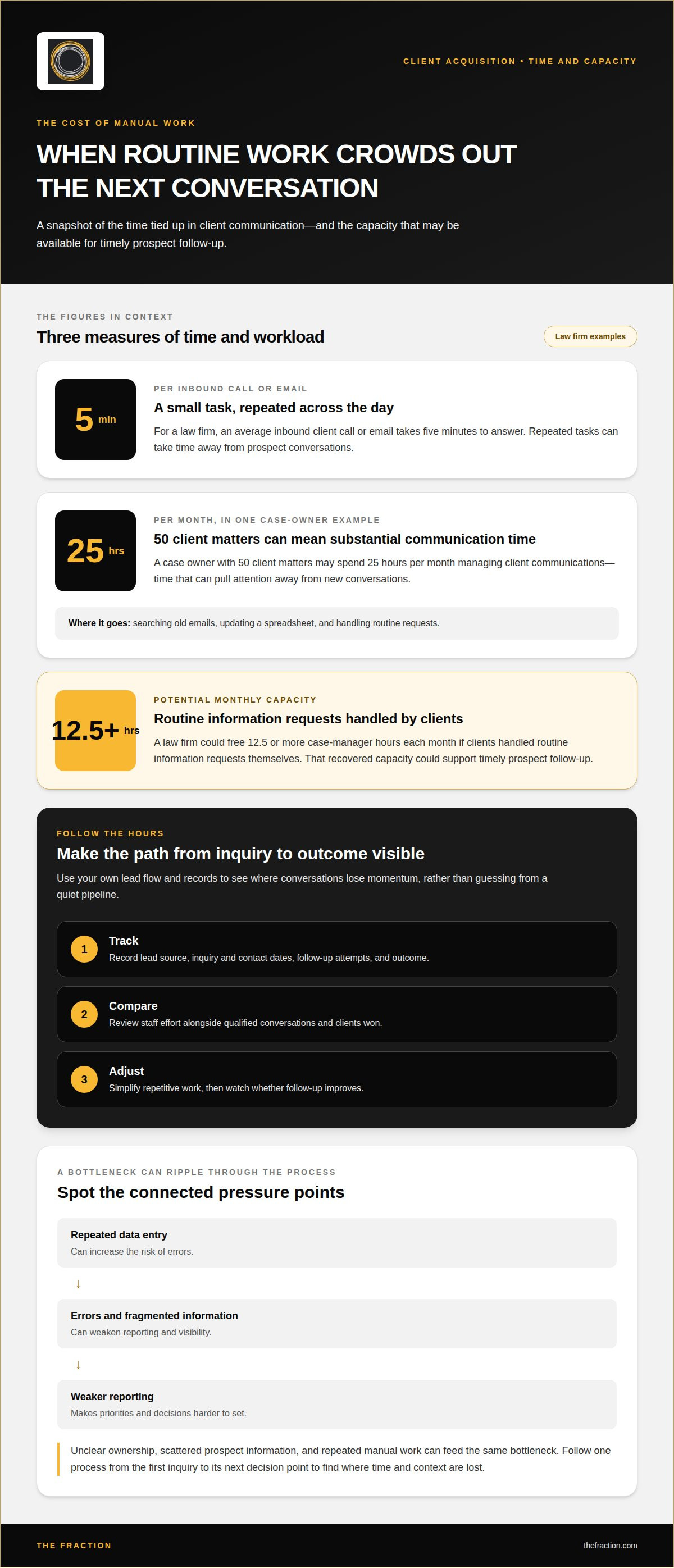
Every repeated task takes time away from the calendar and can crowd out prospect conversations. For a law firm, an average inbound client call or email takes five minutes to answer.
Which client acquisition strategies offer the best return on investment? Prioritize approaches that connect you with suitable prospects and support consistent follow-up. Compare lead quality, clients won, and staff effort to see which activities are earning their place.
How can businesses reduce client acquisition costs and measure results? Identify repetitive steps that delay prospect contact, then simplify or automate appropriate tasks. Track lead source, follow-up, conversion, and staff effort together to see whether a change is helping.
A case owner with 50 client matters may spend 25 hours per month managing client communications. That’s a sizeable block of time, and it can pull attention away from new conversations. Picture a prospect waiting for a useful reply while the same staff member searches old emails, updates a spreadsheet, and handles routine requests. The hours add up, but so do the opportunities waiting on the other side.
Revenue Loss from Delayed Acquisition
Revenue loss from delayed acquisition is business that slips away while a prospect waits for the next useful step. The delay matters because a warm inquiry can cool while staff handle work that keeps them away from active opportunities. A law firm could free 12.5 or more case-manager hours each month if clients handled routine information requests themselves. That recovered capacity could support timely prospect follow-up.
Think of it as a doorway with a queue: when the team is occupied elsewhere, the next conversation has to wait. Review which duties consume staff time, then distinguish necessary client care from repetitive communication. This helps protect service quality while creating a clearer route for new opportunities.
Estimating Missed Leads and Sales
Estimate missed leads by comparing inquiries received with prospects contacted, followed up, and converted. This shows where the process loses momentum instead of leaving you to guess from a quiet pipeline. Record inquiry dates, response dates, follow-up attempts, and outcomes, then look for recurring delays before prospects disengage.
Keep those records consistent and review them together. If inquiries have no assigned next step, that signals a process gap. If follow-up happens but prospects still leave, examine fit and offer clarity. The cost of inaction is easier to assess when you can see where staff time goes and which conversations receive attention.
- Track: Record lead source, contact dates, follow-up, and outcome.
- Compare: Review staff effort alongside qualified conversations and clients won.
- Adjust: Simplify repetitive work, then watch whether follow-up improves.
Meaning of cost of inaction
The cost of inaction can show up as several business pressures arising from one unresolved process. In client acquisition, unclear ownership, scattered prospect information, and repeated manual work can feed the same bottleneck. A delayed decision may leave the next person without the context or authority to act, spreading the strain across the process.
For example, a professional-services firm may add tools as its work grows while teams continue using separate records. One group updates prospect details in a spreadsheet, another keeps notes in email, and a manager assembles reports by hand. Each task may seem manageable alone, but together they make the pipeline harder to understand and decisions slower.
What are the costs of inaction for small businesses versus larger companies? A small-business owner may spend time coordinating prospects instead of building client relationships. A larger company may face duplicated information, siloed teams, or reports that arrive too late to guide decisions. The impact lands in different places, but either can lose capacity and clarity.
Consider these effects as connected issues, not separate complaints. Repeated data entry increases the risk of errors; errors weaken reporting, and weak reporting makes priorities harder to set. Limited visibility can also leave key deliverables overlooked. Tedious work may affect staff satisfaction and contribute to turnover, bringing additional hiring and training demands.
A useful way to assess the situation is to separate the impact into three lenses:
- Hard costs: Consider measurable efficiency gains, system consolidation, and reduced cost overruns.
- Cost avoidance: Identify re-entry errors, visibility gaps, and work lost between siloed teams.
- Quality: Examine reporting consistency, decision-making data, and how well information supports decisions.
Choose one process and follow it from the first inquiry to its next decision point. Note where information changes hands, staff recreate work, or a manager lacks a clear view. This simple map gives leaders a solid basis for weighing the issue against its effects on growth and day-to-day execution.
The effort involved in improving a process depends on its scope, current systems, and the work required to make the change; a quote gives the exact figure for your case. If the challenge also involves making your value clear, a more compelling offer can help prospects understand what you deliver. A focused client acquisition strategy can bring that offer and its process into closer alignment.
The cost of inaction includes business and opportunity costs when organizations delay technology and business-innovation improvements needed to keep pace with growing complexity.
How much revenue can a business lose from delayed client acquisition?
Delaying client acquisition improvements can reduce revenue when qualified prospects go unreached or demand weakens before a decision. The impact depends on missed clients, average client value, conversion, and timing, so a single figure would be misleading.
A law firm growth example shows how acquisition needs can outpace its current pipeline. A firm seeking growth may need to bring in more cases than its current pipeline can support. That target makes the gap visible: if inquiries arrive inconsistently or follow-up stalls, the firm risks falling short of planned growth.
Referrals can also reveal opportunity costs. Case Status estimates healthy firms can source at least one-third of new clients from happy-client referrals, while firms are more likely to average less than 10% of new business from referrals. In the example, that difference amounts to 200 new clients that may not be realized next year. The comparison illustrates potential, rather than a guaranteed result for every firm.
Client retention adds another layer to the calculation. A Case Status survey estimates consumer-based firms experience 2-5% case churn before completion. Those figures describe the case-churn example, so apply them only where that context fits.
To estimate your exposure, connect acquisition activity to business outcomes rather than relying on a headline number. Review these inputs together:
- Unreached prospects: Count inquiries without a completed response or follow-up.
- Conversion: Compare qualified inquiries with clients won over the same period.
- Client value: Use your own revenue records to assess what a typical acquired client contributes.
- Timing: Note when prospects disengage and whether delayed contact preceded that outcome.
For example, if inquiries at a professional-services firm repeatedly stall after an initial conversation, the team can compare follow-up completion with later client wins. This helps distinguish a lead-volume issue from a process issue. It also gives decision-makers a practical basis for prioritizing changes instead of treating every missed opportunity as equal in value.
The cost of inaction becomes clearer when a business compares its growth target with actual acquisition, referral contribution, and churn. Use the organization’s own records, consistent time periods, and clear definitions of qualified leads and won clients. A missed opportunity then becomes a trackable business signal rather than a vague frustration.
Assessing the cost of inaction can clarify why a business needs to act and where to focus. Tie the assessment to the specific acquisition problem rather than treating every gap as identical. The aim is to identify the reason for action and the area that needs attention.
What are the main risks of delaying investment in client acquisition?
Delaying improvements can compound operational problems and reduce productivity and profitability over time. For example, a growing consultancy may assign inquiries through email while staff also maintain separate spreadsheets. Each additional handoff creates another chance for ownership or follow-up to become unclear, allowing the delay to spread across the acquisition process.
Limited access to decision-making information is another risk. If a manager cannot see which inquiries received follow-up, they may mistake a quiet pipeline for weak demand. A weekly report assembled manually may also arrive after the team has decided where to focus. Better visibility helps leaders distinguish low lead volume from a stalled process.
Manual work can create bottlenecks and reduce job satisfaction. When skilled staff repeatedly search email for documents or re-enter prospect details, routine tasks crowd out more engaging work. If this contributes to turnover, the business faces added hiring and training demands, while remaining staff absorb handoffs and unfinished work.
Inconsistent records can also create quality costs. A proposal team, for instance, might rely on an outdated prospect detail copied into a shared spreadsheet. Limited transparency can leave key deliverables overlooked, while siloed teams may each hold only part of the client picture. The resulting rework harms the prospect experience and makes reporting less dependable.
For contractors and engineering, procurement, and construction management firms, inefficient systems can obscure billable items, transactions, or progress draws under cost-reimbursable or fixed contracts. In client acquisition, a similar visibility gap can disconnect a completed prospect conversation from its next commercial step. The specific risk varies by business, but the underlying issue is missing or delayed information.
These risks can be assessed through three practical lenses:
- Productivity: Identify manual tasks that interrupt prospect follow-up or delay reporting.
- Decision quality: Review whether leaders can access consistent pipeline information when making priorities.
- Cost avoidance: Look for re-entry errors, siloed information, overlooked deliverables, and repeated work.
Connect each issue to a measure in the action plan. A business might track reporting consistency, data quality, follow-up completion, or recurring process errors. These indicators show whether a change addresses the bottleneck instead of merely moving work into another spreadsheet. A clear measure also helps teams compare progress with the business goal the change supports.
The central risk is cumulative: a small process gap can lead to lower visibility, delayed decisions, rework, and reduced staff capacity. Map one acquisition handoff from the initial inquiry to the next decision to find where information, responsibility, or momentum breaks down. This gives leaders a concrete place to focus improvement.
How can businesses estimate lost leads and missed sales opportunities?
Start with the acquisition path, from the first inquiry through the client’s decision. Map each handoff and record where prospects stop progressing. For example, a prospect may request information, receive a delayed reply, and never book a conversation. That sequence points to a process gap; a total lead count alone cannot explain it.
Next, separate observable facts from assumptions. Count inquiries received, follow-ups completed, conversations held, and clients won over the same period. Use consistent definitions so a qualified inquiry means the same thing across reports. If one team counts every form submission and another counts only suitable prospects, their conversion figures describe different pipelines.
Then review records for patterns. Look for inquiries without a recorded next step, repeated delays, or unclear ownership. Compare those cases with prospects who progressed. Reviewing email and tracking records can reveal whether missing information, slow handoffs, or inconsistent follow-up tends to appear before a lead goes quiet.
- Define the stages: Specify what counts as an inquiry, qualified lead, active conversation, and won client.
- Set the period: Use matching reporting periods to compare activity and outcomes fairly.
- Find drop-offs: Identify stages where prospects stop advancing and examine the associated records.
- Prioritize action: Focus first on issues or opportunities that would cost the most if left unaddressed.
Estimate potential revenue using your own client-value and conversion records. At each stalled stage, compare prospects who progressed with those who disengaged. Treat the difference as a reason to investigate, not proof that every disengaged prospect would have become a client. The estimate is more useful when assumptions are visible and applied consistently.
Track operational measures alongside sales outcomes. Key performance indicators can show progress toward action-plan goals. For example, review follow-up completion, response patterns, reporting consistency, and conversion by lead source. If follow-up improves but conversion does not, investigate lead fit or offer clarity.
Also assess costs that revenue totals may miss. Hard-cost measures include efficiency gains, asset reductions from consolidating systems, and fewer cost overruns. Cost-avoidance measures include re-entry errors, limited visibility, and siloed teams. Quality measures include reporting consistency, decision-making data quality, and substantiated vendor information. Together, these lenses show whether a process change improves more than one area of the business.
Summarize the findings concisely: name the bottleneck, show the evidence, state the potential impact, and assign an owner. This turns an estimate into a decision tool. Regular KPI reviews then show whether the chosen action is advancing the business’s acquisition goals.
The Fraction: Automated & AI lead generation systems
The Fraction helps professionals address acquisition bottlenecks with automated and AI lead generation systems, a sales process that doesn’t feel like selling, and a compelling offer and service designed to win clients quickly.
If manual follow-up is consuming time, prospects are slipping through gaps, or your offer is difficult to explain, these systems and sales foundations can create a more deliberate path from first interest to a client conversation. The right starting point depends on where your process breaks down: reaching suitable prospects, communicating value, or moving conversations forward.
For a more deliberate approach to client acquisition, contact The Fraction.
Make client acquisition a deliberate business priority
Give client acquisition the same strategic attention as delivery, finance, and operations. A growth plan needs a consistent operating rhythm behind it. Choose one acquisition priority, assign clear ownership, and make progress visible in leadership conversations. This builds a practical bridge between the prospects you want to reach and the work your team can reliably support.
The cost of inaction in client acquisition is easier to manage when decisions are made early and reviewed consistently. Your process can evolve as your offer, audience, and capacity change, so treat it as a working part of the business rather than a one-time fix. Make a considered change, observe what shifts, and use what you learn to guide the next decision.
If you’re ready to shape a more deliberate approach around your business and its priorities, start a conversation with The Fraction.
Progress starts with a clear decision and the willingness to build from it. Create a more focused path forward, one thoughtful improvement at a time.
Frequently Asked Questions
What is the Cost of Inaction?
The cost of inaction is the value a business gives up by delaying a necessary decision or improvement. It can include missed opportunities, wasted staff capacity, errors, and slower decisions. For example, if a firm delays clarifying who owns incoming inquiries, prospects may wait while employees assume someone else will respond. Identifying the specific delayed decision helps separate practical costs from general concern about change.
What does the cost of inaction mean in client acquisition?
In client acquisition, the term describes the business impact of gaps in how prospects are reached, qualified, and guided toward a decision. A consultancy might keep relying on referrals while its expertise or target market changes, leaving its pipeline misaligned with the work it wants to win. Mapping the intended client, offer, and contact path can show whether the current approach supports the business’s direction.
How do you calculate the cost of not acquiring new clients?
Estimate the value of missed opportunities by multiplying the number of qualified prospects lost by their typical conversion rate, then by average client value. Use your own records and a consistent period. For example, review prospects who disengaged after a proposal, compare them with similar prospects who signed, and document your assumptions. Keep this estimate separate from secured revenue, so potential loss remains distinct from actual results.


