

The best memoryBlue alternatives for technical sales development may include an in-house SDR team and agencies such as CIENCE, Belkins, Martal Group, and SalesRoads. Each offers a different way to build sales development capacity. Compare how well teams communicate technical products, where they source prospect data, and how they keep it accurate. An agency’s name alone won’t answer those questions.
Look beyond meeting volume and polished pitches. Technical sales depends on reaching relevant buyers with accurate context and explaining complex offers clearly. This article compares agency and in-house models by technical sales fit, prospect data sources, and data quality, helping you identify the trade-offs that matter for your sales motion before choosing an approach.
Key Takeaways
- Compare CIENCE, Belkins, Martal Group, and SalesRoads by technical sales fit and delivery model, including Belkins’ dedicated appointment-setting teams.
- Weigh an agency’s support against the control and internal knowledge an in-house SDR team can bring to complex sales.
- Evaluate prospect data by its source, relevance, and upkeep so outreach starts with a stronger foundation.
- Consider whether automated and AI-driven lead generation could support your sales process alongside a compelling offer.
Alternatives including CIENCE, Belkins, Martal Group, and SalesRoads
When comparing memoryBlue alternatives for technical sales development, consider CIENCE, Belkins, Martal Group, SalesRoads, and Callbox. For SaaS, cybersecurity, or IT sales, assess how well each program fits your product, buyers, and sales cycle.
Belkins has dedicated appointment-setting teams. Compare how each agency trains SDRs on technical messaging, sources prospect data, and responds when a meeting reveals a poor fit.
| Option | Technical sales fit | Delivery model | Data and outreach check |
|---|---|---|---|
| CIENCE | Test product fluency | Agency program | Ask about sourcing and refresh |
| Belkins | Test technical messaging | Dedicated appointment-setting teams | Review targeting and validation |
| Martal Group | Test buyer knowledge | Agency program | Trace data sources |
| SalesRoads | Test discovery approach | Agency program | Review list maintenance |
| Callbox | Test segment knowledge | Agency program | Check contact relevance |
| In-house SDR team | Build product knowledge internally | Hiring and training | Set data ownership |
Outsourcing can distance outreach from product experts, putting technical nuance and prospect fit at risk. In cybersecurity, for example, effective targeting means matching buyer roles and use cases to the offer.
A useful comparison of memoryBlue alternatives for technical sales development weighs training, message approval, data access, and feedback loops. The three-month average SDR ramp also makes hiring and training time an important factor when considering an in-house team.
Alternative agencies and in-house teams
An outsourced sales partner can add outbound capacity and prospect research. An in-house SDR team builds product and customer knowledge within the business. That distinction matters when buyers ask detailed questions: an agency can run a focused campaign, while internal reps can draw directly on product specialists and customer conversations.
Recruiting brings its own continuity challenge: median annual SDR attrition is 40%, and average SDR tenure is 1.9 years. So strategy needs to account for who maintains buyer relationships and carries learning forward when team members leave. An agency can take on execution, while your team still owns positioning, qualification, and sales handoffs.
Compare proposals by scope, not headline price. Check which tasks each covers, from list research and outbound messaging to campaign execution, meeting qualification, and reporting. Clarify who controls the CRM, approves message changes, and responds to technical questions. For example, a cybersecurity company could have an internal specialist handle architecture questions while an SDR manages initial outreach.
- Choose in-house when product knowledge, buyer feedback, and message changes need close coordination.
- Choose an agency when you need outside execution for a defined outbound program and can provide direction.
- Use a blended model when internal experts own strategy and qualification, while a partner supports prospecting.
Before you commit, give each handoff an owner and define what makes a meeting qualified. A focused sales development strategy can help connect outreach, offer clarity, and follow-up into one coherent process.
Prospect data sources and quality
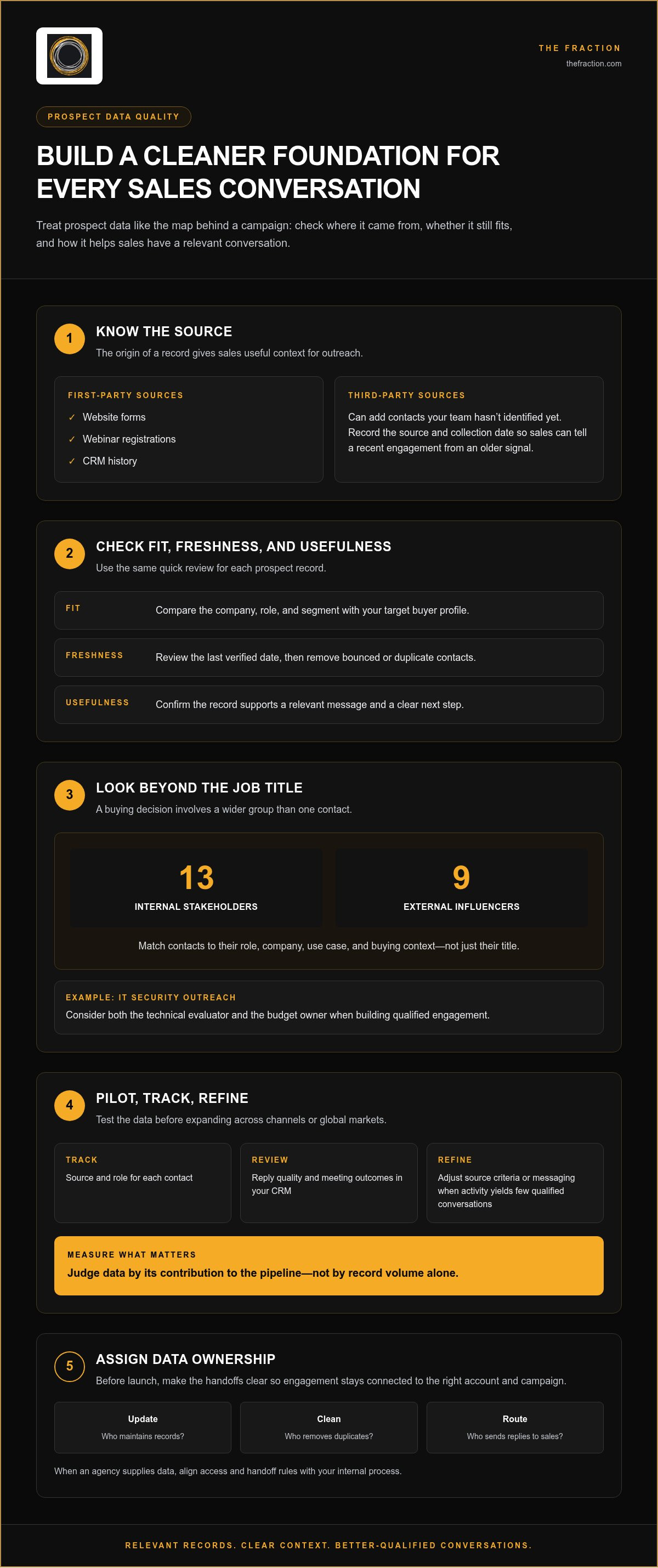
Prospect data is the map behind a campaign: inaccurate details can send outreach off course. First-party sources include website forms, webinar registrations, and CRM history. Third-party sources can add contacts your team hasn’t identified. Record each source and collection date so sales can distinguish recent engagement from an older signal.
A typical B2B buying decision involves 13 internal stakeholders and nine external influencers, so job title alone gives you a narrow view. Match contacts to their role, company, use case, and buying context. For example, an IT security campaign may need to reach both a technical evaluator and a budget owner to build qualified engagement.
- Check fit: Compare each record’s company, role, and segment with your target buyer profile.
- Check freshness: Review the last verified date, then remove bounced or duplicate contacts.
- Check usefulness: Make sure the record supports a relevant message and clear next step.
Before scaling across channels or global markets, run a small campaign and review the results. Track each contact’s source and role, along with reply quality and meeting outcomes in your CRM. If a source generates activity but few qualified conversations, adjust its criteria or messaging. Judge data by its contribution to the pipeline, not just record volume.
Define ownership before launch: decide who updates records, removes duplicates, and routes replies to sales. If an agency supplies data, align access and handoff rules with your internal process so engagement stays connected to the right account and campaign.
The Fraction: Automated & AI lead generation systems
The Fraction helps professionals build a more structured path to client acquisition with automated, AI-driven lead generation systems. If your priority is improving the journey from prospect targeting to a first conversation, its sales process is designed to feel less like traditional selling. A compelling offer and service can also give buyers a clearer reason to engage.
These elements work together: lead generation connects you with prospects, messaging opens the conversation, and a focused offer gives it direction. This approach may suit professionals looking to improve how they attract and convert clients. It is not a substitute for outsourcing a technical SDR team for a specific SaaS, cybersecurity, or IT sales program.
Contact The Fraction to discuss whether this approach fits your client-acquisition goals.
Turn your sales development decision into a clear next step
Choosing among memoryBlue alternatives for technical sales development is easier when you define the outcomes your sales motion needs, the buyer conversations that matter, and who owns the handoff from first contact to follow-up. Use those priorities to compare options rather than relying on a polished pitch or familiar name.
Before committing, decide what a useful prospect conversation should reveal, how your team will respond to buyer feedback, and which parts of the process need to stay close to your expertise. Your answers will help clarify whether you need outside execution, internal ownership, or a different client-acquisition approach.
A deliberate choice can give your growth strategy firmer footing and help you take the next step with confidence.


