

The most effective sales call you'll ever lead is the one where you never actually sell anything. For the seasoned executive or high-value consultant, the traditional pitch often feels like a regression; it's a high-pressure tactic that undermines the very authority you spent decades building. Mastering low friction sales techniques allows you to escape the exhausting reality of the feast or famine lead cycle, where manual outreach feels like a secondary career and sales calls carry a heavy weight of anxiety. You likely agree that true expertise should attract, not chase.
This guide provides an executive checklist to help you close high-ticket deals through a systematic, peer-to-peer consultation process. We will explore how to build a predictable lead flow system, leverage AI for automated outreach, and refine your offer so it meets the 70% to 90% of research buyers now complete before speaking to a representative. You're about to transition from a hunter to a strategic architect of your own growth. By the end of this checklist, you'll be ready to redefine your sales process as a high-caliber professional investment rather than a stressful transaction.
Key Takeaways
- Understand the fundamental shift from high-pressure traditional selling to a system-driven approach that preserves your professional authority and prestige.
- Learn how to architect an offer-first framework that solves high-significance problems, effectively pre-qualifying leads before you even hop on a call.
- Implement low friction sales techniques by integrating AI-driven lead generation to automate your initial outreach and eliminate the emotional burden of manual prospecting.
- Follow a structured executive checklist to audit your service for immediate value and establish a scalable, three-touch automated outreach cycle.
- Build a predictable sales ecosystem that facilitates a strategic 90-day transition from corporate employment to a high-impact fractional career.
The Anatomy of Sales Friction: Why Traditional Selling Fails Experts
Sales friction is the quantifiable gap between an expert's inherent value and a prospect's current perception of that value. When you rely on a traditional sales process, you often introduce unnecessary resistance that alienates sophisticated buyers. High-friction methods, such as cold calling or aggressive hard-closing, create a power imbalance that subordinates the expert to the buyer. Conversely, low friction sales techniques prioritize a system-driven, inbound approach where the prospect is already pre-sold on your authority. For the high-level professional, adopting a specific sales process for consultants is essential because traditional tactics don't just fail; they actively corrode your professional prestige. When an expert acts like a commodity salesperson, they lose the leverage required to command premium fees.
Identifying Your Invisible Sales Bottlenecks
Friction manifests in three distinct layers that stifle growth. Technical friction includes clunky booking tools or delayed follow-up sequences that signal a lack of operational excellence to a potential client. Psychological friction occurs when the expert feels a sense of imposter syndrome, often triggered by the outdated need to "pitch" rather than lead a conversation. Strategic friction is the most dangerous; it's the fundamental misalignment between your service architecture and the actual market demand. Identifying these bottlenecks is the first step toward building a scalable ecosystem that allows you to grow without sacrificing your professional standing.
The Shift from Salesperson to Strategic Architect
Transitioning to low friction sales techniques requires a fundamental mindset shift from "convincing" to "diagnosing." A salesperson tries to persuade; a strategic architect identifies an organizational gap and presents a blueprint for its resolution. This diagnostic approach naturally leverages your authority to reduce buyer resistance before the first consultation call even begins. Unlike retail or SaaS models, the expert-as-seller framework relies on high-level execution and premium positioning to create a balanced partnership. By moving from a hunter mentality to a consultative one, you ensure that every interaction reinforces your status as a high-value partner rather than a vendor. This shift is the cornerstone of a sustainable, high-ticket consulting practice.
The Offer-First Framework: Reducing Resistance Before the Pitch
A compelling offer is the primary engine of your sales architecture. It functions as a strategic filter, ensuring that only the most qualified prospects enter your professional orbit. Market data reveals that buyers often complete 70% to 90% of their due diligence before ever engaging with a sales representative. This reality demands a shift toward low friction sales techniques that prioritize clarity and value over aggressive persuasion. By anchoring your process in a high-value offer that solves a high-significance problem, you're effectively converting leads without hard selling before they even reach your calendar.
The "Low-Friction Bridge" serves as the tactical application of this framework. It involves creating a low-barrier entry point, such as a paid diagnostic or a high-impact strategy session, that allows a client to experience your expertise with minimal risk. When integrated with sophisticated Sales Automation, this bridge becomes a scalable asset that moves prospects through your ecosystem with minimal manual intervention. Transparency in pricing and a commitment to value-based positioning further reduce buyer resistance; the client can clearly visualize the return on investment long before the final agreement is signed.
Productizing Your Professional Expertise
Abstract consulting is inherently difficult to purchase because it carries the weight of uncertainty. To remove this friction, you must translate your years of experience into a tangible "product" characterized by defined deliverables, milestones, and timelines. This structure provides the buyer with a sense of psychological security, as they're purchasing a proven process rather than just your billable hours. Productization is the ultimate friction-reducer for service businesses because it replaces the ambiguity of professional labor with the reliability of a results-oriented framework.
The Peer-to-Peer Positioning Secret
High-value deals are won or lost based on perceived status. If you approach a prospect as a subordinate seeking permission, you create immediate sales friction that undermines your authority. You must speak with the calculated confidence of a peer, utilizing a sophisticated vocabulary that reflects your executive standing. Instead of a traditional sales call, structure the initial "Discovery" phase as a high-level business audit. This diagnostic approach reinforces your role as a strategic architect rather than a vendor. By implementing these low friction sales techniques, you can build automated lead generation systems that respect your time and preserve your professional prestige.
Leveraging AI and Automation to Remove Technical Friction
Technical friction is the silent killer of professional growth. While the Offer-First Framework addresses strategic alignment, automation resolves the operational drag that prevents high-value experts from scaling their impact. Implementing an AI driven lead generation strategy transforms your outreach from a manual chore into a precision instrument. This evolution mirrors the broader industry shift toward Frictionless Selling, where technology handles the repetitive heavy lifting of the sales cycle. By automating the identification of high-value prospects, you effectively remove the emotional friction of rejection, as the system filters for intent before you ever personally engage.
Automated lead nurturing ensures you maintain top-of-mind status without the need for constant manual check-ins. It builds a bridge of trust through consistent, high-value touches that require zero ongoing effort from your side. This systematic approach allows you to focus on high-level delivery while the infrastructure manages the top of your funnel. It's about building a system that works while you're offline, ensuring that your pipeline never runs dry during busy delivery periods.
Building the Automated Lead Ecosystem
A robust sales architecture requires a seamless technical stack. AI tools now filter for high-intent, high-value clients by analyzing behavioral data and firmographics at scale. You can set up low-friction entry points, such as automated assessments or on-demand webinars, that capture interest without requiring a live call. Since February 2024, Gmail has been permanently rejecting bulk email senders who fail to use one-click unsubscribe links or proper authentication. Ensuring your CRM, booking tools, and email sequences work in concert without human intervention is now a prerequisite for professional survival.
The "Always-On" Prospecting Machine
For fractional leaders, manual outreach is the most significant growth bottleneck. You can't hunt for new business while simultaneously delivering premium results for current clients. An automated machine ensures a consistent lead flow that operates independently of your billable hours. This consistency prevents the "feast or famine" cycle that plagues many independent consultants. AI maintains your professional prestige by ensuring that outreach is never perceived as desperate; instead, it's viewed as a timely, highly relevant invitation to solve a specific business problem.
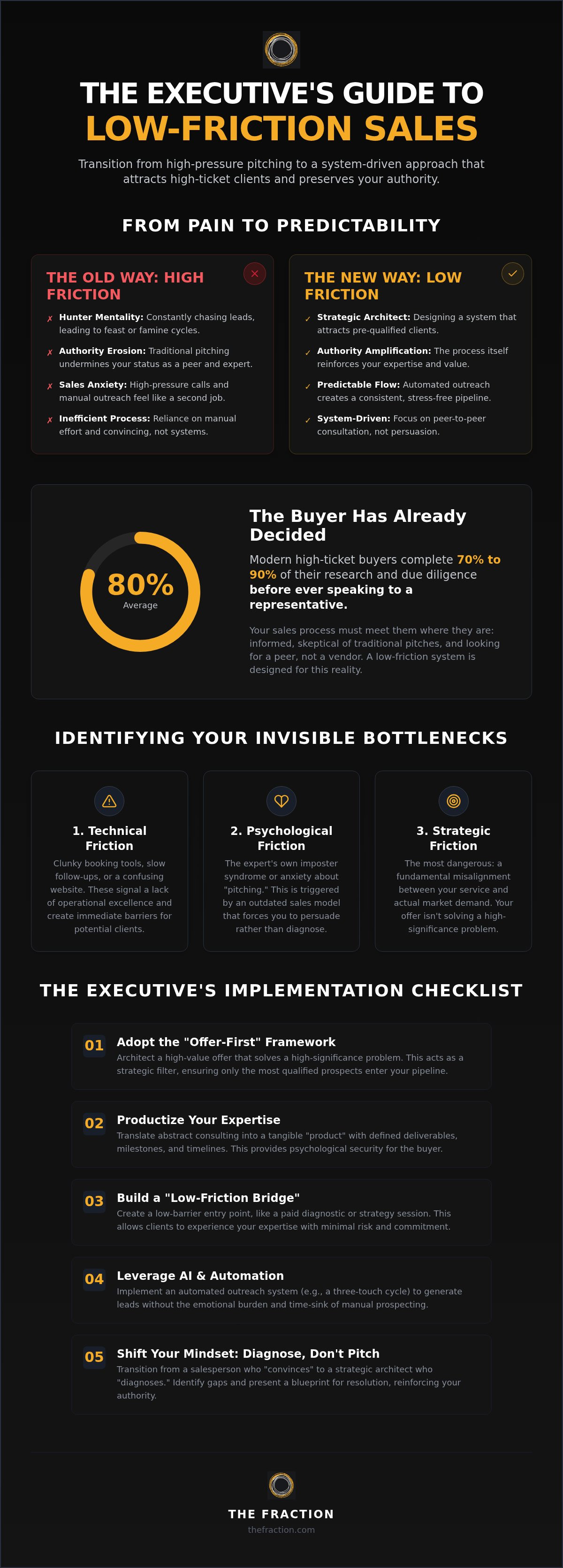
The Low-Friction Sales Checklist: A Step-by-Step Implementation
Practical execution is where strategic architecture meets market reality. To successfully transition from a traditional pitch to a consultative partnership, you must apply low friction sales techniques through a repeatable, high-standard workflow. This checklist serves as your blueprint for building a sales ecosystem that respects your time and your prospect's intelligence. By following a structured approach, you ensure that every interaction reinforces your prestige rather than diluting it through desperate pursuit.
- Step 1: Audit your offer for immediate value. Ensure your service architecture includes a "low-barrier" entry point. This allows prospects to experience your expertise without the friction of a massive upfront commitment.
- Step 2: Automate the first three outreach touches. Consistency is the foundation of trust. Script and schedule your initial follow-ups to maintain momentum without requiring your personal manual intervention.
- Step 3: Replace the "Sales Deck" with a "Strategic Roadmap". Don't just list features. Create a visual journey that maps the client's transition from their current state to a high-value outcome.
- Step 4: Implement automated pre-qualification. Use your scheduling tool to ask critical business questions. This ensures you only spend time with prospects who meet your specific "A-player" criteria.
- Step 5: Standardize value-add follow-ups. Never send a "just checking in" email. Instead, provide a relevant case study, a diagnostic tool, or a strategic insight that continues to solve their problem.
Phase 1: Pre-Call Infrastructure
Your time is your most significant professional asset; don't squander it on low-intent leads. Pre-qualifying leads through automated systems ensures you only engage with clients who possess the budget and urgency to move forward. Before the first call, send a "Pre-Consultation" brief that establishes the frame of the conversation and sets a tone of executive authority. You should also ensure all administrative friction, such as NDAs or contracts, is fully digitized. This level of operational excellence signals that you're a high-caliber partner who values high-level execution.
Phase 2: The Low-Pressure Consultation
The most effective consultation feels like a peer-to-peer business audit rather than a sales pitch. Use the "Diagnostic Method" to ask the incisive questions that lead the client to recognize the cost of their current state. To reduce choice friction, present a "Three Options" pricing strategy that allows the client to choose the depth of engagement that suits their current infrastructure. Finally, always close the loop by establishing definitive next steps before the meeting concludes. If you're ready to start implementing these automated lead generation systems, this checklist provides the necessary framework for sustainable growth.
Scaling Your Professional Impact: Beyond the Manual Hustle
Sustainable growth is never the result of sheer willpower. It's the product of well-architected systems that operate independently of your personal energy or daily mood. For the high-value professional, the manual hustle of traditional prospecting is a significant growth bottleneck that compromises both your time and your prestige. By implementing low friction sales techniques, you can facilitate a structured 90-day transition from corporate employment to a high-impact fractional career. This evolution requires moving beyond the role of an expert-for-hire to become a scalable professional entity that commands respect before the first meeting begins.
Achieving Professional Autonomy Through Systems
Fractional leaders require a robust technical and strategic infrastructure to win in a competitive market. There's a fundamental difference between simply monetizing your experience and running a sophisticated sales business. The former is often just another high-pressure job; the latter is a high-value asset. Positioning this transition as a manageable, step-by-step evolution allows you to maintain your current professional standing while building the foundation for your future autonomy. You're not just selling your billable hours; you're leveraging an ecosystem that validates your value and pre-qualifies your leads at scale.
Next Steps: Deploying Your Sales Ecosystem
The Fraction acts as your strategic architect, deploying a sales process that doesn't feel like selling. Our approach integrates low friction sales techniques with automated outreach, removing the manual labor from your growth strategy. We handle the technical complexities of AI lead generation tailored to your specific niche, ensuring your outreach is precise, professional, and consistent. This allows you to focus on your core expertise while the system maintains a steady pipeline of high-intent leads. It's time to stop chasing opportunities and start architecting them. You can build your low-friction sales system with The Fraction to secure the professional impact and freedom you've earned.
Architecting Your Professional Future
Transitioning from a traditional executive role to a high-impact fractional career requires more than just expertise; it demands a sophisticated sales ecosystem. You've learned that the most effective growth isn't driven by manual hustle but by a strategic framework that prioritizes authority over persuasion. By implementing low friction sales techniques, you replace the anxiety of high-pressure selling with the precision of a peer-to-peer consultation. This shift ensures your outreach is never perceived as desperate and your pipeline remains consistently full through automated precision.
The path to professional autonomy is entirely manageable when you have the right infrastructure in place. With national reach for US-based professionals, The Fraction provides the AI-powered lead generation deployment and strategic framework for high-value offers necessary to secure your standing in the market. It's time to move beyond the constraints of traditional employment and build a scalable entity that reflects your true value. Master the sales process that doesn’t feel like selling with The Fraction. Your next chapter of professional impact starts with a system designed for your success.
Frequently Asked Questions
What is the difference between low-friction sales and soft selling?
Low-friction sales techniques differ from soft selling by focusing on the underlying business architecture rather than just interpersonal style. While soft selling relies on a non-aggressive approach, low-friction methods utilize systematic filters and automated sequences to ensure the buyer moves forward voluntarily. This architecture removes the need for persuasion because the system handles the heavy lifting of qualification and education before you ever personally engage.
How can AI help remove friction in a professional services sales cycle?
AI removes technical friction by automating the identification of high-intent prospects and managing initial touchpoints. By analyzing behavioral data, AI ensures that your outreach is timely and relevant, which reduces the emotional drag of manual prospecting. This technology allows you to maintain a consistent lead flow while you focus on high-level delivery, ensuring your professional prestige remains intact through precise, non-desperate engagement.
Does a low-friction sales process take longer to close deals?
A low-friction process typically shortens the sales cycle by delivering essential information before the first call. Buyers often complete 70% to 90% of their research independently; providing a structured, low-friction path meets them where they are. By pre-qualifying leads and addressing common hurdles through automated content, you arrive at the consultation with a prospect who is already prepared to make a definitive decision.
What are the most common friction points for fractional executives?
Fractional leaders often face friction through manual lead generation, clunky scheduling processes, and ambiguous service definitions. These bottlenecks create a "feast or famine" cycle that drains executive energy. Implementing low friction sales techniques resolves these issues by productizing expertise and automating administrative tasks. This systematic approach facilitates a predictable lead flow that doesn't require sacrificing your billable hours for manual prospecting or repetitive follow-ups.
Can I use low-friction techniques for high-ticket consulting (over $50k)?
These techniques are ideal for high-ticket consulting because they reinforce your status as a strategic partner rather than a vendor. Premium offers over $50,000 require a high degree of trust and authority, which is maintained through a structured, low-pressure diagnostic process. By removing the friction of a traditional pitch, you create a peer-to-peer environment where the value of the solution justifies the significant investment.
How do I handle price objections in a low-friction sales model?
Handle price objections by shifting the focus from cost to the measurable ROI of your strategic roadmap. Low-friction models utilize value-based positioning and a "Three Options" pricing strategy to give clients agency over the depth of the engagement. When the offer is architected to solve a high-significance problem, the price becomes a secondary consideration to the achievement of the desired business outcome.
Is automation too impersonal for high-level executive clients?
Automation enhances the executive experience by respecting their time through efficient, relevant communication. High-level clients value precision and operational excellence; a well-designed automated system signals that you are a high-caliber professional. As long as the content is tailored and provides immediate value, automation is perceived as a mark of sophistication rather than an impersonal shortcut in the sales cycle.
What tools are essential for a low-friction sales stack in 2026?
In 2026, a high-performance stack requires an AI-integrated CRM like Salesforce Summer '26 or HubSpot's API-integrated platform. These tools must work in a unified ecosystem to manage the first several touches of your outreach cycle without human intervention. Ensuring your stack complies with the latest evolving data privacy regulations is critical for maintaining your professional reputation and avoiding significant fines during executive outreach.


