

The investment case for sales automation comes down to the whole picture, so a financial model for sales automation investment should account for implementation, ongoing AI operating costs, expected sales impact, and when those gains cover the spend. Compare projected human and automation cash flows over 12 months using net present value, then see how the case shifts as inquiry volume grows.
The upfront cost of sales automation is easy to spot, but it is only part of the investment. A useful financial model for sales automation investment also accounts for implementation, ongoing operations, and how costs and capacity change as demand grows. Treat the model as a decision map: make the assumptions visible and identify where the case depends on evidence you still need.
A practical model shows what to include, how setup and ongoing AI costs affect breakeven, and how to weigh scalability against productivity and conversion assumptions. Use it to judge whether automation fits your sales process and what to measure before committing.
Key Takeaways
- Build the investment picture around setup, ongoing AI costs, and the sales value you expect, so you can see what needs to happen before breakeven.
- Factor in the learning curve, system connections, and data quality, because each can shape how well automation fits into your sales process.
- Compare projected human and automation cash flows over 12 months using net present value, then see how different assumptions shift the result.
- Think beyond today’s workload and consider how costs and capacity change as inquiry volume grows.
- Use productivity and conversion assumptions to explore automation’s potential, while grounding the forecast in the way your sales process actually works.
What is a Financial Model for Sales Automation Investment?
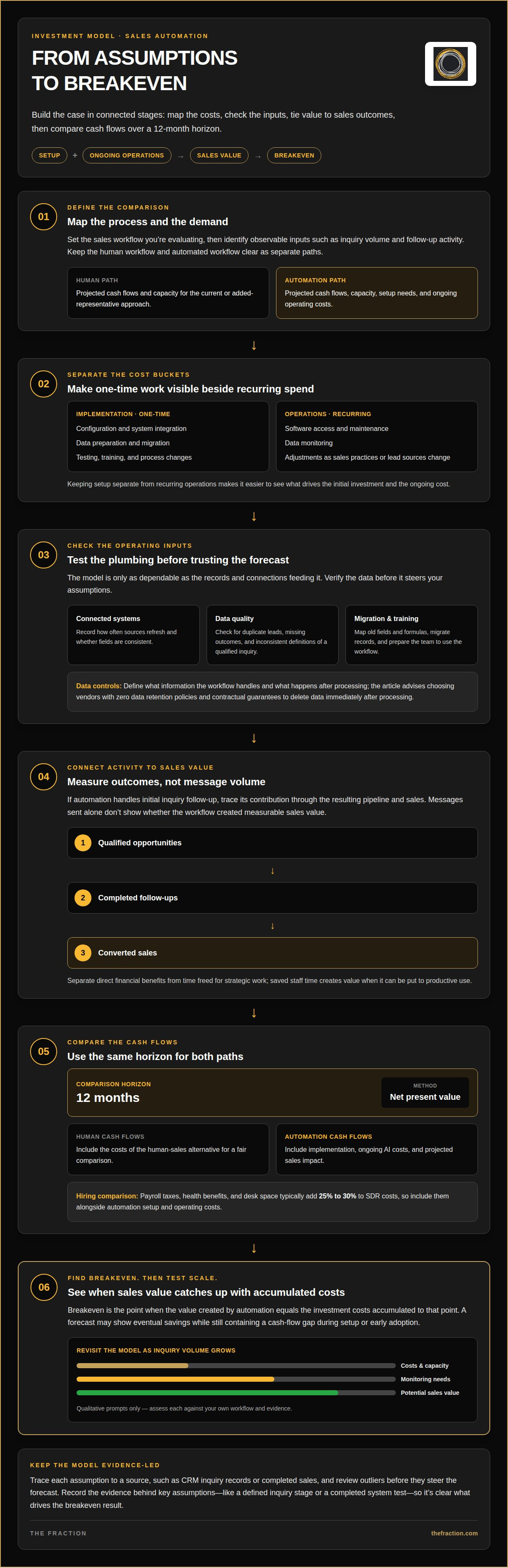
A financial model for sales automation investment maps the cash flows, capacity, and sales outcomes linked to automating parts of a sales process. Think of it as a route plan, where every turn comes from an input you can observe, such as inquiry volume or follow-up activity. Compare projected human and automation cash flows over 12 months using net present value, then see how the case changes as demand grows.
And how does automation compare with hiring additional sales representatives? Payroll taxes, health benefits, and desk space typically add 25% to 30% to SDR costs, so include those alongside automation setup and operating costs for a fair comparison.
AI-driven financial data gathering can help assemble inputs, but validation keeps the forecast on track. AI-powered ingestion can extract and structure historical information from thousands of pages in minutes, while AI can gather valuation multiples and build comparable-company tables in minutes. For a sales model, trace each assumption to a source, such as CRM inquiry records or completed sales, and review outliers before they steer the forecast.
Market data, connectivity, and update frequency are the plumbing behind the model. If records arrive late or systems do not connect, forecasts may reflect an outdated pipeline. For example, a slowly updating lead source can leave an AI workflow prioritizing yesterday’s signals. Record how often connected systems refresh and whether each source uses consistent fields.
Migration and training also affect the transition. Before retiring an old workflow, map its fields and formulas to the new platform, migrate existing data, and train the team to use the system. Duplicate leads, missing outcomes, and inconsistent definitions of a qualified inquiry can distort conversion assumptions. Monitor these issues as the new workflow settles in.
Confidentiality belongs on the investment map, especially when customer or financial information enters an AI workflow. Finance teams are advised to choose vendors with zero data retention policies and contractual guarantees to delete data immediately after processing. Define which information the workflow handles and what happens after processing, so data controls sit alongside connectivity and accuracy in the decision.
Breakeven and implementation costs
Breakeven depends on how quickly measurable sales value offsets setup and ongoing operating costs. Separate one-time implementation work from recurring expenses, so each cost and benefit has a clear place in the investment case.
Breakeven Assessment
Breakeven is the point when the value created by automation equals the investment costs accumulated to that point. A forecast showing eventual savings can still hide a cash-flow gap during setup or early adoption. Compare the automated workflow’s costs with its results, including qualified opportunities, completed follow-ups, and converted sales.
Tie the calculation to actual sales outcomes. If automation handles initial inquiry follow-up, measure its contribution through the resulting pipeline and sales, not the number of messages sent. Separate direct financial benefits from time freed for strategic work. Saved staff time creates value only when it can be put to productive use.
Implementation Cost Assessment
Implementation costs include the expenses and internal effort required to configure software, connect existing systems, migrate information, and prepare people to use the workflow. These costs affect both the initial investment and how soon reliable sales activity can be measured. Include configuration, integration, data preparation, testing, training, and process changes.
For example, connecting an automation platform to a CRM may require field mapping and workflow testing before lead records move consistently. If the sales team uses different definitions of a qualified inquiry, resolve them before comparing performance. Advanced software can support more functions, but may also require additional configuration and training.
Separate planned implementation work from recurring operations. One-time tasks might include transferring records, configuring lead routes, and testing message or follow-up logic. Ongoing costs may include software access, maintenance, data monitoring, and adjustments when sales practices or lead sources change. Keeping the categories distinct prevents setup effort from disappearing inside a monthly estimate.
Test the model under realistic operating conditions. If integration delays access to complete CRM records, results may take longer to emerge. If data quality improves, conversion analysis may become more dependable. Record each assumption alongside its evidence, such as a defined inquiry stage or a completed system test, so decision-makers can see what drives the breakeven result.
The revenue side deserves the same discipline as the cost side. A compelling offer and service can influence whether a qualified opportunity advances, so the model should connect sales outcomes to the offer presented. Developing a compelling offer and service can help clarify that link, while keeping projected conversion separate from guaranteed revenue.
AI operating costs and scalability
AI operating costs continue after launch, while scalability describes how capacity changes as inquiry volume grows. Model them together: a workflow that handles more demand may still need closer monitoring, better data inputs, or algorithm adjustments.
AI Operating Costs
AI operating costs are the recurring expenses and resources needed to run, monitor, and maintain automated sales workflows. Usage, connected systems, and oversight all shape the investment after implementation. A workflow processing more customer inquiries, for example, may use more computing resources, while changes to its data sources or sales logic may require maintenance.
Separate recurring software and usage charges from internal operating effort. Track the time spent reviewing outputs, correcting inaccurate records, and adjusting algorithms when inquiry sources change. Account for monitoring quality, too: an automated response based on an outdated offer may run smoothly but generate less useful conversations. Accurate inputs and regular review help connect operating effort to sales outcomes.
Scalability Considerations
Scalability is the ability to handle more inquiries without expanding resources at the same rate. It matters because growth can change both costs and workload. Human sales teams generally require ten times as many staff to handle ten times the inquiry volume, while automation may absorb some added activity through existing workflows.
That difference depends on what is automated and the capacity around it. More inquiries can increase data processing, follow-up activity, and human review, raising costs even if staffing stays steady. Model lower- and higher-volume cases using consistent assumptions, then identify where service quality or response capacity would require additional resources.
Algorithms also depend on the quality and timing of their sources. A sales system drawing from CRM records, inquiry forms, and campaign responses needs consistent definitions across those sources. If one source labels an inquiry as qualified while another uses a different stage, performance comparisons become less accurate as volume grows. Track record completeness and processing delays alongside conversions, so expansion doesn’t hide a data problem.
Assess capacity across the full journey from incoming inquiry to meaningful sales conversation. An AI workflow may handle initial responses, while a person addresses complex questions or later-stage decisions. Distinguish automated activity from human effort, then track whether each handoff keeps pace as demand rises. This reveals where automation provides leverage and where extra volume creates a bottleneck.
Treat scalability as a set of operating conditions, not a single growth claim. Model how usage, source reliability, algorithm adjustments, and human oversight change with inquiry volume. If a higher-volume scenario depends on accurate data and timely handoffs, show those conditions alongside the financial projection. This makes clear what scaling the workflow requires.
AI sales automation investment modeling
Investment modeling compares projected automation and human-sales cash flows over 12 months using net present value. Useful KPIs include qualified inquiries, conversion rates, cost per acquisition, response time, and manual hours redirected.
Investment Modeling
AI sales automation investment modeling translates workflow costs and expected sales outcomes into a comparable financial forecast. It matters because decision-makers can see when cash flows support the investment, and which assumptions drive the result. Use the same 12-month period for both scenarios, then identify setup costs, recurring operating costs, and projected revenue separately.
Build the automation scenario around specific sales actions, such as capturing inquiries, prioritizing follow-up, and routing qualified prospects. For each action, record its expected effect on workload or pipeline and connect it to an observable CRM measure. A forecast based on completed sales is more useful for decisions than one that counts automated messages alone.
Compare that projection with the human-sales alternative, including hiring, onboarding, and replacement effort. Businesses face SDR rehiring and retraining costs every 12 to 18 months, so the comparison should reflect those recurring activities within the forecast period. Net present value helps compare the timing of costs and returns, rather than treating every future dollar as equally valuable today.
Evaluating Investment KPIs
Investment KPIs are measurable indicators that connect automation activity to sales results and operating effort. They show whether the system improves sales economics, rather than simply increasing activity. Track qualified inquiry volume, inquiry-to-meeting conversion, meeting-to-sale conversion, cost per acquisition, and time from inquiry to first response.
Pair outcome measures with operational ones, such as manual follow-up hours, lead-routing accuracy, and the share of inquiries receiving a timely response. A higher response count means little if qualified prospects do not advance to sales conversations. Define each metric consistently in the CRM and automation workflow, so changes reflect performance rather than revised reporting rules.
Keep the comparison grounded in evidence. PwC analysis estimated that AI agents could improve forecasting accuracy and speed by up to 40%, but a business model still needs its own pipeline assumptions and sales records. Use historical conversion data as the baseline, then show how alternative assumptions change projected outcomes. This makes the forecast useful for decisions, not just presentation.
Review the KPIs together across the 12-month model. If cost per acquisition improves while conversion remains steady, the change may come from reduced manual effort; if response time falls but sales don’t advance, examine lead quality or the offer. A clear view of those relationships helps leaders adjust the workflow and distinguish productive automation from activity that adds little value.
What sales productivity and conversion-rate improvements can sales automation deliver?
Sales automation can improve productivity by handling timely follow-up and repetitive outreach. Conversion gains, however, depend on lead quality and sales execution. Evaluate faster activity separately from revenue outcomes, then connect both to measures such as response time, engagement, and completed sales.
Speed can affect the value of an inquiry. Inquiries contacted within five minutes convert at a rate eight times higher than those contacted later. That makes time to first contact a useful productivity measure, but pair it with the eventual conversion rate. Faster responses indicate operational performance; completed sales show commercial impact.
Engagement offers another signal, especially when follow-up responds to customer intent. Signal-based AI follow-up is described as achieving engagement levels as high as 25% in 2026. Treat that figure as a point of comparison, then define engagement consistently, such as a prospect replying or taking a requested next step. An opened message alone may not represent meaningful interest.
Traditional outbound methods have a 3% reply rate, which gives teams context for evaluating outreach performance. A reply rate compares responses with messages sent, while conversion measures how many prospects advance through later sales stages. Tracking both prevents a high volume of low-intent replies from appearing equivalent to qualified opportunities or closed business.
Productivity measures should show which manual actions automation changes. Compare time spent on initial follow-up, the number of inquiries receiving timely contact, and the share routed to a suitable next step. If a workflow sends prompt responses but qualified prospects still wait for a human conversation, assess that handoff next.
Use conservative assumptions in the financial model. One sales scenario may assume an AI agent converts at 80% of a top-tier human representative’s efficiency. This is a modeling assumption, not a promised result. Compare it with the team’s actual baseline, then test how different conversion assumptions affect projected sales and investment value.
Review related measures over the same reporting period. If response time improves but qualified opportunities and sales do not, examine lead fit, follow-up relevance, and the offer. If engagement and later-stage conversion both improve, reflect that relationship in the model while keeping each step visible. This helps leaders judge whether faster activity is translating into business results.
The Fraction: A sales process that doesn’t feel like selling
The Fraction helps professionals connect sales automation with a clear, client-focused process, so technology supports meaningful conversations rather than adding activity for its own sake. Its automated, AI-driven lead generation systems can help structure how you identify and follow up with prospects.
The investment case also depends on what prospects are being invited to buy. The Fraction helps develop a compelling offer and service, bringing lead generation, the offer, and the sales process into alignment. To explore how these elements fit your business, contact The Fraction to discuss your sales process.
Turn the model into a confident next move
A financial model for sales automation investment is most useful when it supports a clear decision and can be revisited as sales conditions change. Treat its assumptions as working decisions: assign an owner to each input, compare actual performance with projections, and define what evidence would prompt an adjustment. That turns a spreadsheet into a practical management tool.
Connect the financial case to the sales experience you want prospects to have. A sound investment decision considers how automation supports the way your business earns trust, communicates value, and builds client relationships. Keep these priorities in view as you decide what to build, what to measure, and where human judgment matters most.
If you’re ready to shape your next step with a strategic partner, start a conversation with The Fraction.
Build deliberately, learn from the results, and give your growth strategy room to strengthen.
Frequently Asked Questions
Sensitivity Analysis: What if Conversion Varies?
Model conversion changes using low, expected, and high scenarios based on your own sales history. Keep inquiry volume and cost assumptions consistent, then adjust conversion to see how projected sales, net present value, and breakeven shift. If a smaller share of qualified inquiries becomes customers, for example, the model should show whether the investment still works or whether targeting or the offer needs to change.
Where To Go From Here?
Identify the assumption with the greatest influence on your decision, then assign someone to track it in the CRM. If lead quality drives the result, review qualification criteria. If sales progression is the constraint, examine the handoff from automated contact to a human conversation. This focused next step turns the forecast into an operating decision rather than a spreadsheet no one revisits.
What is a financial model for a sales automation investment?
A financial model for sales automation is a structured forecast comparing the costs and expected business value of automating sales activities with an alternative, such as maintaining a human-led process. A useful model connects assumptions to operating measures, including qualified leads, sales conversions, and staff time. For example, compare follow-up approaches and assess their projected cash flows, keeping assumptions visible for review.
What are typical sales automation software costs and pricing models in the US?
Sales automation software commonly uses subscription, per-seat, usage-based, or tiered pricing. Total cost depends on factors such as user access, workflow volume, included features, and integration requirements. Before adding a software estimate to your business case, identify the pricing structure and any activities that could create additional charges. Keep software expenses separate from implementation and internal labor to show each cost driver clearly.
How do you calculate ROI and payback period for sales automation?
Calculate ROI by dividing net benefits by total investment, then express the result as a percentage if required for reporting. Net benefits are the value attributed to automation minus its associated costs. Payback occurs when cumulative benefits cover the initial investment. Use the same period and cost categories throughout, and do not count a benefit twice, such as recording both saved staff time and revenue from that same time as separate gains.
Which costs should a sales automation business case include, such as implementation, training, and integration?
Include software access, configuration, system integration, data preparation, staff training, testing, maintenance, and ongoing oversight. Connecting a CRM, for example, may require internal technical work even when the subscription is already included. Separate one-time setup tasks from recurring expenses, and record staff time as a resource used. This fuller view helps prevent a business case from looking attractive simply because operational effort was left out.
How should a company forecast revenue gains and cost savings from sales automation?
Start with historical inquiry and sales records, then map how prospects move through each pipeline stage. Forecast revenue using qualified inquiry volume, stage-to-stage conversion, and the value of resulting sales. Estimate savings from reduced manual activity separately, and include only time that can be redirected to productive work. Comparing teams or periods with similar inquiry sources can help distinguish process changes from shifts in lead mix.
What risks and assumptions should a sales automation financial model account for?
Account for adoption, integration delays, incomplete or duplicated records, changing lead quality, and the time required for human review. State assumptions about inquiry volume, conversion, sales value, and the tasks automation will handle. If the forecast assumes every inquiry has a complete CRM record, for example, test the effect of missing records. Documenting these dependencies shows decision-makers where results could diverge from projections and what to monitor.


