

A full pipeline can still be an expensive distraction. The opportunity cost of a weak sales pipeline is the time and focus spent advancing deals that may never move forward, time that could go to stronger prospects with a clearer fit, decision maker, outcome, and timeline. The pipeline may look impressive while opportunities with real momentum wait in the wings.
It makes sense to want more leads when future revenue feels uncertain, but lead count alone offers only a partial picture of momentum. Think of the pipeline as a portfolio of active decisions: each weak opportunity absorbs attention, clouds forecasting, and leaves less room for a deal that can progress.
This article explains how pipeline quality differs from lead volume, how weak opportunities consume selling time, and what can weaken a pipeline. Understanding these factors shows why qualification and clear stages help focus the team on prospects with a credible path forward. The goal is to shift from chasing activity to building a sales process that gives the right opportunities room to advance.
Key Takeaways
- Judge pipeline health by how well opportunities fit your ideal customer profile and advance through clear stages, rather than by lead volume alone.
- Use qualification criteria to identify stalled or unlikely deals, then redirect sales attention toward prospects with a credible path to a decision.
- Read pipeline coverage alongside deal quality and stage progress, so quota planning reflects opportunities that can realistically move forward.
- Trace pipeline weakness to its causes, from an undefined sales process to market pressure, and address the source instead of simply adding more leads.
- Keep opportunity stages and statuses current to support clearer forecasts and cash-flow planning; a structured sales process can help make that discipline easier to sustain.
1. Pipeline quality versus lead volume
A crowded pipeline can look like a packed calendar, but activity alone does not show which deals can advance. Lead volume counts potential conversations; pipeline quality reflects movement toward a decision. Every prospect takes attention, so a weak-fit conversation can consume research, meetings, follow-ups, and preparation while a stronger opportunity waits.
An opportunity merits active attention when it has a good fit, access to decision authority, a defined outcome, and a real timeline. These details help the sales team see a credible path forward. A contact may like an idea, for example, but without decision authority or a clear need, the next step remains uncertain. Keep that record in the right context rather than automatically treating it as an active opportunity.
Opportunity value can shape the dashboard, too. A $100K placeholder attached to an early prospect can inflate reported pipeline value before anyone discusses scope or budget. Some teams use $99.999K to distinguish fake values from genuine opportunity values. These figures show how CRM values become useful when supported by customer discussions and clear opportunity evidence.
Stage conversion adds another lens. In a sample funnel, stage two converts from the prior stage at 80%, stage three at 80%, stage four at 50%, stage five at 60%, and stage six at 80%. The sample funnel illustrates how opportunity value can convert to closed business across stages. The progression makes early-stage totals easier to interpret.
Stage two-to-close conversion rates typically range from 10% to 25%. A team’s own history, stage definitions, and deal mix shape the useful expectation. So the CRM can track graded probabilities at each stage, giving sales leaders a consistent view that brings more evidence into planning and less reliance on gut feel.
For a practical quality review, examine each opportunity’s fit, decision authority, desired outcome, timeline, stage, and progress. Compare the evidence with the team’s stage criteria. A deal moving through agreed steps deserves a different level of attention from a record that mainly makes the dashboard look fuller.
Lead volume still matters, but its value comes from qualified conversations that progress. The opportunity cost of a weak sales pipeline becomes clearer when teams identify which activity supports real movement and give stronger opportunities the attention they need to advance.
2. Protecting time from weak opportunities
An inconsistent sales pipeline makes forecasts less reliable and obscures where attention can create progress. Salespeople may spend hours pursuing stalled prospects while viable buyers wait for timely follow-up. The calendar fills, but the route to revenue remains unclear.
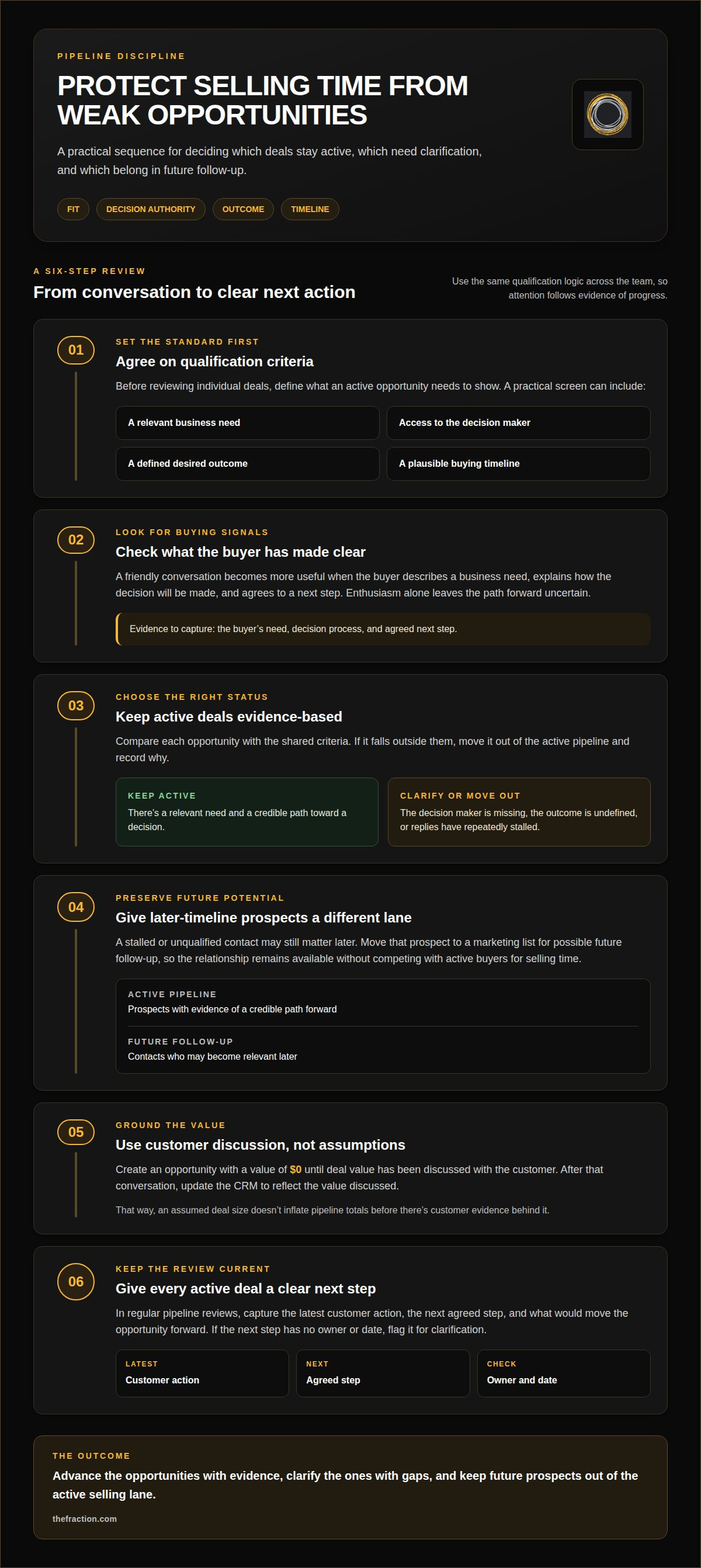
Protect time by assessing whether a prospect is likely to buy. A friendly conversation becomes more meaningful when the buyer describes a business need, explains how a decision will be made, and agrees to a next step. If those signals remain unclear, repeated follow-ups can turn a brief exchange into an ongoing claim on the calendar.
Set qualification criteria before reviewing individual deals, then apply them consistently across the team. For example, the team might look for a relevant need, access to the decision maker, and a plausible buying timeline. Shared criteria give salespeople a practical basis for prioritizing prospects with evidence of intent, rather than relying on enthusiasm alone.
When an opportunity falls outside those criteria, move it out of the active pipeline and record why. A missing decision maker, undefined outcome, or repeated silence may mean the opportunity needs a different kind of attention. This keeps the active list focused and gives managers a clearer view of where selling time can have the greatest effect.
Some prospects may become relevant later. Move stalled or unqualified contacts to a marketing list for possible future follow-up. A prospect with a real need but a later timeline, for instance, can receive suitable communication without competing for attention with an active buyer. The relationship remains available while the sales calendar stays focused.
Keep opportunity values grounded in customer discussions. Create opportunities with a value of $0 until the value has been discussed with the customer. This keeps assumed deal size from shaping pipeline totals prematurely. After that conversation, the CRM record can reflect the value discussed and give managers a more useful basis for planning.
A regular pipeline review makes these choices part of a steady operating rhythm. For each active deal, note the latest customer action, the next agreed step, and what would move the opportunity forward. If a next step has no owner or date, flag the deal for clarification. The review then helps the team advance, clarify, or move each opportunity to future follow-up.
The risks of an inconsistent pipeline include unreliable forecasts and wasted sales capacity. Stalled deals can conceal stronger prospects and make priorities harder to see. A more deliberate sales process for qualifying opportunities can help bring those decisions into a consistent rhythm.
3. How does pipeline coverage ratio affect quota attainment?
Pipeline coverage compares qualified pipeline value with sales quota. The basic formula is pipeline value divided by quota for the same period. It shows whether current opportunities could support the target, but it measures potential coverage, not a promised result. Deal quality and progress determine how much pipeline value becomes closed revenue.
Align the periods. A quarterly quota needs opportunities expected within that quarter, while a longer sales cycle may push deals beyond it. Mixing dates can make coverage look stronger than the sales calendar supports. For example, a deal expected to close later belongs in a later forecast period, even if its value is already in the CRM.
Coverage also depends on which opportunities count. An unqualified prospect can inflate the numerator without meaningfully supporting the quota. A useful calculation includes active opportunities with clear stages, documented next steps, and a plausible close period. This gives managers a more grounded view than simply adding every open record.
Stage weighting can sharpen the estimate. A team assigns each stage a probability based on its own observed conversion, then multiplies opportunity value by that probability. The resulting weighted pipeline expresses expected value more cautiously than an unweighted total. One reporting example assigns 0% weight to stage 2 and stage 3 opportunities, showing how early-stage deals may receive limited forecast credit.
That example is a reporting choice, not a universal rule. Each team needs stage definitions and probabilities that reflect its sales process. Vague entry criteria make a stage’s probability hard to interpret. Consistent definitions let managers compare opportunities using shared evidence instead of individual optimism or inconsistent CRM habits.
Use coverage as a diagnostic, then inspect its components. If coverage appears low, determine whether the gap comes from too few qualified deals, delayed close dates, or weak progress. If it looks high, check whether a small number of uncertain opportunities dominate the total. Either pattern calls for deal-level review before changing activity or forecasts.
Quota attainment depends on both opportunity supply and conversion. More pipeline can create room for potential wins, but weak qualification and stalled stages reduce its usefulness. A sound coverage discussion asks which deals can advance, what evidence supports their value, and when decisions are expected. Those details connect the headline ratio to the work that can improve it.
Review the ratio alongside stage movement and actual outcomes for the same period. This comparison shows whether coverage assumptions match the team’s sales reality. Treat the figure as a planning instrument, like a map that guides attention, while deal evidence shows which routes remain open. A clean calculation supports better decisions; disciplined opportunity management gives them substance.
4. What causes a weak sales pipeline?
A weak pipeline often starts with an undefined sales process. Without shared steps, each salesperson decides what counts as progress. One may call an introductory conversation an opportunity; another may wait for a confirmed business need. That inconsistency makes pipeline records harder to compare and lets hopeful conversations sit alongside active buying decisions.
Lead generation can create another gap when it prioritizes activity over fit. A campaign may attract people interested in a topic, for example, while the offer serves a narrower business need. Moving every response into active sales adds noise. A defined handoff separates an early inquiry from a sales-ready opportunity, protecting attention and giving follow-up a clearer purpose.
Qualification weakens when teams lack shared criteria. If one salesperson requires access to a decision maker and another does not, CRM stages lose meaning. The same problem arises when teams skip questions about the prospect’s intended outcome or timeline. Define the evidence required for each stage so managers can review records against a common standard.
Market conditions can also narrow the pool of viable buyers. Contacts cited particularly weak demand from the energy sector, according to the Federal Reserve Board. This example shows how a pipeline can soften even when outreach continues. When demand weakens, prospects may delay decisions or lose interest. Sales teams need to distinguish changing market conditions from execution gaps, then adjust prospecting focus accordingly.
Competition adds pressure, especially when buyers compare similar services. Strong competition and competitors’ lower rates can make winning new business harder, according to the Board of Governors of the Federal Reserve System. When an offer’s value is difficult to understand, a lower rate can dominate the conversation. Clear positioning helps prospects see the offer’s relevance and outcome instead of comparing price alone.
Follow-up habits can create pipeline drag, too. A prospect may receive an initial reply, then wait without a clear next step. The opportunity remains open in the CRM even though the conversation has stopped. A consistent process records the last interaction, agreed action, and review point. If the prospect’s situation changes, the team can respond with context rather than starting over blindly.
Offer clarity is another structural factor. When prospects cannot tell who a service helps or what problem it addresses, conversations often stall early. A compelling offer connects a specific audience, a pressing need, and a practical outcome. This gives sales discussions a stronger foundation and helps marketing attract prospects whose needs match the service.
To find the cause, trace a stalled deal backward. Check its lead source, first conversation, qualification notes, offer fit, and recorded next step. Repeated gaps point to a process issue; a sudden change across one market may signal demand pressure. Treat the pipeline like an operating system: visible weaknesses often begin in an earlier decision, so fixing that decision can improve later opportunities.
5. How does a weak pipeline affect sales forecasting and cash flow?
A weak pipeline makes future revenue harder to read. The CRM may show open deals, but their stages can conceal stalled conversations. A prospect listed for the current quarter may still lack an agreed decision date. That gap makes the forecast look firmer than the buyer’s actions support, leading leaders to plan around revenue that may arrive later.
Forecasts become more useful when every opportunity has a current status. Record the last meaningful buyer interaction, the next agreed action, and its expected timing. A proposal sent without a scheduled decision conversation, for example, needs a different forecast view. The proposal exists, but the buyer’s next move remains uncertain. Clear records help teams distinguish activity from evidence.
Cash-flow planning faces a related timing problem. A delayed close can shift an expected payment, while planned expenses continue on schedule. A weak pipeline obscures which deals might close within the planning period, making it harder to connect sales expectations with hiring, supplier commitments, or other operating decisions.
A clean, tight sales pipeline helps teams understand deal status and produce more reliable forecasts. “Clean” means records reflect active opportunities and current information. “Tight” means stages have clear meanings and evidence supports movement. A deal should advance after a meaningful buyer action, for instance, not simply because a salesperson completed another internal task.
Separate forecast categories according to the evidence available. An active deal with a confirmed next step can be treated differently from one awaiting a response. A stalled deal can be removed from the active forecast and considered for future follow-up. This gives managers a clearer picture of likely timing instead of blending every open record into one total.
Review forecast changes at each pipeline meeting. Compare the previously expected close period with the current one, then document why a deal moved. If the buyer changed the timing, record that reason. If the team’s estimate changed without new buyer information, revisit the stage evidence. These comparisons show whether forecast movement reflects customer decisions or internal optimism.
Cash-flow forecasts also benefit from scenarios that do not treat every deal as equally certain. Build a cautious view from opportunities with stronger evidence, then identify assumptions that rely on less-developed deals. This helps leaders discuss timing and commitments more clearly. The CRM becomes a planning tool, not a drawer full of hopeful possibilities.
Reviewing pipeline stages, buyer actions, and close timing creates a more dependable basis for revenue planning. A deliberate sales process helps make those records consistent and useful across the team.
The Fraction: A sales process that doesn’t feel like selling
The Fraction helps professionals build a clearer path from lead generation to meaningful sales conversations. Its sales process that doesn’t feel like selling supports a more natural way to engage prospects, while a compelling offer and service make the value easier to understand. Automated, AI-driven lead generation systems can support a steadier flow of potential opportunities.
Consider this next step when your pipeline feels busy but prospects struggle to progress, or when your offer and sales conversations need a clearer structure. The Fraction can help shape an approach focused on stronger-fit opportunities, clear value, and a sales process designed to support client acquisition.
Contact The Fraction to discuss your sales pipeline and next steps.
Turn pipeline insight into a stronger next move
The opportunity cost of a weak sales pipeline shows up in daily decisions: which conversations receive attention, which prospects advance, and how clearly your offer meets a real need. Build a repeatable approach around those decisions so your team can direct its energy with intention and create a steadier path from first conversation to new business.
Start by examining how leads enter the pipeline, what makes an opportunity worth pursuing, and where your current process creates friction. Small, deliberate improvements can give your team a clearer operating rhythm and focus its effort on opportunities that best fit your business.
You’ve identified where attention could be better spent. Use that insight to shape a more focused, confident way forward.
Frequently Asked Questions
What is the opportunity cost of a weak sales pipeline?
The opportunity cost of a weak sales pipeline is the productive selling capacity absorbed by low-potential deals, plus the value of stronger opportunities that receive less attention as a result. Repeatedly preparing for a prospect who never makes a buying decision, for example, can delay follow-up with an active buyer. The effects may include fewer qualified conversations, slower responses, and less time for work where sales expertise can make a difference.
How does a weak sales pipeline affect revenue and sales growth?
A weak pipeline can make revenue uneven and growth decisions harder to plan. If expected deals keep slipping, leaders may delay hiring or investment while salespeople maintain conversations that produce little progress. A service business, for example, may hold capacity for a prospect who postpones a decision, then lack room for a ready buyer. Reviewing closed-lost reasons can show whether the issue involves fit, timing, positioning, or follow-through.
How to calculate the cost of a weak sales pipeline?
Estimate the cost using your own sales records. First, identify time spent on stalled or disqualified opportunities during a chosen period. Then estimate the associated labor cost using internal compensation figures. Separately, assess viable deals that received less attention and their potential contribution, based on your team’s actual close history. Keep these estimates separate to avoid double-counting, and label assumptions so the result guides decisions rather than claiming to be an exact loss.
What is the average cost of missed sales opportunities?
There is no useful average for every business because a missed opportunity’s value depends on the deal, its profit margin, and the likelihood and timing of purchase. A small, one-time engagement differs from a recurring client relationship. To understand your exposure, review missed deals from a consistent period and compare their estimated contribution with the reasons they fell through. This creates a relevant business benchmark without relying on a generic figure.
How can businesses strengthen their sales pipeline?
Strengthen the pipeline by connecting lead generation, qualification, and follow-up to the customers your offer serves well. Use feedback from recent sales conversations to refine the offer and identify where prospects lose clarity or momentum. Review which lead sources produce progressing conversations, then direct effort toward those channels. A repeatable process makes improvement easier to assess by linking each change to buyer response, stage movement, and eventual sales outcomes.


