

Look, choosing leadgenius alternatives for bespoke b2b account research starts with a better question than “Who has the biggest database?” You want to know whether the research will help your team understand its target accounts and make a sharper decision, because a list without direction is a bit like a map with no destination marked.
And it makes sense to want useful context, a clear scope, and findings your team can put to work. LeadGenius combines AI and human research to build custom datasets, while other options may work more like a searchable atlas or a specialist charting one tricky route, so the right approach depends on the job in front of you.
So here’s what we’ll do: compare the different research models by fit, depth, workflow, and follow-through, then look at how to judge whether the findings support your decisions. And if your bigger goal is building a consulting pipeline, we’ll separate that broader business system from the account research that may inform it.
Key Takeaways
- Start with the account decision you need to make, then shape your research brief around the evidence that would support it.
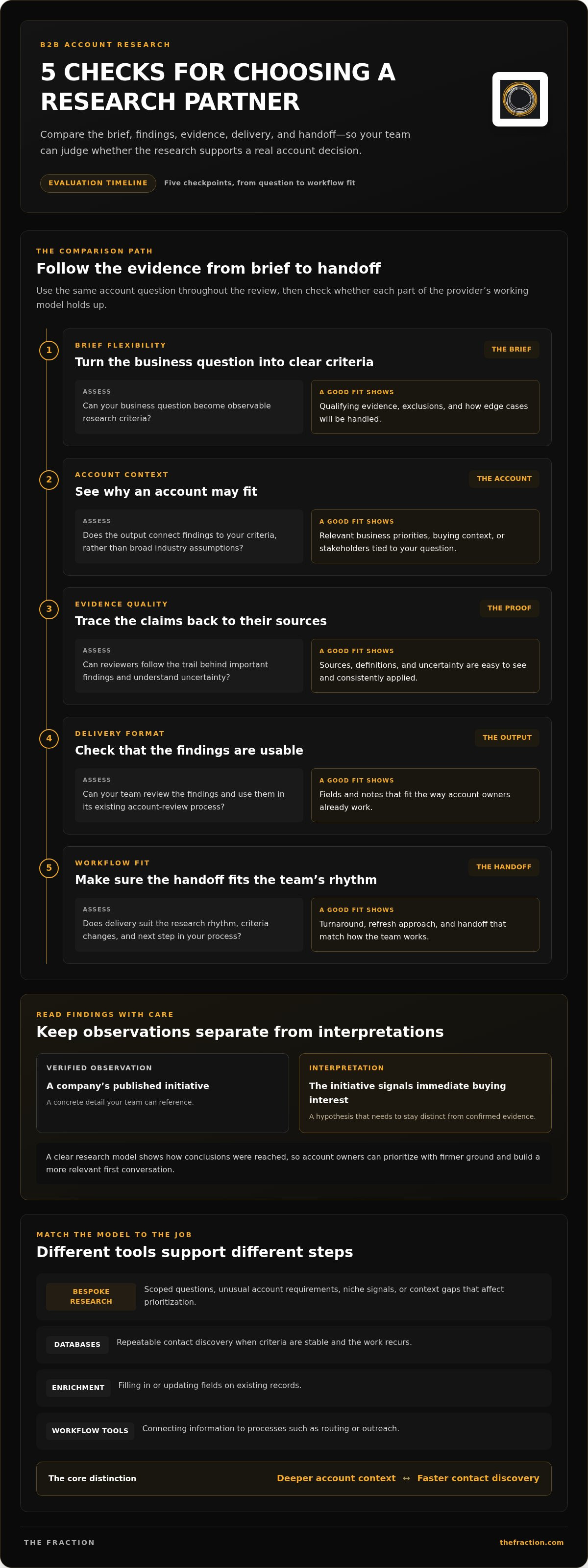
- Compare leadgenius alternatives for bespoke b2b account research by brief flexibility, account context, evidence quality, delivery format, and workflow fit.
- Use a representative pilot drawn from your own account segments to judge whether findings are specific enough to guide prioritization.
- Match the model to the job: bespoke research, broad databases, enrichment, and workflow tools each support a different step.
- When your goal extends to building a consulting pipeline, connect account insight to a clear offer and repeatable client-acquisition process.
Why seek LeadGenius alternatives for B2B account research?
The search usually starts when a team’s research needs outgrow its current way of working. Maybe account owners need richer context to prioritize strategically, or prospecting teams need a steady flow of contacts they can act on quickly. Those are different jobs, so alternatives to LeadGenius range from bespoke research to broad databases, enrichment tools, and workflow orchestration, each bringing a different kind of leverage.
LeadGenius uses a managed model that combines AI and human researchers to build custom B2B datasets around a client’s criteria. Other approaches bring different strengths: databases support repeatable contact discovery, enrichment fills in or updates fields on existing records, and workflow tools connect information to processes such as routing or outreach. The useful distinction is between deeper account context and faster contact discovery. If your team is exploring the first, the principles of Business marketing help frame how organizational priorities and decision-making shape B2B research.
What bespoke account research should help you decide
At the account level, research can clarify fit, surface likely business priorities, reveal relevant buying context, and identify stakeholders connected to your question. Say your team is assessing organizations that may align with a particular service: a company’s published initiative could be a verified observation, while the idea that it signals immediate buying interest remains an interpretation. Keep those categories distinct, and account owners have firmer ground for prioritization and a more relevant first conversation.
That distinction makes findings easier to use, too. Verified observations give the team concrete details to reference; broader industry patterns can help frame a hypothesis, while account-specific evidence shows whether it applies to an individual organization. A clear research model explains how each conclusion was reached, so your team can build a useful picture without mistaking an assumption for a confirmed signal.
When a different research model may fit better
Recurring, large-scale contact discovery may suit a database or enrichment workflow, especially when the criteria are stable and the work repeats. Unusual account requirements, niche signals, or context gaps that affect prioritization may call for a scoped research engagement focused on those questions.
Some teams combine approaches: tools support ongoing discovery, while targeted research fills decision-critical gaps. Others need workflow orchestration to move information into the next step. The comparison ahead focuses on fit, depth, evidence, delivery, and follow-through, giving you a practical way to choose one model, or a combination, around the account decisions your team needs to make.
What to compare in a bespoke B2B account research alternative
Look, a provider’s coverage claim is only a starting point; the sample output shows whether the work lines up with your account criteria. Think of it like a blueprint: the brief, evidence, delivery format, and handoff all need to work together, so your team can use the findings instead of spending time translating them. For leadgenius alternatives for bespoke b2b account research, compare both the deliverable and the working model behind it.
| Dimension | What to assess | What a good fit looks like |
|---|---|---|
| Brief flexibility | Can your business question become clear research criteria? | The scope explains qualifying evidence, exclusions, and how to handle edge cases. |
| Account context | Does the output show why an account may fit? | Findings connect to your criteria rather than broad industry assumptions. |
| Evidence | Can reviewers follow the trail behind key claims? | Sources, definitions, and uncertainty are easy to see. |
| Delivery format | Can your team review and use the findings? | Fields and notes fit the account-review process you already run. |
| Workflow fit | Does delivery suit your team’s research rhythm? | Turnaround, refresh approach, and handoff fit the way the team works. |
Research quality, scope, and evidence
A strong brief turns a business question into something a researcher can observe and assess. Say you’re looking for accounts expanding a particular capability: define what evidence counts, where it might appear, and how uncertain matches should be labeled. The principles behind B2B Market Research make the same practical point: align the research method with the decision you need to make.
Then review a sample against real accounts. Can you trace important findings to sources? Are key terms used consistently, and is missing information handled in a way your team understands? A useful test is whether two reviewers can apply the criteria and arrive at similar prioritization decisions, rather than each reading the output through a different lens.
Delivery, workflow, and operating fit
Custom-service delivery can suit a tightly scoped question, while self-serve tools and automated enrichment can support recurring discovery or record updates. Look at the next step in your process: can account owners filter the output, review the evidence, and move useful findings into their working system without rebuilding the deliverable by hand?
And think about how often your criteria shift. A changing brief may call for an adaptable workflow, while stable, specialized criteria may benefit from a more tailored approach. Compare features, coverage, compliance, integrations, and service terms with the needs of your actual use case, so those details inform the decision rather than a broad claim.
If your bigger challenge is turning account insight into a repeatable consulting pipeline, a consulting client-acquisition system addresses the offer and sales process around that work, alongside your research tools.
Bespoke research, data platforms, and enrichment: which model fits?
Think of the research model as the engine behind a particular job: one approach investigates a specific account question, another helps your team find contacts repeatedly, and another moves information through a workflow. The best fit depends on the decision you’re trying to make, how often the work recurs, and how much interpretation your team can own. That’s the lens to use when comparing leadgenius alternatives for bespoke b2b account research.
Bespoke research
Job: Investigate criteria or context that calls for account-by-account research.
Trade-off: A tailored brief can focus on a narrow question, while the scope and evidence standards need clear agreement.
Best fit when: You need account-specific insight beyond standard fields.
Decision test: What findings would change our account priorities?
Broad B2B database
Job: Find companies and contacts for recurring prospecting.
Trade-off: Broad searchable records can speed discovery, while database fields may leave strategic account questions unanswered.
Best fit when: Your criteria are repeatable and contact discovery is the main task.
Decision test: Does the available coverage match our actual segments and roles?
Enrichment tool
Job: Add or update structured information on records your team already holds.
Trade-off: It can support record completion at scale, while relevance still depends on the fields selected and how matches are interpreted.
Best fit when: Your team has records to improve and a defined use for the added data.
Decision test: Which gaps will this fill, and how will we use the result?
Workflow orchestration
Job: Route, organize, or trigger actions from available information.
Trade-off: It can connect steps in a process, while it depends on sound inputs and clear ownership of follow-through.
Best fit when: The core need is moving research into a consistent operating process.
Decision test: Which decision or handoff will this workflow improve?
When custom research beats a standard data workflow
Custom research can fit when your criteria are nuanced, such as identifying organizations with a particular operating model or a visible initiative that signals alignment with your offer. A prebuilt database may show company size and contact roles, yet leave the strategic “why this account?” unanswered. Give the work a defined scope: specify the question, qualifying evidence, and decision the findings should support.
When data platforms or enrichment are the better fit
For repeatable contact discovery or completing known records, platforms and enrichment workflows can be a more natural engine, especially when teams need structured information for recurring, high-volume tasks. But the team still owns the targeting logic and interpretation: a populated field shows a match to a defined data point, while account priority depends on what that match means for your strategy.
Database breadth and account-specific insight solve related but different problems, like a wide road atlas and a detailed route plan. Compare stated coverage with your target criteria, then judge whether the examples show relevance to those criteria. Broad reach matters when it helps your team identify the accounts and roles it actually wants to pursue.
How to evaluate and pilot a LeadGenius alternative
A useful pilot is a small-scale rehearsal of the decision you’ll make with the research, so give each option the same brief, account examples, and scorecard rather than relying on a polished demo. That makes leadgenius alternatives for bespoke b2b account research easier to compare on the work that matters: relevance, evidence, clarity, usefulness, and fit with your team’s process.
Write a research brief that produces useful findings
Start with the commercial decision, define which accounts qualify, and list the information gaps that keep your team from acting confidently. Rank questions by whether an answer could change account selection or make outreach more relevant, then specify what counts as evidence and how findings should be presented for review. Think of the brief as the recipe: clear ingredients and measures make the resulting work easier to assess.
Run a pilot and judge the output consistently
Choose a representative sample from your own account segments, including straightforward matches and the harder edge cases where criteria need interpretation. Use the same sample and scorecard across options, so differences in results reflect the approach rather than a different test. Before reviewing outputs, agree what relevance, completeness, clarity, and usefulness mean for your team.
- Define the decision. State what the research should help your team decide, such as which accounts to prioritize or which stakeholder role to approach first. Name the action that follows from the answer.
- Write the brief. Describe the target-account definition, required fields, qualifying evidence, and how missing or uncertain information should be labeled. Keep the questions tied to the decision.
- Select representative accounts. Draw examples from the segments you actually target, including accounts with different sizes, business models, or levels of available public context where relevant. Your own criteria should shape the sample.
- Review the evidence. Trace significant findings to their sources, separate observations from assumptions, and record unsupported claims or unresolved gaps. Apply the same standards to every sample.
- Assess the workflow. Check whether the format supports your existing review and action process, and whether the team can use the findings without avoidable reformatting or extra interpretation.
Then judge the results against the agreed scorecard. Did the work identify relevant accounts, provide enough detail to explain its conclusions, and make important gaps visible? Most importantly, did a finding change prioritization or improve the next business action? A complete-looking file can still have limited value if the team reaches the same decisions with or without it.
If the wider goal is building a consulting practice with a repeatable client-acquisition process, that takes work around the offer and sales system as well as account research.
From account research to a repeatable consulting-client acquisition system
Account research helps you understand which organizations may fit and what could make a conversation relevant; a consulting-practice build-out solves the broader challenge of turning your expertise into a clear offer and a dependable way to bring that offer to market. Think of research as a set of useful coordinates, while the acquisition system is the route, vehicle, and operating rhythm that help you move forward. Comparing leadgenius alternatives for bespoke b2b account research answers one question; building a consulting pipeline asks a larger one.
When an independent expert needs more than account data
For experienced professionals, the signal often appears in the business itself: positioning still feels broad, opportunities arrive inconsistently, or a deep body of expertise remains difficult to package into a compelling service. More account data can help identify whom to approach, but it won’t by itself determine what the offer should promise, how it should stand apart, or how a prospect moves from first conversation to a decision.
Research can still play a valuable role. Patterns across target accounts may sharpen the problem you address, reveal language buyers use, or help you prepare a more relevant conversation. Use those observations as input for offer direction and positioning, then connect them to a client-acquisition process. For a related perspective, explore guidance on lead generation for fractional leaders.
What a supported business build-out includes
The Fraction co-builds fractional consulting practices across offer development, client acquisition, and a systematized sales funnel, with work that can extend from the initial offer through delivery. That makes it relevant when an independent expert’s challenge has moved beyond identifying accounts and into assembling the business architecture around a consulting service. The focus is the practice and its acquisition system, rather than a database or a direct substitute for bespoke research.
Market research can inform offer direction, too. The custom Proof of Concept includes interviews with 10 industry leaders before payment; those interviews help explore the direction of the offer, which is a different purpose from researching a particular list of target accounts. That distinction matters, because one informs what you bring to market while the other helps you investigate who may be a fit.
The 30-Day System Build Guarantee applies to the system build, while the lead-generation assurance is conditional on active effort. Those guarantees cover the system and lead-generation support, not a promise of client wins or revenue; the value lies in building the offer and acquisition infrastructure with support, then putting that system into practice. For professionals ready to create a more deliberate path from expertise to client conversations, The Fraction’s structured program can be the next step.
Turn your next decision into a stronger consulting practice
The right research approach should create momentum beyond the spreadsheet, helping you see where your expertise can make a difference and what kind of business you want to build around it. As you evaluate leadgenius alternatives for bespoke b2b account research, keep the bigger choice in view: are you refining how you identify accounts, or are you ready to shape a more complete path from your experience to client conversations?
For an experienced professional, that path can begin with a clearer point of view, grow into an offer that speaks to a defined need, and develop into a sales process that feels natural to both sides. You don’t need every piece mapped out before moving forward; you need a deliberate next step and a willingness to build on what you learn.
Your expertise can become the foundation for a focused, independent practice, and thoughtful choices now can help you build that next chapter with greater clarity and confidence.
Frequently Asked Questions
What is the best LeadGenius alternative for bespoke B2B account research?
The best fit depends on whether your central need is account-specific insight or repeatable contact discovery. For a narrow market where you need to understand why individual organizations may fit, assess bespoke research against a defined business question; for recurring searches across familiar segments, a data platform may be more practical. The strongest leadgenius alternatives for bespoke b2b account research produce information your team can use to make a real decision.
How is bespoke account research different from B2B data enrichment?
Bespoke research investigates a question about a target account, while enrichment adds or updates defined data fields on records you already have. For example, enrichment might fill in a company’s industry or a contact’s role; bespoke research could examine whether a company shows evidence of a particular strategic priority. The first improves record completeness, while the second helps you interpret an account in relation to a specific opportunity.
Can a B2B database replace custom account research?
A database can replace custom research for tasks its standard fields answer well, such as finding contacts by role or organizing companies by established criteria. It may leave a gap when your team needs context that requires investigating a specific account or interpreting less-standard information. Before deciding, compare a sample of records with the questions behind your target list and identify which unanswered questions would change your next action.
What should a bespoke account research brief include?
A strong brief states the business decision, defines which accounts qualify, and explains what evidence would count as a meaningful match. Add examples of clear matches and edge cases, plus exclusions that prevent broad or irrelevant results. Specify how uncertain findings should be labeled, what to do with unavailable information, and how the team will review the final output. This gives everyone a shared standard for judging the work.
How do I evaluate the quality of B2B account research?
Check whether a reviewer can trace important findings to supporting evidence and distinguish direct observations from interpretation. Then compare records against your own criteria: a useful result should explain why an account merits attention, rather than merely repeat general company information. Keep a simple review log of mismatches, unclear sources, and decisions the findings influenced. That makes quality easier to assess across accounts and future research rounds.
Is The Fraction a LeadGenius alternative?
The Fraction serves a different need: it co-builds a fractional consulting practice, including the offer and client-acquisition system, rather than supplying account data or bespoke research. That can be relevant to experienced professionals who have expertise to take to market and need a more structured path from positioning to client conversations. If the broader challenge is building a consulting business, explore The Fraction’s client-acquisition program.


