

So, if senior marketing direction is the next piece your business needs, a fractional leadership marketing strategy brings an experienced marketing leader into the room on a part-time or project basis, often for 10-20 hours per week, shaping the plan and helping the work move. Think of it like bringing an architect into the build, someone who can help set the direction while your business keeps growing.
If you’re weighing an agency, a consultant, or more leadership inside the business, the distinctions matter: each plays a different role. This guide explains fractional marketing, how its leaders differ from agencies and consultants, and what a fractional CMO does, so you can decide which approach fits your team and goals.
Key Takeaways
- Fractional marketing leadership brings experienced strategic direction into a business on a part-time or project basis, with the scope shaped around its needs.
- Understand how a fractional leader’s ongoing strategic role differs from an agency’s delivery capacity and a consultant’s focused advice.
- See how a fractional CMO can set marketing priorities, guide a team, and connect execution to broader business goals.
- Assess how specialized expertise and cross-industry perspective can help address gaps in your current marketing capabilities.
- Use your growth priorities, existing team, and need for hands-on leadership to judge whether a fractional model fits.
What Is Fractional Marketing?
Fractional marketing brings experienced leadership into a business on a part-time or project basis. It provides senior direction while shaping the role around current needs. Think of the leader as an architect: they set the design, connect the moving parts, and keep the work focused on business goals. A fractional leadership marketing strategy can suit a company that needs clearer marketing ownership and wants to scale its efforts deliberately.
How many hours per week does a fractional marketing leader typically work? Fractional marketers commonly commit 10-20 hours per week, with the scope shaped around the company’s priorities. That can mean ongoing strategic input, support during a launch, or leadership focused on a specific project. The useful question is which decisions need senior attention and how much time the team needs to turn them into action.
Here’s one reason businesses weigh this model: according to the U.S. Bureau of Labor Statistics, the median annual wage for a marketing manager in the United States was $166,790 in May 2025, before benefits, payroll taxes, and recruiting costs. That figure gives context for a full-time hire, while fractional leadership lets a business shape the role around the expertise and effort it needs now.
Support can flex as business priorities shift. A company preparing a product launch may need concentrated planning and coordination, then a different level of guidance as execution moves forward. Another business may focus on messaging, pipeline, or campaign decisions. For companies with annual revenue between $10 million and $200 million, comparing a one- or two-hire marketing model with available budget can clarify whether senior leadership or execution capacity is the bigger need.
Integration works best when the leader has a defined place in the operating rhythm. Start by naming the business goal, assigning ownership for each marketing activity, and agreeing how decisions reach the team. For example, the fractional leader might align campaign priorities with the CEO, coordinate staff and freelancers, and review progress in regular planning meetings. Clear ownership turns strategy into customer-facing work.
A fractional CMO is a senior marketing executive engaged on a part-time or project basis, with responsibilities tied to the company’s goals. Start by identifying the leadership gap: does the business need clearer direction across audience, offer, and channels, or more hands for defined tasks? For example, a company seeking better lead generation can align its audience, service offer, and sales process, then use that direction to guide the team.
Differences between a fractional leader, agency, and consultant
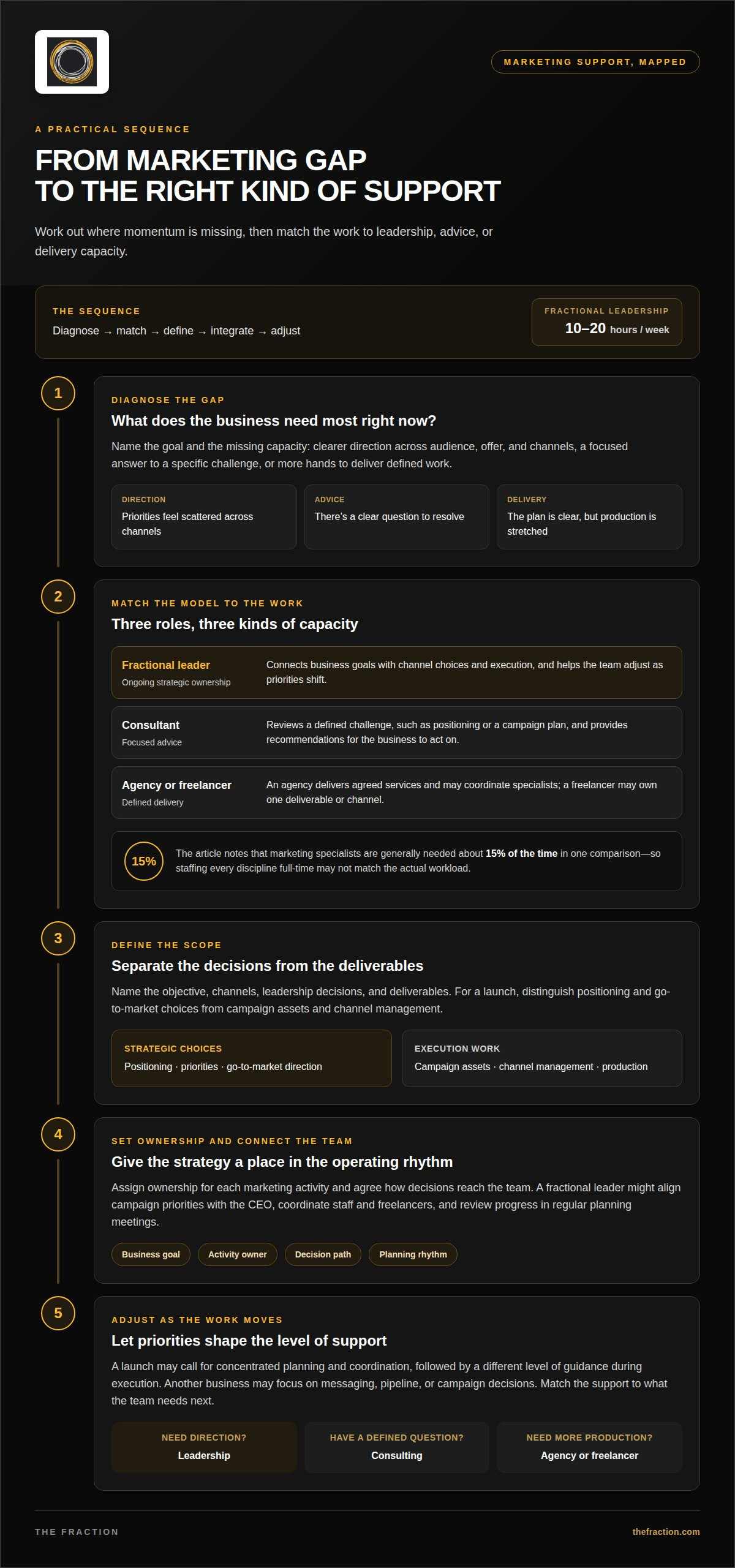
These three models provide different kinds of capacity, so start with where your business needs help. A fractional leader provides ongoing strategic ownership, an agency delivers agreed services, and a consultant offers focused advice. For a product launch, the leader might align priorities, the agency build and run campaigns, and the consultant review the plan. Each brings a different role and kind of momentum.
A fractional leader works with your existing team to connect business goals with channel choices and execution. An agency usually owns a defined scope, such as paid media or content production. That delivery capacity can be valuable, but the company may still own the broader strategy. If your team’s work is spread across channels without shared direction, establish leadership and alignment before adding more production.
A consultant typically focuses on a specific challenge, such as reviewing positioning or assessing a campaign plan, then provides recommendations for the business to act on. This can suit a clear question with a defined endpoint. A fractional leader remains involved as priorities shift, helping the team turn advice into ongoing action and adjust direction as needs change. Think of a consultant as mapping one route, and a leader as helping the team stay on course.
Freelancers and agencies also bring different shapes of support. A freelancer may own one deliverable, such as a landing page or a single channel, while an agency can coordinate several specialists and broader campaign production. A fractional team pairs leadership with specialized contributors, bringing in the right expertise for the work. In one comparison, marketing specialists are generally needed about 15% of the time, so staffing every discipline full-time may not match the actual workload.
Compared with an in-house team, fractional support balances continuity with flexible capacity. An employee can stay close to daily operations and customer feedback, while a fractional leader provides senior direction across internal staff and freelancers. If execution is strong but priorities feel scattered, leadership may be the gap. If the plan is clear but production is stretched, more delivery capacity may matter more.
Before choosing a fractional marketing agency or team, define the gap you need to close. Name the objective, channels, leadership decisions, and deliverables. For a launch, separate positioning and go-to-market choices from campaign assets and channel management, then clarify who owns each decision and how progress connects to growth. A clear scope helps you choose the right support and set expectations from the start.
Once you’ve mapped the gap, match the model to the work: ongoing direction calls for leadership, a defined question may call for consulting, and production needs may call for an agency or freelancer. If a stronger offer is central to your growth plan, explore strategic growth support as a related next step.
What Are a Fractional CMO's Roles & Responsibilities?
A fractional CMO connects business priorities with marketing decisions, then helps the organization move from planning to execution. Responsibilities may include setting priorities, guiding the marketing team, coordinating vendors, and reviewing results with company leadership. Think of them as a conductor: specialists play different parts, while the leader keeps the work aligned around a shared commercial objective.
How does a fractional marketing leader develop a marketing strategy? They clarify the company’s goals, audience, offer, current marketing activity, and available resources, then turn those findings into priorities and an execution plan. For example, a business focused on customer engagement might align messaging, channel choices, campaign ownership, and performance measures around that goal.
What should a fractional marketing leadership engagement include? It should define business goals, scope, decision-making responsibilities, team and vendor roles, and a regular review rhythm. A practical structure might include weekly planning, brief progress reviews, and a monthly review of changes, keeping leadership and execution connected.
The fractional CMO can build and guide a team to execute a marketing map for the next 60 days, then provide an updated plan and execute it every 90 days thereafter. That cadence gives the team a clear near-term direction while leaving room to adjust as business needs evolve. During a product launch, for instance, the leader can coordinate campaign planning across internal staff and freelancers.
Team transformation often starts with clearer ownership, not more hiring. A responsibility map can show who approves messaging, creates campaign assets, manages channels, and reports progress. If a content specialist and an agency each assume the other owns final approval, work stalls. A fractional leader can clarify handoffs and ensure each brief specifies its audience, purpose, deliverable, and approver.
What are the risks and limitations of fractional marketing leadership? A fractional leader contributes focused time, so urgent decisions may wait if schedules, access, or internal approvals slow the work. The model also depends on employees or vendors to complete agreed tasks, making unclear ownership and weak follow-through practical risks. It works best when the organization assigns internal contacts and gives them authority to move work forward.
Managing vendors is another responsibility: a fractional CMO can connect agency or freelancer work to the broader marketing plan, review briefs, and flag conflicting priorities. They might guide a digital campaign for brand awareness and customer engagement while a specialist handles production. Focused time each week can keep projects moving, but the organization still needs clear points of contact and timely decisions.
Specialized expertise and cross-industry experience
Specialized expertise helps a business connect marketing objectives with the skills needed to execute them. Cross-industry experience can offer fresh perspective, but the right fit still depends on your audience, offer, and growth priorities.
Strategic Expertise and Specialized Skills
A fractional leader combines senior marketing judgment with practical knowledge of how different capabilities work together. They might assess positioning, content, paid acquisition, or customer engagement, then identify which skills matter most to the business objective. The value is coordination: rather than treating every channel as a separate project, the leader can shape a strategy in which specialists’ work supports a shared direction.
Consider a company with strong content production but weak lead flow. It may need to clarify its offer, align content with buyer intent, and improve how leads move toward sales. Another organization may have campaigns underway but unclear audience priorities. In that case, research and positioning expertise can sharpen the message before the team adds more channel activity.
On-Demand Access to Marketing Expertise
On-demand access means bringing in specialized marketing skills when a business need calls for them, rather than hiring every discipline full-time. A launch, for example, may require coordinated messaging, campaign planning, and channel execution, while a later phase may need a different mix. This flexible approach matches expertise to current objectives and focuses attention on work with a clear strategic purpose.
This model can also help a smaller marketing team identify capability gaps before adding permanent roles. A fractional leader can assess the work, clarify which skills are needed, and guide internal staff or external specialists. Start with a defined brief: specify the audience, objective, deliverable, owner, and measure of progress so expertise translates into action.
Cross-industry experience can be useful because marketing disciplines often transfer across business contexts. A leader who has worked in different sectors may bring approaches to positioning, customer research, or campaign measurement that the current team hasn’t considered. Still, sector familiarity matters when buying behavior, sales cycles, or customer expectations shape the strategy. Compare a leader’s experience with the specific decisions your business needs to make.
Assess experience by looking at the problems a leader has owned and the work they can explain. Ask how they diagnosed an audience challenge, chose channels, coordinated execution, and evaluated results. A strong example links a clear objective to a measurable outcome and explains the leader’s contribution rather than relying on a broad success claim.
Marketing executive capability is specialized: roughly one in 100 effective marketers has the skills to move into an executive marketing position. For a business, that distinction matters when evaluating whether someone can set direction as well as deliver a specialist task. Match the leader’s demonstrated strengths to your objectives, then define how the team will turn that expertise into measurable execution.
Fractional marketing leadership and roles
Fractional leadership works best when the role addresses a specific business need. The leader can set direction, coordinate execution, and connect marketing efforts to revenue objectives, while the company’s team and specialists handle defined work.
Commitment and scope should match the work. A company building its marketing function may need ongoing leadership, while one with a clear plan may need focused support to maintain momentum. Some engagements use focused days each month to reset direction and guide priorities. The practical question is which decisions need senior ownership and which tasks already have capable owners.
Roles can change as the business develops. Fractional support may begin as temporary help, then shift to more in-house execution, light advisory support, or a full-time hire. For example, a leader might clarify positioning and establish priorities, then help an internal marketing manager take ownership of delivery. This makes the engagement a flexible part of the organization’s design.
Clear ownership keeps the model useful. A role map can distinguish responsibilities such as:
- Direction: connect marketing objectives to company growth and revenue priorities.
- Coordination: align employees, freelancers, and agencies around agreed work.
- Measurement: review pipeline and revenue signals through one shared scorecard.
- Transition: prepare internal owners to lead work as the engagement changes.
A shared scorecard gives the CEO and marketing team a common view of progress. Lead with pipeline and revenue measures, then include supporting indicators that explain performance. If a campaign attracts attention but few qualified opportunities, investigate audience fit, messaging, or the next step in the sales process. That evidence helps focus effort on work tied to business goals.
Fractional leaders also shape how decisions move through the organization. If an agency, freelancer, and internal marketer each own a channel, someone needs to connect their work to shared priorities. The fractional leader can establish a decision rhythm, clarify who approves changes, and surface dependencies before they delay execution.
The strongest commitment is active and shared. Leadership can set direction, but employees and vendors still need to carry out agreed responsibilities and share timely feedback. Define who owns approvals, data, and follow-through, then revisit those assignments as needs evolve. This makes the arrangement a working part of the organization, not an isolated advisory layer.
The Fraction: Automated & AI lead generation systems
The Fraction helps professionals build a clearer path from marketing interest to client conversations with automated, AI-driven lead generation systems. When strategy is in place but attracting and converting prospects remains a challenge, strengthening the offer and the process that guides prospects toward a decision may be the next step.
The Fraction also develops a sales process that doesn’t feel like selling, alongside a compelling offer and service designed to help win clients quickly. These elements work together: the offer gives prospects a reason to engage, lead generation creates a path to discovery, and the sales process supports a natural conversation.
If you’re ready to strengthen how your business attracts and wins clients, contact The Fraction to discuss your next step.
Turn your marketing direction into your next move
Start by identifying where growth needs a stronger bridge: attracting qualified prospects, communicating your value, or moving conversations toward a decision. A fractional leadership marketing strategy becomes useful when it connects clear direction with consistent action, helping your team focus on the work that matters most.
The Fraction supports that path with automated, AI-driven lead generation systems, a sales process that doesn’t feel like selling, and a compelling offer and service designed to help win clients quickly. The pieces work together: the offer gives prospects a reason to engage, lead generation helps create opportunities, and the sales process guides the conversation.
If you’re ready to explore how these priorities could fit your business, start a conversation about the client acquisition challenge you want to address. A clear next move can turn strategy into focused momentum, giving you a practical place to build from.
Your next stage of growth can begin with one deliberate, well-chosen step.
Frequently Asked Questions
Is A Fractional CMO Right For Your Business?
A fractional CMO may fit when your business needs senior marketing decisions but your team lacks a clear owner for them. If campaigns are underway but audience, offer, or channel priorities keep shifting, experienced leadership can help create alignment. The model suits organizations ready to share information, make decisions, and assign people to carry out agreed work. If you need only one specialist deliverable, a narrower arrangement may be a better fit.
How Does Hiring a Fractional CMO Work?
Start by defining the business challenge and the decisions that need experienced ownership. Clarify your goals, team structure, access to customer and performance information, and the leader’s authority to guide work. Then agree on responsibilities, communication rhythm, and how you’ll review progress. For example, a business entering a new market could align the CMO’s work with audience research, positioning decisions, and the internal owners responsible for launch execution.
How Much Does a Fractional CMO Cost?
The price depends on the case and is provided after a quote request. Key cost factors include the scope of leadership, expected time commitment, business complexity, and whether the engagement covers strategic guidance, team coordination, or hands-on execution. A focused positioning review requires a different level of involvement from ongoing leadership across several marketing priorities. Define the outcomes and responsibilities first so the proposed engagement reflects the work your business needs.
How do I know if a fractional team is working?
A fractional team is making progress when its efforts advance agreed business outcomes and the team can explain what is changing. Review pipeline and revenue alongside supporting signals, such as qualified inquiries, campaign response, or progress through the sales process. Compare results with the starting position and discuss what the evidence suggests in regular reviews. For example, rising inquiry volume with few sales conversations may point to an audience or offer mismatch.
What Are the Duties of a Fractional CMO?
A fractional CMO helps align marketing choices with the company’s commercial priorities. Duties may include assessing market positioning, prioritizing initiatives, allocating resources, advising the CEO, and coordinating internal specialists with external vendors. If a business plans to enter a new segment, for example, the CMO can help assess the audience, shape the message, and coordinate the teams responsible for reaching that market. The remit depends on the organization’s goals and needs.
What Does Fractional CMO Mean?
A fractional CMO is a chief marketing officer who works with a company on a part-time or project basis, bringing senior marketing responsibility into the organization without taking a full-time role. “Fractional” describes how the leadership capacity is engaged; “CMO” describes the executive marketing remit. The leader might guide company-wide positioning and priorities while an existing marketing manager oversees routine campaign tasks.
What Skills Does a Fractional CMO Need?
A fractional CMO needs strategic judgment, clear communication, and the ability to connect marketing activity with commercial goals. Useful capabilities include audience research, positioning, channel planning, budget prioritization, analytics, and team leadership. The leader also needs to turn complex choices into clear decisions. For example, they should explain why a campaign targets a particular audience, what response it aims to generate, and what evidence will inform the next move.
What is fractional marketing leadership?
Fractional marketing leadership uses part-time or project-based senior expertise to guide a company’s marketing direction and related work. A fractional leadership marketing strategy can clarify how marketing priorities support business goals and give existing employees a stronger framework for execution. For example, a company with several active channels can use senior guidance to align messaging and decide which efforts deserve attention first.


