

A new outreach platform can give you more ways to reach prospects, but a clear offer and a well-chosen audience give those prospects a reason to respond. So if you’re weighing growbots alternatives for automated sales outreach, start by asking whether software is the bottleneck or whether the strategy behind your outreach needs work. When your expertise and reputation are on the line, it makes sense to want targeting, messaging, and follow-up to fit together instead of feeling like separate jobs.
This comparison will help you identify the route that fits your audience, your sales process, and the time you can put into it, so you’re comparing more than feature lists and activity levels. We’ll look at outreach platforms alongside the broader work of building a client-acquisition system, including how offer clarity, prospect selection, and human-reviewed automation work together. Think of software as one section of a bridge between a relevant prospect and a worthwhile conversation…when the other sections are solid, outreach has a stronger foundation for becoming a repeatable way to find clients.
Key Takeaways
- Choose among growbots alternatives for automated sales outreach by identifying whether you need different software, more execution support, or a stronger acquisition system.
- Evaluate each option against your desired outcome, audience, channel, workflow, and ownership needs so the platform fits your sales motion.
- Compare alternatives by operating model, from managed outreach and multichannel sequencing to data-led prospecting, rather than relying on feature lists alone.
- Protect outreach momentum during a switch by documenting your process, preserving essential assets, and testing a defined segment against consistent measures.
- A done-with-you approach can connect offer development, targeting, automation, and sales flow while leaving you with the systems and infrastructure you build.
Why consider Growbots alternatives for automated sales outreach?
Looking at growbots alternatives for automated sales outreach usually starts with a practical decision: replace the software, change how outreach gets executed, or rebuild the client-acquisition process around a clearer offer and better-fit prospects. Those are three different jobs, so naming the one you need keeps you from getting pulled toward features that solve a different problem.
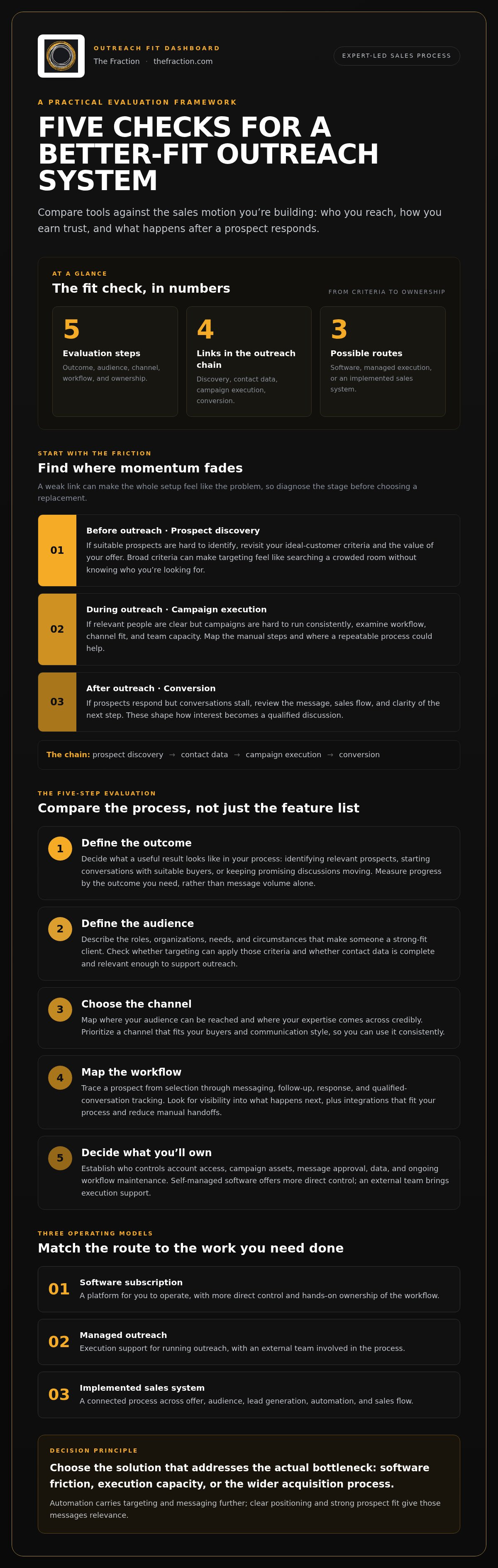
A software subscription gives you a platform to operate; a managed outreach service adds execution support; an implemented sales system connects your offer, audience, lead generation, automation, and sales flow into a working process. Each model calls for a different level of ownership and hands-on work. An independent expert, for example, may want close control over how their expertise is presented, while a team with established positioning may mainly need a smoother way to run campaigns.
An outreach alternative is the tool, service, or system that solves the specific point of friction between identifying a suitable prospect and starting a qualified conversation. That’s a more useful test than counting features, because automation carries your targeting and message into more inboxes, while clear positioning and good prospect fit give those messages relevance.
What problem are you actually trying to solve?
Think of outreach as a chain with four links: prospect discovery, contact data, campaign execution, and conversion. When one link breaks, it can look like a problem somewhere else, so find where momentum fades before replacing the whole setup.
- Before outreach: If the right prospects are hard to identify, revisit your ideal-customer criteria and the value of your offer. Broad criteria make targeting feel like searching a crowded room without knowing who you’re looking for.
- During outreach: If you can identify relevant people but struggle to run campaigns consistently, workflow, channel fit, or team capacity may be the constraint. Map the steps that require manual effort and see where a repeatable process would help.
- After outreach: If prospects respond but conversations fail to progress, examine the message, sales flow, and clarity of the next step. These shape how interest becomes a qualified discussion.
Contact data, campaign features, and automation support the process, but strategic judgment identifies strong-fit buyers and a clear service offer makes the value easier to understand. Get those choices right and every step that follows has a stronger foundation.
When does switching tools make sense?
A switch can make sense when the current workflow creates avoidable friction, your outreach channels have changed, or your team needs a different balance of control and execution support. For a solo expert, a complex team-oriented workflow may add overhead; for a team coordinating outreach, a limited process may create handoffs and gaps.
A platform mismatch and a sales-process issue call for different responses. If the tool can’t support the workflow you’ve defined, comparing alternatives is sensible. If your offer, audience, or conversion path remains unclear, switching may only give the same uncertainty a fresh interface. Diagnose the bottleneck first, then decide whether new software, changed execution, or a more complete acquisition system is the right move.
How to evaluate Growbots alternatives for an expert-led sales process
For an expert-led business, the right platform should fit the way you earn trust and turn your expertise into client conversations, so start with the sales motion you want to support rather than a long feature checklist. Outreach-tool fit depends on how well the audience, offer, channel, and process work together. A system built for a high-volume sales team can feel like an elaborate cockpit when your work calls for focused, personal conversations.
Use these five steps to compare growbots alternatives for automated sales outreach against the business you’re actually building:
- Define the outcome. Decide what a useful result looks like in your process, such as identifying relevant prospects, starting conversations with suitable buyers, or keeping promising discussions moving. This gives you a clearer measure than simply counting sent messages.
- Define the audience. Describe the roles, organizations, needs, and circumstances that make someone a strong-fit client. Then assess whether your targeting process can apply those criteria and whether the contact data is complete and relevant enough to support your outreach.
- Choose the channel. Map where your audience can be reached and where your expertise comes across credibly. Prioritize a channel that suits your buyers and communication style, so you can use it consistently.
- Map the workflow. Follow a prospect from selection through messaging, follow-up, response, and qualified-conversation tracking. Look for visibility into what happens next, along with integrations that fit your existing process and reduce manual handoffs.
- Decide what you’ll own. Establish who controls account access, campaign assets, message approval, data, and ongoing workflow maintenance. Self-managed software may give you more direct control, while an external team may take on parts of execution; either way, understand how the process will work day to day.
Which evaluation criteria matter beyond features?
Look at the complete path from ideal-customer criteria to a relevant message and then a tracked conversation. Can you adapt the message for different segments and connect it to the service you actually offer? Can you see whether follow-ups happen and whether a response becomes a qualified discussion? For broader context on connecting targeting and automation, explore this AI-driven lead generation strategy. Compare capabilities using current product materials or a demonstration, and separate confirmed product details from assumptions in comparison articles.
How should consultants weigh automation against control?
Self-managed software puts campaign operation in your hands, while an external team can support execution; the right balance depends on your capacity and how closely you want to review each message. For a consultant whose reputation rests on judgment and expertise, approval, asset ownership, and maintenance deserve as much attention as automation. Let technology carry repeatable steps, while your offer and positioning lead the conversation.
If you’re building a consulting practice and want the offer, targeting, automation, and sales flow designed as one connected system, explore The Fraction’s done-with-you implementation approach.
Growbots alternatives compared: software, managed outreach, and sales systems
The alternatives fall into different operating models, so the useful comparison is what each one takes responsibility for and what remains yours. A platform can support execution, a managed service can add hands-on campaign support, and a system implementation can connect your offer, audience, lead generation, automation, and sales flow. Those routes solve different problems, even when they all sit under the broad search for growbots alternatives for automated sales outreach.
| Category | Operating model | Best-fit need | Likely trade-off and ownership |
|---|---|---|---|
| Managed outreach | An external team supports outreach execution alongside strategy. | Teams that need help carrying campaigns forward. | Clarify who approves messaging, controls campaign assets, and maintains the process. |
| Multichannel sequencing | Software organizes outreach across planned touchpoints or channels. | Teams with defined audiences, offers, and messaging that need a repeatable workflow. | Your team still owns the strategy, message quality, and day-to-day oversight. |
| LinkedIn-focused automation | Tools emphasize outreach through LinkedIn. | Sales motions centered on that channel. | Channel focus shapes the workflow; ownership and execution remain important considerations. |
| CRM-led outreach | Outreach is organized around customer and pipeline records. | Teams prioritizing pipeline visibility and sales-process management. | Records alone don’t define the offer or create a relevant prospect conversation. |
| Data-led prospecting | Prospect discovery and contact data are central to the approach. | Teams that need to build or refine prospect lists. | Data still needs clear fit criteria and a message grounded in the service offer. |
| Implemented sales system | Strategy and infrastructure are built to work together. | Experts who need a connected client-acquisition process. | Implementation requires active collaboration; it isn’t a standalone software subscription. |
Which alternative category fits each sales motion?
Choose managed outreach when campaign execution support matters alongside strategic input; consider sequencing software when your team already has its audience, offer, and messages defined. A CRM-led approach suits teams that want pipeline records and sales-process visibility, while LinkedIn-focused tools suit a motion built around that channel. Data-led prospecting addresses list-building needs, but your business still defines what makes a prospect a good fit.
How do named alternatives differ in the available comparison?
Dux-Soup is a LinkedIn-focused option, while HubSpot Sales Hub is CRM-led; Salesforge, Lemlist, and Expandi are also among the tools commonly considered in this category. Reply.io and Close appear in broader alternatives lists, while Apollo.io combines a contact database with sequencing. These descriptions help distinguish categories, but product capabilities can change, so compare each tool’s current features with your workflow before making a decision.
The Fraction belongs in a separate category: it’s a done-with-you system-implementation option, not a Growbots-like software product. The work connects offer development, ideal-customer segmentation, lead generation, automation setup, and a systematized sales funnel, with clients retaining their systems, automations, content, and infrastructure. Think of it as building the operating structure around the tools, rather than adding another tool to the shelf.
How to switch from Growbots without losing outreach momentum
A platform change can feel like rebuilding a bridge while people are still crossing it, so treat the transition as a controlled handoff: preserve what works, test what you’re changing, and keep a person close to the conversations. Before comparing growbots alternatives for automated sales outreach, define what success means for the switch, so more campaign activity doesn’t get mistaken for better progress.
What should you document before changing systems?
Write down how your current outreach actually runs, including audience segments, the logic behind each message, the follow-up sequence, and any handoffs from outreach to a sales conversation. Record the assets and process knowledge you’ll need during the move, such as approved messaging and the criteria used to qualify a prospect. This turns an informal routine into a map your team can follow during the transition.
Before moving campaigns, establish a baseline that reflects both activity and quality. Depending on what you currently track, that could include prospects contacted, replies, qualified conversations, or where follow-up tends to stall. Keep the measures consistent across the old and new workflows, and you can judge whether the change improved the path to a real conversation rather than simply increasing output.
How can you test a new outreach approach responsibly?
Start with a defined audience segment and a clear hypothesis, such as whether a more specific service message will lead to better-fit responses. Then follow a deliberate sequence:
- Document the workflow. Capture targeting rules, message logic, follow-ups, handoffs, and current measures before making changes.
- Preserve essential assets. Keep the data, messaging, and process details you need accessible throughout the transition.
- Select a test segment. Choose one audience you can describe clearly, and identify the change you want the test to assess.
- Review the evidence. Have a person assess whether prospects fit, the message reflects their likely needs, and replies are becoming meaningful conversations.
- Adjust before expanding. Use what you learn to refine audience criteria, offer language, or follow-up before applying the approach more broadly.
Keep the review grounded in what prospects actually say and do. A response can reveal a mismatch between the audience and the offer, a question the message leaves unanswered, or a useful next step for the sales conversation. That feedback is part of the transition, not noise around it. For more context on connecting outreach workflows with a broader professional-services sales process, explore this professional service sales automation framework.
If you want the offer, targeting, outreach, and sales flow built as connected infrastructure, explore done-with-you system support.
Build a complete automated outreach system with The Fraction
Sometimes the missing piece is bigger than another outreach platform. If you’re an experienced professional building or strengthening a consulting practice, The Fraction helps connect your offer, the right audience, outreach, and sales flow, so each part works like a joined-up bridge from your expertise to a client conversation. This is a done-with-you implementation model: you help shape the system, and the work turns strategy into practical client-acquisition infrastructure.
What does a system-building approach include?
The work brings together offer development, ideal-customer segmentation, lead generation, automation setup, and a systematized sales funnel. LinkedIn Sales Navigator supports prospect targeting, with automation configured as part of the wider workflow; the approach is built around your audience and offer rather than assuming one software product suits every practice. You retain access to your accounts and ownership of the systems, automations, content, and infrastructure built through the process.
There’s also a research foundation before implementation moves forward. Through a custom proof-of-concept process, you receive a personalized market-research strategy before payment, including interviews with 10 industry leaders using a provided framework. That gives the offer and targeting work a stronger starting point, so the system is shaped around the market you’re preparing to serve instead of assembled from generic campaign templates.
The 30-Day System Build Guarantee provides a full refund if the complete system isn’t built within 30 days. It covers completion of the system build, while each client’s commercial results depend on their offer, audience, execution, and the conversations they develop.
Who is this implementation approach designed for?
This approach is designed for experienced professionals who are ready to translate their expertise into a consulting practice and want support building the structure behind client acquisition, rather than simply subscribing to another platform. Think of it as co-building the workshop, tools, and operating plan, not purchasing a machine and expecting it to run the business by itself.
That distinction matters. Offer clarity, audience choices, and sales conversations still call for your judgment and participation; automation can carry repeatable parts of the process, but your expertise needs to meet the right buyer. So if you want implementation across positioning, targeting, outreach, and sales flow, this may fit better than a software-only alternative. If you’re looking for a passive subscription with no involvement in building or running the process, this model serves a different need.
Explore The Fraction’s system implementation to see how a done-with-you build can support your consulting practice.
Build an outreach engine that grows with your practice
Your next move can be smaller and more strategic than a complete platform overhaul: choose the part of your client-acquisition process that deserves attention first, then build a rhythm for improving it as your expertise, offer, and understanding of the market develop. That way, your outreach becomes a living business asset, shaped by real conversations rather than a set of campaigns left running on autopilot.
As you weigh growbots alternatives for automated sales outreach, keep the bigger ambition in view: creating a practice where the right people understand the value you bring, recognize how you can help, and can take a natural next step. Technology can support that journey, while your judgment and expertise give it direction. The strongest path is one you can understand, operate, and refine with confidence.
Your experience already has value. With a deliberate system behind it, you can build a more confident path from expertise to meaningful client conversations.
Frequently Asked Questions
Is Growbots a good fit for consultants?
Growbots may suit a consultant who values its service model, while another may prefer self-managed software or a complete client-acquisition system. Start by clarifying your offer and the audience it serves, then consider how much control you want over targeting, messaging, and follow-up. Compare the operating model with your working preferences and available capacity, so the choice supports how you want to build client relationships.
Can Growbots alternatives automate both email and LinkedIn outreach?
Alternatives serve different channel use cases, and the exact capabilities depend on the platform and its configuration. Compare the channels and workflow each tool supports with the routes your audience uses. Combined channels can support a thoughtful follow-up rhythm, but personalized messages and clear targeting still matter more than simply appearing in more places.
How do I choose the right Growbots alternative for my business?
Start with the outcome you want, your ideal customer, the channels you’ll use, who will own the workflow, and how much time you can give it. Then compare growbots alternatives for automated sales outreach against those needs instead of choosing by feature count. For consultants, test whether your offer addresses a real client problem and whether the process guides a relevant prospect from first message toward a qualified conversation.
What should I do before switching from Growbots?
Before switching, record your current audience segments, message logic, follow-up steps, essential assets, and baseline measures, so you have a reliable reference point. Choose a focused group of prospects and decide what improvement would look like before moving the workflow. During the test, review whether the message feels relevant to the audience and whether replies lead to useful conversations. Expand after you’ve learned what the new approach changes.
Is a sales outreach tool enough to generate qualified consulting leads?
A sales outreach tool can organize or automate parts of prospecting, while lead quality also depends on who you target, how you position your expertise, the service you offer, and how you follow up. Picture a relay: the tool can carry one leg, but the full process needs each handoff to work. Track progress through relevant conversations and buyer fit, not just the number of messages sent or contacts added.
Can I build an outreach system while staying employed?
Yes, outreach can be scheduled for evenings and LinkedIn activity can be structured to avoid employer conflicts, helping you build a consulting practice alongside a job. Set a manageable cadence that fits your work and energy, and keep business development separate from employer resources and responsibilities. Your role, schedule, and workplace expectations are individual, so plan a routine you can sustain with care and consistency.
What does a done-with-you outreach system include?
A done-with-you system brings together offer development, ideal-customer segmentation, lead-generation setup, automation configuration, and a systematized sales funnel. You work alongside the implementation process, shaping decisions around your expertise and intended market, while retaining the systems and infrastructure built for your practice. Think of it as co-building the operating framework, rather than signing up for a standalone software tool or expecting a passive service to run your business.


