

Leads often stall between initial interest and a real sales conversation. A prospect responds, but the next step is unclear, follow-up loses momentum, or the prospect and offer do not match. That disconnect is a major reason why lead generation agencies fail for consultants: activity continues, but the path to a qualified opportunity breaks down.
If meetings make it onto your calendar but turn out to be a poor fit, lack context, or go nowhere after the first conversation, the frustration is understandable. A pipeline is like a bridge: traffic can approach in volume, but targeting, trust, follow-up, and the offer must connect to help prospects move forward.
This article explains where consultant leads stall and how qualification, follow-up, agency practices, pricing models, and contract terms affect the outcome. It distinguishes lead volume from buying intent, identifies where momentum slips, and shows how a connected sales process can turn interest into useful conversations.
Key Takeaways
- Define a qualified lead around fit, need, and buying readiness so marketing activity connects to real sales opportunities.
- Build follow-up and nurturing into the process, with clear ownership for what happens after a prospect responds or goes quiet.
- Use transparent reporting to distinguish booked meetings from held meetings and genuine opportunities, then identify where momentum stalls.
- Assess pricing against the outcomes an agency is incentivized to produce, rather than relying on lead volume alone.
- Understand contract commitments and exit terms before signing, so the working relationship has clear expectations and a practical path forward.
Marketing and sales qualification misalignment
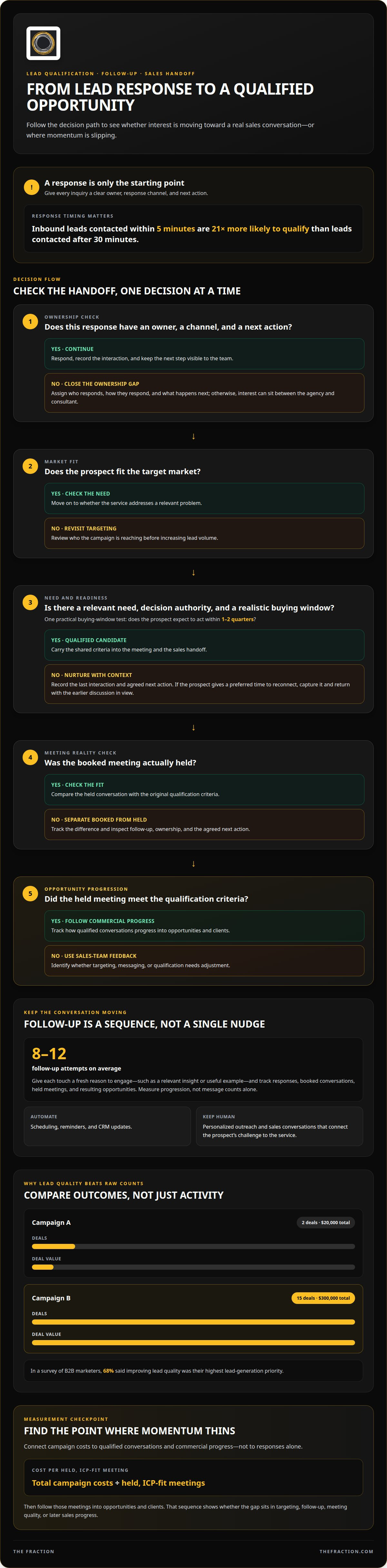
A campaign can bring in plenty of activity, but the sales team may still see few real opportunities when an agency counts responses and the consultant needs prospects with a relevant problem, authority, and a realistic buying window. One practical qualification test is whether a prospect fits the target market, has a need the service addresses, and expects to act within 1-2 quarters, because without shared criteria, marketing and sales are working from different maps.
The mismatch can also appear in cold outreach and content. A message may catch attention without giving the right prospect a reason to continue. For example, an email to a specialist consultancy can connect its service to a specific business challenge instead of relying on generic praise. A case study can explain the client’s problem, the work performed, and the outcome, making the expertise behind the offer clear.
More volume alone rarely repairs weak targeting, and campaign examples show why outcomes deserve more attention than raw contact counts: Campaign A produced 2 deals worth $20,000 total, while Campaign B produced 15 deals worth $300,000 total. In a survey of B2B marketers, 68 percent said improving lead quality was their highest lead-generation priority, which points consultants toward defining fit before widening the audience.
Agencies, referrals, content marketing, and in-house outreach each create a different route to prospects. Referrals start with existing trust, content can build credibility over time, and in-house outreach gives consultants direct control. An agency can add campaign execution capacity. Compare these approaches by how they contribute to held, qualified conversations and real opportunities, not by lead volume alone.
For outreach in the United States, applicable requirements vary by channel, audience, and federal and state rules. Before a campaign starts, assign responsibility for reviewing email and calling requirements, privacy, identification, consent, and opt-out handling. These considerations need a clear owner in the process.
Meeting quality makes the handoff visible, especially when an agency reports 30 meetings: separate calls that were booked from those held, then identify which meet the qualification criteria. A meeting without a relevant need or buying authority can add volume without creating an opportunity, so compare sales-team feedback with the original criteria and identify whether targeting, messaging, or qualification needs adjustment.
To measure performance and ROI, connect campaign costs to qualified conversations and commercial progress. Calculate cost per held, ICP-fit meeting by dividing total campaign costs by the number of held, ICP-fit meetings. Then track how those meetings progress into opportunities and clients. This sequence shows where leads stall instead of treating every response as a successful outcome.
Following up with and nurturing prospects
A prospect’s first response opens a small window, and follow-up is the bridge that keeps the conversation moving while interest is still warm. Inbound leads contacted within 5 minutes are 21x more likely to qualify than leads contacted after 30 minutes. So give every inquiry a clear owner, a response channel, and a next action; otherwise, it can sit between the agency and consultant like a message passed around a room with nobody sure who should answer.
A single email rarely carries the whole conversation, which is why a multi-touch follow-up cadence requires 8-12 attempts on average. Each touch should bring a fresh reason to engage, perhaps a relevant insight, a useful example, or a clear invitation to talk, because repeating “just checking in” is like knocking on the same door with the same note. A considered sequence gives prospects new context as their priorities shift.
Picture a firm generating 100 leads per month but following up properly on only 20; the other prospects can disappear through delayed replies, incomplete records, or unclear ownership. That gap can make the campaign look quiet even when interest existed, so record the last interaction, the agreed next action, and who owns it. Those details give the team a trail to follow when a prospect goes quiet.
Let prospects’ stated preferences guide follow-up. If someone asks you to reconnect after three months, record the timing and return to the conversation with context. A reminder without context can feel like starting over; a message that refers to the earlier discussion gives the prospect an easy way back in. Their priorities may have changed, so use the follow-up to find out what makes sense now.
Good nurturing separates administration from judgment. Automate scheduling, reminders, and CRM updates, while keeping personalized outreach and sales conversations human. AI can support note-taking and research, but the consultant must connect the prospect’s challenge to the service. That human connection matters when trust, nuance, and expertise shape a decision. A relevant offer gives the prospect something concrete to consider.
Measure follow-up through progression rather than message counts alone: track responses, booked conversations, held meetings, and resulting opportunities, then look for the step where momentum thins. If prospects respond but avoid a meeting, the invitation may need a clearer purpose; if meetings happen but stall, the next conversation may need stronger alignment. A more deliberate client-acquisition approach connects each follow-up to a prospect’s need and a meaningful next step, helping conversations move toward revenue instead of becoming a stack of reminders.
Agency communication and transparency
Clear reporting shows how outbound activity connects to targeting and sales progress. Without it, an agency may report completed work while the consultant sees no movement. A useful update explains what the campaign did, whom it reached, what prospects said, and what happens next. Each detail helps the sales team understand the work and decide how to proceed.
Start with the targeting decisions behind the campaign. Reports should show which audience characteristics shaped the prospect list, what message each group received, and which responses signaled interest. If the campaign shifts to a different sector, the report should explain why and what the change is expected to achieve. For example, a consultancy serving operations leaders might test a message for finance leaders. Connect that change to an observed response or a clear targeting hypothesis.
Contact data needs the same visibility. B2B databases decay by 30% per year, so older records can weaken outbound results. In one example, a database of 50,000 contacts might contain 35,000 reachable people. A separate data-quality example found 10,000 emails sent to a purchased list yielded a 10% viable rate. These figures show why reporting should distinguish attempted contacts, delivered messages, and usable replies.
Ask for a campaign record that traces activity through its stages. It can show:
- Targeting: the audience definition and the list’s source.
- Execution: messages sent, delivery issues, and campaign changes.
- Response: replies categorized by interest, timing, or poor fit.
- Handoff: the next action, its owner, and the prospect’s context.
These details make an update useful for decision-making. Replies from the wrong roles may mean the audience definition needs work. If suitable prospects respond but then stall, the handoff or next conversation may be the bottleneck. A transparent agency should explain what changed and why, rather than presenting activity totals without interpretation.
Communication also requires honest limits. Reports should distinguish confirmed outcomes from assumptions and record when a prospect asks for later contact. For example, “interested” needs context: did the prospect request a meeting, ask for information, or simply acknowledge the message? Clear categories prevent a warm reply from being mistaken for a sales opportunity.
Agree on reporting fields and review them together so the campaign remains easy to understand as it evolves. A short written summary can capture targeting changes, prospect feedback, and unresolved decisions. This shared record helps consultants spot patterns, understand agency choices, and adjust before weak data or unclear handoffs become blind spots.
Agency incentives and pricing models
The payment model shapes what an agency is incentivized to deliver. A fee tied to lead volume can encourage more names in the pipeline, even when prospects have little buying intent. The consultant may end up sorting contacts instead of advancing promising conversations. Ask which outcome the agreement rewards and whether it connects to revenue.
Per-lead pricing makes activity easy to count, but it can reward quantity over fit. An agency could provide contacts who match a broad industry description but have little need for the consultant’s service. The contract should define a lead using relevant role, need, and valid contact details. Clear criteria turn a vague deliverable into something both sides can assess.
Pay-per-meeting arrangements create a different incentive. The agency may focus on booking meetings, while the consultant needs meetings held with suitable prospects. A call that is canceled, lacks decision authority, or concerns an unrelated service adds little pipeline value. Define whether payment applies to booked, held, or qualified meetings, and agree on the qualification criteria before the campaign starts.
A retainer can support ongoing targeting, message refinement, and campaign management, but the fee alone does not show performance. Connect the work to observable stages: outreach completed, responses categorized, qualified meetings held, and opportunities created. These stages help explain changes in results and show whether targeting or the sales handoff needs attention.
Before choosing a model, map each incentive to the consultant’s actual business goal:
- Lead volume: useful when reach is the immediate constraint, provided fit is defined.
- Qualified meetings: useful when sales conversations are the priority, with clear rules for attendance and fit.
- Ongoing service: useful when campaign strategy and iteration require continuous work, with reporting tied to agreed outcomes.
Every model involves tradeoffs, so examine the reasoning behind the proposed structure. A low cost per lead can still deliver poor value if contacts rarely become clients. A high meeting count can also mislead if the sales team spends time with unsuitable prospects. Review the full path from first contact to opportunity and client conversion, then judge the model by how well it supports that path.
Clear terms also help prevent disputes. Specify what counts as a deliverable, how rejected leads are handled, which campaign changes require approval, and what reporting supports invoices. If compensation depends on volume, include quality criteria in the lead definition. If it depends on meetings, distinguish attendance from qualification. The agreement should reward the agency for work that supports the consultant’s growth.
That alignment matters because a pipeline is more than a list of names. It is a sequence of prospects moving toward a decision. Pricing works best when the agency can explain how its work supports that progression and the consultant can trace the resulting activity to meaningful opportunities.
Agency red flags and contract exit terms
A 12-month contract recommendation deserves scrutiny because it commits the consultant before performance is clear. To fix an underperforming relationship, identify the weak stage, agree on a corrective action, and set a review point in writing.
Recognizing Agency Red Flags
Red flags are signs that the agency’s claims, reporting, or contract terms obscure how work becomes sales progress. A promise of 30 meetings a month needs clear definitions: booked, held, or qualified. Vague reporting makes it harder to measure what the campaign delivers, while unclear ownership leaves prospects and follow-up actions in limbo.
Watch for specific warning signs: unexplained targeting changes, activity totals without outcome context, or loosely defined deliverables. A report that counts booked calls but omits attendance and prospect fit is incomplete. If a proposal emphasizes volume, it should also explain how the agency evaluates relevance and records feedback from the sales team.
Contract language matters, too. Review the initial term, renewal process, cancellation notice, and any requirements for ending the engagement. A 12-month commitment can make course correction difficult if these terms offer little flexibility. Clear language around account access, campaign records, and work handoff also helps preserve continuity if the relationship ends.
Addressing Underperformance
Address underperformance by turning disappointing results into a documented adjustment plan. Identify the stage where progress stalls, such as replies, qualified meetings, or opportunities. Then agree on one change, who owns it, and when to review it. This creates a shared test instead of another broad promise that the next campaign will improve.
If responses come from unsuitable prospects, revisit targeting and qualification criteria together. If qualified prospects engage but conversations do not advance, examine the offer and handoff. Record the current pattern, the change being made, and the outcome both sides will measure. This helps distinguish a campaign problem from a sales-process problem.
Bring the findings to a scheduled review and ask for an explanation grounded in campaign activity. Keep decisions in writing, including what will change, who owns each action, and when you will assess progress. If the agreed adjustment does not resolve the gap, follow the contract’s exit terms and preserve essential records for a clean transition.
Clear expectations make an agency relationship easier to assess, improve, or conclude. If the current arrangement needs a stronger acquisition system, explore a more structured client-acquisition approach.
The Fraction: Automated & AI lead generation systems
The Fraction helps consultants create a clearer lead-generation system, strengthen qualification, and build a sales process that feels natural. Its automated and AI-powered lead generation systems support client acquisition, while a compelling offer gives prospects a clear reason to engage. These elements work together: outreach opens a path, the offer gives prospects a reason to continue, and the sales process guides the conversation forward.
The Fraction’s approach can suit consultants who want to improve how they attract and convert prospects, especially when activity is happening but the next steps feel disconnected. Contact The Fraction to discuss what your client-acquisition process needs.
Build a client-acquisition system you can steer
Understanding why lead generation agencies fail for consultants gives you a useful starting point. A stronger approach is to treat client acquisition as an operating system you can shape and improve, rather than a black box you hope will produce business. Define what sustainable growth means for your practice, then align each part of your acquisition process with that goal.
Your expertise deserves a path to new business that reflects its value. Make deliberate choices about the clients you want to serve and the experience you want prospects to have. With that foundation, decisions about outside support become more grounded, and you can build momentum around the work you do best.
Keep building with intention. A well-designed system can help your expertise reach the right clients.
Frequently Asked Questions
Where do leads go to die?
Leads often stall between a prospect showing interest and someone guiding them toward a useful next conversation. A prospect might download a consulting case study but receive no relevant follow-up or clear invitation to discuss the problem. Momentum can also fade after an introductory call if nobody agrees on a next step. Treat each transition as a handoff, carrying context and ownership forward.
Why Do Lead Generation Agencies Fail?
The main reasons lead generation agencies fail for consultants include misaligned goals, shallow audience understanding, weak execution, and an offer that gives prospects little reason to engage. An agency may deliver activity when the consultant needs qualified business conversations. The gap becomes clear when reports describe what happened but cannot explain why prospects responded, declined, or stopped progressing. Shared definitions and useful feedback help uncover the cause.
Why do lead generation agencies fail to deliver qualified leads for consultants?
Agencies can miss qualified leads when audience criteria describe a company but overlook the buyer’s actual problem and readiness. A list of senior leaders, for example, may include people whose priorities have nothing to do with the consultant’s service. Qualification improves when a campaign reflects who experiences the problem, what makes it urgent, and who can support a decision inside the organization.
How do agencies define and qualify a sales-ready lead for consulting services?
A sales-ready lead fits the consultant’s target market, has a problem the service can address, and shows a credible reason to discuss a solution. For consulting, a job title alone rarely signals readiness. The prospect’s stated challenge, influence over the decision, and willingness to explore change provide useful context. Agree on these criteria in plain language, then record why each referred prospect meets them.
What risks should consultants look for in lead generation agency contracts?
Look for contract terms that make deliverables, ownership, or exit procedures difficult to understand. Know what happens to campaign records, messaging, and account access if the relationship ends. Clarify renewal and cancellation procedures, notice requirements, and how disputes about lead quality are handled. A contract that promises “leads delivered” without defining a valid lead can create disagreements about what the agency owes.
What causes poor targeting and low conversion rates in consulting lead generation campaigns?
Poor targeting often starts with a broad audience definition that ignores the conditions behind a buyer’s need. A campaign aimed at every company in one sector may reach leaders with different priorities, authority, or urgency. Conversion can also suffer when messaging lists the consultant’s credentials but leaves the business problem unclear. Match each audience segment with a specific challenge and an offer that addresses it.
What questions should consultants ask before hiring a lead generation agency?
Ask how the agency defines a qualified prospect, what campaign results it reports, and how feedback informs changes to targeting or messaging. Clarify who handles prospect replies, how handoffs work, and what the agreement counts as a completed deliverable. Request a sample report that connects campaign activity with sales progression. These questions reveal whether the agency’s process supports your business development needs.


