

What if your client pipeline felt more like a well-built bridge than a string of lucky introductions? If referrals arrive unpredictably and prospect conversations come in waves, it makes sense to look for a steadier process, especially when you’re translating years of executive experience into an offer buyers can quickly understand. Lead generation systems for fractional executives connect a clear offer, focused prospecting, thoughtful follow-up, and a practical way to qualify opportunities.
The key is to make each stage support the next. Define a valuable business outcome, identify the buyers who need it, start relevant conversations, and track what should happen next. This process can be designed around the time and professional boundaries you have while still employed.
In this article, you’ll learn how to shape that process for fractional work, choose which tasks to automate, and turn conversations into a manageable pipeline. You’ll also see how offer clarity, market feedback, and a considered sales process can work together to support your practice.
Key Takeaways
- Build lead generation systems for fractional executives as a connected path from an outcome-focused offer to a qualified sales conversation.
- Define the buyer and business problem your offer addresses, then use market conversations to test your assumptions before expanding outreach.
- Choose manual, assisted, or automated outreach based on where consistency helps and where personal judgment makes the conversation stronger.
- While employed, map your pipeline, choose one priority, and test a manageable workflow that fits your schedule and capacity.
- Consider a done-with-you build-out when you want collaborative help connecting offer development, targeting, automation, and a structured sales process.
What Fractional Executive Lead Gen Systems Must Do
A reliable pipeline comes from connected decisions and actions that help a suitable buyer move from recognizing a business need to having a useful conversation with you. That’s the job of lead generation systems for fractional executives: connect your expertise to organizations that can benefit from it, then give both sides a clear next step. The term Fractional executives describes leaders who provide executive-level capability on a part-time or shared basis. Your system needs to explain the value of that capability and how an engagement could address a buyer’s needs.
A tool, referral, campaign, or burst of outreach can create a conversation, but each is only one part of the process. The offer sets the direction, targeting helps identify relevant buyers, engagement opens a conversation, and follow-up keeps the opportunity moving. When one stage is unclear, prospects can stall even when your experience is a strong fit.
Which fractional executive problems should the system solve?
An inconsistent pipeline can point to specific issues. You may be targeting too broad a group, describing responsibilities instead of a business outcome, or relying on memory to follow up. Strong corporate experience gives you deep expertise, but prospective clients still need a buyer-facing explanation of the problem you can help solve and the value of engaging you.
If selling feels awkward, treat it as a process-design challenge. A clear offer, relevant questions, and a considered follow-up rhythm can make business development feel more like a strategic conversation and less like performing a sales persona.
What does a complete lead generation system include?
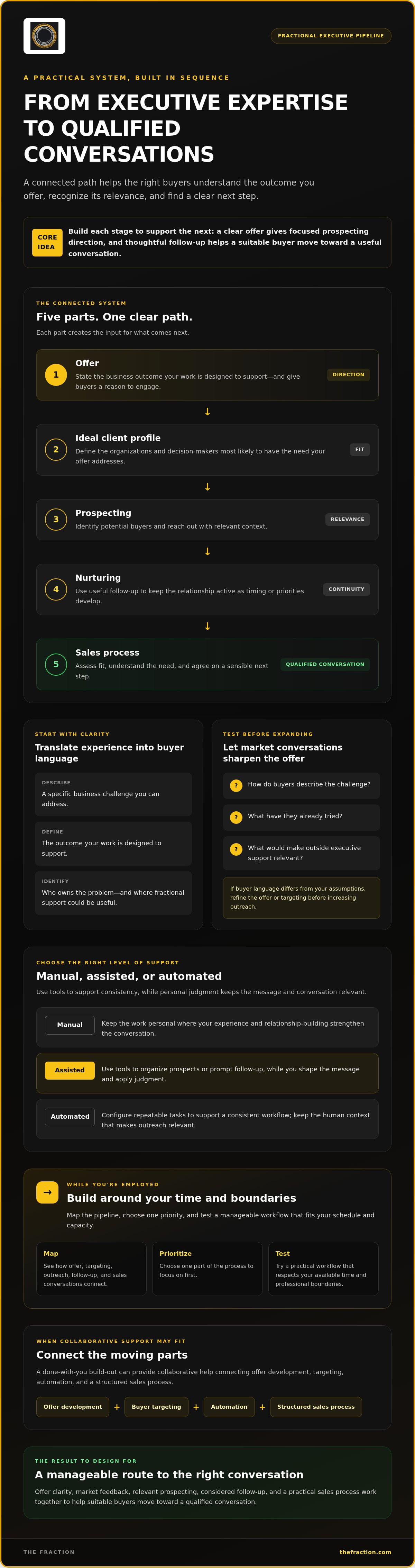
A lead generation system is a repeatable sequence that connects an offer, a defined ideal client, relevant prospecting, thoughtful nurturing, and a sales process, helping appropriate buyers move toward a qualified conversation. Each component creates the input for the next:
- Offer: States the business outcome and gives buyers a reason to engage.
- Ideal client profile: Defines which organizations and decision-makers are most relevant.
- Prospecting: Identifies and reaches potential buyers with relevant context.
- Nurturing: Uses useful follow-up to keep the relationship active as timing or priorities develop.
- Sales process: Helps you assess fit, understand the need, and agree on a sensible next step.
Automation can organize prospects or prompt follow-up, while your judgment shapes the message and conversation. Use it to support consistent routines, not to replace the experience and relationship-building that make your approach relevant.
How to Design the Fractional Executive Lead Generation System
Design the system in sequence, because outreach is only as effective as the offer and buyer decisions behind it. Start with a business problem you’re equipped to solve. Define the outcome a client would value, then identify organizations where that need is likely to matter. Before expanding prospecting, test those assumptions in market conversations. This helps you build from buyer language rather than guesswork. Harvard’s Building Your Consulting Business program also treats client development and sales-funnel building as important parts of a consulting practice.
Start with the buyer, problem, and fractional offer
Translate your executive experience into a specific buyer-facing offer. Instead of describing a broad leadership background, name a business challenge you can address and the outcome your work is designed to support. Then define your ideal client profile by asking: which organizations are likely to have this need, who owns the problem, and what would make fractional support useful?
Former industry contacts can be a starting point for learning, but assess each against buyer fit, the need your offer addresses, and readiness to engage. In conversations with potential buyers and industry leaders, ask how they describe the challenge, what they have already tried, and what would make outside executive support relevant. If their language differs from your assumptions, refine the offer or targeting before increasing outreach.
Connect prospecting, follow-up, and sales conversations
Once the offer and buyer are clearer, build a route from relevant prospect to agreed next step. LinkedIn Sales Navigator can help narrow searches by buyer and organizational characteristics. Configured automation can support repeatable tasks, such as organizing prospects or reminding you to follow up. Review messages before they go out so each approach reflects why that person or organization may be a fit.
Give follow-up clear ownership and a practical rhythm. Record the last interaction, the prospect’s stated interest or timing, and the next action. Before sending a follow-up, check whether it adds context or asks a useful question instead of repeating the original pitch. For a closer look at how AI can support this process, explore this AI-driven lead generation approach.
Simple workflow
Inputs: Offer, buyer profile, market feedback, and prospect signals
Human decisions: Confirm fit, personalize engagement, choose follow-up, and qualify the conversation
Outputs: Relevant responses, clear next steps, and qualified opportunities
That’s the architecture behind lead generation systems for fractional executives: targeting and automation support consistency, while your judgment guides the relationship and the decisions that move a conversation forward.
Automation or Manual Outreach: What Fits a Fractional Executive?
Outreach can feel like a second full-time job when every search, message, reminder, and follow-up depends on you. A well-designed system takes routine work off your mental desk, leaving you more time to understand a prospect’s context, decide whether there’s a fit, and choose a useful next step. That’s the balance at the heart of lead generation systems for fractional executives: consistent processes supporting a real person who guides the relationship.
Think of automation as the rails and your judgment as the driver. The rails keep the process moving; you choose the direction and interpret what a buyer needs. Start with buyer fit and message quality, then use automation to make repeatable tasks easier to manage.
Which lead generation tasks are suitable for automation?
System-supported tasks can include organizing a defined prospect list, setting workflow reminders, recording outreach activity, and creating follow-up tasks. Keep offer decisions, relationship context, message review, and prospect qualification in human hands. An automated prompt can remind you to reconnect; you decide whether the timing makes sense and what would be useful to say.
Manual outreach
Suitable tasks: Researching context, writing a highly tailored first message, and handling nuanced follow-up.
Trade-off: Gives you close control and personalization, but repeated administrative steps take time.
Review needed: Your judgment guides the full process.
Assisted outreach
Suitable tasks: Using templates, saved research fields, and reminders to support a human-led workflow.
Trade-off: Adds consistency while preserving room to tailor messages, with active oversight keeping the process aligned.
Review needed: Check prospect fit and personalize each interaction.
Automated workflows
Suitable tasks: Routing information, tracking activity, and prompting the next process step.
Trade-off: Can reduce repetitive coordination, while thoughtful review keeps each interaction relevant.
Review needed: Set clear boundaries and review messages and outcomes.
How can outreach feel credible and personal?
Start with a specific detail about the prospect’s business context, then connect it to experience that genuinely applies. Keep the message concise and make the next step clear, whether that’s a question or a short conversation. Experience-based posts or brief insights can also show how you think. Choose a publishing rhythm you can sustain.
If you’d like a sales process built around useful, natural conversations, explore a sales process that feels natural. The aim is a steady rhythm you can manage, with automation supporting the work and your experience leading the conversation.
How to Build and Improve a Lead Generation System While Employed
Building a fractional practice alongside a current role calls for a system that fits your actual calendar. Start by documenting your pipeline: who you’re targeting, how you’ve engaged them, which conversations are active, and what next step each needs. Put referrals, warm introductions, and direct outreach in one tracker so you can see what’s moving and where momentum fades.
Next, choose one bottleneck. If suitable buyers aren’t responding, revisit your targeting or opening message. If conversations happen but go quiet, review follow-up and the clarity of the next step. Test one change at a time, note what happens, and use the feedback to refine the workflow. That keeps lead generation systems for fractional executives manageable while you’re employed, because progress comes from focused adjustments rather than simply adding activity.
What should an executive measure in the lead pipeline?
Track the stages a prospect moves through: target account, engaged prospect, qualified conversation, and defined next step. Also separate activity measures, such as outreach completed or follow-ups sent, from commercial progress, such as a qualified opportunity advancing. Activity shows what you did; movement through the stages helps show how the process is working.
Pipeline stages reveal where a lead generation system needs attention by showing where suitable prospects stop moving toward a qualified conversation and agreed next step.
Keep the review simple. Look for patterns in who responds, what language creates interest, which conversations meet your fit criteria, and where follow-up loses traction. Then adjust targeting, messaging, or the next-step process and observe what changes. Your own pipeline can show you where to investigate without relying on an invented benchmark.
How can the system fit around current employment?
Choose a steady operating cadence that fits your capacity, with a protected block for pipeline review and focused outreach. The Fraction’s materials describe scheduling outreach for evenings as one way to help separate business-development activity from employer commitments. Treat that as an option and shape your routine around your responsibilities and personal boundaries. For more on building a thoughtful approach, explore strategic lead generation for experts.
Think of the workflow as a compact flywheel: document, prioritize, test, review, and refine. Each pass should make the next action clearer while leaving room for the judgment and relationships only you can bring.
When a Done-With-You Lead Generation Build-Out Makes Sense
A done-with-you build-out can make sense when you have substantial executive expertise and want to turn it into a clear offer and working client-acquisition system, but would like a partner to help implement the pieces and maintain momentum. The Fraction’s program co-builds a consulting practice from offer to delivery, bringing together market research, targeting, automation setup, and a structured sales process. The Fraction supports implementation rather than acting as a recruitment firm or standalone software provider.
This support is most relevant when you’re ready to make decisions, test assumptions, and participate in building the system. Lead generation systems for fractional executives need your expertise and judgment at the center, supported by infrastructure that helps turn them into consistent business-development activity.
What does implementation support involve?
Implementation can bring the practical pieces into one framework, including playbooks, scripts, standard operating procedures, configured automation, and client-success support. Playbooks clarify the process, scripts offer a starting point for outreach and sales conversations, and automation supports repeatable workflows. The Fraction configures and trains clients to use tools such as LinkedIn Sales Navigator and automation software. Clients retain their systems, automations, content, and infrastructure to use and refine.
A structured sales process can make prospect conversations feel more natural because you have a clear way to explore fit and agree on next steps. For a closer look at this part of the system, read about the sales process for consultants.
What is a sensible next step for evaluating fit?
Before committing to a build-out, consider four things: how clearly you can describe your offer, whether you can identify a relevant target buyer, how much capacity you have for business development, and whether you’re ready to participate in implementation. If your direction still feels unsettled, The Fraction’s custom Proof of Concept research includes interviews with 10 industry leaders before payment. It can help you examine market assumptions, but it is not a guaranteed business outcome.
The guarantees have specific terms: the 30-Day System Build Guarantee provides a full refund if the complete system isn’t built within 30 days. The 10X ROI Guarantee continues until booked contract value equals ten times the program investment. Review the current public wording and conditions as part of your evaluation, then decide whether collaborative implementation fits your goals and readiness.
Build a Pipeline That Supports Your Next Move
A dependable client pipeline grows from connected choices: define an offer around a valuable business outcome, focus on buyers who have a reason to need it, and use thoughtful outreach and follow-up to move suitable prospects toward a conversation. The strongest lead generation systems for fractional executives pair repeatable processes with your judgment, so business development can fit your capacity and reflect the depth of your experience.
If you’re considering implementation support, The Fraction’s custom market research includes interviews with 10 industry leaders before payment, giving you input as you assess your offer and target market. Clients retain the systems, automations, content, and infrastructure developed with them. The 30-Day System Build Guarantee provides a full refund if the complete system isn’t built within 30 days. The 10X ROI Guarantee continues until booked contract value equals ten times the program investment. Review the current public wording and conditions as part of your decision.
Your experience already has value; a clear offer and a considered system can help the right buyers recognize it. When you’re ready, explore The Fraction’s done-with-you program to assess whether collaborative implementation fits your next step.
Frequently Asked Questions
What is a lead generation system for fractional executives?
A lead generation system for fractional executives is a repeatable sequence connecting a clear offer, a defined ideal client, prospecting, follow-up, and a sales process. Each stage helps a suitable buyer move toward a useful conversation and gives you a way to review what’s working. A tool or referral can contribute, but the system comes from how those activities fit together and how you use your judgment along the way.
How do fractional executives build a consistent client pipeline?
Build a steadier pipeline by defining the business problem your offer addresses, identifying organizations likely to face it, and creating a manageable routine for relevant outreach and follow-up. Track each prospect’s stage and next step, then review where conversations slow down. If the right prospects aren’t engaging, revisit targeting or message clarity. If conversations stall, review follow-up and how you agree on what happens next.
Can AI and automation help fractional executives find clients?
Yes. AI and automation can support repeatable parts of client acquisition, such as organizing prospect information, assisting with research, tracking activity, or prompting follow-up. They can make a workflow easier to maintain, while your experience should guide the offer, message review, relationship context, and qualification decisions. Treat the technology as support for the checklist, while retaining responsibility for the professional judgment that makes each interaction relevant.
Can I build a fractional consulting pipeline while I’m still employed?
Yes. You can build a pipeline while employed by choosing a manageable cadence and keeping business-development activity separate from your current work commitments. The Fraction’s materials describe scheduling outreach for evenings to help avoid employer conflicts. Start with a focused block for pipeline review, prospecting, or follow-up, then adjust the routine to match your responsibilities and capacity rather than assuming you have a full-time sales schedule.
What should a fractional executive track in a lead generation system?
Track movement from target account to engaged prospect, qualified conversation, and defined next step. Also record activity, such as outreach and follow-ups, separately from commercial progress, such as whether a conversation meets your fit criteria or advances to an opportunity. Activity shows what you’ve done; stage movement helps reveal where targeting, messaging, qualification, or follow-up may need attention.
How can fractional executives generate leads without feeling pushy?
Make outreach a relevant professional conversation by connecting a prospect’s business context to a problem your experience can help address. Keep the message concise, ask a thoughtful question, and suggest a next step that fits the prospect’s response. Follow up with useful context rather than pressure, and let the buyer’s needs guide the discussion. A clear offer makes it easier to explain why you’re reaching out and who you can help.
Does a fractional executive need a productized offer before starting outreach?
A clear offer gives outreach direction, but you can refine it through market conversations before finalizing every detail. Start with a specific business problem you’re equipped to address, the kind of buyer who may value your expertise, and an outcome the work is designed to support. Then use prospect and industry feedback to sharpen the scope and positioning. This gives you a meaningful starting point without requiring a perfectly polished offer upfront.


