

The best outbound alternative gives your expertise somewhere compelling to go. When comparing outbound works alternatives for professional services, it’s easy to focus on who sends the emails or which tool automates follow-up, but outreach is only one part of the engine. If conversations arrive without a clear offer behind them, you can end up with a busy pipeline that’s still hard to steer.
That’s a familiar tension for experienced consultants: generic messaging can flatten years of senior expertise into just another pitch, while manual prospecting competes with the client work already on your desk. A stronger system connects what you know to a specific service, then creates a considered path from the right prospect to a qualified sales conversation.
In this guide, you’ll compare outbound agencies, software, self-managed prospecting, and done-with-you support by how each packages your expertise, supports relevant conversations, and fits the realities of your working week. Think of it as choosing the right architecture for your pipeline, rather than simply adding another tool to the stack, so you can build a more repeatable foundation for your consulting business.
Key Takeaways
- Compare outbound works alternatives for professional services by who owns strategy, messaging, execution, sales conversations, and the underlying infrastructure.
- Assess whether your offer connects your expertise to a clear client outcome, rather than relying on undifferentiated hours to make the case.
- Use your business goal, offer readiness, available capacity, support needs, and ownership priorities to identify the right operating model.
- See how The Fraction’s done-with-you approach brings offer development, lead-generation infrastructure, and a systematized sales process together.
- Explore the five components of the Fractional 1of1 Formula™ and how they can form a connected client-acquisition system.
Outbound Works alternatives for professional services: what are you comparing?
Think of this comparison as a choice between operating models for creating professional-services opportunities. The phrase outbound works alternatives for professional services points to different routes for finding potential clients and turning relevance into a focused business conversation. The useful question is what each route helps you do, what work it leaves in your hands, and how it connects outreach to an offer a prospective client can understand.
An outbound alternative is a different route to qualified client conversations, built around how your expertise reaches the right buyer and how interest moves toward a clear offer. That route can involve several connected jobs: identifying suitable prospects, reaching out with relevant messaging, positioning a defined service, holding sales conversations, and following up thoughtfully. A tool or provider might support one part, while a complete operating model connects them, like a relay where every handoff matters.
That distinction matters because lead identification and outreach create opportunities to connect, while offer positioning gives a prospect a reason to care. Sales conversations help both sides assess fit, and follow-up keeps a promising exchange from fading into an inbox. When one piece is missing, activity can look busy while the path to a genuine client opportunity stays unclear.
Why expert-led services need a different comparison lens
Buyers of professional services are choosing judgment as much as a deliverable, so they look for relevance, trust, and a sense that the specialist understands the stakes. That’s why message volume alone gives an incomplete picture: a full calendar of outreach says little about whether the right people recognize the value. Business development is relationship architecture, much like an executive moving into an advisor role, where credibility and a well-built connection open the door.
The five parts of a client-acquisition system
A dependable system links five components, each moving a prospect closer to a useful conversation:
- ICP segmentation defines which organizations and decision-makers are the strongest fit.
- Outcome-based pricing ties the commercial conversation to the value of the result.
- A productized offer turns broad expertise into a clear service with a defined purpose.
- Client acquisition creates relevant ways to reach and engage the right prospects.
- A sales funnel guides interest through conversation, qualification, and considered follow-up.
Together, these pieces give outreach a destination: a specialist can identify a fitting prospect, explain the business outcome their work supports, and invite a focused conversation. For a closer look at the acquisition engine, explore this AI-driven lead generation strategy as one element of the broader system, where technology supports relevance and a clear offer gives each interaction direction.
The main outbound alternatives for professional services, compared by model
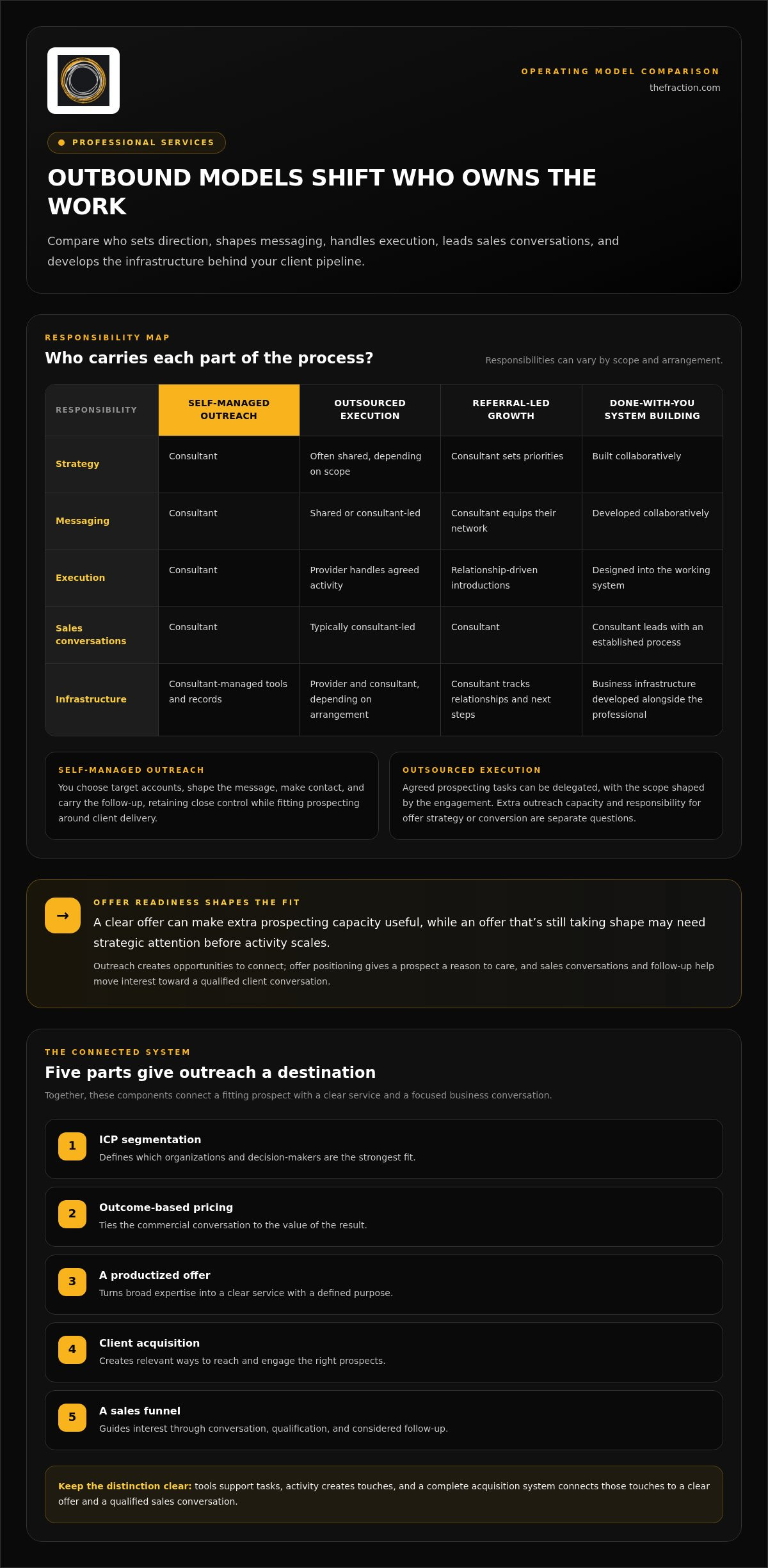
Each model moves responsibility around differently, so compare who sets direction, who does the work, and who owns the client conversation. The right fit depends on what you’ve already built: a clear offer can make extra prospecting capacity useful, while an offer that’s still taking shape may need strategic attention before activity scales.
Tools support tasks, activity creates touches, and a complete acquisition system connects those touches to a clear offer and a qualified sales conversation. Keep that distinction in view as you compare outbound works alternatives for professional services, because prospecting activity is most useful when clear positioning and consistent follow-up give it direction.
Operating model | Strategy | Messaging | Execution | Sales conversations | Infrastructure
Self-managed outreach | Consultant | Consultant | Consultant | Consultant | Consultant-managed tools and records
Outsourced execution | Often shared, depending on scope | Shared or consultant-led | Provider handles agreed activity | Typically consultant-led | Provider and consultant, depending on arrangement
Referral-led growth | Consultant sets priorities | Consultant equips their network | Relationship-driven introductions | Consultant | Consultant tracks relationships and next steps
Done-with-you system building | Built collaboratively | Developed collaboratively | Designed into the working system | Consultant leads with an established process | Business infrastructure developed alongside the professional
Self-managed outreach and outsourced execution
With self-managed outreach, you choose the target accounts, shape the message, make contact, and carry the follow-up, so you retain close control while fitting prospecting around client delivery. Outsourced execution can delegate agreed prospecting tasks, with the scope shaped by the engagement. In either model, extra outreach capacity and responsibility for offer strategy or conversion are separate questions, and your sales conversation still needs a compelling reason for the prospect to continue.
Referral-led growth and done-with-you system building
Referral-led growth builds on trust and existing relationships, which can make introductions feel natural, while timing depends on when people in your network encounter a relevant need. Done-with-you support takes a collaborative route, building business infrastructure alongside you so the offer, acquisition activity, and sales process work together. For professionals exploring professional service sales automation, that connection can turn repeatable tasks into a more considered client-acquisition process.
Think of referrals as a strong bridge that still depends on when someone crosses it, while a system gives you additional routes to create and manage conversations. The Fraction’s done-with-you business build-out brings offer development, lead generation, and sales infrastructure into a collaborative process.
How to compare outbound alternatives when expertise is the product
For experienced professionals, the core question is whether a business-development approach can make specialist judgment easy for the right buyer to understand and act on. As you assess outbound works alternatives for professional services, use the same six lenses across every option, so you’re comparing the quality of the business system rather than the apparent sophistication of a tool or the volume of activity.
Offer clarity: Can a potential client quickly understand the problem you solve, the result your work supports, and the shape of the engagement?
Targeting: Does the approach help you focus on organizations with a relevant need, decision authority, and a reason to act?
Outreach: Does each message connect your expertise to the recipient’s context, with a sensible next step?
Sales process: Is there a clear path from first response to a qualified conversation, fit assessment, and follow-up?
Support: Does the model provide software access, delegated execution, collaborative implementation, or a combination that matches your needs?
Asset ownership: Which systems, automations, content, and processes remain available to your practice as you continue building?
Assess offer clarity, targeting, and buyer relevance
A strong ideal client profile (ICP) brings together the problem a buyer needs solved, the authority to make a decision, and the business outcome they care about. For example, an independent operations specialist might focus on leaders facing a recurring delivery bottleneck, then frame a defined engagement around improving that process. A productized service makes the scope and intended value easier to grasp, while outcome-based pricing connects the commercial discussion to the result. With open-ended hourly work, the buyer has to work out what the hours add up to.
The offer and the message play different roles. A polished outreach message can earn attention, but the offer gives that attention somewhere meaningful to go. So before increasing activity, check whether a prospect can recognize themselves in the problem, understand the proposed service, and see why a conversation could help them decide on a next step. A practical high value offer development approach starts with buyer relevance, then shapes the message around that offer.
Compare implementation, support, and asset ownership
Software access gives you tools to operate, while done-for-you execution delegates agreed activities, and collaborative implementation builds the working process alongside you. Each serves a different need: software suits a professional ready to operate the system, delegated execution can create capacity for prospecting, and collaboration can help connect the offer, outreach, and sales process. Implementation support shapes how the system gets built, while asset ownership shapes what your practice can keep using.
Then connect activity measures to commercial progress. Track outreach as an input, responses as signs of engagement, qualified conversations as evidence of fit, and commercial outcomes as the business result. That sequence gives you a clearer view of where the process needs attention, whether targeting, offer clarity, or follow-up.
Choose an outbound alternative that fits your capacity, offer, and readiness
Choosing among outbound works alternatives for professional services gets easier when you treat the decision like building a bridge from your current business to the pipeline you want. Start with the outcome you’re aiming for, then work through the offer, available capacity, support, and ownership. This order helps you see whether you need more prospecting activity or a clearer reason for the right buyer to engage.
- Define the business goal. Decide what progress you want business development to create, such as more qualified conversations with a particular type of buyer or a more visible path from first contact to sales discussion. A clear destination helps you assess whether each model supports your priorities.
- Check the offer. Can a prospective client understand the problem you address, the outcome your service supports, and the shape of the engagement? If those pieces feel broad, strengthen the positioning before adding more outreach, so increased activity carries a focused message.
- Map your capacity. Look at the time you can consistently dedicate to targeting, outreach, conversations, and follow-up alongside current client work. If delivery fills your calendar, choose support that addresses the specific tasks competing for that time.
- Choose the support you need. Software, outsourced execution, and collaborative system building each provide a different level of involvement. Match the approach to your readiness to implement, your comfort leading sales conversations, and the parts of business development where you want practical support.
- Decide what you want to own. Consider whether you need temporary execution capacity, an operating process you can maintain, or infrastructure that remains part of your independent practice. Clear ownership expectations help you build capability alongside pipeline.
Match the approach to your current business stage
An early consulting practice may need to test its offer, refine its target audience, or establish a follow-up rhythm before it expands prospecting. An established practice may already have a strong offer and instead need a repeatable process and better visibility into pipeline movement. Readiness comes down to your goal, the time you can make available, and your willingness to implement the chosen approach as part of the business.
Build around existing responsibilities and sales confidence
Business development can feel like a second job when it has to squeeze between delivery commitments, but a deliberate schedule gives it a place on the calendar. Employed professionals can schedule outreach during evenings, creating room for consistent action while managing existing responsibilities. A systematized funnel also gives non-sales specialists a practical sequence for moving from initial interest to a focused discussion and follow-up. A clear sales process for consultants can act like a map, helping you guide conversations with confidence while keeping the steps visible.
For a collaborative approach that connects offer development, lead generation, and sales infrastructure, explore a done-with-you executive business build-out.
The Fraction’s done-with-you alternative: connect offer, outreach, and sales
Among outbound works alternatives for professional services, The Fraction’s done-with-you build-out connects offer creation, lead generation, and sales infrastructure in one collaborative process. Think of it as building the frame, wiring, and controls of a business-development system alongside you, so each part has a role and you can take an active hand in putting it to work.
The Fractional 1of1 Formula™ brings the five components outlined earlier into a single framework for building a consulting practice: outcome-based pricing, clear ICP segmentation, a productized offer, a client-acquisition system, and a systematized sales funnel. Its Custom Proof of Concept Call delivers personalized market-research strategy before payment, including interviews with 10 industry leaders using a proven question framework.
What the collaborative build-out includes
Support includes weekly 1:1 sessions, mastermind calls, private Slack, and a dedicated client-success team. The lead-generation setup uses LinkedIn Sales Navigator targeting and automation configured and trained for you, while you retain control of your account. As the infrastructure takes shape, you retain your systems, automations, content, and infrastructure, giving your practice assets to keep using beyond implementation.
The program includes a 30-day system-build guarantee, with a full refund if the complete system isn’t built within 30 days. Under the lead-generation guarantee, if calls aren’t booked after your active effort, The Fraction generates leads at no extra cost. The 10X ROI guarantee means the program continues until booked contract value equals ten times the program investment, with no time limit and no upsells.
Who this approach is designed to serve
This model is designed for experienced corporate professionals preparing to build a fractional consulting practice and ready to shape an offer around their expertise. It suits people willing to participate in implementation and make decisions as the business takes form, with a collaborative structure that supports action and ownership.
The work centers on building business-development infrastructure. Professionals seeking a passive-income arrangement, recruitment, legal or tax advice, or general executive coaching are looking for a different kind of support. For those ready to build and take an active role in the process, this approach creates a practical path from expertise to a functioning consulting business.
Build a pipeline that reflects the value you bring
The best next step is to choose an approach you can sustain, then let your business development grow from a clear view of the clients you want to serve and the expertise you bring to them. As you weigh outbound works alternatives for professional services, think of the decision as designing a working rhythm, one that makes room for client delivery while creating a deliberate path toward the conversations your practice needs.
You don’t need to solve every part of the pipeline at once. Start with the point creating the most friction today, whether that’s shaping the offer, reaching the right buyers, or guiding an interested prospect through a sales conversation, and build from there. The right structure can help your professional experience travel further, so your next chapter grows from considered action rather than scattered effort.
Your expertise already has value; build a clearer route from that expertise to the clients who need it by exploring The Fraction’s executive program.
Frequently Asked Questions
Does outbound work for professional services?
Yes, outbound can help professional-services firms start conversations with potential clients who may not find them through referrals or content alone. For those weighing outbound works alternatives for professional services, relevance is the key test: a message to an organization facing a problem you understand gives your expertise a meaningful opening. Treat replies and meetings as signals to learn from, then refine your audience and approach based on the conversations you’re having.
Can automated outreach still feel personal?
Yes, automation can support personal outreach when you choose the audience and context thoughtfully. For example, an operations consultant could organize prospects by the type of operational challenge their organization is addressing, then tailor the opening message to that shared context. Automation can help manage contact records and reminders, while you review the message and decide how to respond. The aim is to make relevant communication easier to sustain, with a real person’s judgment shaping each interaction.
What is the difference between lead generation and appointment setting?
Lead generation identifies and engages potential buyers, while appointment setting focuses on arranging a meeting with a prospect who shows interest or meets agreed criteria. A campaign might generate responses from relevant decision-makers, then an appointment-setting process handles availability and confirms a conversation. The handoff should be clear: define what makes a prospect suitable, what information gets passed along, and who follows up if a meeting is postponed or the person needs more context.
Should consultants use referrals and outbound together?
Yes, referrals and outbound can complement each other, because trusted introductions and proactive outreach create different openings for useful business conversations. A consultant might maintain relationships with former colleagues and clients while also reaching out to organizations that match a defined area of expertise. Keep the approaches coordinated: share a consistent description of your work, track follow-ups in one place, and use insights from conversations to make future introductions and messages more relevant.
How can a consultant define a qualified lead?
A qualified lead is a potential client whose situation aligns with the work you can deliver and who has a plausible path to making a decision. Make the definition practical by checking for a relevant business problem, access to someone involved in choosing a solution, and willingness to discuss possible next steps. A senior contact with no active need may be a useful relationship, while a less senior contact with a live issue could merit timely follow-up.
Do fractional executives need a large online audience to find clients?
No, a large following isn’t a prerequisite for developing a consulting pipeline. A smaller, well-defined network can still support conversations when people understand the problems you solve and who benefits from your experience. A fractional finance executive, for instance, can share concise observations about a relevant business challenge and build direct relationships with potential buyers or referral partners. Focus on being clear and credible in the places your prospective clients already use.


