

Look, the absolute biggest mistake most high-level executives make when they step out of the boardroom and into the consulting world is thinking they need to be better at "selling," but the truth is that your corporate expertise is actually being throttled by what I call the "Corporate Hangover," and that's usually because you're trying to justify a premium price tag using the same HR-style interview logic that got you your last salary. It's sooooo frustrating to know you're worth 150, 200, or even 250 grand a year but still feel that pit of anxiety about where the next lead is coming from, so I'm going to show you exactly how to stop "selling" for good and start architecting a high ticket client acquisition system that turns your deep industry knowledge into a predictable $30k-a-month consulting engine.
We're going to move past the sleazy sales tactics and the desperate pitches so we can build a process that feels like a peer-to-peer strategic conversation, and by the time we're done, you'll understand how to position yourself as the only logical choice for high value fractional contracts so you can finally command the prestige and the income you've already earned. Alls I'm saying is that you don't need to be a better salesperson, you just need a better architecture for your expertise that allows you to lead with authority and leverage.
Key Takeaways
- Look, you'll learn how to finally shake off that "Corporate Hangover" where you're basically asking for permission in meetings, and instead start leading the room like the seasoned executive you actually are.
- We're diving deep into why architecting a high ticket client acquisition system is the absolute best way to move from a capped salary to a predictable $30k-a-month engine without ever feeling like a pushy salesman.
- You'll see why custom proposals are essentially just a fancy way of begging for work, and how switching to productized outcomes allows you to command respect and much higher fees.
- I'm breaking down a low-friction, five-step sales conversation that turns "selling" into a simple strategic diagnosis, so you can close $15k engagements without any of that typical high-pressure anxiety.
- Discover the single biggest shortcut to professional freedom by using a proven blueprint that co-creates your entire fractional practice, so you don't have to waste months trying to figure it all out on your own.
Why Closing High Ticket Consulting Deals Feels So Hard (Hint: It's Your Corporate Brain)
Look, the single biggest reason I see brilliant executives fail when they try to go fractional is something I call the "Corporate Hangover," and it's basically this deep-seated habit of asking for permission because you've spent 20 years being interviewed by HR and boards... so you show up to a meeting with a potential client and you're essentially auditioning for a job you don't even want. If you're still out there selling your "time" or trying to lead with your resume, you've already lost the high-ticket game before it even started. Traditional sales methods are often the sales process for consultants bottleneck that keeps you stuck in a cycle of chasing leads instead of building a high ticket client acquisition system that commands authority, prestige, and measurable results.
The Death of the Hourly Rate
When you sell your hours, you're essentially telling the client that your value is tied to a clock rather than your brain, and that tethers you to a desk in a way that caps your income at a level that's frankly insulting for someone with your level of expertise... but even worse, it creates a weird conflict where the faster you solve their problem, the less you get paid, which is just absolutely the worst way to run a practice. High-ticket clients don't actually want to buy your "hours" anyway, they want to buy the "end of their problem," so you have to make that psychological shift from being an "employee" who follows orders to being a "strategic asset" who provides a definitive outcome. This is where consultative selling becomes your secret weapon because it moves the focus away from the price of your time and onto the value of the transformation you're delivering through your high ticket client acquisition system.
The 'Interview' vs. The 'Consultation'
Soooo, if you show up to a sales call and just sit there waiting for them to ask you questions, you've already handed over all your authority and you're basically back in that HR office. You have to flip the script and become the one diagnosing the problem because, look, a world-class surgeon doesn't "audition" to fix your broken leg or ask you if their rate is okay... they tell you exactly what's wrong and what the plan is to fix it. Alls I'm saying is that you need to lead the room with an approach that positions you as the expert architect, because the moment you start explaining your "process" instead of your "background," the whole dynamic changes from a job interview to a high-level strategic partnership based on trust, expertise, and mutual respect.
The Fractional 1of1 Formula™: Architecting Deals That Close Themselves
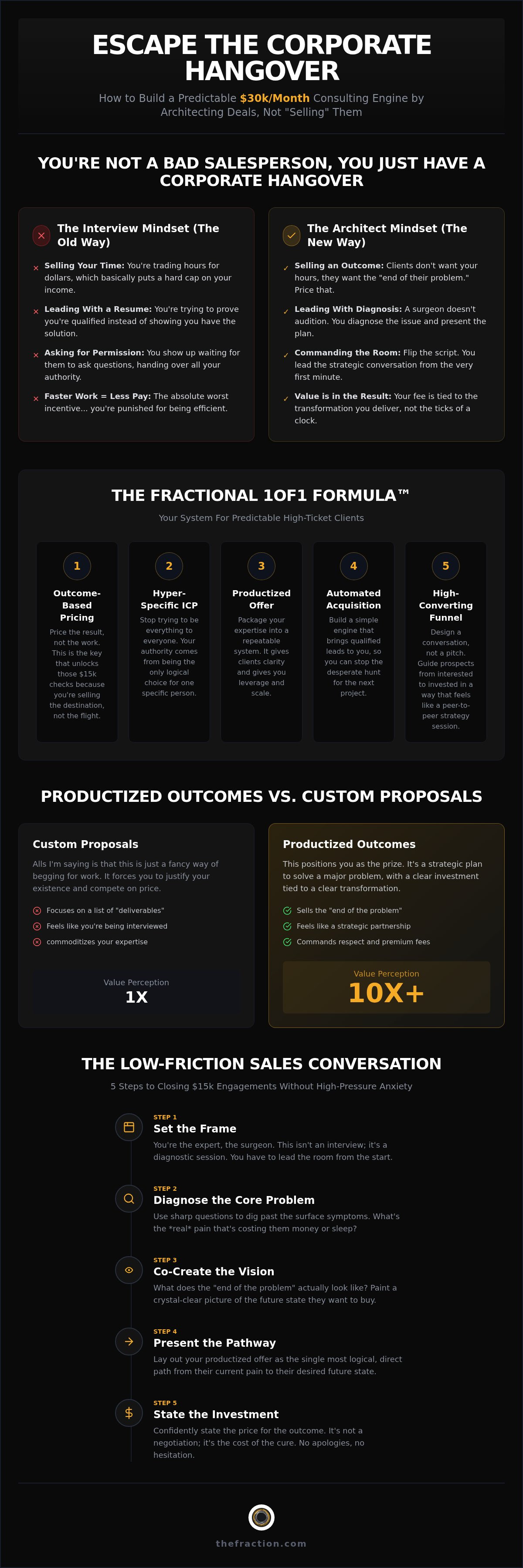
Look, the absolute best way to transition from a $200k corporate salary into a predictable $30k+ monthly practice isn't by working harder, but by installing what we call the Fractional 1of1 Formula™, which is a proprietary system that basically replaces the exhausting "selling" cycle with a repeatable, productized infrastructure. This high ticket client acquisition system is built on five core pillars, including outcome-based pricing, hyper-specific ICP segmentation, a productized offer, an automated acquisition system, and a high-converting funnel... and the reason this is the single biggest game-changer is because it gives you that steady, corporate-style predictability without forcing you to grind out 80-hour weeks just to keep the lights on. Alls I'm saying is that having a system is the only way to escape the "feast or famine" cycle that kills most consulting practices before they even get off the ground.
Outcome-Based Pricing: The Key to the $15k Check
Soooo, if you're still sending out proposals that list a bunch of "deliverables" like audits or weekly calls, you're essentially telling the client to judge you by the volume of your work rather than the value of your brain, and that's exactly why you're struggling to land those $15k retainers. You have to realize that your expertise is easily worth 150, 200, or 250 grand a year to the right company, so you need to start pricing based on the "cost of inaction," which is the massive financial hole that stays open if they don't hire you, rather than just counting your hours. By focusing on Improving Your Outcomes through strategic diagnosis, you turn the price into a simple investment calculation for the CEO, making the decision to move forward a complete no-brainer.
The Productized Offer Advantage
Look, if every single person you talk to gets a "custom proposal," you're essentially running a high-end sweatshop where you have to reinvent the wheel every Tuesday, but a productized offer changes everything because the "what" and the "how" are already solved before you even get on the call. This is why a high ticket client acquisition system relies so heavily on having a productized offer that removes the guesswork from the sales process and allows you to close deals way faster because the prospect can actually see the bridge from where they are to where they want to be. Speaking of closing, you should check out this low friction sales techniques checklist to see how a structured offer does the heavy lifting for you. If you're ready to stop guessing and start building, you can book a custom proof of concept call to see how this architecture fits your specific background.
Productized Outcomes vs. Custom Proposals: Why One Closes at 10x the Price
Look, custom proposals are basically just a fancy way of begging for work because they scream to the prospect that you don't actually have a predictable lead generation system in place, so you're forced to treat every single conversation like a unique snowflake that you have to cater to just to keep the lights on. When you show up with a "custom" solution, you're essentially falling into the generalist trap where you're competing on price against every other consultant on LinkedIn, but when you have a high ticket client acquisition system built on productized outcomes, you're positioning yourself as the Specialized Architect who has already solved this exact problem a dozen times before. The absolute best way to close a deal is to make the offer so specific that the client feels like you've been reading their private Slack channels, and that only happens when you stop being a "helper" and start being a strategic authority with a "take it or leave it" infrastructure that commands respect and much higher fees.
Why 'Custom' is a Code Word for 'Cheap'
Soooo, the second you tell a prospect that you'll "put a custom proposal together," you've given them an open invitation to negotiate your price down because they see your work as a variable cost they can trim rather than a fixed asset they need to buy. Alls I'm saying is that your unique expertise should be the only solution in its category, which is why the Fractional 1of1 logic is so powerful; it turns your corporate background into a singular product that nobody else can replicate. If you want to stay in your zone of genius and avoid the "salesy" feeling of haggling over line items, you should use a sales system for non-salespeople that allows the architecture of your offer to do the heavy lifting for you while you focus on the high-level strategy you actually enjoy.
The 'Outcome' Framework
Look, a client's CFO doesn't actually care about how many meetings you attend or how many pages are in your audit, they only care about the ROI and the operational stability you're bringing to the table, so you have to transition the conversation from "what I do" to "what you get" immediately. Instead of generic service descriptions, your high ticket client acquisition system should lead with phrases that describe a definitive future state, such as:
- The 90-Day Revenue Engine Build-Out: Replacing fragmented sales processes with a predictable $2M growth framework.
- Operational Exit Readiness: Implementing the systems required for a clean, high-multiple acquisition within 12 months.
- Fractional Leadership Integration: Stabilizing the department and reducing churn by 25% without the cost of a full-time C-suite hire.
When you speak in outcomes, the price of 150, 200, or 250 grand a year becomes a simple business decision rather than a personal expense, and that's how you land the big retainers while everyone else is still arguing over their hourly rate.
The Low-Friction Sales Conversation: 5 Steps to Closing $15k Engagements
Look, closing a $15k retainer isn't about being a silver-tongued devil or using some high-pressure closing technique you saw in a movie, but it's actually about leading a high-level strategic conversation that follows a very specific architecture so the client feels like you're the only logical solution to their problem. Alls I'm saying is, if you don't find the "pain" that's keeping the CEO up at 2 AM, you can't sell the "cure," and that's why the first step of this high ticket client acquisition system is always a deep-dive diagnosis where you're the one asking the hard questions. Once you've found the leak in their boat, you move to the reframe, where you shift their perspective from "I need a consultant" to "I need THIS specific outcome," effectively pulling yourself out of the generalist pool and into a category of one. Then you show them the gap... exactly why their current team or plan hasn't solved this yet... and you back it up with a proof of concept using real market data to show them you've already done the heavy lifting. Finally, you don't "close" them, you simply offer an invitation to solve the problem together, which feels like a natural extension of a peer-to-peer conversation rather than a desperate pitch.
The 'Non-Sales' Sales Script
So here's my advice: stop trying to be "convincing" and start being "convicted" in your solution because when you truly believe your architecture is the absolute best way to fix their business, that confidence is what actually closes the deal. You should focus on converting leads without hard selling by keeping the vibe strictly professional and executive-to-executive, almost like you're already on the team and you're just reviewing the quarterly strategy. Sometimes this means telling the "uncomfortable truth" about why their current plan is failing, but look, if you aren't willing to tell them their baby is ugly, they'll never trust you to perform the surgery that actually fixes the underlying issues.
Handling Objections Like an Executive
Soooo, when a prospect says "it's too expensive," they aren't actually attacking your price, they're just telling you that they don't see the value yet, and that's usually because you haven't tied your fee to a 10X ROI logic that makes the investment feel safe. If a client tries to lowball you or treat you like a line-item expense, my favorite one-word reaction is just... "Interesting." Then you wait. You have to be comfortable with the silence because you're a strategic asset worth 150, 200, or 250 grand a year, and the moment you start defending your price, you've lost the authority that makes a high ticket client acquisition system work in the first place.
Building Your $30k/Month Engine: The Single Biggest Shortcut to Freedom
Look, you can keep spinning your wheels trying to figure out this high ticket client acquisition system on your own, but you're probably just going to end up exhausted and under-leveraged because you're trying to build a plane while you're already flying it... so the single biggest shortcut to professional freedom is actually using a proven blueprint that co-creates every part of your business with you. At The Fraction, we don't just do "coaching" because, look, you don't need another person to simply hold your hand and tell you to "believe in yourself," you need a partner to build the technical and strategic infrastructure of your professional future. The Fractional 1of1 Formula™ is the absolute best way to guarantee your results because it's a "done-with-you" build-out where we actually architect the engine that brings in those $15k retainers while you stay focused on your zone of genius.
The Custom Proof of Concept (PoC) Call
Before you even pay us a dime, we deliver a multi-page market research strategy that basically acts as a high-resolution diagnostic scan for your specific niche... so you can see exactly what your market is willing to pay for before you take any financial risk. This PoC call is the ultimate low-friction entry point because it removes all the guesswork and shows you the concrete math behind your future $30k-a-month practice, proving that your expertise is worth the premium fees you want to charge. I should mention that we're quite selective about who we partner with, and we currently only accept about 40% of the executives who apply to ensure that every system we build has the highest possible chance of dominating its category.
The 10X ROI and 30-Day Build Guarantees
We take execution sooooo seriously that we offer a 30-day guarantee on the system build itself, which means if your infrastructure isn't fully operational in that timeframe, we issue a full refund... but the real security for high-achievers comes from our 10X ROI Guarantee where we literally stay in the trenches with you until you've booked 10x what you invested in the program. Alls I'm saying is that when you're used to commanding 150, 200, or 250 grand a year in the corporate world, you shouldn't settle for a "maybe" or a "hope" when it comes to your own practice. You deserve a predictable engine that turns your years of hard-won wisdom into a scalable asset that finally gives you the time and financial freedom you've been chasing.
Architecting Your Professional Autonomy
Look, the absolute best way to stop the corporate grind and start commanding the prestige you've already earned is to treat your expertise like a high-value architecture, because you're becoming a strategic architect who leads with authority through a high ticket client acquisition system. We've seen how the Fractional 1of1 Formula™ moves you beyond the "Corporate Hangover" and into a category of one where your outcomes do the talking, so you're leading with predictable results and high-level strategic conversations instead of chasing leads. By installing an engine that runs on strategy rather than hope, you're buying your time back and securing a future where $30k months are the baseline rather than the ceiling. Alls I'm saying is that with our 30-day system build guarantee and the 10X ROI guarantee, the single biggest risk is staying exactly where you are right now, and that's why we're soooo focused on execution over theory.
You've already done the hard work of building two decades of expertise, so now it's just about putting the right infrastructure around it so you can work with the clients you actually like and command the fees you're truly worth. It's time to step into your role as a visionary mentor and start building the professional life you've already earned through your years of dedication and high-level leadership.
Frequently Asked Questions
How do I justify a $10k+ monthly retainer as a new fractional consultant?
You justify a premium price by shifting the focus away from your "newness" as a consultant and onto the 20 plus years of corporate results you've already delivered... so you're not selling your hours, you're selling the end of a million-dollar problem. Look, if your intervention saves a company $500k in churn or adds $1M in revenue, a $10k retainer is just basic math, not a "high price."
Do I need a fancy sales deck or a massive LinkedIn following to close high-ticket deals?
No, you don't need to be a famous influencer or have a 50-page deck because high-ticket deals are closed on the strength of your architecture and the depth of your diagnosis... but you do need a high ticket client acquisition system that handles the heavy lifting of trust-building before you ever get on a call. Most of my clients close $15k deals with a simple two-page proof of concept.
What happens if a prospect says they can't afford my high-ticket consulting offer?
You should realize that "I can't afford it" is usually just code for "I don't see how this makes me more money than it costs," so you have to reframe the conversation around the cost of inaction. Alls I'm saying is, if they don't solve the problem, they're already paying for it through lost revenue or inefficiency... so you're actually the most affordable option they have.
Can I really close high-ticket deals while still working my full-time corporate job?
Yes, you absolutely can because we specifically architect your outreach and systems to run in the background or during evening hours so you don't have any conflict with your current employer. It's actually the absolute best way to build your "bridge" to freedom... but you need a system that doesn't require you to be on LinkedIn all day long while you're at your desk.
How long does it typically take to close the first $15k deal using The Fraction system?
While every niche is a bit different, we've seen executives build their entire infrastructure and start booking calls within 30 days because we focus on speed and execution over endless theory. Some clients have seen revenue hits within their first few weeks of launching their high ticket client acquisition system because the architecture is sooooo precise and targets the exact pain points of their market.
What is the difference between a high-ticket consultant and a regular freelancer?
A freelancer is essentially a pair of "hands for hire" who takes orders and gets paid for tasks, but a high-ticket consultant is a strategic architect who tells the CEO what the orders should be. You're not there to do the busy work... you're there to own a specific business outcome and provide the high-level leadership that a regular freelancer simply isn't equipped to deliver.
Is it possible to close high-ticket deals without doing any cold calling or sleazy outreach?
It's totally possible because we use automated systems and AI to find the right people and start the conversation in a way that feels professional and peer-to-peer... so you never have to feel like a desperate telemarketer. The whole point of our methodology is to make the sales process feel like a natural extension of your existing expertise rather than a forced or pushy pitch.


